About a dozen years ago, I heard from Ted Dintersmith. I didn’t know anything about him other than that he was a venture capitalist who was interested in education reform. My hackles went up, because the term “venture capitalist who was interested in education reform” immediately conjured up images of Democrats for Education Reform,” a faux group that is dedicated to charter schools, Teach for America, evaluating teachers by student test scores, and union-busting.
When I thought about the people in this category, I thought about very wealthy men like Ravenal Boykin Curry IV, Whitney Tilson, John Perry, Ken Griffin, Jeff Yass, Daniel Loeb, Arthur Rock, Joel Greenblatt, Bruce Rauner, and Paul Tudor Jones. They are financiers who have committed millions to the cause of privatizing public schools. They are united in their contempt for public schools, teachers, and unions.
So I was wary of Ted and suspicious of his motives. And I pushed him aside, thinking he was part of the cabal of know-it-all entrepreneurs with a zeal to reform (privatize) public schools.
So, I now publicly admit that I was wrong. Ted has traveled the country, visiting schools and listening. He knows how hard teachers work, and he admires them. He has teamed up with some savvy people, like Tony Wagner and the late Sir Ken Robinson, to produce films and write books.
When I recently read his latest article, I realized that I had completely misjudged Ted. He doesn’t want to destroy public schools or privatize them. He wants to make them better. He wants students to love school and learn what they need to know to make informed choices.
He has seen some good charter schools (as I have), but he knows that a few hundred charter schools won’t lead to the transformation of tens of thousands of public schools. And–my thought–to the extent that charter schools defund public schools, they create more problems, more inequities.
So, I hereby apologize to Ted Dintersmith for prejudging him and for lumping him with the Billionaire Boys Club, those who see school transformation as a hobby.
When you read this post you will see that he doesn’t have all the answers, but he is asking the right question.
He writes:
About these notes: Always Monday. Always short. Always free. Always about civil society’s future. At times, interesting. If this was forwarded to you, subscribe here.
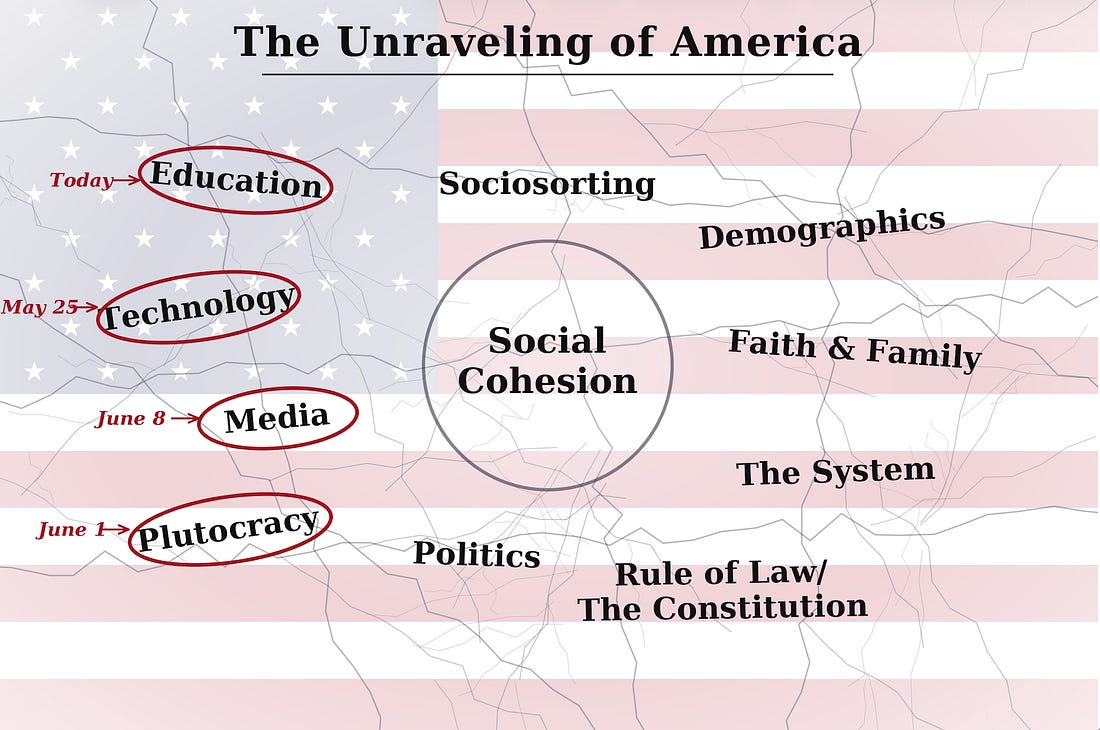
First, thanks for your feedback on my recent posts. My goal of late is to explore the various factors causing America to unravel. Toward a systems model of the forces undermining America’s democracy, moral compass, and social cohesion. Today, education.
For five decades, U.S. education policy has been driven by two goals: test scores and college. The No Child Left Behind Act in 2002. Then in 2010, Common Core. Obama’s rallying cry: “By 2020, the United States will once again lead the world in college completion.” Our all-consuming education focus. With massive collateral damage.
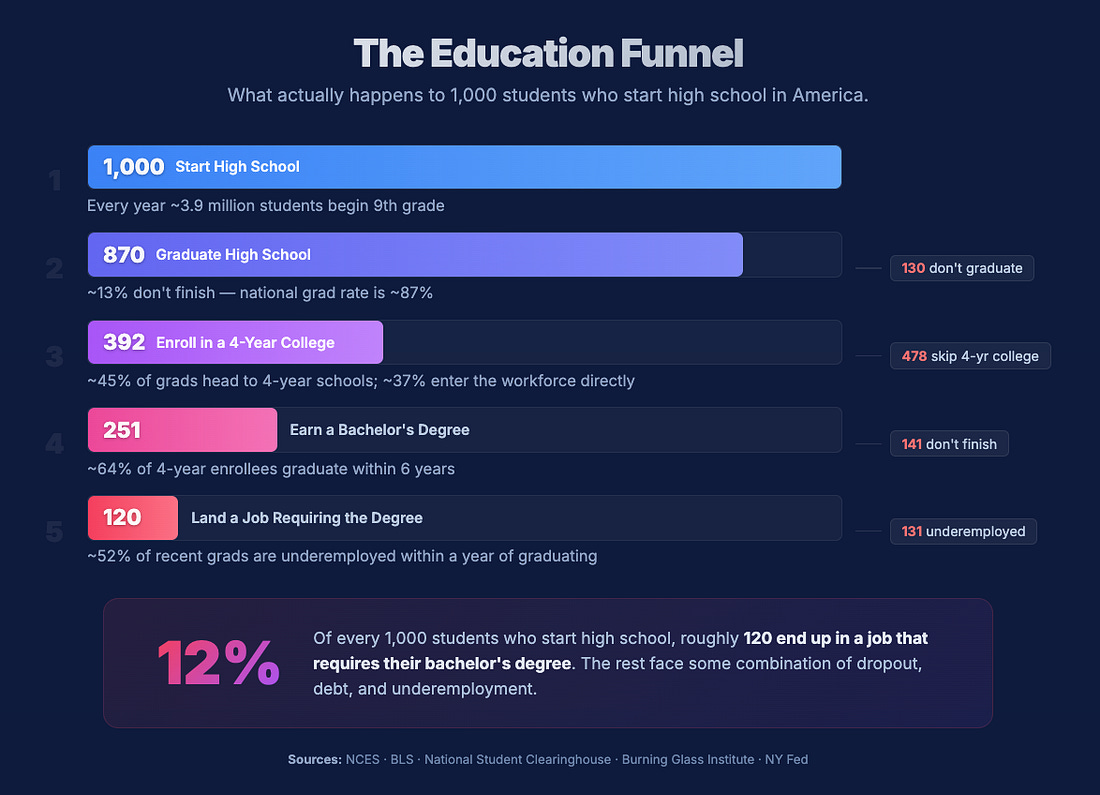
Let’s start with the funnel. While the college path works out well for some, most end up on the wrong side of education’s Bell Curve. Over half go directly to career, lacking a hirable skill and often with gutted self-esteem. Of those heading off to college, half don’t finish. Of those who graduate, half don’t get any kind of dream job. A system that’s produced some 43 million adults burdened by $1.8 trillion of student loan debt.
With a boost from Harvard-educated JFK, America grew to equate a prestigious college degree with human worth. This equivalence worked its way into news stories, movies, television shows, commercials . . . and labor markets. Prestige employers (that’s you, Goldman Sachs and McKinsey) made an elite college degree the essential hiring criterion. Less glamorous companies (that’s you, Sherwin-Williams) made a college degree mandatory for promotions. Rich families push their kids from the womb toward an Ivy+ degree. Poor families want the same for their kids. University research teams (that’s you, Georgetown) produce skewed studies touting a massive $1.2 million earnings lift for college grads. The Federal government opens the spigot for readily-obtained, impossible-to-shake student loans.
We’d like to think that America’s education system levels the playing field, but it does the opposite. The SCOTUS 1973 San Antonio Independent School District v. Rodriguez says it’s just fine for U.S. public schools to be largely funded by local property taxes. Rich kids are showered with resources’; poor kids show up to school hungry. Test scores point to an education ‘achievement gap’ that gets pinned on our teachers – not America’s staggering income inequality. The system’s winners feed elite colleges that educate more students from the richest 1% of families than from the bottom 50%. For more, read Paul Tough’s book The Inequality Machine.
With college placements as the measure of success, America’s K12 schools became college-ready test-prep institutions. Pit kids in dog-eat-dog competitions: class rank, SAT scores, AP scores, college placement. A barrage of state- and Federally-mandated multiple-choice exams that rank kids, teachers, schools, districts, and states. Clear marching orders for K12 schools – train kids to perform well on multiple-choice exams and get them off to some college.
To this day, America relies on two numbers to define the education quality of a school, district, state, nation, and human. Math and reading scores. That’s it. Don’t believe me? Just note what journalists write and what policymakers cite. We’ve pushed generations of young Americans to get those damn test scores up. No worries if we short-change career-based learning, civics, history, and art. No worries if we disenage kids and demoralize teachers. No worries if a relentless focus on rote learning crushes a child’s curiosity, creativity, joy, and agency. No worries if kids get the soul-sucking message that what matters in life is outcompeting others on pointless tasks. Education priorities that encapsulate the classic definition of insanity – doing the same thing over and over, expecting different results.
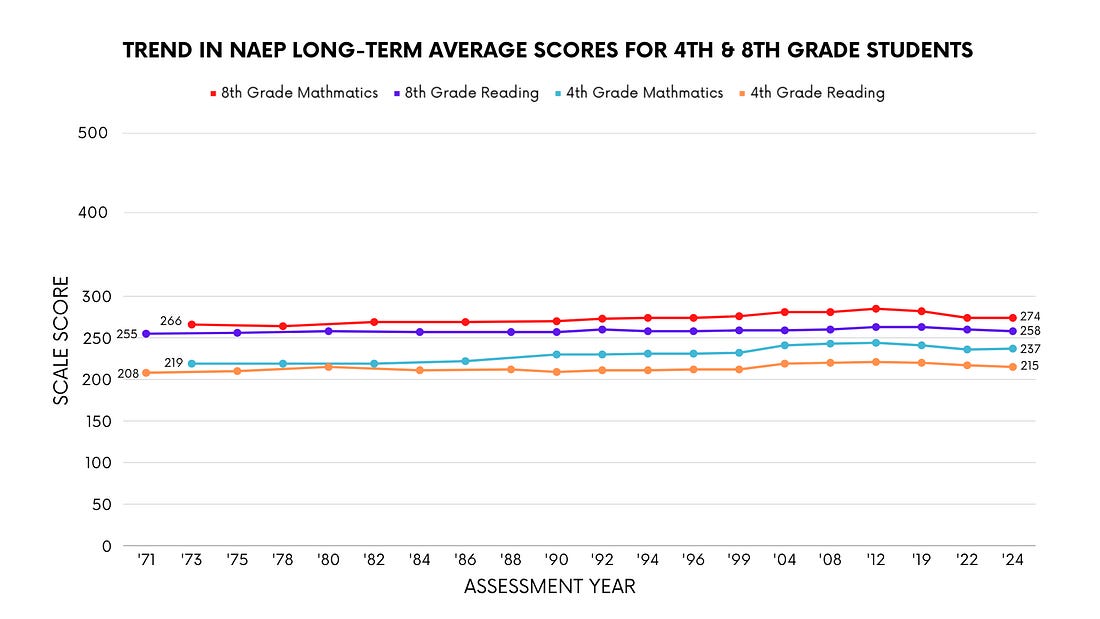
During their formative K12 years, America’s kids take more than 100 standardized exams. These cost-minimizing exams are expressly designed to be graded by a computer. And if a computer can grade a task, it can do that task. In every sense, we push kids to develop rote skills that machines handle flawlessly. Already, AI aces every assignment and exam required to graduate magna cum laude from Harvard. Reading exams call for regurgitating what’s put in front of you – perfect training for conspiracy-absorbing adults. Math exams are tied to esoteric micro-procedures (e.g., factoring polynomials) that adults never use. Yet we chase these scores, for decades, making no progress, ignoring Goodhart’s Law: “Any measure that becomes a target ceases to be a good measure.”
There you have it. America’s colossal education botch. Train kids to perform rote tasks. Crush out the essential human traits of curiosity, audacity, creativity, agency, and joy. Standardize what’s taught and tested to produce data that ranks and sorts — rather than helping each child develop their distinctive human potential. Most get a chronic ‘you lack proficiency’ message in a system that heaps advantage on the affluent. Botched priorities, paving the way to our current nightmare. A populace unable and unwilling to critically analyze the torrent of lies coming from the White House. A populace that holds its nose to vote for a convicted felon who rails on the ‘educated elite.’ A boiling cauldron of resentment, corruption, and anti-science vitriol. As to how this has worked out, read David Brooks’ fascinating How the Ivy League Broke America.
I don’t offer these views on education casually. For the past fifteen years, I’ve immersed myself in this world. I’ve visited hundreds of schools, and convened thousands of conversations, all across America. I celebrate the bright spots in my books (What School Could Be: Insights and Inspiration from Teachers Across America) and films (Most Likely to Succeed and Multiple Choice). But I’ve seen the failure. Failure caused by an obsolete system and failed accountability measures. Our classroom teachers are heroes. It’s not easy to fight the system, but many do. Give special thanks to the teachers in your life, who persevere despite being shortchanged on pay, respect, and trust. They endure in an entrenched system that has churned out generations of young adults ill-prepared for career, citizenship, and life. A system sowing the seeds for democracy’s collapse.
Three Bold Ideas
Career-Based Learning for All: My recent film Multiple Choice showcases a mainstream public school district that immerses all high-school kids in career-based learning across a range of skills (e.g., carpentry, welding, healthcare, cybersecurity, digital media, AI). Better for the career-bound and, a bit surprisingly, better for the college-bound. The key is making career-based learning essential for all kids, not just ‘those’ kids who don’t resonate with academic curriculum.
Finland: America can learn much from Finland. Their remarkable education progress resulted from a budget crisis that forced them to choose between data and educator excellence. They dumped all standardized tests and focused on developing outstanding classroom teachers – better training, more pay, loads of respect. Finnish kids spend comparatively little time on ‘school’; even high-schoolers have just six hours of class time and homework during the school week. Lots of time for play and exploration. A well-educated populace. For more, read Pasi Sahlberg’s Finnish Lessons.
Accountability: Base accountability on a child’s growing ability to create and carry out initiatives that help make their world better. Portfolios of purpose, not a checklist of counterproductive numbers. Check out New York’s Performance Standards Consortium or read Tony Wagner’s Mastery.
Bonus Idea: Long talked about, America would be well-served if every high school graduate engaged in public service — lifting up their community while developing important skills. Those going on to college bring maturity and real-world experience to years often wasted on beer pong. Those eschewing the college path are off and running with purpose and skills. Young Americans across all demographics in a melting pot that bridges our current demographic and political divides.
Nervously,
Ted


I had pretty much the same first impression, and the same conclusion, 8 years ago. Dintersmith read my piece and sent me an email thanking me.
https://www.edweek.org/teaching-learning/opinion-book-review-what-school-could-be/2018/08
LikeLike
Thanks, Nancy. It’s interesting to see your reaction to Ted Dintersmith. Like you, I was biased against hedge fund managers and equity investors who want to reinvent schools. Most of them went to elite private schools where classes were often as smal as 12 and all students were carefully screened. They look down their noses at public schools and their teachers.
LikeLiked by 1 person
With all due respect to this well meaning author, he seems a bit dismissive of college students in his reference to beer pong. My daughter is as busy as a one-legged man at a butt kicking. Time to volunteer in the field she is considering always seems just over the next hill of a paper or course of study.
That said, much of what he says seems very sensible. There is a tremendous demonstration today in India against its education minister led by the Cockroach Party. This conglomeration of Modi opponents is protesting fraud in the testing system that India uses to sort out who gets to live a relatively good life and who remains dirt poor. Therefore n lies the rub, does it not?
LikeLike
WOW! I wish I’d said that. I have said a lot of it–being an old guy who went to school in two midwestern states–Michigan and Ohio–and saw the difference of public investment, and in attitudes about kids and what they need–and what our society needs. Being a guy who grew up in a union family, and went to schools influenced by them–where every kid took art every day–then transferred to a school system in Southern Ohio, where parsons held forth, pledging the flag was coerced, and lunch hours and possibilities restricted. Finished school in Southern Ohio–where movie theaters and dances were still segregated. But I went on to Ohio State, where John Dewey still held sway–for awhile–in the education department and we were encouraged to be creative teachers. So I became one, using what I’d learned in Michigan and adding more. Using art in every classroom. Music too. Using mock trials, learned at OSU law school, using group and committee work, where kids learned to work cooperatively–democratically.
Went into union work and helped create public, alternative schools–not technology, but language and cultural immersion. Etc. But now, still living–in the backlash of the studied, monied right-wing of America–right-wing now of the world.
If there are any younger people, or people still “practicing” education, reading this—“keep on keeping on!”
LikeLike
Finally, a rich guy that does not see all us minions as human capital widgets. There is no doubt that privatization continues to be a divisive force in our society. In fact, privatization was spawned to oppose integration, a sad notion which continues in today’s privatization. Many public schools do amazing work with young people, but unlike private groups, there is little money or time to spread the good news of their work. In contrast, propaganda against public education, generally funded by wealthy individuals, captures interest quickly as it is spread in the media.
Public education brings diverse students together for mutual understanding and benefit. They are products and an extension of the communities they serve. Public schools are public assets that help build cohesive communities. They are also guided by locally elected officials. As such they are an example of democracy in action. In a society as fragmented as ours, we need to reaffirm our commitment to the public schools that helped build our great nation and invest in them for a better future for our young people.
LikeLike
Great insights. I often think back and wondered how I made it 30+ years in public education. From the get go (and being completely ignorant all of it) I saw right away how “backwards” things were. My brain said, “What happened to kids having ‘common sense’ skills?” And every time I asked (the suits) questions the more I got a look of, “Why do you ask?” And more of a “keep quiet” and make sure the kids check all the boxes. And data sheets. And more tests. No fun. No making stuff. It really hit me when the kids had to complete community service hours (that really led to nothingness skills) so I brought my yard tools to school because I wanted them to clean up the front of my building (we were the place where all the “gotta stick ’em somewhere”) kids went. So, I said, “I really need this done. This has been a mess and no one cares.” I said this is how I did it when I was your age, bid a job, agreed on the cost, and did the work. In their case I told them it was valued at so many service hours. I explained by having a skill set (other than checking boxes on a test) I was able to sustain myself while trying to earn a degree. I couldn’t believe how they didn’t know how to use basic gardening tools. But, I showed them. Like a lot of things I did. I told them, “I have never been asked how well I did on a multiple choice test to get a job. Rather, I was asked if I had skills (one person saw I built bikes at Sears) so it led to working on trucks at a food plant) to do the job at hand or the ability to learn.” My main goal was get through the tests and give them the skills to navigate the world once they walked out my door. It was the “Charvet Way” and I got a lot of push back for it. I live in the same town as most of my students and have seen them grow up. Most are doing really well. One owns a pub downtown and is the president of the Downtown Business Association. Another person has her poetry books for sale. Another painted a mural and has an organization for kids like her. Not saying I was an expert, but I did put kids in positions for success — their way. I sent many to the local community college to learn a trade or an AA. I remember being lectured about test scores at a staff meeting, blah, blah, blah, reading and math, reading and math. I said, “So all the subjects I teach really don’t matter because they aren’t on the test? (I taught Art, American Government, PE, English, Science, and whatever else because as I was told “You can’t teach art all day unless you put more reading and math in art.” Obtuse thinking at its best. I just report what I lived. Enough for now.
LikeLike
Love the reference to living in the town where you taught. This has s as sways been an important part of my experience.
LikeLike
Thanks, Roy. You know now the kids I helped find their way, help me with my plumbing, welcome me to their pubs, draw my blood (many work for Kaiser), and help me find my way. So nice.
LikeLike
Wired has this post up, taking a fairly even handed look at the “science” of reading and how that policy plays out in Mississippi. Well worth reading both articles in tandem.
https://www.wired.com/story/mississippi-state-testing-reading-comprehension-literacy/
LikeLike
Christine, the WIRED article is behind a paywall
LikeLike
Does it work in Reader mode? I have a subscription, but they don’t offer gift articles.
LikeLike
Totally unrelated, but I owe an apology to Ted Nugent. I once referred to him, incorrectly, as a musician.
LikeLike
Bubba, glad to hear from you. You make me laugh!
LikeLike