Federal Judge Richard Leon issued a decision stopping work on Trump’s Hideous Grand Obsession: the ballroom that will replace the East Wing of the White House. Trump demolished the East Wing without going through the legal requirements and permissions.
Judge Leon, appointed by President George W. Bush, opened his decision with two sentences:
The President of the United States is the steward of the White House for future generations of First Families. He is not, however, the owner!
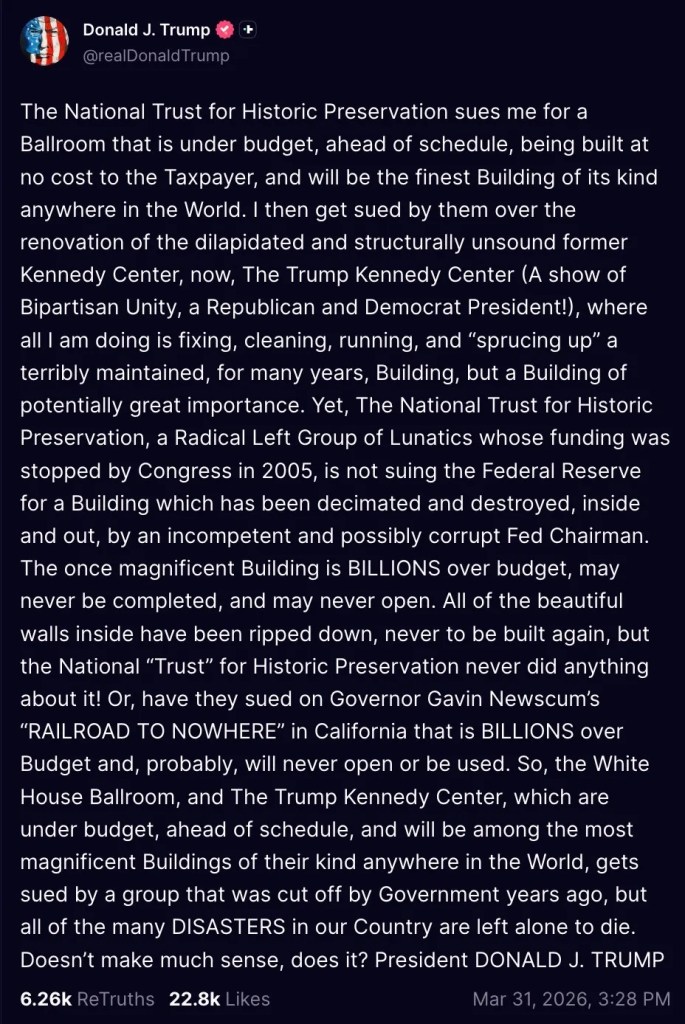
Trump responded with this cry of outrage:
Trump is determined to leave his garish mark on D.C.
Not only did he tear down the East Wing of the White House, but he plans other major alterations to the White House and the city.
Of course, he added his name to the Kennedy Center, which was dedicated by Congress as a memorial to the assassinated President. After Trump took control of the Center, artists began canceling their performances and ticket sales fell. To cover his embarrassment, he is closing the Center for two years while “renovating” it. Critics fear that it will emerge as a gold-encrusted monument to Trump.
The New York Times reported that Trump is fixated on making changes to the White House:
He plans to turn the historic Treaty Room into a guest bedroom. Really! He has zero respect for history, and he thinks the White House is his personal property.
Mr. Trump already has torn down the East Wing to make room for his $400 million, 90,000-square-foot ballroom; he remade the bathroom attached to the Lincoln Bedroom in marble and gold; he paved over the Rose Garden grass; he added marble floors and a chandelier to the Palm Room; he covered the Oval Office in gold; and he has a new, 33,000-square-foot security screening center for White House visitors in the works.
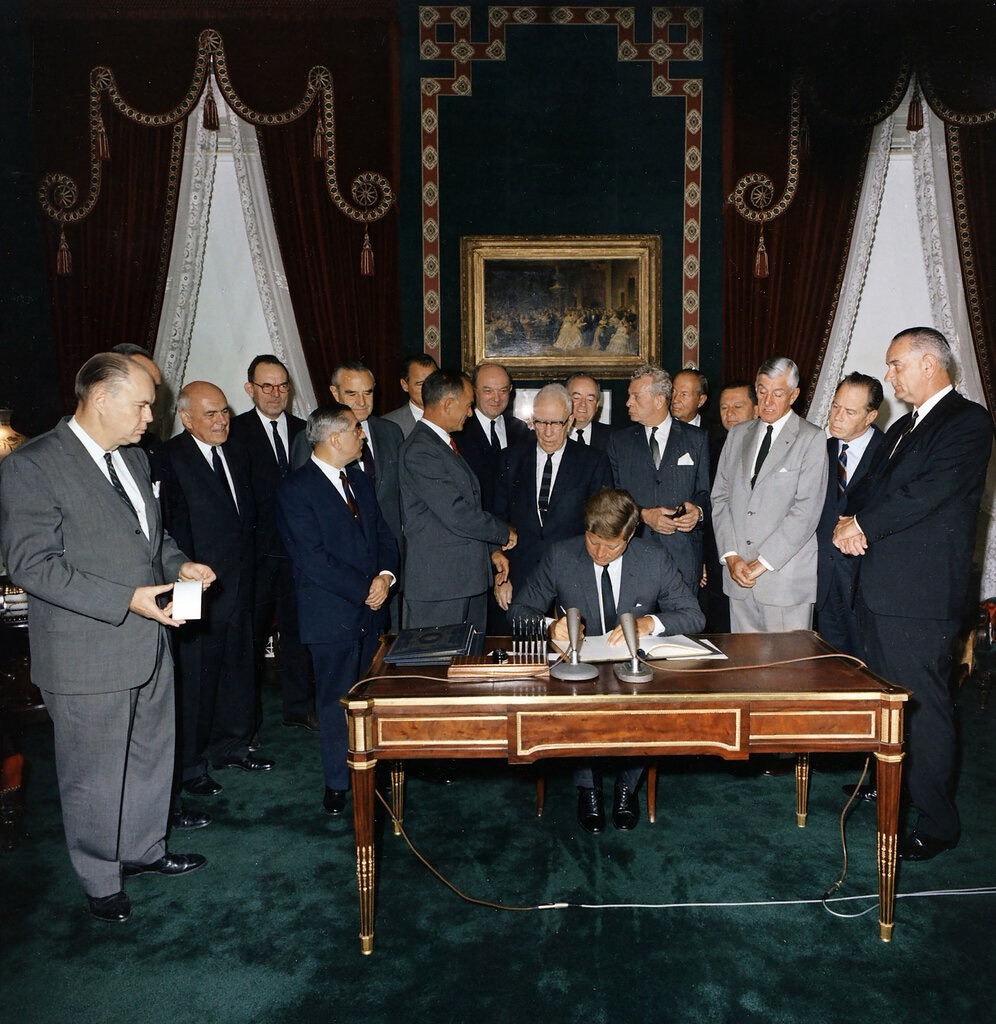
His latest plans involve the more private spaces of the White House, in the second-floor presidential residence. The Treaty Room — which is separate from the Indian Treaty Room in the Eisenhower Executive Office Building — is one of the most historic rooms in the White House. Presidents Ulysses S. Grant and William McKinley used it as a Cabinet room, and it was where the Spanish-American War peace protocol of 1898, and the nuclear test ban treaty of 1963, were signed.
This is a photograph of President John F. Kennedy signing the Nuclear Test-Ban Treaty in the Treaty Room.
Trump’s egomania doesn’t stop there. It’s boundless. The U.S. Treasury will mint a $1 coin with his face on it to honor the 250th anniversary of the United States. It will also release a large gold coin with his image that will cost thousands of dollars. And in an unprecedented move, the U.S. Treasury will add Trump’s signature to paper currency. No other President has placed his signature on the nation’s currency. Presently, our paper currency has the signatures of the Secretary of the United States and the Treasurer of the United States. Not the President.
Trump wants to build a gigantic arch on the Virginia side of the D.C.-Virginia border. It will be the Arch of Independence, but is colloquially called the “Arc d’Trump.” It will tower over the nearby Lincoln Memorial. Some renderings show the arch slathered in gold, Trump’s favorite decoration.
The most devastating critique of Trump’s efforts to reshape the District of Columbia and the White House was written by Phillip Kennicott, the Pulitzer-Prize winning critic of art and architecture for The Washington Post. It was published before Judge Leon stopped work on the ballroom. Trump, Kennicott says, is the greatest threat to D.C. and the White House since 1812, when the British burned the Capitol and the White House to the ground.
He wrote:
A loosely circular driveway sweeps through the White House grounds, just below the beloved South Portico of the mansion. Its shape echoes a larger park, known as the Ellipse, which connects the president’s home to the National Mall. It also mirrors the curving pathways of nearby Lafayette Square, on the north side of the complex.
The simple symmetry of this modest roadway and the grace of the White House south grounds are no accident: They were the vision of the great landscape architect Frederick Law Olmsted, Jr., one of the original members of the Senate Park Commission, which created the monumental core of Washington as we know it, more than a century ago.
The geometry of this driveway — a small but resonant element of Olmsted’s master plan for the White House campus — will soon be erased, now that a federal judge has allowed President Donald Trump to proceed at least temporarily with construction of his 90,000-square-foot, $400 million ballroom. The ballroom, which will be larger than the original mansion, is so gargantuan that the original curving road simply won’t fit. To make room for Trump’s entertaining and fundraising space, a large notch will be clawed out of the driveway, according to drawings released by Shalom Baranes Associates, the D.C.-based architecture firm overseeing one of the most unpopular projects of the president’s second term.
Washington has a composed geometry built up from significant details like this elliptical drive. As with the diagonal avenues that connect symbolically important circles, squares and civic landmarks, the Platonic perfection of this shape is best appreciated from the air. But it is a vital reminder of the care taken, over the past 200 years, in the design of the capital city, and the deference paid to a set of aesthetic and cultural values that came out of the Enlightenment, including a love of symmetry, repetition, iterative patterns and a fine balance between grandeur and grandiosity.
Trump is the most significant threat to the city’s architectural and design legacy since British forces burned the Capitol and White House during the War of 1812. He has already demolished the East Wing of the White House, which dates to the administration of Franklin D. Roosevelt. He will replace it with a building that makes James Hoban’s neo-Classical executive mansion a mere appendage to a space meant to function like a hotel-convention-center-entertainment venue. He has proposed (but temporarily delayed) painting the next-door Eisenhower Executive Office Building a blinding shade of white, which preservation groups argue could irreversibly damage the stone facade.
He wants to build a 250-foot-tall memorial arch near the most hallowed ground in the country, Arlington National Cemetery. His “Independence Arch,” which he has said will honor himself personally, would dwarf the largest victory arches in the world, including the arch in Pyongyang, built in 1982 to honor North Korea’s murderous dictator, Kim Il Sung. Only Eero Saarinen’s slender ribbon of steel, the Gateway Arch in St. Louis, would be taller. Although it would be built in a traffic circle on the Virginia side of the Potomac, the Trump arch would compete with some of the tallest buildings in Washington, including the Washington Monument and Washington National Cathedral, fundamentally altering a meticulously preserved skyline.
The president’s proposed “National Garden of American Heroes” would introduce a forest of quickly designed statues to the banks of the Potomac almost opposite the new triumphal arch. A sylvan space defined by monumental memorials to Roosevelt, Martin Luther King, Jr. and Thomas Jefferson would be cluttered, wax museum-style, with hundreds of stubby tributes to showbiz stars, folk heroes and sports celebrities.
These proposals, the rush to realize them, the stacking of key oversight groups with Trump loyalists and flunkies and the collaboration of firms like Shalom Baranes Associates, have upended and effectively destroyed the process of design review — which has until now preserved Washington as a monumental, picturesque capital.
They would also manifest in stone, cement and steel a vision of the city fundamentally at odds with the democratic ideals of the city’s founders, the stewards of its expansion in the 19th and 20th centuries, and the vigilance of its latter-day defenders against shabby development, cheapness and commercialization.
In 1806, Benjamin Latrobe, perhaps the first great architect in America, sent a letter to Congress, defending his work on the U.S. Capitol, which was then under construction. Latrobe, who also contributed to the interiors of Hoban’s White House, was a proud and difficult man, and his letter to Congress, which exercises authority over the design of the nascent city — a duty it is now shirking — was prickly and defensive. But in it, he articulated foundational principles for the aesthetics and architecture of the new republic, which recognized no kings, and no absolute authority beyond the laws and the Constitution.
“Nothing appears so clear,” he wrote, “as that a graceful and refined simplicity is the highest achievement of taste and art.” American buildings should be “chaste and simple,” and to ornament them just for the sake of surface attraction was folly.
“We find ornaments increase in proportion as art declines, or as ignorance abounds,” he maintained.
This was the common language of American architecture at the time — stately, chaste, simple, dignified — and it echoed ideas from a half-century earlier, as capitalism and representational government were together forging a new, bourgeois worldview. In Adam Smith’s 1759 “Theory of Moral Sentiments,” the Scottish philosopher and economist sometimes called the Father of Capitalism wrote that two new aesthetics were in competition as the world industrialized and broke down the old, feudal orders.
One was based on greed, power and avidity; the other on equity, justice and humility. These values would express themselves in our political systems, our economies, our ethics, our art and our architecture.
“Two different models, two different pictures, are held out to us, according to which we may fashion our own character and behaviour,” he wrote. “The one more gaudy and glittering in its colouring; the other more correct and more exquisitely beautiful in its outline; the one forcing itself upon the notice of every wandering eye; the other, attracting the attention of scarce anybody but the most studious and careful observer.”
The elliptical drive at the White House, about to be disappeared by a gaudy new ballroom, was the exact sort of subtle detail that delighted the designers of early Washington, a pattern hidden in plain sight that would attract the attention of only “the most studious and careful observer.”
The ballroom itself, which Trump has promoted as spectacular and ornate, exemplifies the aesthetic — and moral value system — that Smith found both dangerous and abhorrent.
How did we get here? How have we strayed or been misled so far from the values, ideals and aesthetics that gave Washington its current form?
Trump doesn’t have a coherent or consistent aesthetic ideal. Rather, the veteran real estate developer has reflexive responses and aesthetic tics when it comes to design — and for a president, an unprecedented willingness to assert them. Three of these habits are easy to see in his plans for Washington, mirroring his style of politics and his use of rhetoric and language. He has a primitive attraction to the big, the grand, the colossal. When he speaks, he uses superlatives reflexively, and he brings the same sensibility to architecture. And just as nature abhors a vacuum, Trump abhors anything he sees as empty. There is no value in silence, no beauty in open, uncluttered spaces. Everything must be filled, branded, made busy. Finally, he has no sense of context or formal relationships, no understanding of the hierarchies of how buildings (and institutions) relate to each other, to history, to formal plans.
The design of beautiful cities, and the design of effective governments, are predicated on “gentleman’s agreements,” voluntary deference to precedents and conventions. Trump respects none of this.
But there is a fourth deficiency in his understanding of architecture and design, which arises from and amplifies his other three failures of taste and judgment: He appears utterly uninterested in basic American values, history and symbols, and so there are no guardrails, no limits, to the damage done by his other failings.
Trump’s single-minded and unwavering preference for the biggest, his equating of size with significance, has become so familiar we have started to overlook it. But the architectural consequences for Washington will be devastating. When Stanford White — whose architecture firm McKim, Mead & White designed several branches of New York’s Public Library and the original Pennsylvania Station — drafted a memorial arch, he included in an 1892 rendering the figure of a man holding a measuring stick to offer a sense of its size. The arch, built in Manhattan’s Washington Square Park to honor the nation’s first president, rose to 77 feet, a bit taller than the ancient Roman Arch of Titus on which it was loosely modeled. But while grand and imposing, it still had a relationship to human scale.
Trump’s arch will dwarf this, and all other ancient precedents. Only the monuments erected by modern governments that rule by terror and dehumanization offer any comparable examples. And it is larger than many of those, too, dwarfing the Victory Arch in the North Korean capital of Pyongyang.
It will also fundamentally alter one of the essential elements of what is known as the McMillan Plan, the Senate Park Commission’s 1902 redesign of the capital city which created the National Mall and the monumental core of Washington. The McMillan Plan forged a grand, axial vision of national healing and reconciliation that symbolically reconnected the North and the South by a bridge across the Potomac, joining a city of the dead at Arlington Cemetery to the city of the living, with the Lincoln Memorial as a hinge point. Long vistas and clear views drew the eye from the memorial to the military architect of Civil War victory, Ulysses S. Grant, at the base of the U.S. Capitol, to the temple devoted to the political architect of reunification, Lincoln, more than two miles away. The men and women who sacrificed their lives for reunification were honored by the Arlington Memorial Bridge leading to the cemetery and low-lying hills of Virginia just beyond.
That open view across the Potomac River to the hallowed burial ground was essential. A winning design in an early competition for a bridge at that crossing included two massive arches over its central piers — small compared to Trump’s arch, but large enough to impede views. The leaders of the McMillan Plan not only rejected these arches, they took particular care to keep sight lines open and the design of the shallow, low-slung bridge (by McKim, Mead & White) simple and elegant. They also stripped away a complex plan for some 40 decorative sculptures. The closer they got to the final resting place of Civil War soldiers, the more the planners insisted on dignity, sobriety and simplicity.
All of Trump’s proposed designs for a victory arch that he has shared on social media would block that carefully preserved view. One would also be laden with gilded statues, eagles and other glittering ornamental forms.
To understand the true scale of Trump’s ballroom, you have to get beyond the mere size of its floor plan — at 90,000 square feet, almost twice as large as the original structure’s 55,000 square feet. Rather, you need to take into account the context of the White House grounds and the surrounding federal buildings. The scale of the addition will destroy any sense of symmetry between the East and West wings and reorient the White House campus to the east, where it faces the massive Treasury Department building, a dispiriting, fortresslike phalanx of Ionic columns that natter on like someone discoursing on the infallible wisdom of free markets. Renderings of the new structure make it look like the old White House mated with Treasury, spawning a grotesque creature that has traded the livability of a domestic space for the untrammeled power of a banking colossus.
Trump’s gilded arch, ballroom and his redesign of the Oval Office with incrustations of historically anachronistic gold ornament, introduce a fussiness and busyness into a Washington aesthetic that has generally favored the chaste and simple, at least when it comes to the profile of classical buildings. His hanging of banners — in many cases featuring gigantic portraits of himself — as well as projecting images onto the blank face of the city’s most sublime and minimalist structure, the Washington Monument, suggest a need to fill in blank space, animating planes that are meant to be spare and quiet. The ballroom isn’t simply too big, it is also too busy.
Like the news cycle, architectural and urban spaces are treated as mere voids, waiting to be filled with Trumpian noise. Once filled, he owns them, at least in his own mind. Once owned, they can be monetized, and it’s likely only a matter of time until advertising is projected onto the Washington Monument and other structures.
All of this has consequences on a deeper, symbolic level. The ballroom reorients the White House to suggest that it is fundamentally responsive to economic rather than civic power, confirming visually what is too often the case politically: The executive serves the financial class first and foremost.
The triumphal arch will be placed on the Virginia side of the Potomac River, effectively crowning the South as the victor in the Civil War. That too reaffirms in visual terms what is too often the case in civic life: That the values of the Confederacy, including its deeply entrenched racism and violence, remain extraordinarily powerful in American culture.
The gilding of the arch echoes the tinsel applied to American history through entrenched mythologies like the Lost Cause.
There is no final price tag on all of this, beyond a few figures floated by the president, who has said that his $400 million ballroom will be financed privately — by billionaire donors and corporations maintaining contracts with the federal government in the hundreds of billions of dollars. Some of the funding for the National Garden of American Heroes will come from siphoning money out of the National Endowments for the Arts and Humanities. We may never know how much it all costs, or who curried favor by paying for it, or what conflict-of-interest lines were crossed.
But the larger, less tangible costs can be roughly tabulated. The Commission of Fine Arts, which was created in 1910 to oversee the design of the city and execute and protect the vision of the McMillan Plan, is now a toothless organization stacked with loyalists including some with no expertise in design or architecture — among them a 26-year-old White House aide who has served as the president’s executive assistant.
Design review is dead, and with it the values of simplicity, chastity and modesty celebrated by Latrobe and Smith. Washington is now subject to design by fiat, by whim, by executive orders, whether legal or not. Trump is moving quickly to introduce noise, disorder and incoherence into the design of the capital city. It will be a lot less beautiful. And people who live here and those who visit may not know why, but they will sense that disorder and incoherence and tune it out, like just more noise.

 Diane Ravitch's blog
Likely the first time the National Trust for Historic Preservation has been called a “Radical Left Group of Lunatics.”
LikeLike
Ha!
Anyone who dares to disagree with Trump is a “radical left lunatic.”
I wonder if he knows that Nixon started affirmative action and the Environmental Protection Agency?
LikeLike