When an education policy is tried and failed, then tried again and continues to fail, that policy may justly beee called “zombie policy.” It survives despite experience..
Tom Ultican, retried teacher of physics and advanced mathematics in California, here describes such a policy. It is called “grade retention,” but is more commonly known as flunking a student because he or she is not “ready” to be promoted with peers. The short-term effect may seem successful: test scores. But the long-term effect on students’ success is typically negative.
Ultican writes:
Twenty-six American states have a mandatory third-grade retention policy for students who do not pass the state’s reading exam and Maryland is set to implement that policy in 2027. According to researchers, this is bad thinking based on intuition not science. Writing for Education Trust, Brittney Davis declared, “The research is clear that grade retention is not effective over time, and it is related to many negative academic, social, and emotional outcomes for students — especially students of color who have been retained.”
Economist Jiee Zhong won her PhD from Texas A&M in 2024 and is now an assistant professor of economics at the University of Miami. Last year, she just finished a very impressive study on the effects of grade retention for Texas third graders. Texas abandoned mandatory third-grade retention in 2009.
Zhong studied outcomes of third-graders from 2002-03, 2003-04 and 2004-05 school years who took the Texas reading exam that carried retention consequences. This large data set allowed her to use a fuzzy regression discontinuity design to extract many results. By 2024, the students studied were all young adults over 26 years of age. She was able to evaluate their education, social and economic outcomes using powerful math techniques.
Zhong concluded:
“I find that third-grade retention significantly reduces annual earnings at age 26 by $3,477 (19%). While temporarily improving test scores, retention increases absenteeism, violent behavior, and juvenile crime, and reduces the likelihood of high school graduation.”
For one outcome, she investigated a group of students who barely passed or barely failed the reading test. She learned that the barely failing students earn $1,682 (11.3%) less at age 23 than the barely passing students. Zhong noted that 64.2% of barely passing students graduated from high school while just 55.1% of the barely failing students graduated. She observed that both of these results were statistically significant at a 5% level.
Zhong also noticed a racial disparity. She reports, “White students experience a sharp 43.8 percentage point decline in high school graduation probability, higher than the reductions for Black (17.6 percentage points) and Hispanic students (0.6 percentage points).”
These results from 2025 add more weight to similar results that previous researchers have reported.
The Retention Illusion
In January 2025, Duke University in Chapel Hill, North Carolina published a linked series of three policy briefs concerning grade retention by Claire Xia and Elizabeth Glennie, Ph.D. The Duke researchers stated, “The majority of published studies and decades of research indicate that there is usually little to be gained, and much harm that may be done through retaining students in grade.”
They also mention the grade retention illusion is held by many community members, administrators and teachers who believe grade retention is helpful and needed. The Duke researchers stated, “The findings that retention is ineffective or even harmful in the long run seem counterintuitive.” This belief is so strong that on the 31st Annual Phi Delta Kappa/Gallop Poll, 72% of the public favor stricter promotion standards even if significantly more students would be held back. Other studies show the public being strongly opposed to social promotion believing low-achieving students will continue to fall farther behind.
Please open the link to finish reading.

 Diane Ravitch's blog
I don’t doubt that repeating grades is discouraging to the repeaters. But what does the research show about the effect on higher-achieving students? I’ve often heard complaints that classes bore the more proficient students because the teachers have to direct their teaching to the lower-achieving. I suppose one answer is that students who struggle with reading skills need tutoring. Can schools afford that and are trained tutors available?
LikeLike
So if retaining the lower achieving students helps the higher achieving ones, do you think we should do something that harms the lower achieving ones in order to benefit the higher achieving ones?
LikeLike
We know how negative such retention policies are. Why do states persist in adopting them given that this is KNOWN? It’s freaking crazy.
LikeLiked by 1 person
Retention is an economic and personal hardship. Giving students an extra year needlessly costs taxpayers more while it damages the self-esteem of students on whom it is inflicted. As Nancy Bailey points out, there are many other more positive ways to assist struggling students without resorting to retention.
States should look at the evidence from research on retaining students before blindly jumping on the retention bandwagon because it has been adopted by neighboring states. The research is clear. Retention is bad for students and may have lingering negative impact on students’ self-image with harmful implications for future endeavors.
LikeLike
The thing to remember about legislating education policy and practice is that the overwhelming majority of state and national legislators know very little about education and are easily swayed by lobbyists and propagandists. The only things legislators care about are 1) cost and 2) miracle cures.
LikeLike
“Other studies show the public being strongly opposed to social promotion believing low-achieving students will continue to fall farther behind.”
If you ask the public about school policy, they will zero in on not giving someone a free pass who does not deserve it. I have had that conversation way more than anyone can imagine. We can’t have these people getting the same thing as my kid when my kid worked hard and your kid just sat there and didn’t even try.
this is not even close to the same conversation professionals have about how we can succeed with as many students as possible.
LikeLike
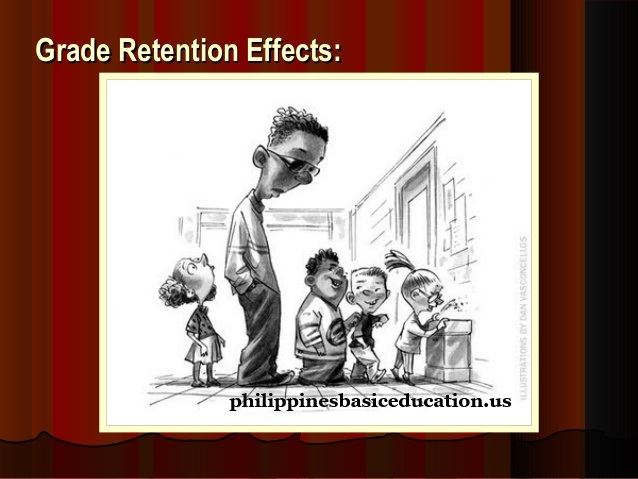
I know what you mean. I heard from a bunch of those folks on the BATS FB page about retention. Was told, children need “the gift of time.” Not so much a gift when you’re towering over your peers in middle school like the picture above.
Psychologist Shane Jimerson’s research showed that, even without remediation, students with learning problems who are promoted still do better than those retained. But he’s quick to state that promoting students with difficulties and retention are both inappropriate, and that students need assistance.
LikeLike
Retaining a student reflects not a failure of the student. Rather, it reflects a failure of the system. A system disinclined to learn to improve.
LikeLiked by 1 person