Anand Giridharadas is a remarkable thinker and writer. In this post, he ties together the legacy of a very wealthy man who funded the fight against climate change and the terrible fate of his great-granddaughter Janie, who died in the flood in the Hill Cihntry of Texas.
He wrote:
In April 2013, Joe Barton, a Republican congressman from Texas, made a statement that transcended the traditional obscurity of House Subcommittee on Energy and Power proceedings to trigger national headlines. “Republican Congressman Cites Biblical Great Flood To Say Climate Change Isn’t Man-Made,” declared BuzzFeed.
In a hearing about the Keystone pipline, Representative Barton, whom The New Yorker once described as one of “Washington’s most vociferous — and, arguably, most dangerous — climate change deniers,” played the denier’s game of delinking human activity from weather events: “I would point out that if you’re a believer in the Bible, one would have to say the Great Flood is an example of climate change and that certainly wasn’t because mankind had overdeveloped hydrocarbon energy.”
Three months later, Barton received a campaign contribution from William Herbert Hunt, an oil baron in Dallas. It was neither the beginning nor the end of their alliance. According to the Open Secrets database, Hunt had already donated to Barton about ten times since 2005. And Hunt would go on to donate to Barton another half dozen times, as well as to the Texas Freedom Fund, a political action committee linked to Barton. Though most of Hunt’s donations were to Barton, he also donated to other climate deniers and foes of environmental protection, such as Christi Craddick, David McKinley, Dan Sullivan, and Dan Patrick, who once said former President Barack Obama “thinks he can change the weather…because he thinks he’s God.”
I have not been able to get the Hunt family out of my heart after I learned from The New York Times over the weekend that one of William Herbert Hunt’s great-grandchildren, Janie Hunt, all of 9, was among the dozens tragically killed in those Texas floods that were biblical in proportion, if not in explanation. Remarkably, Janie was one of seven cousins who attended the camp, and the only one to die.
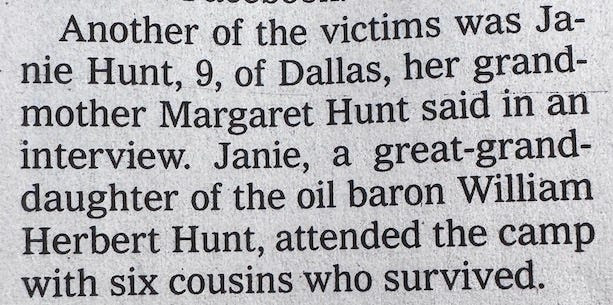
Now, I know how the internet works. I know people pounce on news items like this to make heartless, cruel comments. The object of this essay is very different from that.
I am a father, and I know what I’d do to protect my children’s lives. The answer is anything. I hope I live one day to become a great-grandfather. William Herbert Hunt, according to this Dallas Morning News obituary, passed in April 2024, at 95, a life long enough that he got to enjoy more than 72 years of married life, see his children and grandchildren grow and thrive, and even get to see 35 great-grandchildren of his line.
I have to imagine that Hunt, like me, would have done anything, absolutely anything, for his family. I even have to imagine that, if, by impossible magic, you could go back in time and a little birdie could whisper that one day a catastrophic flood, made more probable by climate change, made worse by fossil fuels, would claim one of his great-grandchildren at summer camp, Hunt might have reconsidered fundamental things.
I have to believe that, because I refuse to believe that being an oilman makes you any less human. When the equation is made that simple, anyone would do the right thing. Anyone would do what it takes to save their own flesh and blood. But when it becomes more abstracted — when one’s activities indirectly cause X, which indirectly causes Y, which sometimes makes Z happen more often than usual — the mind loses its clarity. When no individual happening can be definitively linked to climate change, the deniability, the not-knowing, grows easier still. Suddenly a human being can go from doing anything to save their kin to doing nothing to save everyone’s. A person who, I have to imagine, would have given his own life for his great-granddaughter’s donates to those who have fought for a world that makes deaths like hers more likely.

Source: OpenSecrets.org
I am not writing to accuse one man. On the contrary, this story of a great-grandfather and his great-granddaughter is a story of a whole country and its descendants. As always, some will say the death of children should not be politicized. I hear that. But, also, what is politics for if it’s not a debate about stopping the death of children?
I have sat with this story since I read the Times paragraph above. It has given me a pit in my stomach. I guess what one does with that is write. There is no glib I-told-you-so here. This is about what kind of great-grandparent all of us want to be, collectively. Do we want to put our heads down, do our work, justify it however we can justify it, donate to people who defend our interests, ignore the gathering evidence that we are on a path that will kill many of us and, at some point, take down the livable world?
Or do we want to be the kind of great-grandparent who right now is acting to save great-grandchildren who aren’t even born yet, but who one day, beside some river, surrounded by inner tubes and kayaks and Crocs and flip-flops and cabins and bunk beds and singalongs and brightly colored blankets — the kind of elder who defends those lives and their right to glorious summers even before we know their names?
What does it take to be that kind of great-grandparent now? It takes fighting back against the war on science that makes it harder for climate scientists and weather forecasters to do their jobs. It takes pushing back against extractive industries and their political protectors who would sell our future for a song, and who have made it unsafe for young girls to enjoy a Christian camp. It takes a campaign of media and organizing to educate people about the fact that a cabal of wealthy, well-connected corporate overlords is profiting at the expense of a future of carefree summers.
I am still sitting with the pit in my stomach. My heart goes out to the Hunt family, to those six surviving cousins who must be feeling so many awful things that children should never have to. They are feeling things many others have already had to feel, and that more and more of us are going to be feeling if we continue down this road.
On Instagram, an adult cousin of Janie, Tavia Hunt, who is the wife of Clark Hunt, the owner of the Kansas City Chiefs football team, shared the family’s pain and raised the old Jobian question of how to sustain faith in the wake of such inexplicable tragedy.
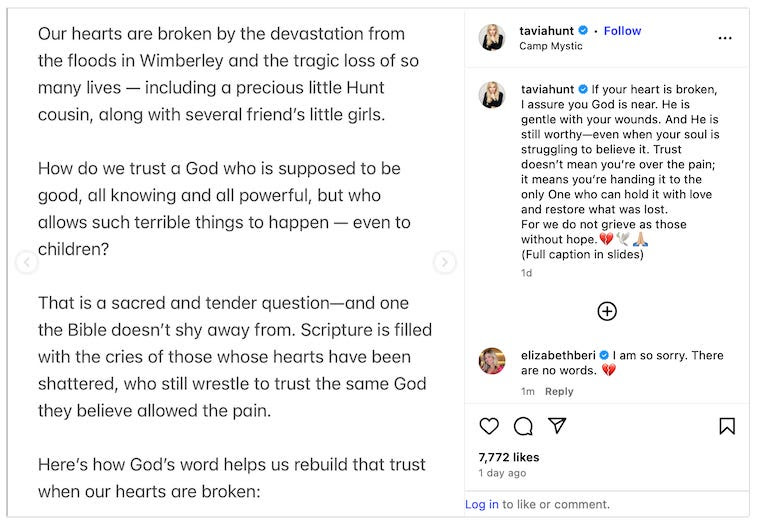
I am not a religious person, but my heart goes out to her, too. And, whether or not you believe in the god she cites above, it is also, of course, people who let things happen in this world we live in. It is also we who allow things to happen to us. And part of me wonders if, even hopes that, there might be an awakening from a story that connects cause to effect, upstream to downstream, more clearly than usual in a crisis that has long suffered from nebulousness. Perhaps this family, out of this horror, can help rouse the rest of us to become the great-grandparents our descendants deserve.

 Diane Ravitch's blog
the gap between causes and their effects is too great to overcome human denial. Ironically, this is the theme of the creation story so familiar to Judeo-Christian text. Hog told Man not to eat of the tree, but he did. Instead o confronting the error, all the participants in the story deny their role. Hunt would do the same, for probability is not, in the general mind, linking to causality. The way I read the story, this is the original sin.
LikeLike
While I appreciate the theme of this essay, I feel less forgiving than Giridharadas. No child should needlessly lose his or her life when we have the capacity to do something about it. This includes those that depend on USAID, the children of Gaza, the children that will lose Medicaid, and Mr. Hunt’s great granddaughter. I cannot understand how those that profess to be Christian or even American have no empathy for others. The concept of freedom and equality depend on a global concept of empathy. Those that claim to be devout Christians, but have the “we all have to die”mentality are merely performative Christians that clearly do not understand The New Testament. These people voted for a man that ridicules the handicapped, calls our military suckers and losers, vilifies LGBTQ people and immigrants and treats women as second class citizens. While I am truly sorry that this child needlessly died, maybe the biblical lesson is “you reap what you sow.” Galatians 6:7.
LikeLike
Thoughts and prayers ! Next
LikeLike
A very compassionate yet comprehensive and wise post.
Whereas I often get up to my allegorical lectern and take on a Old Testament prophet style tone warning those who deny climate change and fool with the Environment, when tragedy strikes and folk die, it is time to call ‘truce’ and turn attention to rescue, recovery and give sympathy to those mourning.
There will be time enough in the aftermath to press home the point to those who persist in the delusion that there is no climate change. Our hearts should go out to the Hunt family, as ours hearts should go out to others grieving and in shock, as well as those whose task it was to recover the dead.
As I was writing this just one cautionary image came into my head. For those who have seen the stark film ‘On The Beach’. The last scene an empty street and the banner which had been born by a Salvation Army group earlier on ‘There Is Still Time..Brother’
LikeLiked by 1 person
Leave god out of this. He doesn’t exist, and can neither be blamed nor blessed. This is all on us humans. Humans who burned all the fossil fuels that made the weather crazy. Humans who thought they could save a few tax dollars by not paying for warning systems in flood country. Humans who elect people who reflect our biases and ignorance.
LikeLiked by 2 people
John,
I agree. Humans failed.
LikeLike
This piece does such a great job of showing the terrible responsibility of those in govt [or govt-adjacent, influential] positions, whose decisions affect everyone within their jurisdiction, including their own kin. It’s possible, perhaps probable, that the great-grandfather’s $$influence effected (gradually, over time) a lack of regulations that doomed these children [27 from one camp died; 161 still missing from the area, many of whom are children].
Lack of regulations is an issue especially in TX. [See the Feb ’21 freeze that killed an estimated 800]. To put a finer lens on it, looks like too much responsibility for regs is left to successively lower levels of govt (like county/ municipality), where local funds are most lacking & in need of general support from state (or even fed) level. Reports suggest the immediate locality hosting these riverside camps chose not to fund emergency evacuation communications [perhaps due to lack of broadband communications (?)].
Add to that what Roy says so well above: “the gap between causes and their effects is too great to overcome human denial.” The incidence of extreme events caused by climate change has been coming faster & furiouser for at least a decade– but that’s not quite long enough for the public to recognize, hey, that could be on my doorstep tomorrow. They are still lulled by, well, it never happened here…
LikeLike