Glenn Sacks is a veteran social studies teacher in a Los Angeles public high school. Many of the students he teaches are immigrants. He describes here what he has learned about them.
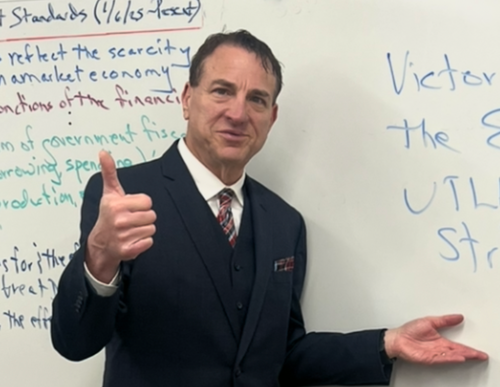
Teacher Glenn Sacks
“If they spit, we will hit, and I promise you, they will be hit harder than they ever have been hit before. Such disrespect will not be tolerated!” — Donald Trump
President Trump says he is defending Los Angeles from a “foreign invasion,” but the only invasion we see is the one being led by Trump.
Roughly a quarter of all students in the Los Angeles Unified School District are undocumented. The student body at the high school where I teach consists almost entirely of immigrants, many of them undocumented, and the children of immigrants, many of whose parents and family members are undocumented. This week we held our graduation ceremony under the specter of Trump’s campaign against our city.
Outside, school police patrolled to guard against potential Immigration and Customs Enforcement raids. Amidst rumors of various actions, LAUSD decided that some schools’ graduations would be broadcast on Zoom.
For many immigrant parents, graduation day is the culmination of decades of hard work and sacrifice, and many braved the threat of an ICE raid and came to our campus anyway. Others, perhaps wisely, decided to watch from home.
They deserve better.
Trump’s Homeland Security Secretary Kristi Noem calls us a “city of criminals,” and many Americans are cheering on the Trump administration and vilifying immigrants. What we see in LAUSD is an often heroic generation of immigrant parents working hard to provide for their children here while also sending remittance money to their families in their native countries. We see students who (usually) are a pleasure to teach, and parents who are grateful for teachers’ efforts.
Watching the students at the graduation ceremony, I saw so many who have had to overcome so much. Like the student in my AP U.S. government class who from age 12 worked weekends for his family’s business but made it into UCLA and earned a scholarship. There’s the girl who had faced homelessness this year. The boy with learning issues who powered through my AP class via an obsessive effort that his friends would kid him about, but which he committed to anyway. He got an “A,” which some of the students ribbing him did not.
Many students have harrowing, horrific stories of how they got to the U.S. — stories you can usually learn only by coaxing it out of them.
There’s the student who grew up in an apartment complex in San Salvador, where once girls reached a certain age they were obligated to become the “girlfriend” of a member of whatever gang controlled that area. When she was 14 they came for her, but she was ready, and shot a gang member before slipping out of the country, going all the way up through Guatemala and Mexico, desperate to find her father in Los Angeles.
As she told me this story at parent conference night, tears welled up in her father’s eyes. It’s also touching to watch their loving, long-running argument — he wants her to manage and eventually take over the small business he built, and she wants to become an artist instead. To this day she does not know whether the gang member she shot lived or died.
At the graduation ceremony, our principal asks all those who will be joining the armed forces to stand up to be recognized. These students are a windfall for the U.S. military. I teach seniors, and in an average class, three or four of my students join the military, most often the Marines, either right out of high school or within a couple years.
Were these bright, hard-working young people born into different circumstances, they would have gone to college. Instead, they often feel compelled to join the military for the economic opportunity — the so-called “economic draft.”
Some also enlist because it helps them gain citizenship and/or helps family members adjust their immigration status. A couple years ago, an accomplished student told me he was joining the Marines instead of going to college. I was a little surprised and asked him why, and he replied, “Because it’s the best way to fix my parents’ papers.”
Immigrants are the backbone of many of our industries, including construction and homebuilding, restaurants, hospitality and agriculture. They are an indispensable part of the senior care industry, particularly in assisted living and in-home care. Of the couple dozen people who cared for my ailing parents during a decade of navigating them through various facilities, I can’t remember one who was not an immigrant. There is something especially disturbing about disparaging the people who care for us when we’re old, sick, and at our most vulnerable.
Immigrants are woven into the fabric of our economy and our society. They are our neighbors, our co-workers, our friends, and an integral part of our community. The average person in Los Angeles interacts with them continually in myriad ways — and without a thought to their immigration status.
Immigrants are also maligned for allegedly leeching off public benefits without paying taxes to finance them. This week conservative commentator Matt Walsh called to ”ban all third world immigration″ whether it’s “legal or illegal,” explaining, “We cannot be the world’s soup kitchen anymore.”
One can’t teach a U.S. government and politics class in Los Angeles without detailing the phenomenon of taxpayers blaming immigrants for the cost of Medicaid, food stamps and other social programs. My students are hurt when they come to understand that many Americans look at their parents, who they’ve watched sacrifice so much for them, as “takers.”
Nor is it true.
Californians pay America’s highest state sales tax. It is particularly egregious in Los Angeles, where between this and the local surcharge, we pay 9.75%. As I teach my economics students, this is a regressive tax where LAUSD students and their parents must pay the same tax rate on everything they buy as billionaires do.
Moreover, most immigrants are renters, and they informally pay property taxes through their rent. California ranks 7th highest in the nation in average property taxes paid.
Our state government estimates that immigrants pay over $50 billion in state and local taxes and over $80 billion more in federal taxes. Add this to the enormous value of their labor, and America is getting a bargain.
Part of what is driving the current protests is the sense that once somebody is taken by ICE, their families won’t know their fate. Where will they be sent? Will they get due process? Will they end up in a Salvadoran megaprisonwhere, even if it’s ordered that they be returned home, the president may pretend he can’t get them back? It is fitting that the flashpoint for much of the protests has been the federal Metropolitan Detention Center downtown.
We also question the point of all this, particularly since the Trump administration can’t seem to get its story straight as to why ICE is even here.
Trump’s border czar Tom Homan says the raids are about enforcing the laws against hiring undocumented workers and threatens “more worksite enforcement than you’ve ever seen in the history of this nation.” By contrast, Homeland Security Assistant Secretary Tricia McLaughlin, citing “murderers, pedophiles, and drug traffickers,” says the purpose of the raids is to “arrest criminal illegal aliens.”
And now, having provoked protests, the Trump administration uses them as a justification for escalating his measures against Los Angeles.
Amid this, our graduating students struggle to focus on their goals. One Salvadoran student who came to this country less than four years ago knowing little English managed the impressive feat of getting an “A” in my AP class. He’d sometimes come before school to ask questions or seek help parsing through the latest immigration document he’d received. Usually, whatever document I read over did not provide him much encouragement.
He earned admission to a University of California school, where he’ll be studying biomedical engineering. Perhaps one day he’ll help develop a medicine that will benefit some of the people who don’t want him here.
When we said goodbye after the graduation ceremony, I didn’t know what to say beyond what I’ve often told him in the past — “Just keep your head down and keep marching forward.”
“I will,” he replied.
Glenn Sacks teaches government, economics, and history in the Los Angeles Unified School District. His columns on education, history, and politics have been published in dozens of America’s largest publications.

 Diane Ravitch's blog
Yes, yes, and more yes. I taught the same kids in Gilroy, CA. Felon 47’s first round kids were scared and wondered if they would come home to an empty house. People waving “good-byes” while saying “Go back to your own country.” I often said, “My kids would be the valedictorian if they didn’t have to hold jobs, take care of siblings, translate in the court system, and navigate gang-infested neighborhoods walking to and from school. One of my best students left school because she was “burnt out” and just couldn’t handle it anymore. I was able to help her graduate high school via Adult Ed. And she went on to write her own poetry book. She now works with our local CARAS organization https://odfree.santaclaracounty.gov/community-agency-resources-advocacy-and-services-caras to better the lives of others. A student I have helped since 8th grade just sent me a text asking if his scholarship renewal letter was adequate (he graduated high school with not only his HS diploma but an AA as well). He now attends UC Riverside studying to be a geologist. His family arrived here hiding in wheel wells of trucks. His mother has been waiting on her citizenship papers (I advocated for her) for close to 6 years. She worked harder than anyone I know to support her family. I also was part of our citizenship class on Saturday mornings as well. My kids were so bogged down with so much “life stuff” they had to sacrifice so much to try to get ahead. My joy was lifting them up in school, in the community, and life. I still get emails and texts asking for help and some just “checking in on me.”
LikeLiked by 1 person
Rich,
I hope all your former students and their families are safe.
LikeLiked by 1 person
Even though it has been analyzed from a variety of angles, the right refuses to accept that immigrants are a net plus for our economy and culture. The criminals are a small minority of immigrants, and immigrant neighborhoods are generally safer and have less crime. My white daughter is living in El Paso County, and she has never felt unsafe in her community. Most of the residents are busy and hard-working, and they do not deserve the lies that the extremists continue to spew about them, or the mass deportations that will destroy families and undermine our economy.
BTW my feed was also stuck on the older post as well.
LikeLiked by 1 person
Rich and Retired Teacher,
I can’t say YES loud enough or long enough to make people hear! I posted Mr. Sachs letter on my FB page – I don’t go there often – so maybe, just maybe, some of my MAGA relatives and acquaintances will read, all the way to the end, for once.
How do we make people understand the positive and important impact our immigrant neighbors and friends have on our daily lives? I don’t know anyone that hasn’t had their lives made easier by our immigrant communities, who work hard and do what they can to eke out a living here. Trying to point that out to people that won’t hear has become and exercise in futility.
Most of the 4th of July celebrations in LA County have been shut down this year. There is too much fear so many cities are choosing not to hold parades or firework displays. Not that I feel we have much to celebrate this year, especially here in SoCal, but still, kids love the fesitvals, parades and fireworks. It is sad to lose traditions to fear.
LikeLike
@Running Granny — I often told people, “You say they have a second chance, but they never had a chance to begin with. I mean walk in their shoes for a day.” Geez. You know, I am the “weird teacher” who actually made house calls and delivered diplomas to places not many would go. For years, I donated items to my friend who went into the migrant camps. We both wanted to make sure the kids were not forgotten at Christmas time. So many stories; I wanted people to remember me by my acts. One of my students needed to turn in some assignments in order to graduate. I tracked him down to the migrant shacks by the fields. I told him, “Look out there or finish these assignments and make a better life for yourself.” He made the right choice, graduated, and now is doing well with a great job. Many of my students learned a different way, so I adjusted, and they found their way. So proud of all my students. We were all “not perfect,” but we did make life and our community better. Thanks for reading my words. Bless you.
LikeLiked by 1 person
Most of my students over 36 years were immigrants or children of immigrants, but the first time I learned a student was undocumented was in 1986. She was the child of a Salvadoran woman who had fled civil war, and she never learned of her status until the fall of her senior year, when she was about to apply to college. A brilliant student, who attended an excellent selective admissions school, she would have qualified for an IV league school with a full scholarship. In a panic, her mother told her she was undocumented, and prohibited her from working with her guidance counselor on applications or even explaining the situation.
It lead to a chasm between parent and child. The student took on fulltime work at a small, chic bakery. Several years later, the owner decided to retire and offered my student the chance to buy the business. I don’t know what the outcome was, as I lost contact with the student, but the bakery no longer exists. So much potential – gone.
Another student came to the US from the Dominican Republic in the ninth grade. He quickly mastered English and decided he wanted to be an astronomer. Unlikely though it seems, he enrolled in a summer program for high schoolers at Harvard. They maintained a lab online with access to their telescope and he spent nearly every afternoon after school in my classroom for hours on my sadly ancient desktop. As an JROTC member, he secured admission to the Navy which led to his career in astronomy via Harvard University.
These students were equally talented, but one was denied any opportunity.
LikeLike
As a naturalized citizen legal immigrant (60 yrs ago) to the USA I sympathize with both sides: the open borders, let them in and we will sort it out later attitude, was as irresponsible as the push back, labeling and vilifying those looking for a better future for themselves and their children.
Nonetheless, most citizens and legal immigrants resent the actions of those who choose to bypass the legal immigration process, jumping ahead of those waiting years to be considered. They were used as pawns by politicians turning a blind eye, enticing illegal immigration to historic levels. A classic example of putting a stone in front the blind (masses) creating untenable situations for hosts and guests.
Solutions will require Solomonic wisdom, take decades to implement and like a parent at the dentist office cringing over the cries of their child on a candy diet, will not be pain free.
LikeLike