Today is an ironic holiday. The nation recognizes the day and most offices are closed to honor the dignity of labor. But it was not created in the late nineteenth century to honor labor in general but to honor labor unions.
Why ironic? Because right wingers have always hated labor unions. Today, unions represent about 10-11% of workers. Most unionized workers belong to public sector unions. In the 1950s, about one-third of private-sector workers belonged to a union; now only 6% do. Most people think that the decline in union membership has been bad for the country. They are right.
Why does it matter? Because unions were crucial in building the middle class. Because they have always been a stepping stone from low-wage jobs to better-paying jobs with benefits, including healthcare and pension. Because they promote better working conditions and higher salaries. Because unions are the answer to closing the vast gap between rich and poor. Without unions, there will be more super-billionaires and more living in poverty.
We need more unionized workers and workplaces.
The Department of Labor has a page about the day’s history.
The first Labor Day holiday was celebrated on Tuesday, September 5, 1882, in New York City, in accordance with the plans of the Central Labor Union. The Central Labor Union held its second Labor Day holiday just a year later, on September 5, 1883.
By 1894, 23 more states had adopted the holiday, and on June 28, 1894, President Grover Cleveland signed a law making the first Monday in September of each year a national holiday.
A Nationwide Holiday
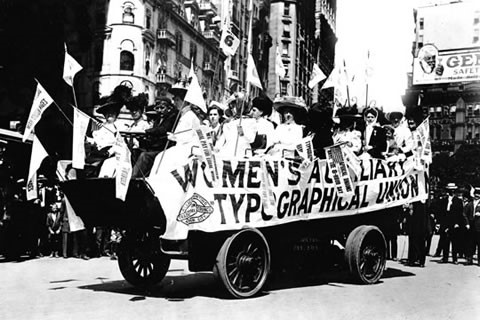
Many Americans celebrate Labor Day with parades and parties – festivities very similar to those outlined by the first proposal for a holiday, which suggested that the day should be observed with – a street parade to exhibit “the strength and esprit de corps of the trade and labor organizations” of the community, followed by a festival for the recreation and amusement of the workers and their families. This became the pattern for the celebrations of Labor Day.
Speeches by prominent men and women were introduced later, as more emphasis was placed upon the economic and civic significance of the holiday. Still later, by a resolution of the American Federation of Labor convention of 1909, the Sunday preceding Labor Day was adopted as Labor Sunday and dedicated to the spiritual and educational aspects of the labor movement.
American labor has raised the nation’s standard of living and contributed to the greatest production the world has ever known and the labor movement has brought us closer to the realization of our traditional ideals of economic and political democracy. It is appropriate, therefore, that the nation pays tribute on Labor Day to the creator of so much of the nation’s strength, freedom, and leadership – the American worker.

 Diane Ravitch's blog
When I was a preschooler in the late 1940s, my family escaped poverty because of a labor union that represented construction workers in a cement plant where dad got a union job with help from his best friend.
Because I belonged to a union as a public school teacher, I have a livable retirement income today that’s much better than Social Security, even though I paid into that too for my first 15 years in labor earning minimum wage in non union jobs. SS pays me $175 a month. When my dad died, my mother lived another 10 years without his union retirement income. It died with him. SS paid her $500 a month and she worked in mostly minimum wage, non-union jobs most of her life. When she was 14, she was supporting her mother and new born sister as a waitress. When I was a child, she worked at the City of Hope laundry and baked decorated cakes for weddings and birthdays at home after work. She was an artist and could turn a cake into a lake with trout leaping out of the water for someone’s birthday who loved fishing. That one cake I remember the most. There were many cakes like that. She worked all day at City of Hope and came home to bake and decorate cakes.
When President Teddy Roosevelt decided to support labor unions around 1900, the criticism from the Robber Barons, who hated the idea of labor unions taking away their total Trumpian power hold over the slave labor working class, was that the labor unions were corrupt.
Teddy said something to the effect that the robber barons and/or corporations were also corrupt, so even corrupt labor unions were better than nothing. That workers deserved to have a voice.
The uncle I was named after worked for the railroads before the labor unions. He said hundreds would show up at the railroad yard outside of Deadwood South Dakota in blizzard and wait to see if there was a job that day to load or unload freight cars. I remember him telling me the pay was 0.25 cents a day with no benefits at all. After waiting in hours in often brutally cold weather, a foreman would show up and tell them he had several jobs that day and then throw that numbers of chits into the crowd where the desperate workers might fight over them. The rest who didn’t get a chit, walked home, still poor and hungry for another day. After the labor unions, Uncle Lloyd earned a livable income with a guaranteed full time job with the same railroad. That was before WWII. He was 5 when my mother was 14.
The world of the Robber Barons is the world Traitor Trump wants to bring back. That is his vision of MAGA. And Musk supports him. The same vision all the wealthy that support Traitor Trump also have.
LikeLike
Your story of crowds of workers waiting for a job in Deadwood reminds me of the stories I heard growing up near a Tennessee railroad town. Each morning, six days a week, a group of day laborers would gather to meet potential farm labor. Cars meant farmers could take advantage of this from a larger radius. Some people would hang around all day. Critical onlookers criticized these “loafers” for not working.
As mechanization of agriculture took over in rural areas, jobs in distant places took the population away from the small towns and they dried up. Not understanding the dynamic of population change, the farmers complained bitterly that they “couldn’t get anybody to work.”
LikeLike
Heather Cox Richardson pointed out in her daily dose of history today that Cleveland was elected president in 1892 with a platform of helping labor only to greet the 1893 depression, one of the harshest in history. Most of the ideas he had were thrust aside to deal with the recession. Thus the proclamation in 1894 was an attempt to do something.
The rest of the story is that the rising distrust between labor and management produced the progressive era, a period of 20 years during which American Presidents quit intervening solely on behalf of management and attempted to enact some reforms that helped labor.
LikeLike
Anthony Romero, Executive Director of the ACLU, describes growing up poor in a large Puerto Rican family in NYC. His dad worked as a waiter in a banquet hall and was a member of a union. His dad applied for a better job and was told that his English was poor so the job was off limits to him. But his union representative made the argument that as it was a catering job, the same meal was served to everyone, so speaking English well wasn’t necessary.
Romero says that improved union wage changed his family’s life. His dad was able to buy a car to take the family outside the city. Tensions at home over money eased. Life was better.
LikeLike
Labor has achieved the gains they have through methods you don’t approve of. Strikes are always almost always violent, especially the ones that led to the kinds of worker protections we now have. People are forced to go without products and services they need. Products are boycotted. Workers stand up to police violence. At the time the labor movement was fighting for the gains you now laud, you would have been opposed to them because they were too violent and radical. I know because you oppose any such actions now.
LikeLike
PRO Act
Kamala has pledged that she will work to enact the PRO Act — the Protecting the Right to Organize Act. Enactment of PRO is absolutely essential to the renewal of The American Middle Class because PRO will return to Middle Class Americans the collective power to win fair wages, good health insurance, and reliable fixed-benefit retirement plans to replace bank-friendly 401(k) plans.
The American Middle Class has greatly declined because of the corporation-sponsored Taft-Hartley Act which severely restricted the constitutional right of American workers to organize into unions and to take job actions to protest unfair wages and treatment. The corporate Taft-Hartley Act (Labor Management Relations Act) tilted power in favor of corporate management and made it possible for corporations to buy political influence in state legislatures to pass so-called “Right to Work” laws that are actually “Right to Fire Union Workers” laws. The PRO Act will end all of that.
If We the People elect Kamala and elect Democratic majorities to the House and Senate in November, passage of the PRO Act will put America on course to rebuilding the great American Middle Class and to restoring The American Dream.
LikeLike