Archives for the month of: September, 2024

At least for now, abortion is legal again in Georgia.

The Atlanta Journal-Constitution reported:

The state can no longer enforce its ban on abortion that took effect in 2022, a Fulton County judge said Monday, allowing the procedure again to be performed in Georgia after a doctor detects fetal cardiac activity.

Fulton County Superior Judge Robert McBurney issued an order Monday that said abortions must be regulated as they were before Georgia’s 2019 law took effect in July 2022 — meaning the procedure is again allowed up until about 22 weeks of pregnancy.

Fulton County Superior Court Judge Robert McBurney wrote in his order that “liberty in Georgia includes in its meaning, in its protections, and in its bundle of rights the power of a woman to control her own body, to decide what happens to it and in it, and to reject state interference with her healthcare choices.”

We have all seen the devastating photos of the effects of Hurricane Helene. Many people in the areas hit by this storm have lost their homes, everything. My older sister lives on the border of Florida and Georgia, in the direct path of Helene; she was lucky: a tree fell onto her roof but no one was killed, and she still has a home.

Please donate to charities that are helping people, such as:

The Red Cross

The North Carolina Disaster Relief Fund


World Central Kitchen


Salvation Army

North Carolina Foundation for Public School Children’s disaster relief fund

If you have other charitable groups to add to this list, please send them.

Jon Valant, head of the Brown Center at the Brookings Institution, reviewed the education sections of both parties.

He writes:

K-12 education has captured its share of headlines over the last few years. Schools—and, specifically, local school boards—became a lightning rod for anger about the disruption caused by the COVID-19 pandemic. From the first weeks of the pandemic, Republicans accused Democratic leaders of being too slow to reopen schools. That accusation gained potency as evidence mounted that schools hadn’t been the vectors of COVID-19 transmission that experts initially feared. Sensing vulnerability, Democrats became reluctant to engage on K-12 issues, and Republicans such as Glenn Youngkin showed that Democrats wouldn’t put up much of a fight if education became a battlefield for culture war conflicts. The result was a dizzying, maddening stretch where schools were embroiled in controversies over critical race theory and transgender students’ rights when education leaders needed to focus on pandemic recovery.

Now, as memories of the pandemic recede, the politics of education are changing. Democrats are talking more about schools, emboldened by the selection of a former schoolteacher, Tim Walz, as Vice President Harris’s running mate. Republicans, for their part, have harnessed discontent with public schools into an aggressive push for private school voucher programs that threaten America’s public education systems.

The platforms of the Democratic and Republican parties, along with the education-related portions of Project 2025, provide a glimpse of where K-12 education might be headed.

The Democratic platform

The Democrats’ 2024 platform is light on specifics, with more attention to the current administration’s accomplishments and the would-be Harris administration’s support for some broadly defined goals (e.g., reducing chronic absenteeism). To some extent, the lack of specifics stands in contrast to both the Democrats’ 2020 platform—which, for example, pledged a tripling of Title I funds for high-needs schools—and more detailed 2024 proposals for early childhood education (e.g., free, universal pre-K) and higher education (e.g., free community college). 

The 2024 platform does contain relevant, specific ideas outside of its “Education” section. For example, Democrats propose rebates for school districts that purchase electric school buses—an idea grounded in research on the harms of students’ exposure to toxins. They also offer specific proposals to reduce gun violence (amid a scourge of school shootings) and to strengthen civil rights protections for LGBTQ+ children and students of color (frequent targets of culture war attacks).

Notably, some of the platform’s clearest statements on education describe what Democrats oppose. That includes private-school voucher plans and policies hostile to transgender youth that have become increasingly popular among Republican leaders.  

The Republican platform

Republicans’ 2024 platform is also light on policy specifics. The platform has a few ideas that have long been cornerstones of GOP education politics. That includes ending teacher tenure—an idea that would require local or state action and confront fierce opposition from teachers’ unions.

The platform has language about resisting political indoctrination in schools—while seeming to propose some indoctrination of its own. This includes proposals to “support schools that teach America’s Founding Principles and Western Civilization” and “promote Fair and Patriotic Civics Education.” Along similar lines, former President Trump recently described a bewildering plan to create a credentialing body to “certify teachers who embrace patriotic values, support our way of life, and understand that their job is not to indoctrinate children.”

Substantively, the most important part of the Republican education platform might be its support for universal school choice. In about a dozen states, Republicans have recently created or expanded education savings account (ESA) programs that make public funds available to pay for private school or other educational expenses. Critics of these programs—myself included—argue that they violate our basic traditionsbenefit the wealthy at the expense of others, and are not well supported by research.

Project 2025

If the Republican platform is light on policy proposals, Project 2025 certainly is not.

Along with my colleagues Rachel Perera and Katharine Meyer, I recently wrote a more detailed piece that analyzes Project 2025’s education proposalsProject 2025 proposes severe cuts to the resources and protections available to the country’s poorest, most marginalized children. For example, it proposes to eliminate the Head Start program (for young children in poverty), discontinue federal Title I funding (for schools that serve low-income children), and kneecap IDEA (federal legislation that supports students with disabilities). It’s especially harsh on transgender children, with proposals aimed at reorienting civil rights enforcement around “rejecting gender ideology and critical race theory” and stripping Title IX protections from transgender students.

In other words, Project 2025 sets its sights on the programs that serve America’s neediest students. It would essentially terminate the federal government’s long-running role in addressing inequities that arise in locally governed school systems.

Notably, many key Project 2025 proposals would require an unlikely degree of congressional cooperation. This includes some of the highest-profile proposals, such as eliminating the U.S. Department of Education (a vaguely defined idea that’s unlikely to materialize in its most extreme form). Still, a second Trump administration couldenact some Project 2025 proposals unilaterally. That includes rolling back civil rights protections and replacing civil servants in the U.S. Department of Education with political appointees after reinstating Schedule F.

Taking stock

It’s fair to say that Democrats’ plans for federal education policy are modest. Democrats aren’t proposing a markedly stronger role for the federal government. On K-12 education, Democrats remain in a mostly defensive posture as they offer a more “conservative” agenda that protects against the GOP’s increasingly radical efforts.

Just what those GOP plans might be—and just how radical they are—depends on whether the true Trumps X administration plan is the Republican platform, Project 2025, or some combination of the two. That remains to be seen

Indiana has followed the lead of Florida, Arizona, Ohio and other states, starting a small voucher program, expanding year by year until almost every child in the state is eligible for a voucher. Voucher advocates in Indiana hope that the only remaining limits are soon removed so that all students in the state, rich and poor alike, will qualify for a voucher.

Most of the students who use vouchers were already enrolled in private schools. The same is true in every other state with vouchers. The voucher program creates an entitlement for parents who can already afford private school.

The cost of the voucher program is near $500 million. About 70,000 students use vouchers. The public schools of Indiana enroll one million students.

Chalkbeat reports:

Voucher use has soared in Indiana since lawmakers made nearly every student in the state eligible, with more than 90% of students at more than half of all participating schools using a voucher during the 2023-24 school year, a Chalkbeat analysis found.

That was true in just 11% of private schools before lawmakers made the Indiana Choice Scholarship available to nearly every student in Indiana by relaxing income eligibility and removing other requirements to participate in the program.

Since lawmakers approved the expansion last year, the number of schools where 100% of students receive a voucher rose from just one in 2022-23 to 28 in 2023-24. Last year, in 178 of the 349 private schools that accept vouchers, more than 90% of students enrolled used a voucher to pay for tuition.

The recent growth in the share of students using vouchers has remade the scope of Indiana’s school choice program. Instead of being limited initiatives allowing students to leave struggling public schools, it’s increasingly a means for all families to choose their preferred educational settings.

Among supporters of choice, there is disagreement about the shift. Some say it proves just how popular and justified vouchers are.

“It’s phenomenal. In some ways, it’s predictable,” said Betsy Wiley of the Institute for Quality Education, a school choice advocacy group in Indiana, about the growth in voucher use. “In the years where eligibility has been expanded, you’ve seen greater growth.”

But others worry about costs and say the program has moved too far from its original purpose.

“A few of us feel strongly that this movement is about leveling the playing field for low income kids and working class kids. There’s an argument that these are taxpayer funds and we should limit that to a purpose that’s necessary, for kids who could not make those choices without it,” said Michael Petrilli, president of the Thomas B. Fordham Institute, a conservative education policy think tank. “I do think I’ve lost that argument.”

Meanwhile, critics of vouchers say the result isn’t just that Indiana is subsidizing tuition for families who can afford it without state funds, but that the state is doing so at the expense of up to hundreds of millions in funding for public schools.

“It’s the legislature’s obligation to provide for the common school system,” said Cathy Fuentes-Rohwer of the Indiana Coalition for Public Education. “You’re taking the pie and slicing it up.”

Another big change to Indiana school choice could be coming soon. Some Republican leaders are pushing to merge the state’s three voucher tracks into one universal program that would give parents free rein over where to spend state funding.

Universal education choice through incremental expansion

Data from the state released earlier this year indicated that voucher use grew faster than enrollment, suggesting that vouchers were going to families already enrolled at private schools.

A Chalkbeat analysis comparing enrollment data to voucher use data at individual schools shows voucher use has grown at a faster rate than enrollment at the vast majority of schools. (One caveat: Many private schools have populations of just a few dozen students, meaning changes in enrollment and voucher use lead to large jumps in percentages.)

Statewide, around 70,000 students out of the 92,000 enrolled at private schools used a voucher to attend, receiving either the cost of the tuition and fees at their school, or 90% of the per-pupil funding the state gives to their local public schools — whichever is less.

More students receive a voucher worth 90% of their public school funding rather than the full cost of tuition and fees.

At only 13 schools statewide, less than half of all students received a voucher in 2023-24. Not every private school in Indiana participates in the voucher program.

Though private school enrollment has grown, it remains far below that of public schools in Indiana, which enroll over 1 million students…

Average ILEARN scores for the last year show that students at private schools performed better on the tests than students in public schools. But several years of broader studies of vouchers’ effects on student achievement — and other outcomes — show mixed results.

Christopher Lubienski, director of the Center for Evaluation and Education Policy at Indiana University, said his research has shown that when socioeconomic factors are controlled, public school students outperform their private school peers…

But critics like Fuentes-Rohwer of the Indiana Coalition for Public Education say the $439 million price tag for the program in 2023-24 represented a costly diversion of public resources from public schools that the state is constitutionally obligated to fund.

According to the state’s 2023-24 voucher report, if all 70,000 students receiving vouchers had attended public schools, the state would have added over $500 million in public education funding. But most voucher students receiving vouchers have never attended a public school.

“There are so many things you have to go through as a public school system to be transparent,” Fuentes-Rohwer said. “We are very concerned that funding leaves public schools that have the obligation to educate everyone.”

With a rise in the number of schools that have a large voucher population, some predict that private schools may seek the same per-pupil funding as public schools in the future.

Lubienski noted that charter schools were once thought to be able to deliver greater achievement with less funding and regulation, but now are seeking equitable funding.

Petrilli of the Fordham Institute agreed: With less funding, charter schools ultimately couldn’t compete with traditional public schools on teacher salary.

Please open the link to finish reading the article.

For only the second time in its 179-year history, the prestigious magazine Scientific American issued a Presidential endorsement. It endorsed Kamala Harris. The only other endorsement in its history was four years ago for Joe Biden. The magazine cares deeply about science, climate change, health, and factual evidence. For these reasons, it opposes Trump.

The editors of Scientific American wrote:

In the November election, the U.S. faces two futures. In one, the new president offers the country better prospects, relying on science, solid evidence and the willingness to learn from experience. She pushes policies that boost good jobs nationwide by embracing technology and clean energy. She supports education, public health and reproductive rights. She treats the climate crisis as the emergency it is and seeks to mitigate its catastrophic storms, fires and droughts.

In the other future, the new president endangers public health and safety and rejects evidence, preferring instead nonsensical conspiracy fantasies. He ignores the climate crisis in favor of more pollution. He requires that federal officials show personal loyalty to him rather than upholding U.S. laws. He fills positions in federal science and other agencies with unqualified ideologues. He goads people into hate and division, and he inspires extremists at state and local levels to pass laws that disrupt education and make it harder to earn a living.

Only one of these futures will improve the fate of this country and the world. That is why, for only the second time in our magazine’s 179-year history, the editors of Scientific American are endorsing a candidate for president. That person is Kamala Harris.

Before making this endorsement, we evaluated Harris’s record as a U.S. senator and as vice president under Joe Biden, as well as policy proposals she’s made as a presidential candidate. Her opponent, Donald Trump, who was president from 2017 to 2021, also has a record—a disastrous one. Let’s compare.

HEALTH CARE

The Biden-Harris administration shored up the popular Affordable Care Act (ACA), giving more people access to health insurance through subsidies. During Harris’s September 10 debate with Trump, she said one of her goals as president would be to expand it. Scores of studies have shown that people with insurance stay healthier and live longer because they can afford to see doctors for preventive and acute care. Harris supports expansion of Medicaid, the U.S. health-care program for low-income people. States that have expanded this program have seen health gains in their populations, whereas states that continue to restrict eligibility have not. To pay for Medicare, the health insurance program primarily for older Americans, Harris supports a tax increase on people who earn $400,000 or more a year. And the Biden-Harris administration succeeded in passing the Inflation Reduction Act (IRA), which caps the costs of several expensive drugsincluding insulin, for Medicare enrollees. Harris’s vice presidential pick, Tim Walz, signed into law a prohibition against excessive price hikes on generic drugs as governor of Minnesota.

When in office, Trump proposed cuts to Medicare and Medicaid (Congress, to its credit, refused to enact them.) He also pushed for a work requirement as a condition for Medicaid eligibility, making it harder for people to qualify for the program. As a candidate, both in 2016 and this year, he pledged to repeal the ACA, but it’s not clear what he would replace it with. When prodded during the September debate, he said, “I have concepts of a plan” but didn’t elaborate. Like Harris, however, he has voiced concern about drug prices, and in 2020 he signed an executive order designed to lower prices of drugs covered by Medicare.

The COVID pandemic has been the greatest test of the American health-care system in modern history. Harris was vice president of an administration that boosted widespread distribution of COVID vaccines and created a program for free mail-order COVID tests. Wastewater surveillance for viruses has improved, allowing public health officials to respond more quickly when levels are high. Bird flu now poses a new threat, highlighting the importance of the Biden-Harris administration’s Office of Pandemic Preparedness and Response Policy.

Trump touted his pandemic efforts during his first debate with Harris, but in 2020 he encouraged resistance to basic public health measures, spread misinformation about treatments and suggested injections of bleach could cure the disease. By the end of that year about 350,000 people in the U.S. had died of COVID; the current national total is well over a million. Trump and his staff had one great success: Operation Warp Speed, which developed effective COVID vaccines extremely quickly. Remarkably, however, Trump plans billion-dollar budget cuts to the Centers for Disease Control and Prevention and the National Institutes of Health, which started the COVID-vaccine research program. These steps are in line with the guidance of Project 2025, an extreme conservative blueprint for the next presidency drawn up by many former Trump staffers. He’s also talked about ending the Office of Pandemic Preparedness and Response Policy, calling it a pork project.

REPRODUCTIVE RIGHTS

Harris is a staunch supporter of reproductive rights. During the September debate, she spoke plainly about her desire to reinstate “the protections of Roe v. Wade” and added, “I think the American people believe that certain freedoms, in particular the freedom to make decisions about one’s own body, should not be made by the government.” She has vowed to improve access to abortion. She has defended the right to order the abortion pill mifepristone through the mail under authorization by the U.S. Food and Drug Administration, even as MAGA Republican state officials have tried—so far unsuccessfully—to revoke those rights. As a U.S. senator, she co-sponsored a package of bills to reduce rising rates of maternal mortality. In August, Trump said he would vote against a ballot measure expanding access to abortions in Florida, where he lives. The current Florida “heartbeat” law makes most abortions illegal after six weeks of pregnancy, before many people even know they are pregnant.

Trump appointed the conservative U.S. Supreme Court justices who overturned Roe v. Wade, removing the constitutional right to a basic health-care procedure. He spreads misinformation about abortion—during the September debate, he said some states support abortion into the ninth month and beyond, calling it “execution after birth.” No state allows this. He also refused to answer the question of whether he would veto a federal abortion ban, saying Congress would never approve such a ban in the first place. He made no mention of an executive order and praised the Supreme Court, three justices of which he placed, for sending abortion back to states to decide. This ruling led to a patchwork of laws and entire sections of the country where abortion is dangerously limited.

GUN SAFETY

The Biden-Harris administration closed the gun-show loophole, which had allowed people to buy guns without a license. The evidence is clear that easy access to guns in the U.S. has increased the risk of suicides, murder and firearm accidents. Harris supports a program that temporarily removes guns from people deemed dangerous by a court.

Trump promised the National Rifle Association that he would get rid of all Biden-Harris gun measures. Even after Trump was injured and a supporter was killed in an attempted assassination, the former president remained silent on gun safety. His running mate, J. D. Vance, said the increased number of school shootings was an unhappy “fact of life” and the solution was stronger school security.

ENVIRONMENT AND CLIMATE

Harris said pointedly during the September debate that climate change was real. She would continue the responsible leadership shown by Biden, who has undertaken the most substantial climate action of any president. The Biden-Harris administration restored U.S. membership in the Paris Agreement on coping with climate change. Harris’s election would continue IRA tax credits for clean energy, as well as regulations to reduce power-plant emissions and coal use. This approach puts the country on course to spend the authorized billions of dollars for renewable energy that should cut U.S. carbon emissions in half by 2030. The IRA also includes a commitment to broadening electric vehicle technology.

Trump has said climate change is a hoax, and he dodged the question “What would you do to fight climate change?” during the September debate. He pulled the U.S. out of the Paris Agreement. Under his direction the Environmental Protection Agency and other federal agencies abandoned more than 100 environmental policies and rules, many designed to ensure clean air and water, restrict the dangers of toxic chemicals and protect wildlife. He has also tried to revoke funding for satellite-based climate-research projects.

TECHNOLOGY

The Biden-Harris administration’s 2023 Executive Order on Safe, Secure and Trustworthy Development and Use of Artificial Intelligence requires that AI-based products be safe for consumers and national security. The CHIPS and Science Act invigorates the chipmaking industry and semiconductor research while growing the workforce. A new Trump administration would undo all of this work and quickly. Under the devious and divisive Project 2025 framework, technology safeguards on AI would be overturned. AI influences our criminal justice, labor and health-care systems. As is the rightful complaint now, there would be no knowing how these programs are developed, how they are tested or whether they even work.

The 2024 U.S. ballots are also about Congress and local officials—people who make decisions that affect our communities and families. Extremist state legislators in Ohio, for instance, have given politicians the right to revoke any rule from the state health department designed to limit the spread of contagious disease. Other states have passed similar measures. In education, many states now forbid lessons about racial bias. But research has shown such lessons reduce stereotypes and do not prompt schoolchildren to view one another negatively, regardless of their race. This is the kind of science MAGA politicians ignore, and such people do not deserve our votes.

At the top of the ballot, Harris does deserve our vote. She offers us a way forward lit by rationality and respect for all. Economically, the renewable-energy projects she supports will create new jobs in rural America. Her platform also increases tax deductions for new small businesses from $5,000 to $50,000, making it easier for them to turn a profit. Trump, a convicted felon who was also found liable of sexual abuse in a civil trial, offers a return to his dark fantasies and demagoguery, whether it’s denying the reality of climate change or the election results of 2020 that were confirmed by more than 60 court cases, including some that were overseen by judges whom he appointed.

One of two futures will materialize according to our choices in this election. Only one is a vote for reality and integrity. We urge you to vote for Kamala Harris.

In Vermont, Republican Governor Phil Scott nominated a candidate for State Commissioner of Education who had spent seven years as a leader of Charter Schools, USA, a for-profit charter chain in Florida. However, the Vermont State Senate rejected the nomination. Governor Scott then named his nominee Acting Secretary of Education. Two members of the legislature sued to block her appointment.

Peter Greene writes about what happened in Vermont.

First, a recap of how the state arrived at this point.

Vermont had been short an education secretary for about a year when Governor Phil Scott got his heart set on Zoie Saunders, despite Saunders having a less-than-spectacular resume.

Zoie Saunders has barely any background in public education. She attended the Dana Hall School, a private girls’ school in Wellesley, Massachusetts. Her first jobs were in the pediatric health care field, then she went to work in strategy for Charter Schools USA, a Florida for-profit charter chain, in particular profiting from taxpayer-funded real estate business. CSUSA was founded by Jonathan Hage, a former Green Beret who previously worked for the Heritage Foundation and Jeb Bush’s Foundation for Florida’s Future. Here’s League Education Chair Patricia Hall talking about how CSUSA rakes in the bucks:

Our shining local examples in Hillsborough County are owned by Charter Schools USA. My first glimpse of Winthrop Charter School in Riverview in November of 2011 was during a scheduled visit with then Rep. Rachel Burgin. When told the two story brick building was a charter school, I was mystified. The site on which it was built was purchased from John Sullivan by Ryan Construction Company, Minneapolis, MN. From research done by the League of Women Voters of Florida all school building purchases ultimately owned and managed by for-profit Charter Schools USA are initiated by Ryan Construction. The Winthrop site was sold to Ryan Co. in March, 2011 for $2,206,700. In September, 2011 the completed 50,000 square foot building was sold to Red Apple Development Company, LLC for $9,300,000 titled as are all schools managed by Charter Schools USA. Red Apple Development is the school development arm of Charter Schools USA. We, tax payers of Hillsborough County, have paid $969,000 and $988,380 for the last two years to Charter Schools USA in lease fees!

After six and a half years with CSUSA, Saunders moved into the job of Chief Education Officer for the city of Fort Lauderdale, a job that involved expanding education opportunities, including nonpublic schools.

 
Saunders took her first job in public education, chief strategy and innovation officer got Broward County Public Schools, in January 2024; her job there was the lead the district’s work to “close and repurpose schools,” a source of controversy in the community, according to the Sun-Sentinel. But her time as a school-killer for a public system was short, because Vermont was calling.

Once Scott announced his hiring choice (on a Friday), pushback was swift and strong. John Walters at the Vermont Political Observer, a progressive blog that has been all over this, noted that the lack of qualifications for the job was not the bad part:

The bad part is that her experience as a school killer and her years in the charter school industry are in perfect alignment with the governor’s clear education agenda: spread the money around, tighten the screws on public education, watch performance indicators fall, claim that the public schools are failing, spread the money around some more, lather, rinse, repeat. Saunders may not qualify as an educational leader, but her experience is directly relevant to Scott’s policy.

Objections to Saunders in the job were many, including her lack of any apparent vision for job. Add to the list the fact that she’d never run any organization remotely as large or complicated as a state’s education department.

Saunders moved into the office April 15, but the Senate still got to have a say, and what they said was, “Nope.” They voted her down 19-9, a thing which pretty much never happens.

And Scott went ahead and put her in office anyway.

Roughly fifteen minutes (okay–one whole day) after the Senate rejected her, Scott appointed Saundersthe interim Secretary of Education, a thing that does not require any Senate approval and which he presumably doesn’t have to move on from any time soon, particularly given she has announced her 100 day plan. Scott did not appear moved to appoint an interim during the year since Dan French resigned the post.

Scott characterized the vote as a “partisan political hit job,” even though three Democrats voted with the GOP senators to approve. He characterized attacks on Saunders as “unfair,” “hurtful,” and “false.”

Scott kept spinning in the aftermath, claiming that it was false to say that she only had three months experience in public education, even though she clearly only has three months of experience in the public education sector. As John Walters reported,Scott also tried to pin the defeat on “outside groups.” Walters pointed out that Scott has previously said he favors “CEO experience more than public school experience,” though Saunders doesn’t have that, either.

In June, two state senators (Tanya Vyhovsky and Dick McCormack) sued the governor and Saunders for “purposefully circumventing” the Senate’ authority to confirm or deny appointments. As reported by Sarah Mearhoff at VTDigger, another news site that has stayed on stop of the story:

“This is now no longer even about the secretary of education,” Vyhovsky told VTDigger in an interview. “It’s about separation of powers and the right of the Senate to do the job that it is constitutionally and statutorily given.”

So now…

Yesterday, the two sides got to speak their piece in Vermont Superior Court in front of Judge Robert Mello. Mello was appointed by Republican Governor Jim Douglas in 2010. 

Mello promised a quick decision on Thursday, and sure enough– he issued his ruling today (Friday).

Judge Mello dismissed the lawsuit:

To the extent that the Senators argue that the Senate’s decision to not confirm Ms. Saunders prevents the Governor from reappointing her, whether on an interim or permanent basis, the court disagrees…When the legislature has wanted to so limit the Governor’s appointment power, it has simply said so.

The reference is to legislative action that specifically forbid the governor reappointing someone to the Green Mountain Care Board after the Senate rejected them. Apparently since the legislature didn’t specifically list another time that the governor is not allowed to overrule them, well, too bad. 

What comes next? We’ll have to wait and see, but in the meantime Saunders can keep treating the job as hers, “interim” notwithstanding, because there’s no sign that the interim is going to conclude any time soon. 

Jonathan V. Last of The Bulwark has performed a public service by dissecting the actual cost of the brand-new Trump watches, which Trump is advertising and selling online. The top of the line sells for $100,000, the least expensive is $499. All profits, of course, go to Trump personally, not to his campaign. Trump is cashing in on the gullibility of his cult.

Last shows in his post that the actual cost of putting together the $100,000 all-gold with inlaid diamonds watch (engraved with Trump’s name on is face) is $20,000. The actual cost of the $499 watch with Trump’s name on its face is $60.

He writes:

How much are these watches worth, really?

Let’s take the $499 version, which is a red-dial steel dive watch. It has an automatic date movement of unspecified origin. (Translation: China.) It has a mineral crystal with an aluminum bezel. The clasp does not appear to have micro-adjustments.

The internet is full of off-brand watches like this. Here’s how you build one:

Everything you need comes from China using AliExpress. First you buy a steel case and bracelet for, say, $30. Like this one.

You engrave the caseback using laser etching working off an .svg file. Maybe that costs $5. Then you buy the cheapest possible automatic movement with a date function. Here’s one for $9. Pop the movement into the case and all that’s left are ial and handset. Hands are super-cheap.

And sunburst dials—even with applied markers—are not terribly expensive, either.

The final step is actually the most expensive: You have to pay someone to machine the “TRUMP” and signature bits and glue them to the dial. This is the first truly custom step and maybe, if the manufacturer wants to spend a little more money, they’re having a fourth-party make the dials for them out of sunburst blanks.

All told we’re in the neighborhood of $60. And that’s if you’re just trying to build a single watch without bulk purchasing power.

Reminder: They’re selling it for $499.

Last determined that Trump will pocket millions of dollars from the sale of these watches.

Here is his description of the $100,000 watch:

Enough with the plebe beater watches. I want to know about the $100,000 Trump “Victory” watch!

At least these aren’t from Ali Express.

Almost the entirety of the cost for the Victory models comes in the material cost for the “solid gold” case and bracelet. Trump claims there’s 200 grams of 18K gold in each watch. If true, the spot price of gold puts that cost near $13,000.¹ That’s real money.

The tourbillon movement inside these watches also appears to be an off-the-shelf product, but at least it’s a high shelf.² If I had to bet, I’d guess the Victory uses something from Olivier Mory, who sells “Swiss Made” tourbillon movements that generally run around $3,000.

How does Mory keep costs down? “Swiss Made” is like “Broadway”—it sounds like a colloquial description, but it’s actually a legal term of art.³Swiss Made means that 60 percent of the manufacturing costs and 50 percent of the “essential manufacturing step” must occur in Switzerland. Mory sources as many parts of his movement as he can from outside Switzerland—while still maintaining his “Swiss Made” status. And he streamlines his build process so that he can assemble 1,000 movements per month while keeping half of the “essential manufacturing step” in country.⁴

I can’t speak to the cost of the diamonds because there’s no information about the total karat weight involved but they appear to be quite small, in the <1mm range. For the sake of argument let’s say that the diamonds add another $1,000.

We’re now talking about a total production cost in the neighborhood of $20,000—and possibly much less—for a watch offered at $100,000.

As a point of reference, the list price on a solid gold Rolex Submariner is $40,600. In the Submariner you get an in-house, state-of-the-art movement running at COSC spec inside a bullet-proof case. The fit and finish will be superlative. And even though you’re paying over the odds for the Rolex name, you’re getting 10x the watch for 40 percent of the price of a Trump Victory.

Did I mention that the Trump Victory can’t get wet? From the Trump website: “The Tourbillon watches are not intended for water exposure.

Which watches does Trump own?

Last writes:

Trump is not a watch nerd, exactly, but he knows that Big Rich Guys should wear expensive gold watches. So he has a Patek Philippe Golden Ellipse ($17,500), a gold Rolex President Day-Date ($40,000), and a Vacheron Constantin Historiques Ultra-Fine ($20,000). It’s a small, understated collection and if I’m being honest, it’s impressive in its own way. These are beautiful watches from serious watchmakers and they suggest an elevated taste that I would not have expected from Trump.

The website for Trump watches includes this advisory:

Trump Watches are not designed, manufactured, distributed or sold by Donald J. Trump, The Trump Organization or any of their respective affiliates or principals. TheBestWatchesonEarth LLC uses the “Trump” name, image and likeness under a paid license agreement which may be terminated or revoked according to its terms. Trump Watches are intended as collectible items for individual enjoyment only, not for investment purposes. 
The images shown are for illustration purposes only and may not be an exact representation of the product.
These watches are not political and have nothing to do with any political campaign.

Panelists on MSNBC’s “Morning Joe” agreed that it’s become very expensive to be a follower of Trump. The Trump Bible. The Trump commemorative coins. The Trump NFT. The Trump sneakers. Now the Trump watch.

And there is much more for sale at Trumpstore.com.

Gotta make money while there’s still time.

Profiteering off your candidacy is tawdry and undignified.

Leonie Haimson, executive director of Class Size Matters, writes about the latest developments in New York City. Mayor Eric Adams was indicted on multiple charges of corruption. His top aides resigned, including his schools chancellor David Banks. Adams says he is innocent and won’t resign. Leonie worries about what will happen to the city’s public schools, which are controlled by the mayor. Some of us–Leonie and I–long for the end of mayoral control and a revival of an independent Board of Education. Checks and balances are a very important part of democratic government. Under mayoral control, there is more cronyism than accountability.

She writes:

Mayor indicted, Chancellor resigning, and the Panel for Educational Policy eliminates its Contract Committee; so much for Mayoral control!! 

Mayor Eric Adams talks to the press outside Gracie Mansion, the official residence of the mayor of New York City, on September 26, 2024, after he was indicted on federal criminal charges

Mayor Adams has now been indicted on  five federal charges of bribery, fraud and soliciting illegal foreign campaign donations.  Chancellor Banks is resigning as of Dec. 31, 2024, to be replaced by Melissa Aviles-Ramos, current Deputy Chancellor for Family Engagement. This follows the announced resignations of other top officials, including the Police Commissioner and Commissioner of Health, in the last two weeks.

We should recall the false narratives promoted by those including Governor Hochul who insisted on extending unchecked Mayoral control for two more years last April, with no strings attached: that any other system invited corruption, instability, and inefficiency. The Mayor himself insisted on renaming Mayoral control “Mayoral Accountability”, and Chancellor Banks threatened to resign if the governance system was altered in any significant way. And look at what has happened since. 

The only minor tweak the Legislature made to Mayoral control was that the Chair of the Panel for Educational Policy chair would be appointed by the Mayor from among three nominees put forward by leaders of the Legislature and Board of Regents. And yet it turns out that the new Chair will be exactly the same man who already held that seat as a Mayoral appointee, Greg Faulkner. The only difference is that now the Mayor will get an extra PEP appointee, to further cement his control over controversial educational policies, as well as questionable contracts and spending.

The Chancellor himself was reported having privately met with the CEO of 21stCentEd in October of 2022, and  subsequently greenlit a major contract with this company that had hired his brother, Terrence Banks, as a lobbyist. According to the Daily News,  21stCentEd has since received more than $1.4 million in business from the Department of Education for providing a variety of services. In cases where a family member is involved, the city requires that a Conflict of Interest waiver be obtained.  And yet Banks never applied for one. Both Chancellor Banks and Terence Banks have had their homes raided and their telephones seized by federal investigators.

Terence Banks also apparently lobbied for a Florida-based tech firm called Saferwatch which markets “panic button” apps to be used to alert authorities in case of school emergencies such as fires or active shooters.  The NYPD signed a contract with Saferwatch which was piloted in several schools  last year.

We have seen tremendous privacy problems with Teenspace, an online mental health program for NYC students 13 and up, relentlessly promoted by the Mayor and the Chancellor, after the Department of Health signed a $26 million dollar with the parent company Talkspace last year. And yet as we have discovered, Teenspace collects, shares and uses personal student data for marketing and commercial purposes with multiple social media “partners” that would be illegal if the contract was with the DOE rather than the Department of Health.  When a NYC student visits the Teenspace website on their phone, their personally identifiable information is collected by 34 cookies, and shared with 15 ad trackers, as well as Facebook, Amazon, Meta, Google, and Microsoft among other companies. The company has also been sued in Californiafor sharing personal data with TikTok, including  the mental health data of minors. One should not be surprised to learn that lobbying firm for Talkspace is Oaktree Solutions, the firm owned by Frank Carone,  a close associate and a former chief of staff to the Mayor who was with him last night when Adams was huddling with his attorneys after learning of his federal indictments. 

Shortly after he was elected, Mayor Adams own partner,  Tracey Collins, who already worked at DOE,  was promoted and named the “senior adviser to the deputy chancellor of school leadership,” and received a 23% boost to her salary to $221,597 a year.  Shortly thereafter, Sharon Adams, the wife of the Mayor’s brother Bernard Adams, was hired by DOE, at a salary of $150,000-a-year .

The whirlwind of scandals and investigations surrounding the Mayor and his top appointees, including the Chancellor, should give rise to a new call for more accountability, oversight and checks and balances at DOE, but I fear that no lessons will be learned by those in power, because their interests lie in maintaining one-person rule, and ignoring the voices of parents and teachers.  Indeed, there have been many cases of large-scale corruption at the DOE under previous administrations. 

Eric Goldstein was hired in 2004 during Bloomberg/Klein years as a deputy overseeing food, transportation and high school sports, and promoted to chief executive in 2007. Goldstein was just recently sentenced to two years in prison, for a corrupt scheme he was involved in 2015-2016, during the De Blasio administration, by receiving bribes in exchange for turning a blind eye to tainted food served to public school kids — including chicken tenders laden with plastic, bones and metal, causing choking. 

There is also the recently revealed, shocking case of DOE staffers in the Queens office who took their own kids on trips to Disneyland and other trips by using federal funds meant to provide educational experiences for homeless children.  For some reason, the DOE failed to ask for restitution for the money stolen; and neither the DOE nor the Special Investigator for Schools  reported the alleged fraud, forgery and misuse of federal funds to any authorities for possible prosecution.  To make things even more bizarre, the SCI held off posting its findings report, dated January 2023, for nearly two years after it was completed, and when they did so, they posted it quietly without any press release or notification, perhaps in hopes it would be ignored by the media focused instead on the allegations and investigations surrounding the Mayor.  I have since reported these alleged crimes to the Inspector General’s office of the US Department of Education, and the U.S. Attorney for the Southern District of New York.

There have been many more multi-million dollar DOE corruption scandals under Mayoral control over the last 20 years, a selection of which I summarized in my testimony to the State Education Department and my presentation last year to the NYC Bar Association, both posted here.

And yet despite all these allegations of cronyism and worse, the first thing that the newly reconstituted Panel for Education Policy did in its first meeting of the new school year on September 25 is to eliminate its Contracts Committee by amending their  Bylaws  as depicted below. 

Image

This committee, whose meetings have been livestreamed and recorded, has provided the only public airing of discussion and questioning of DOE officials by PEP members of the rationale behind  hundreds of millions of dollars of questionable DOE contracts before the final Panel vote.  The approval to ditch the committee was 13-6, with one abstention.   As usual, every Mayoral appointee plus the new, supposedly “independent” Chair voted in lockstep to eliminate the Contracts Committee and its monthly public meetings.  So much for so-called Mayoral accountability!

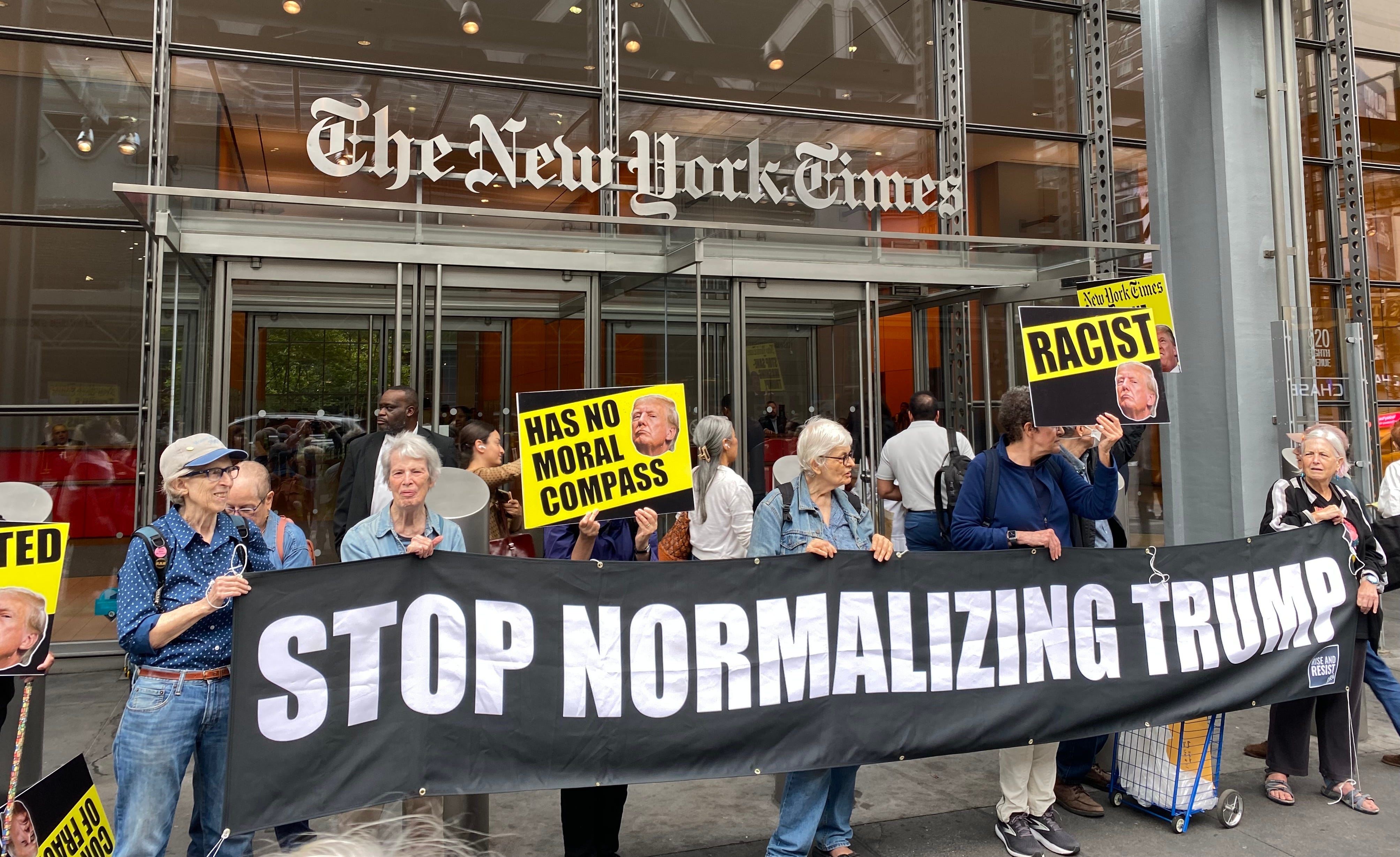
Bloggers are quick to report on Trump’s latest mistakes, lies, gaffes, outrages, and mental confusion, but a large swathe of the media reports on his speeches without pointing out his lies, threats, and incoherence. A group called the Media and Democracy Project decided to bring their complaints directly to the nation’s most influential newspaper, The New York Times.

THE GOOD NEWS

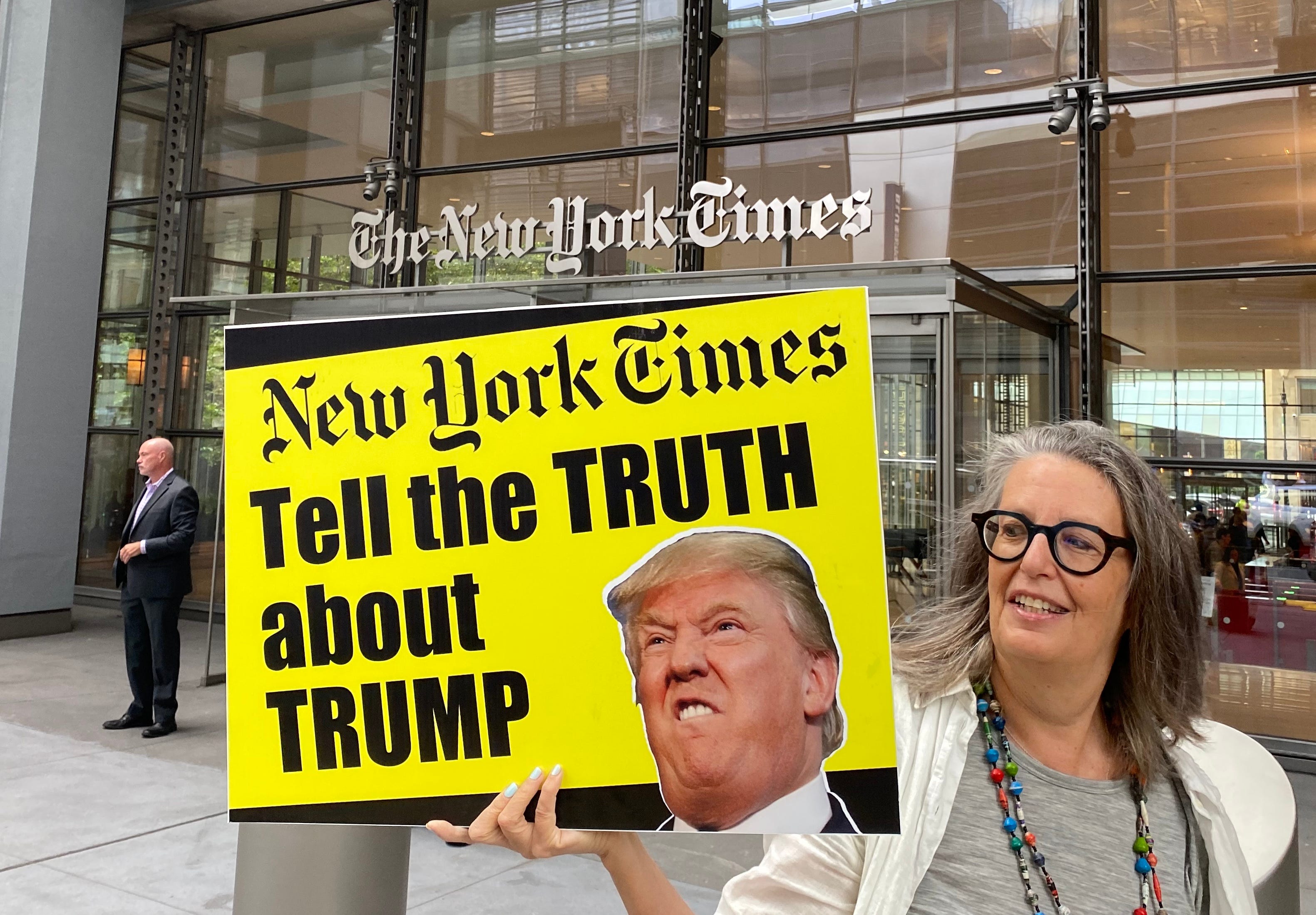
Members of Media and Democracy Project joined Rise and Resist’s protest outside the New York Times offices in Manhattan on September 18th, 2024

Peaceful Protest Outside The Times

The New York Times is the most powerful news organization in the United States. The narratives created by its editors and journalists have a cascading effect; the rest of the political press internalizes the Times’ agenda and then spits out its priorities and frames to the wider masses. The editorial decisions made on 8th Avenue in New York have a real impact on Americans’ understanding of the stakes of the upcoming elections and the future of our democracy.

An increasing number of regular people are joining media critics in pointing out that the Times is failing catastrophically with its election coverage, in what feels like their leadership willfully ceding to abnormalcy. This month, Times publisher A.G. Sulzberger wrote an exhaustive chronicle of worldwide threats to press freedoms, yet still drew the conclusion that he mustn’t direct his staff to accurately contextualize, or warn of, the threat to democracy here at home.

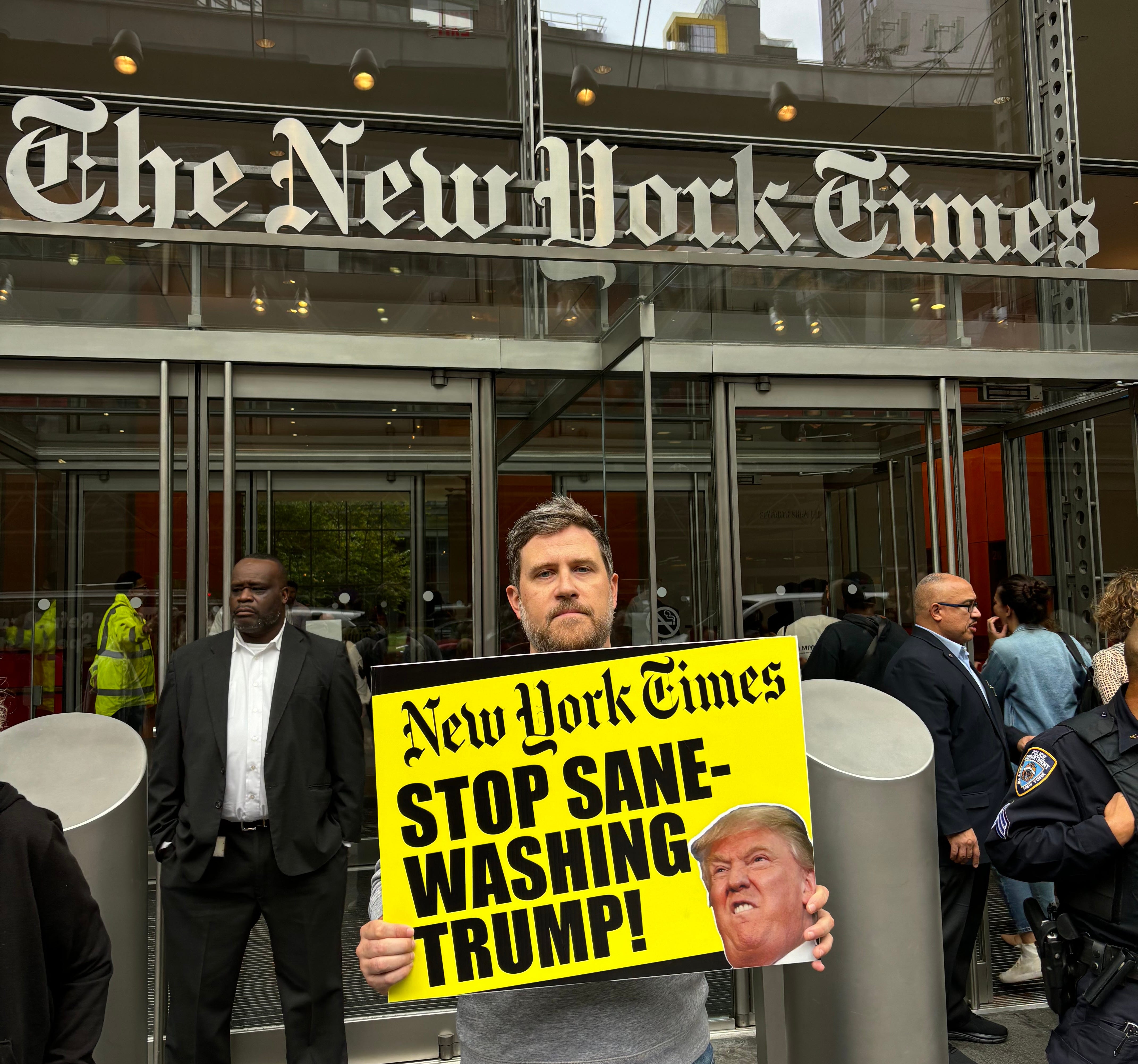
Yours truly protesting outside the New York Times offices in Manhattan on September 18th, 2024

By failing to join the fight and act as partisans for democracy, Sulzberger and the Times are failing in their critical role to accurately inform American citizens. Drew Magary recently commented in SFGATE that the “Times cares more about its place in the power structure than in actually affecting that power structure.” Magary’s piece goes further to say no one should care what the Times says anymore and we should all ignore its political coverage. His righteous dismissal is a response to the Times’ efforts to reject criticism, both internal and external.

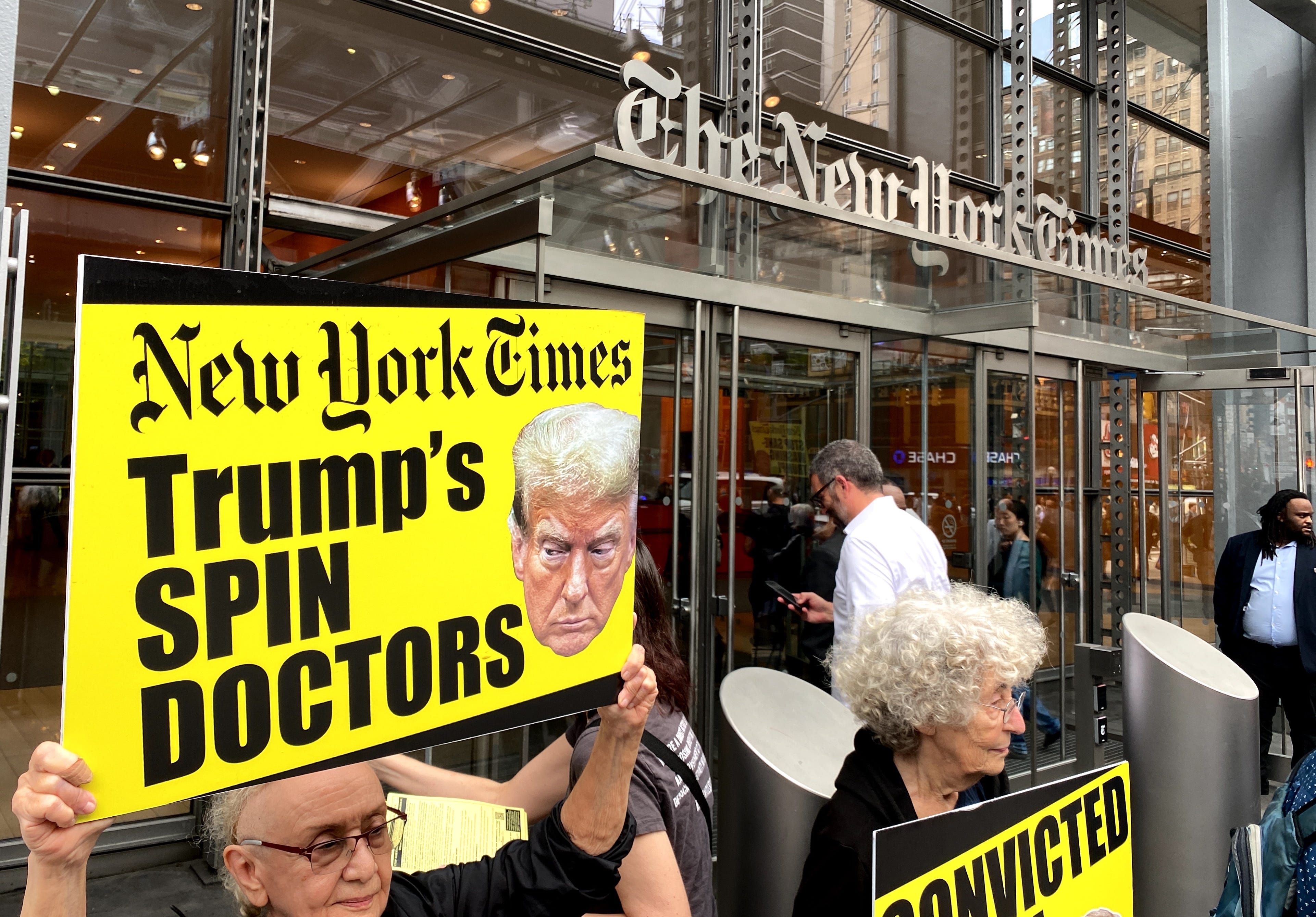
Members of Media and Democracy Project joined Rise and Resist’s protest outside the New York Times offices in Manhattan on September 18th, 2024

When A.G. Sulzberger’s father eliminated the Public Editor position in 2017, he assured his readership that they were now the most important critics. Dan Froomkin chronicled this for his Press Watch website:

At the time, Sulzberger wrote in a memo to the newsroom that “our followers on social media and our readers across the internet have come together to collectively serve as a modern watchdog, more vigilant and forceful than one person could ever be. Our responsibility is to empower all of those watchdogs, and to listen to them, rather than to channel their voice through a single office.”

The charade of newsroom responsiveness to outside criticism did not last long. Only a few years later, Times chief Dean Baquet was completely dismissive of “followers on social media,” saying “I could care less about the unnuanced voices on Twitter. That doesn’t mean I don’t care about what our readers think, but I don’t pay as much attention to Twitter as Twitter might want me to.”

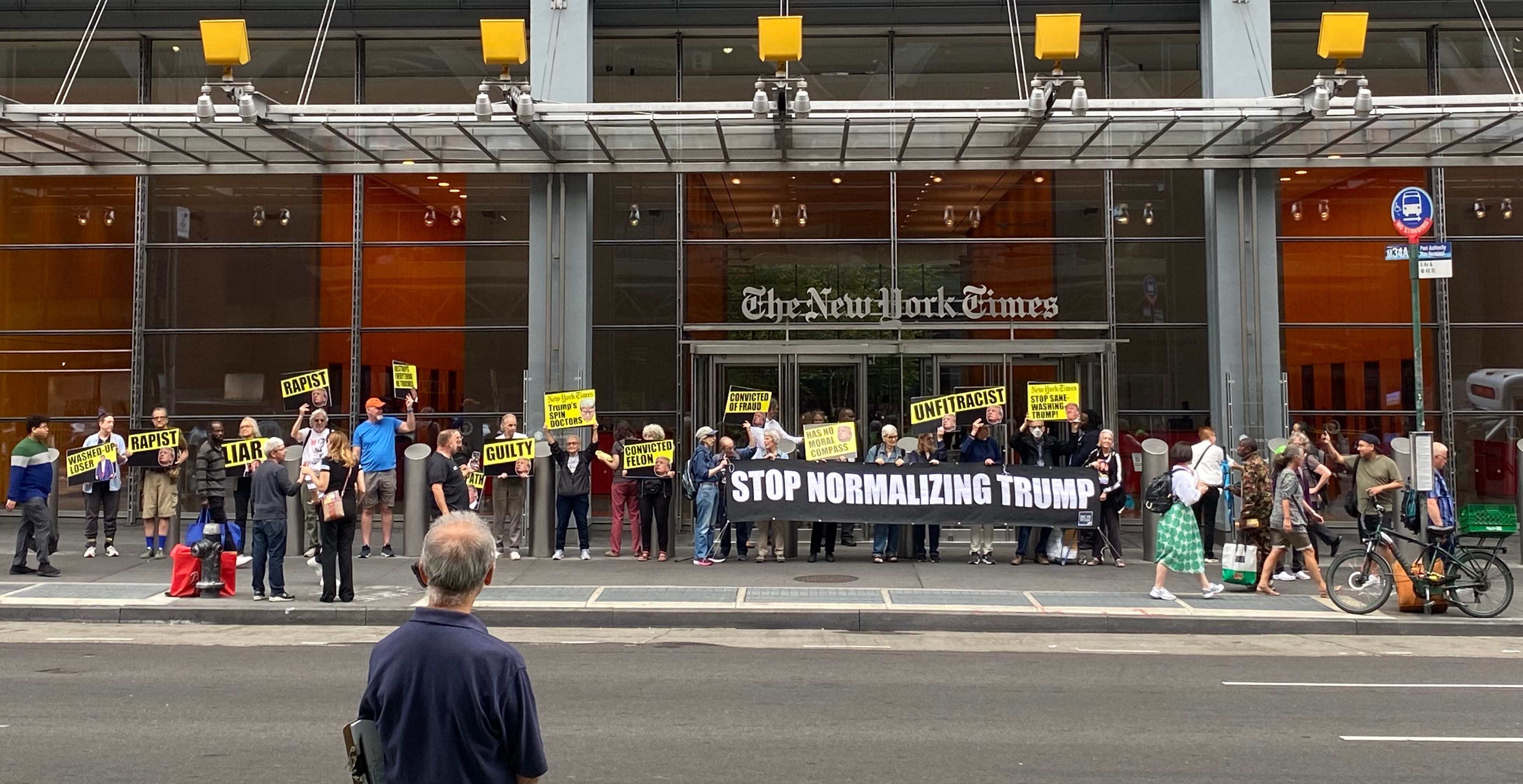
Members of Media and Democracy Project joined Rise and Resist’s protest outside the New York Times offices in Manhattan on September 18th, 2024

We’ve explored all manner of tactics to get the Times to improve its coverage and regain its credibility, including calling on them in January to reinstate the position of Public Editor. We have not heard back as of the writing of this piece. 

While some, like Magary, believe it’s no longer worth anyone’s energy trying to effect change at the Times, we disagree. A workplace is not a monolith and there are many employees there who disagree with the Times’ normalizing coverage of the Trump/MAGA threat to democracy. We want to aid those workers by facilitating a culture of dissent. 

Members of Media and Democracy Project joined Rise and Resist’s protest outside the New York Times offices in Manhattan on September 18th, 2024

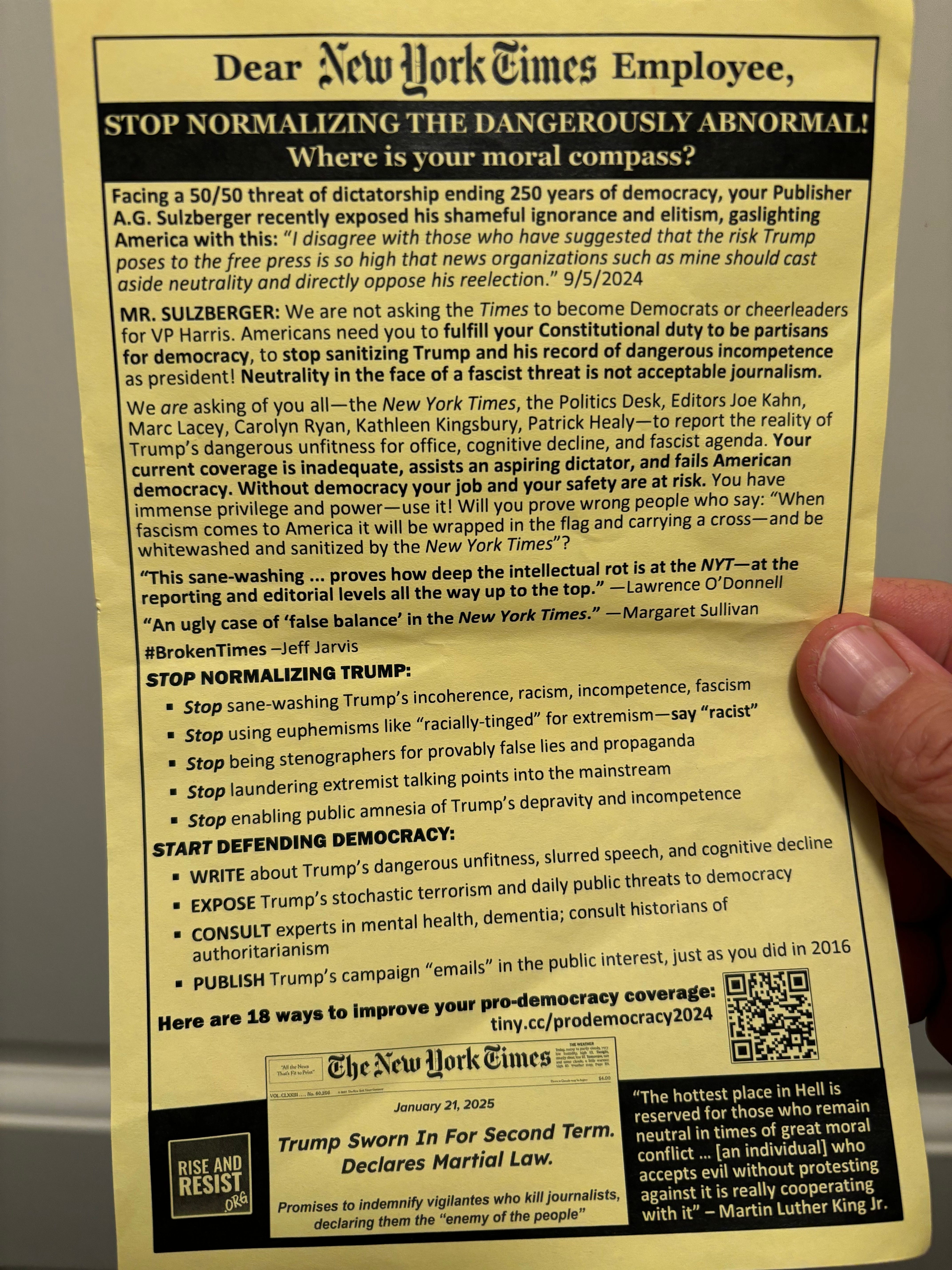
On September 18th, we joined a peaceful protest outside the Times building organized by Rise and Resist, a New York City-based direct action group. Flyers with criticisms of A.G. Sulzberger and senior editors were handed to employees entering the building with the goal of inspiring the humans who power the New York Times to activate their moral core and advocate for a change in political coverage. 

The flyer that was handed out to Timesemployees

No more excuses can be made for the upper management’s normalizing and sanewashing of the most manifestly unfit person ever to run for president. It is unlikely that the Times’ HR department would approve a person like Trump for any position in their building. So why are the powerful people who run the Times deceiving America about his fitness to take a job leading us all?

Jennifer Rubin is a columnist for The Washington Post. She was hired to be a conservative voice. Trump flipped her.

She writes here about Kamala’s specific economic proposals:

The media, political insiders, former Republicans and even members of Harris’s own party have underestimated her abilities to carve policy positions and reconsolidate the Democratic base.

Most prominently, she has been consistently criticized for failing to articulate her economic vision. However, in two speeches — one in Raleigh, N.C., last month and one in Pittsburg on Wednesday(where she identified herself as a capitalist seeking “bold, persistent experimentation”) — as well as numerous campaign events, she has delineated a set of serious, concrete policies. These include: restoring the child tax credit; creating a $6,000 credit for the parents of newborns in their baby’s first year; stimulating the housing market; subsidizing first-time home buyers; eliminating unnecessary college degree requirements for federal jobs; subsidizing child care (thereby limiting child-care costs to 7 percent of lower-wage earners’ income); raising the corporate tax rate to 28 percent; and expanding the tax credit for start-up businesses to $50,000 (with the goal of 25 million new business applications by the end of her first term). In Pittsburgh, she added new economic policy positions: become the global leader in everything from artificial intelligence to clean energy to aerospace to biomanufacturing; double the number of paid apprenticeships; reform tax laws to allow more employee profit-sharing; incentivize investment in factory towns; and cut red tape in permitting for construction.

This week, the White House announced that “the economy has grown by 3.2 percent per year during Biden-Harris administration — even stronger than previously estimated — and better than the first three years of the previous administration.”

Harris has managed to reduce former president Donald Trump’s polling edge on the candidate most trusted with the economy. And frankly, she has left those complaining about her “lack of details” with egg on their faces.