Jim Hightower, activist Democrat and former elected official in Texas, says it’s time for “Do-It-Yourself Democracy.” We can’t sit back and let Trump’s Supreme Court whittle away our rights and laws.
He writes:
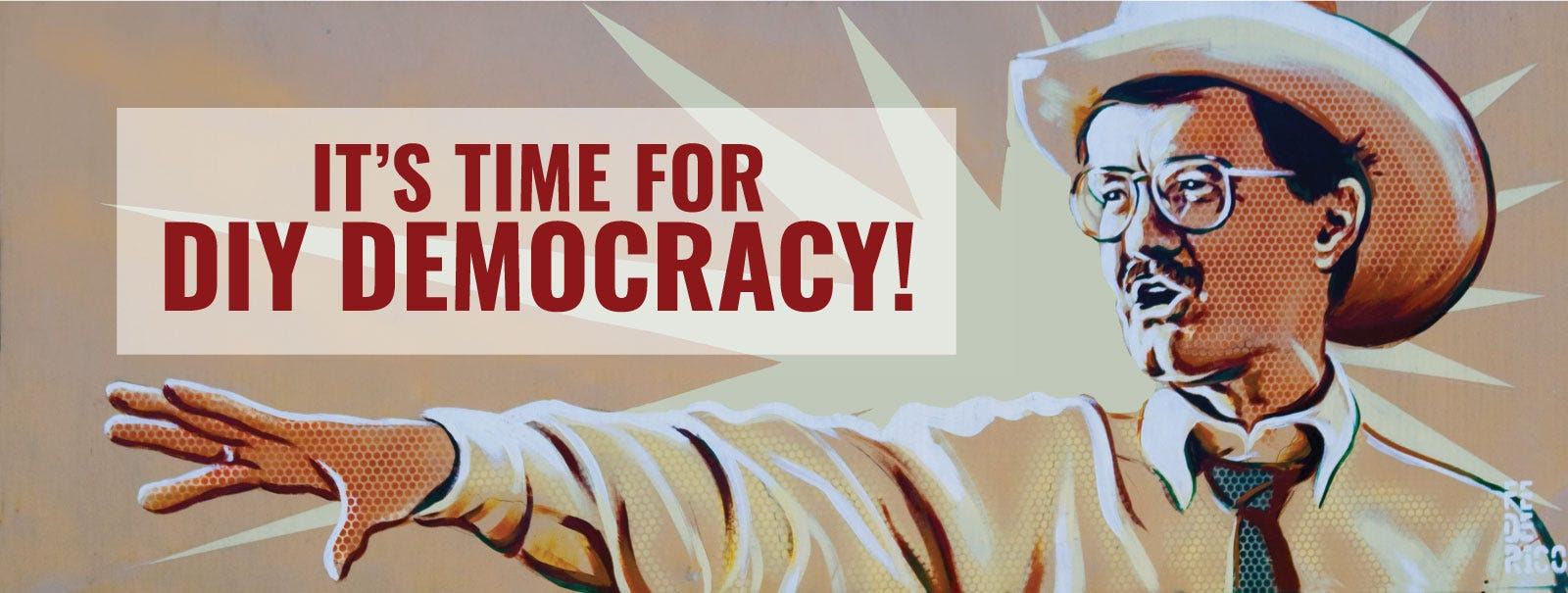
It’s July 4th week!
Sure, do a few 12-ounce elbow bends and set off some sparklers in celebration of our people’s democratic values. But wait – why are we celebrating the Spirit of ‘76, but meekly accepting the recent tsunami of autocratic, plutocratic dictates from a sextet of extremist, right-wing, partisan lawyers?
These six unelected Republicans, put on the Supreme Court by a tiny group of billionaire-funded political operatives, are routinely imposing their anti-woman, racist, xenophobic, homophobic, anti-worker, anti-environment, theocratic agendas on the vast majority of us who want none of the above.
Start with the fact that they are liars. Each one duped senators into giving lifetime appointments to them by loudly promising that they would never even consider rewriting the fundamental laws and legal precedents that form the egalitarian fabric of American society. Nor, each insisted, would they ever dream of being a part of a cabal working to turn the judicial branch into a repressive force routinely eliminating democratic power in order to erect a government of-by-and-for right-wing elites.
Then they proceeded, case-by-case, to do exactly what they swore on their honor they would not do. And now, with yesterday’s Trump v. United States edict, the six have haughtily attempted to rewrite the Constitution and 248 years of our People’s history by proclaiming, on their own whim, that America has an imperial presidency with executive authority to act with impunity.
We the People do not have to put up with their imperious crap.
They’ve turned the Supreme Court into a political operation – so it’s the duty of us grassroots democracy champions to fight their usurpation, not only in the presidential race, but carrying the fight into every political forum. Don’t wait on national “leaders” – they lack the guts for standing up to runaway power.
And while no individual can fix our democracy, a movement can. I think of a small hardware store here in Austin that had a can-do attitude, offering to help customers handle even the biggest tasks. The store’s slogan was “Together, we can do it yourself.”
We’re collecting actions that grassroots people can take, and are collaborating with longtime friends and allies to light a fire under the butts of Democratic Party leaders. We’ll keep you updated on those efforts, but to start, here are two groups to join up with.
Demand Justice has been advocating for the Judiciary Act, which would expand the court by four seats. They’re asking people to call their representatives, and to join their rapid response team.
We’ve long been a fan of Lisa Graves (you can watch our 2022 Chat ‘n’ Chew episode with her here), and she’s teamed up with the folks at Court Accountability for a new round of intense actions called Justice Can’t Wait. They’ve shared with us a list of things you can do:
- Share the Justice Can’t Wait updatedwebsite.
- Raise awareness of the seeds being planted by Trump and his allies to deny the results of the 2024 election if it doesn’t go their way. Trump has refused to commit to accepting legitimate election results if he does not win, and his allies are laying the groundwork for election denial through lawsuits and false claims about election fraud.
- Urge Congress to pass reforms clarifying the Insurrection Act, which Trump plans to invoke to deploy the military against the American people, on his first day in office.
- Share Stand Up America’s Supreme Court Voter website, which aims to educate and mobilize voters on the impact the next president will have on the future of the U.S. Supreme Court.
- Educate Americans on the economicthreats that the extremist Project 2025 poses. Economic concerns “consistently rank as top issues among likely voters,” and people need to understand the likely consequences and chaos for our economy and American families if Project 2025 affiliates are able to carry out their dangerous agenda.
- Join United for Democracy in calling on Congress to rein in the out-of-control Supreme Court.
- Drive home that this is Trump’s Supreme Court. Trump installed the corporatist majority that has taken away women’s fundamental freedoms and stripped away protections for Americans’ health and safety. Even after Trump led an insurrection, the Court that Trump built is now tipping the scales to help him win again in November and protect him from accountability for his actions.
- From the Hightower staff: And let’s not forget how the Supremes view actual bribery: as nothing more than a tip or a token of thanks for a job well done. They’re basically creating loopholes to legalize their own corruption!

 Diane Ravitch's blog
I’m not so sure that expanding the court is a solution since when the GOP is in power, they can expand the court with more right wingers. I’d be in favor of term limits for SCOTUS justices. Maybe 15 or 20 years?
LikeLike
This is a real possibility. Trump wins. Republicans keep the House and take the Senate. Filibuster killed, SCOTUS expanded and packed by Trump.
There are no easy choices or clear paths, but it is difficult to not feel we are floating toward disaster if something doesn’t change soon.
LikeLike
agreed
Totally frightening. If they get it all, some really dark stuff is going to start happening. They are bloodthirsty. Like wild dogs, they can smell it.
LikeLike
I’ve been ambivalent about whether Biden should step aside because the risks are not trivial. But I’m starting to come around to the view that he needs to make way for something new. There is a chance the Dems come out of the convention with ferocious energy and unity, but that chance only exists on a timeline where Biden is not the nominee.
LikeLike
agreed
LikeLike
LikeLike
The best way to change the future composition of SCOTUS is for the Democratic nominee for President to be elected in 2024. But the likeliest nominee – Joe Biden – now has a very small chance of being elected. Diane Ravitch shares Biden’s delusion that he will be cognitively fit to serve another four year term.
For those of us who aren’t blind partisans for Biden, we know that belief is absurd. Biden’s condition has been well-known for 2+ years, but almost all journalists and other D.C. insiders deliberately lied to the public about the reality. Does Diane Ravitch approve of this lying? The linked essay was published four months BEFORE the recent debate.
whatthehellisgoingon.substack.com/p/wth-what-we-hear-about-bidens-decline
LikeLike
I don’t know Biden’s chances of being re-elected. The dangers of Trump are existential. I do know that the Biden administration has a remarkable record. Trump warned in 2000 that if Biden should be elected, the stock market would collapse. Instead, the stock market is at record highs.
Everything Trump says is a lie.
Biden is a man of honor, character, and wisdom.
I will support any Democratic nominee over the narcissistic, ignorant, racist, misogynist, homophobic, xenophobic Trump.
LikeLike
Diane,
There have been many admissions recently from journalists that Biden’s cognitive decline was well-known and was intentionally concealed from the public for over two years. In other words, most journalists lied to their audiences, by commission and/or omission. Do you approve of their lying to protect Joe Biden?
LikeLike
Cathy,
I don’t know if that allegation is true.
What I do know is that Biden has been one of our most successful presidents while Trump is a congenital liar and sex abuser.
LikeLike
Biden fundraiser and erstwhile supporter George Clooney, yesterday:
“It’s devastating to say it, but the Joe Biden I was with three weeks ago at the fund-raiser was not the Joe “big F-ing deal” Biden of 2010,” Clooney wrote in a guest essay in the New York Times. “He wasn’t even the Joe Biden of 2020. He was the same man we all witnessed at the debate.”
The same man
LikeLike
I just got around to watching this. Feels like a guilty pleasure, a time machine back to the early 2000s, before Total Partisan Warfare precluded us from laughing hard and thinking clearly.
LikeLike
Reasonable people can disagree about this, and you don’t need to be a jerk about it. Diane’s a real person, not some dartboard for you.
LikeLiked by 1 person
Well said, Flerp.
LikeLike
DENIALISM is no solution. Democracy is not a market commodity, to be bought or sold. Democracy doesn’t prostitute itself to the highest donor. Of more than 2,234 adjectives used to describe democracy in the English language, how many are “Rule by SCOTUS” or “Rule by Money”? So when it comes to “Barking up the wrong tree”, who else benefits from blowing the democracy dog whistle?
LikeLiked by 1 person
The anti-woman members of the Supreme Court include 2 sex offenders. I still believe Anita Hill.
LikeLike
Of course. I had two relatives who worked for Thomas and with Anita Hill at the EEOC. Here’s what they said about all this: Thomas and Hill were from similar backgrounds–rural, extremely conservative black fundamentalist backgrounds. Both were, in the extremely racist Washington, DC, of the day, token black conservatives often trotted out by powerful white Republican leaders. They were invited to all the big parties to show how inclusive the powerful conservative white people were, and they clung to one another in these circumstances where they were constantly on show and under inspection. And in those circumstances, Thomas came to believe that they were a lot more emotionally intimate than they in fact were and felt totally free to fill the air with sexual innuendo and familiarity. If you will remember the hearing, and I do extremely well as I was riveted to them, Thomas looked throughout like someone hurt and betrayed. I think that this was genuine. he believed that his dear, dear friend was betraying him and humiliating him in public. She thought that she was responding, FINALLY, to a long period of his being totally inappropriate. After all, he was her boss. She was right, of course, but he didn’t grok this. Probably still doesn’t.
LikeLiked by 1 person
Thanks for the details. I had mostly forgotten them.
LikeLike
AMERICAN OLIGARCHY: HOW THE AMERICAN DEMOCRACY WAS KILLED
After researching more than 20 years of government policy, Princeton University researcher Martin Gilens and Northwestern University researcher Benjamin Page documented that the U.S. is no longer a representative republic because the government does not represent the interests of the majority of the country’s citizens, but is instead ruled by the rich and powerful. The researchers analyzed 1,800 U.S. policies enacted over a period of two decades and compared the laws and regulations that were passed to those favored by average Americans to those favored by wealthy Americans and corporations, and here’s what the research revealed: “EVEN WHEN A MAJORITY OF CITIZENS DISAGREES WITH ECONOMIC ELITES OR WITH ORGANIZED SPECIAL INTERESTS, ORDINARY CITIZENS GENERALLY LOSE.”
THE ROBERTS COURT INFAMY:
America has become an oligarchy because of the Supreme Court. Today’s Roberts Court will live in the same odious infamy as the Taney Court whose 1857 Dred Scott ruling declared that human beings are mere property, which lit the fuse to the ruinous Civil War from which America has yet to recover. In its 2010 Citizens United ruling, the infamous odious Roberts Court ruled that mere property is equal to a human being, leading to corporations being given the “human right” to pour unlimited dollars into America’s political system, putting government up for sale to the highest bidder and corrupting the system to the extent that our nation has become an oligarchy.
Today, America has the best government that money can buy and has become an oligarchy, serving the interests of corporations and billionaires, thanks to the corrupt, infamous, odious Roberts Court.
THE U.S. SUPREME COURT GAVE ITSELF POWER THAT OUR CONSTITUTION DOESN’T GIVE IT:
President and writer of our Declaration of Independence Thomas Jefferson pointed out that fact with these words: “The question whether the [Supreme Court] judges are invested with exclusive authority to decide on the constitutionality of a law…THERE IS NOT A WORD IN THE CONSTITUTION which has given that power to them.”
Not only is there nothing in Article 3 of our Constitution that gives the Court authority to rule on the constitutionality of any law, the actual minutes of the Constitutional Convention of 1787 that were accurately recorded by Founding Father James Madison, whom we honor as “The Father of the Constitution”, make it clear that when writing Article 3, the delegates at the Convention made a clear distinction between judicial matters — rulings on civil and criminal matters — and constitutional matters, and that the intent of and the understanding among the delegates was that “the jurisdiction given [to the Supreme Court] was constructively LIMITED TO CASES OF A JUDICIARY NATURE” and did not include authority to decide constitutionality.
Jefferson pointed out the very real danger to our democracy of allowing the Supreme Court the unconstitutional power to decide the constitutionality of laws: “Our judges are as honest as other men and not more so,” Jefferson noted. “They have with others the same passions for party, for power, and the privilege of their corps…and their power is all the more dangerous because they are in office for life and are not responsible, as the other functionaries are, to the elective control. The Constitution has erected no such single tribunal, knowing that to whatever hands confided, with the corruptions of time and party, its members would become despots” and “Experience has already shown that the impeachment it [our Constitution] has provided is not even a scare-crow…The Constitution on this hypothesis is a mere thing of wax in the hands of the judiciary, which they may twist and shape into any form they please.”
When the Court gave itself that unconstitutional authority, Jefferson sadly said that it was “the end of our democracy.” And that’s what’s happening today.
Since the Constitution does NOT give the Supreme Court any authority to decide on the constitutionality of laws, where did the Court seize the authority that it claims to have? Well, the Court GAVE ITSELF that alleged authority in its Marbury v. Madison ruling.
Must be nice to give yourself constitutional authority that the Constitution doesn’t give you.
On Wed, Jul 10, 2024 at 8:01 AM Diane Ravitch’s blog < comment-reply@wordpress.com> wrote:
LikeLiked by 1 person
With all due respect, the idea that the Supreme Court lacks the authority to determine the constitutionality of laws is inane.
LikeLike
So, The Father of Our Constitution and the author of our Declaration of Independence are “inane”?
Our nation’s third President and the writer of our Declaration of Independence Thomas Jefferson pointed out that fact with these words: “The question whether the [Supreme Court] judges are invested with exclusive authority to decide on the constitutionality of a law…THERE IS NOT A WORD IN THE CONSTITUTION which has given that power to them.”
Not only is there nothing in Article 3 of our Constitution that gives the Court authority to rule on the constitutionality of any law, the actual minutes of the Constitutional Convention of 1787 that were accurately recorded by Founding Father James Madison, whom we honor as “The Father of the Constitution”, make it clear that when writing Article 3, the delegates at the Convention made a clear distinction between judicial matters — rulings on civil and criminal matters — and constitutional matters, and that the intent of and the understanding among the delegates was that “the jurisdiction given [to the Supreme Court] was constructively LIMITED TO CASES OF A JUDICIARY NATURE” and did not include authority to decide constitutionality.
Jefferson pointed out the very real danger to our democracy of allowing the Supreme Court the unconstitutional power to decide the constitutionality of laws: “Our judges are as honest as other men and not more so,” Jefferson noted. “They have with others the same passions for party, for power, and the privilege of their corps…and their power is all the more dangerous because they are in office for life and are not responsible, as the other functionaries are, to the elective control. The Constitution has erected no such single tribunal, knowing that to whatever hands confided, with the corruptions of time and party, its members would become despots” and “Experience has already shown that the impeachment it [our Constitution] has provided is not even a scare-crow…The Constitution on this hypothesis is a mere thing of wax in the hands of the judiciary, which they may twist and shape into any form they please.”
When the Court gave itself that unconstitutional authority, Jefferson sadly said that it was “the end of our democracy.” And that’s what’s happening today.
Since the Constitution does NOT give the Supreme Court any authority to decide on the constitutionality of laws, where did the Court seize the authority that it claims to have? Well, the Court GAVE ITSELF that alleged authority in its Marbury v. Madison ruling.
Must be nice to give yourself constitutional authority that the Constitution doesn’t give you.
Section 2 of Article III says that the Supreme Court only has authority “both as to Law and Fact, with such exceptions, under such Regulations as the Congress shall make,” which means that Congress, not the Supreme Court, can determine and limit what matters of Law and Fact the Court has authority to rule on.
Nowhere in the Constitution is the Supreme Court explicitly given authority to rule on the constitutionality of “Law and Fact”. President Andrew Jackson clearly showed the Court’s constitutionally-limited power when he ignored the Court’s Cherokee Nation ruling and did what he wanted. The Court had no constitutional power to do anything about it. In fact, the Court itself didn’t explicitly claim that it had authority to rule on the constitutionality of any law until the 1958 Cooper v. Aaron ruling.
Congress let that claim go unchallenged because the Court’s 1954 Brown v. Board of Education ruling had saved the politicians in Congress from having to make the hard decision on integration. From that point on, even though the Court doesn’t have the constitutional authority to rule on the constitutionality of laws, and even though Article III, Section 2, gives Congress the constitutional authority to limit the Supreme Court, Congress has allowed the Court to exercise its unconstitutional power because letting the Supreme Court make the hard decisions allows politicians to avoid criticism from voters by pointing to the Supreme Court and saying: “It’s the Court’s fault!”
LikeLike
There are two questions raised.
Does the Constitution give the Supreme Court jurisdiction to decide whether laws or conduct are constitutional? The answer is yes, it’s a textual slam dunk and makes obvious policy sense.
Were Madison and Jefferson inane? A thing like this is a reminder that very smart people can be very stupid about specific things.
LikeLike
You’re cutting and pasting text. You need to really think about this on your own.
LikeLike
So, then, Quickwrit, how would constitutionality be determined? How would anyone challenge the constitutionality of a law. Or would any law that Congress passes be assumed to be, ipso facto, constitutional?
LikeLike
It’s just silly.
LikeLike
This theory has no textual basis. Article III lists the types of cases that the federal judicial power extends to, and it includes “cases . . . arising under this Constitution.” So I don’t care whatever Madison may have scribbled. Federal courts have the power to decide whether a law or conduct is unconstitutional.
And it makes no sense. As you observe, quickwrit’s theory would mean there is no check on Congress’s ability to enact legislation, apart from the people’s ability to elect new representatives. Poll tax? Constitutional. Slavery? Constitutional. No matter that the Constitution itself says slavery is unconstitutional. If it wants to, Congress has the authority to enact a new law saying slavery is legal. Yes, that new law would conflict with the constitution. But who has the authority to invalidate the new law? Only Congress? Absurd.
John Marshall went through all this in Marbury v. Madison and he got it right.
“If an act of the legislature, repugnant to the constitution, is void, does it, notwithstanding its invalidity, bind the courts, and oblige them to give it effect? . . . . It is emphatically the province and duty of the judicial department to say what the law is. Those who apply the rule to particular cases, must of necessity expound and interpret that rule. If two laws conflict with each other, the courts must decide on the operation of each. . . . . [T]he constitution is superior to any ordinary act of the legislature, the constitution, and not such ordinary act, must govern the case to which they both apply. [And so] if a law be in opposition to the Constitution, if both the law and the Constitution apply to a particular case . . . the Court must determine which of these conflicting rules governs the case. This is of the very essence of judicial duty.”
LikeLiked by 1 person
agree
LikeLike
Section 2 of Article III also says that the Supreme Court only has authority “both as to Law and Fact, with such exceptions, under such Regulations as the Congress shall make,” which means that Congress, not the Supreme Court, can determine and limit what matters of Law and Fact the Court has authority to rule on.
Nowhere in the Constitution is the Supreme Court explicitly given authority to rule on the constitutionality of “Law and Fact”. President Andrew Jackson clearly showed the Court’s constitutionally-limited power when he ignored the Court’s Cherokee Nation ruling and did what he wanted. The Court had no constitutional power to do anything about it. In fact, the Court itself didn’t explicitly claim that it had authority to rule on the constitutionality of any law until the 1958 Cooper v. Aaron ruling.
Congress let that claim go unchallenged because the Court’s 1954 Brown v. Board of Education ruling had saved the politicians in Congress from having to make the hard decision on integration. From that point on, even though the Court doesn’t have the constitutional authority to rule on the constitutionality of laws, and even though Article III, Section 2, gives Congress the constitutional authority to limit the Supreme Court, Congress has allowed the Court to exercise its unconstitutional power because letting the Supreme Court make the hard decisions allows politicians to avoid criticism from voters by pointing to the Supreme Court and saying: “It’s the Court’s fault!”
LikeLike
This is so wrong
LikeLike
Section 2 of Article III says that the Supreme Court only has authority “both as to Law and Fact, with such exceptions, under such Regulations as the Congress shall make,” which means that Congress, not the Supreme Court, can determine and limit what matters of Law and Fact the Court has authority to rule on.
Nowhere in the Constitution is the Supreme Court explicitly given authority to rule on the constitutionality of “Law and Fact”. President Andrew Jackson clearly showed the Court’s constitutionally-limited power when he ignored the Court’s Cherokee Nation ruling and did what he wanted. The Court had no constitutional power to do anything about it. In fact, the Court itself didn’t explicitly claim that it had authority to rule on the constitutionality of any law until the 1958 Cooper v. Aaron ruling.
Congress let that claim go unchallenged because the Court’s 1954 Brown v. Board of Education ruling had saved the politicians in Congress from having to make the hard decision on integration. From that point on, even though the Court doesn’t have the constitutional authority to rule on the constitutionality of laws, and even though Article III, Section 2, gives Congress the constitutional authority to limit the Supreme Court, Congress has allowed the Court to exercise its unconstitutional power because letting the Supreme Court make the hard decisions allows politicians to avoid criticism from voters by pointing to the Supreme Court and saying: “It’s the Court’s fault!”
Thomas Jefferson suggested that since our Constitution is a covenant between We the People and that not even state legislatures were allowed to vote on its ratification, the constitutionality of any given law could be decided either by a national vote of the People or by the House of Representatives which represents We the People. The Senate, which represents state governments, would have no say.
LikeLike