Education is always ablaze with the latest fad (think “grit,” “think “self-esteem,” think “character education,” think “growth mindset,” think a hundred other hot topics).
Now it is “social and emotional learning.” You might think that SEL is simply built into the classroom experience. But no, there is now a demand from some quarters to teach it as a separate activity or even subject.
Peter Greene has a few choice words on the subject.
With Peter Greene, experience and common sense go a long way.
He begins:
Social and Emotional Learning (SEL) has been gathering traction as a new education trend over the past few years. Back at the start of 2018, EdWeek was noting “Experts Agree Social-Emotional Learning Matters, and Are Plotting Roadmap of How To Do It.” But as we head into the new year, many folks still haven’t gotten far beyond the “it matters” stage in their plotting.
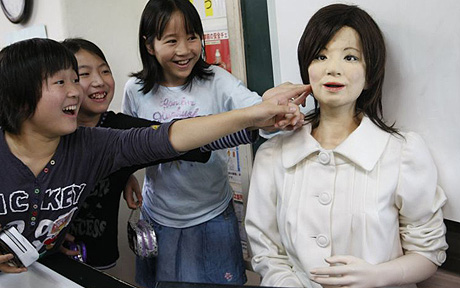 |
| I’m here to teach you how to be human. |
That’s the easy part. We can mostly agree that SEL matters; in fact, we ought to agree that it already happens in classrooms. It’s impossible to avoid; where children are around adults, SEL is going on. Asking if SEL should occur in a classroom is like asking if breathing should happen in the room. The real question is whether or not it should occur in a formal, structured, instructed and assessed manner. That is the question that starts all the arguments. We can break down the arguments by asking the same questions we ask about any content we want to bring into the classroom.
Why do we want to teach this?
Some SEL proponents have developed a utilitarian focus. Summarizing the work of the Aspen Institute National Commission on Social, Emotional and Academic Development, EdWeek said “social-emotional learning strategies center on research that has linked the development of skills like building healthy peer relationships and responsible decision making to success inside and outside the classroom.” But what happens if we approach what used to be called character education with the idea that it’s useful for getting ahead? Doesn’t SEL need to be about more than learning to act like a good person in order to get a grade, a job, and a fatter paycheck? Are you even developing good character if your purpose for developing that character is to grab some benefits for yourself?
We can reject that kind of selfish focus for SEL and instead focus on the “whole child,” and treat SEL, as Tim Shriver (co-chair of that Aspen Institute) and Frederick Hess (of the American Enterprise Institute) wrote, as “an opportunity to focus on values and student needs that matter deeply to parents and unite Americans across the ideological spectrum—things like integrity, empathy, and responsible decision making.” But then we find ourselves with another problem.
What do we want to teach?
If we’re going to adopt SEL in order to essentially teach students to be better people, then who will decide what “better” looks like? Is “tolerance” going to be one of the virtues, and if so, does that mean that students must learn to tolerate persons who would not be tolerated by their families (be that married gay folks or strict religious conservatives)? Should students be taught to feel empathy for everyone, from Nazis to sociopaths?
The Collaborative for Academic, Social and Emotional Learning (CASEL) identifies five “competencies” for SEL(self-awareness, self-management, responsible decision-making, social awareness, relationships skills). That framework is widely used, but “explained” with a wide variety of definitions (one resource says it includes “achieving useful goals”). All of them are heavily loaded with value judgments; how many arguments have you been in your life about whether or not something was a “responsible” decision or not? Who decides if a goal is “useful?”
We have been down this exact road before. In the 90s, Outcome Based Education was going to be a great new thing in education, but before it could gain traction, a bunch of folks noticed that it included an element of teaching values, and a large number of parents were certain that was not a job they wanted the schools to do. OBE never recovered. As two articles in this packet from AEI note, much of what comes under the SEL umbrella used to be considered the providence–indeed, the whole point–of religious and faith-based education.
Wherever SEL is implemented, expect a huge fight over what will actually be taught.
He has much more to say on the topic. Read it.

 Diane Ravitch's blog
I’m a public school parent and I’m certainly in favor of what are ordinary civic and public values in public schools- teaching them to be considerate to others- ALL others so that would include diversity- not cheat, work hard, etc. I don’t know- do they need it explained further than that? It doesn’t have to be lodged within a particular religious tradition. I think one could trust them to see the value of these things just on general “decent behavior” grounds. They can certainly explore the origins of these ideas as they grow and they don’t have to do that IN a public school. They can use it as a standard of behavior and a jumping off point for their own thoughts.
Our public school encompasses a Menonnite community and they pushed for and promote this “value of the month” thing. It will be like “take responsibility for mistakes” or “think of others”. Those are fairly universal, right? I don’t object to them and I’m not Mennonite.
LikeLike
I remember all those values and character traits being taught as part of normal classroom behavior–in the 1940s. Kindness to others, good citizenship, etc.
LikeLiked by 1 person
I agree. Good behavior can be “taught” by teachers who demonstrate it through their regular interactions with students. When a teacher is attentive and respectful to all the kids in the class, they will start to copy her, even if it’s just saying “thank you” once in a while. It’s much easier to teach behavior by modeling it than by formally teaching it.
LikeLiked by 1 person
that is not just good advice but research based: kids often don’t hear corrections when told but tend to act them out when seen
LikeLike
We went through a character Ed phase somewhere in the 1990s, unless I miss my guess
LikeLike
This strikes me as yet another fad. If I’m to believe the city’s press releases, it’s being implemented full-bore in NYC schools, along with restorative justice. As a parent, I find it difficult to get a good bead on it because it’s typically presented in language laden with jargon and bromides.
Somewhat unrelatedly, I recommend George Packer’s piece in the Atlantic today. It’s long. I think it’s very good.
https://www.theatlantic.com/magazine/archive/2019/10/when-the-culture-war-comes-for-the-kids/596668/
LikeLike
Thank you for sharing that link to George Packer’s piece in the Atlantic. Well worth reading all the way through.
LikeLike
The next great money maker for ed tech companies. I do remember discussions on using computer scenarios to help autistic children improve their social skills. The idea was to give them practice in recognizing emotions and how to respond appropriately. I don’t know if anyone has figured out how to data mine it and make money off it. Perhaps this new push to “train” everyone in SEL.
LikeLike
Social-emotional data are the most valuable data to advertising and surveillance organizations. The current SEL fad has little to do with teaching students anything. The push for SEL teaching is just the camel’s nose under the tent. Entrepreneurs are trying to build and scale up social-emotional education to turn it into a business.
It’s all about the money and the power to control people’s behavior. It’s always about the power and money. If SEL had really to do with teaching, it would have come from practicing teachers at the grassroots level. It didn’t. Teaching manners and citizenship did, dating back to the first public schools, and has always been embedded instead of emphasized.
LikeLike
The influence of the tech industry on all types of human interaction is quite perverse.
And the whole sorry Epstein/MIT/Harvard affair indicates that it is perverse in a quite literal sense.
It’s basically technology run amok with no morals and no restraints.
LikeLike
So our students are getting JUNK MATH, JUNK SCIENCE, JUNK HISTORY, and JUNK LITERACY ala those DEFORMERS
We’ve been here BEFORE and this is just more $$$$$ for the DEFORMERS who want to control each and every one of us peons … and FOR THEIR OWN PROFITS.
LikeLike
I am reminded of Robert Fulghum’s “All I Need to Know I Learned in Kindergarten.” Kindergarten reminds children that they need to share, be considerate of others and other life lessons. Teachers spend a good part of their day reminding students to responsible and kind. However, in the wrong hands social emotional learning could be a stigmatizing nightmare.
Big Tech is interested in SEL, and this is alarming news. Big Tech is known for making overstated claims about their products that often fall flat. SEL is another data product for Big Tech to sell. Collected information determined by an algorithm may have far reaching conclusions over which a person has no control. I see this as an invasion of privacy. This information may follow a person for years, or curtail opportunities for people based on so-called information gleaned from six year old. As in VAM, how do we know the information they are dispersing is correct? I see lots of opportunities for misinformation and potential abuse.https://wrenchinthegears.com/2018/09/11/mindful-compliance-or-non-cooperation/
LikeLike
The most alarming thing about the interest of big tech in social/emotional learning is that the titans of big tech are by and large people who know little about normal human interactions. And what little they do know seems to be about the worst type of human interactions (lying, manipulation, control. exploitation, etc)
LikeLike
Just look at the growing list of techies entangled in one way or another with Jeffrey Epstein.
What kind of person knowingly associates with someone like Epstein in ANY capacity?
And what kind of person defends/excuses those who associate with a person like Epstein?
LikeLike
And what kind of person takes money from someone like Epstein?
LikeLike
Are you calling Bill Gates a person? He’s not that evolutionarily advanced. He appears somewhat simian, I’ll give him that.
LikeLike
Other than the obvious thing Greene points out, that the process of dealing with adults creates social and emotional learning, I am loathe to get into any more than has already been placed at the door of the public school. Consider a list of all the social problems dropped on our door:
Segregation. All we have to do is bring a generation of students up together in schools and racism will vanish, talkig all of society’s inequities with it. I must have missed the end of that movie.
Sex education. Too many pregnant teens. We need to tell children to abstain from sexual behavior, or was it wear a conundrum?
Driver education. Where else are you going to learn to drive if your kids no longer live on a farm?
Personal finance. Every kid needs to be able to do a budget.
Physical fitness. Kids watch too much TV and then it was too many games. Public school is marshaled as the only solution
Nobody can afford books. We can buy textbooks for kids to use.
Neighborhood diversity issues. We can bus kids around and force them to be with children whom their parents have taught them to hate. No need to enforce laws against discrimination. The school will do things for us.
School, which was designed to teach people reading, math, and retoric, has been assaulted from all points of the compass. Aside from the necessity of the academic subjects, school must be re-designed to do any good at all the other aspects of education. Maybe it is in some parts of the country, but we still just meet from 8 to 3. Nobody wants a tax increase that will take care of all the other dreams.
LikeLiked by 1 person
like I said before..everyone but genuine educators are no w talking pitching their. ideas.
Who should be writing about education and isn’t? – The Washington Post
Although you will get the latest in the war on public schools at OEN, where I bring the new from Diane and the NPE, and where Carl Peterson writes — there is a paucity of writers discussing education (what learning looks like and what is required), and nothing about the assault on public schools… which is easy to understand when you realize the power-elite that want an ignorant citizenry owns the media.
This wonderful article “Who should be writing about education and isn’t?” https://www.washingtonpost.com/education/2019/09/03/who-should-be-writing-about-education-isnt/ looks at how elite media outlets address education. He points out that even in the New Yorker, where the 63% of the 38 articles about medicine were written by doctors, in the meager 17 articles about education; not a single one of them is written by a professional educator, nary a classroom teacher or educational researcher among the authors.
Rose says: “ this disparity in authorship, this absence of people closest to the remarkable act of educating, has come to represent for me a much bigger issue having to do with the place of education in our society!
Because Rose writes specifically about the New Yorker magazine—a comment from its editor, David Remnick, is at the end. *Rose is a highly respected education scholar at the University of California at Los Angeles, and the writer of almost a dozen books, including “The Mind at Work: Valuing the Intelligence of the American Worker,”
This appeared on Rose’s blog. http://mikerosebooks.blogspot.com
(which he gave Strauss permission to publish):
LikeLike
I’m surprised by Greene’s assertion that Outcome Based Education (OBE) never got traction. “Outcomes” and “SWBAT” (Students Will Be Able To) pervades the Common Core, as well as university teaching. Goals are “outcomes,”and many people can’t seem to be able to conceive an assignment or write a prompt until AFTER they’ve constructed a rubric. I feel like Alice through the Looking Glass!
LikeLike
Well said. Similar to “outcomes” is the term “deliverables” which up until recently I thought of only in terms of babies and pizzas. The “results-based” test-obsessed crowd just want to graft the business model onto education. Tides are turning and they will draw Trump, DeVos et al out to sea.
LikeLike
Greene is right that “SEL” is embedded in everything we do as humans. But now we are abstracting SEL from ordinary life and ordinary school experience and turning it into a stand-alone class. A series of lessons has been devised. By whom? What are their qualifications? Have these lessons been tried out? (Probably not.) My colleagues are not interested in these questions. They just want to “do the curriculum”. Does making skits where kids stand up to peer pressure really make kids better able to withstand peer pressure? Does drawing a heart on a piece of paper and writing down the benefits of forgiveness really make kids more forgiving? Does inventing your own quasi-yoga “compassion pose” really make you more compassionate? Who knows? Let’s just do the curriculum. Like Common Core, this is yet another experiment that turns every kid in America into an involuntary guinea pig. I’m ashamed for my profession. Why do we allow this?
I suspect “SEL” was once achieved, in part, through reading great literature, like Great Expectations and Shakespeare’s sonnets and plays. These present human dilemmas for examination, and enrich on other levels at the same time. Today’s SEL courses are like a debased literature education.
LikeLike
It’s not just abut reading great literature….it’s the reading AND discussion of great literature. Common Bore wants kids to read informational text and then be able to pull the main idea for a test answer. The ELA standards don’t want kids to read and be better people, the standards want kids to answer questions on a test correctly. Just remember….no one gives a _hit about how you think or feel (David Coleman)…..except that life is ALL about thinking and feeling.
LikeLike
well said!
LikeLike
Most of what I feel about social justice came from reading Dickens and Emile Zola.
LikeLike
Yes.
LikeLike