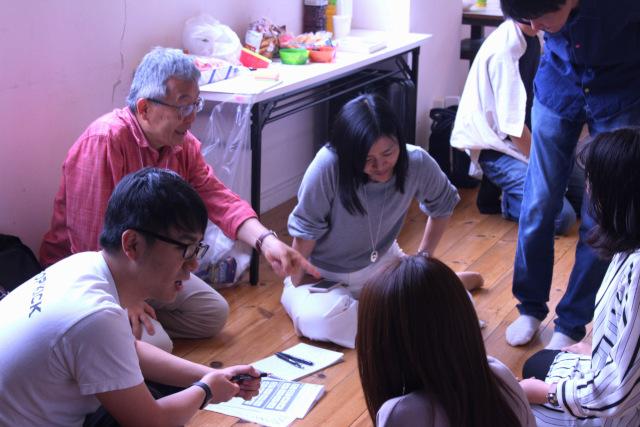
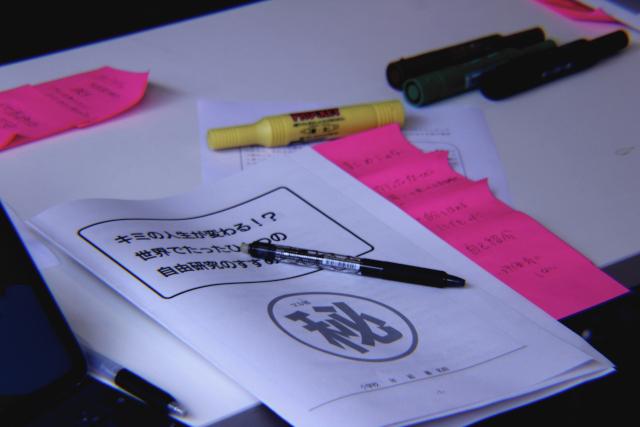
It guides the teachers to ask open-ended questions so students can locate “seeds of interest. For example: What do you wonder about? What did you find strange? How does that work? What have you thought was delicious?
In the Japanese context, this is something very new.
Rieko Akiyoshi, a fourth grade teacher in a Catholic school outside of Tokyo, has taken this course before. She says enrollment is up at her school since they shifted to this more active and engaged form of pedagogy. Parents think it will better prepare their children for a global economy. But they also push back. For example, the parents of Akiyoshi’s students learned 30 key figures in Japanese history by fifth grade. Although Rieko Akiyoshi’s students learned about historic figures like
Himiko and
Oda Nobunaga, they didn’t do a deep dive on
Tokugawa Yoshinobu, the 15th shogun. (A more minor figure, says Akiyoshi.) And parents, who learned plenty about Tokugawa Yoshinobu, were concerned that gap might hurt their kids’ chances to test into an elite high school or hurt their score on the ‘Center Test” which evaluates a student on their recall of knowledge accumulated from primary school right through high school.
“We tell parents that we want our children to learn more than history, we want them to learn from history,” says Rieko Akiyoshi.
Enrollment at a good public university, though, remains the narrow conveyor belt to a decent corporate job. And getting accepted at a good university does not depend on curiosity, creativity or understanding history but on tests which rely on memorizing historical facts, says fifth grade teacher public school teacher, Minote Shogo. And while the “Center Test” is changing and will change even more in five years, the speculation is that it won’t change that much. Japanese public education is built on tradition, says Minote Shogo, who teaches in Koganei near Tokyo. “I think a lot of teachers, too, think traditional is better. There is a set lesson and set ways for how you carry that out. The classroom is set up in a certain way. If I don’t follow the textbook, and give a test after 11 hours of math instruction, there is concern from parents and other teachers.”
For his part, Minote Shogo is convinced that teaching to spark curiosity and creativity is better for his students. “In the beginning, it was very difficult,” says Minote Shogo. “I would ask a question, and they would stop and couldn’t respond. But now they are getting accustomed to it. Gradually, they are speaking about their ideas. And I see that all this time, they have kept this inside, and now it is pouring out.”
NEXT UP: A showcase school and a visit with “The First Penguin” of education reform. (He jumps in the water and the others follow.) Then, a look at how traditional political figures and big business are rallying behind progressive education. And why.
Interested in what I’ve discovered so far?
You can take an active role in shaping this project. Please send me questions, observations, research, history and personal reflections about your own teaching and learning, thoughts about rote learning and your ideas about what makes an innovator. Tell me what you want to know from my reporting. Twitter: @pegtyre or email:
pegtyre1@gmail.comAlso, if you know of someone who might be interested in being part of this project, kindly send me their email and I’ll add them to the mailing list.
My trip is made possible by a generous Abe Fellowship for Journalists (administered by the
Social Science Research Council.) I retain full editorial control. I also appreciate the moral support of my colleagues at the
EGF Accelerator, an incubator for education-related nonprofits.


 Diane Ravitch's blog
I think the whole idea of “teaching creativity” frames the issue in the wrong way. What does that even mean?
I would say that you don’t so much “teach” creativity as inspire and cultivate it (much as you cultivate a garden)
Yong Zhau identifies talent shows in US schools as one of the important ways this is done.
LikeLiked by 1 person
You don’t teach creativity. You establish opportunities for it to grow and flourish.
LikeLike
Humans are naturally curious and creative.
As Einstein said (and I paraphrase), if you are lucky, your education does not destroy your curiosity and creativity.
LikeLike
You don’t teach creativity. You establish opportunities for it to grow and flourish.
That’s a great guiding principle.
Nota bene: Charter schools get a set amount of money from the state, every year, per student, and everything that they don’t spend on the students, they get to keep as profits or pay to their owners in salaries. So, they tend not to have theatres and well-stocked art rooms and media centers and media production facilities and so on. Yes, you can do theatre on a street corner, but you certainly can’t learn, there, how to do theatrical lighting or practice costume design.
LikeLike
Robert–correction:
“Nota bene: PRIVATE Charter schools. . . “
LikeLike
One can teach a lot of descriptive and procedural knowledge that can be employed creatively, and one can teach heuristics, or rules of thumb, for thinking creatively. Here, for example, is a list of rules of thumb for product innovation that I drew up for a workshop on this topic for one of my clients. Some heuristics for thinking creatively to create a “new” product:
Convergence. Combine features that were formerly separate.
Divergence via specialization or subtraction of features. Do one thing well and simply.
Meet an unmet need/fixing what’s really broken. Find what people hate or want and eliminate that or give it to them.
Borrowing. Steal an idea from a completely different area or thing–from a different field of human endeavor, for example, or from nature.
Make it cheaper. Same value, lower cost.
Fix what’s really broken. Ask the people who actually have to use the thing what they hate.
Create an alternative. Find a completely different way to deliver the same outcome.
Theme and variations. Create variants and choices.
Add a feature. (But avoid featuritis)
Change how people pay or who pays.
Change the delivery vehicle or channel.
Challenge a default assumption.
Leverage a new technology.
Crowd source.
The long tail. Sell fewer of more items; do micro-merchandising rather than mass merchandising.
Get closer to the customer. Modify the item in a way that establishes a more intimate relationship with the customer.
Social responsibility. Make the product or service in a way that makes a difference.
Evolutionary Method. Successive recombination with differential survival according to criteria.
Empowerment. Put the customer (audience) in control of something you formerly controlled.
Change the business model.
Do an exhaustive search of combinations of possible features
LikeLike
I would agree that you can teach stuff that makes creativity possible (teaching drawing, sculpture, painting, pottery throwing, etc) but I would draw a distinction between that and actual creativity.
There are lots of people who have all the skills down pat, but who are nonetheless quite uncreative.
Even a computer can produce copies of paintings that are all but indistinguishable from the originals. But they are not creative.
LikeLiked by 1 person
“but I would draw a distinction between that and actual creativity”
I agree, but as Pasteur said, “Chance favors only the prepared mind.” [le hasard ne favorise que les esprits préparés]
So, you need both. You need the instruction in materials and technique, you need the instruction in heuristics for creative thinking, and you need the time and space for mucking around in the possibilities. Guided, open-ended assignments that start with a heuristic and allow for infinite possibilities in response are great for this.
LikeLike
On the other hand, ” creativity” without the skills is of dubious worth.
I think that’s where the arts education comes in.
It gives people the tools to be creative.
LikeLiked by 1 person
Genuine Creativity
To build up something new
You have to have a floor
To genuinely do
What’s ne’er been done before
LikeLike
Bob…
There are plenty of creative musicians that didn’t study how to do it. Instead, their teachers allowed them express what they felt (because is ‘sounded good’ to them) and then offered encouragement.
My ‘Physics for Artists and Poets’ course was one of my favorite because I designed it (although I got the inspiration to do so from the Conceptual Physics guy… His first edition was great, and it only took a few years for textbook publishers to ruin his original concept) Also, the students understood that if they wanted to be an Engineer or ‘Scientist’, they were in the wrong class.
We tried to stay completely away from Mathematics because Science only uses math as a tool. Science is largely inductive (requiring creativity), whereas math is purely deductive (requiring adherence to a set of given rules). But, the best part about the course involved listening to the students. What wonderful and diverse ways they thought. I think I learned much more from them than they learned from me, but I hope they also learned something about themselves. Released from the obligation to come up with the ‘right answers’, they were free to not only interpret things in an often creative and valid manner, but they also turned their attention to a basic understanding of how the ‘creator’ of idea thought. I was forced to ‘give a grade’ and ‘evaluate the students’, but I hated that aspect. This became the core of my ‘Earth Science’ course long before the ‘Conceptual Physics’ guy came along, so that’s why he resonated so strongly with me.
I have Astronomy (and Physics) degrees, and one of my most inspiring teachers gave an introductory course that combined technical stuff with a bit of history. He encouraged us to read Arthur Koestler’s ‘The Sleepwalkers’ to get some insight into how science works. He said he wasn’t so sure that all of these people Koestler described were stumbling around in total darkness, but that Koestler was far more right than wrong.
That’s what we call ‘creativity’. The act of stumbling around in darkness and putting the pieces together in a new way that ‘works’ better, that allows us to predict and describe the impact of the stimulus our nervous system gets just a bit better. It’s really what most mammals do. It also describes historical ‘human development’ rather well. Our environment has made us, and shapes us, and we need to appreciate that truth.
LikeLiked by 1 person
Indeed there are. But those self-taught folks are rare, and there are severe limitations, usually, on what they can do. The case of musicians is very much to the point. Right now, there are more world-class classical and jazz pianists and guitarists in the world than at any other time in history, and that is due to one thing: the quality of musical instruction is so much, much higher than it was in the past. Bach had a terrible time finding anyone who could play his stuff. No shortage of folks, today, who can fire off one of the Goldberg Variations. Why? One word: instruction. That said, your Physics for Poets and Arts sounds really, really interesting. We could use a lot more of that kind of thing!
LikeLike
Interesting, Daedalus. I have a longer response, but it is in moderation.
LikeLike
My other comment is still in moderation. But one more thing, Daedalus. Most people think of the ability to draw as something one is either born with or not. But I can take almost anyone and teach him or her how to do simple line drawing in perspective using some simple techniques like the Durer grid, using perspective lines, drawing the negative space, and roughing in shapes. The learning ENABLES the creativity rather than stifling it. It sets people free.
LikeLike
There are always exceptions to the general rule that one needs training to get good enough at something to start pushing the envelope of what has been done before.
In the field of physics in particular, I think it is safe to say that it is highly unlikely that someone without formal training will make a major breakthrough, primarily because of consistency requirements. It’s not enough for an idea to be novel/creative, but it also must explain all the existing data AND if possible make testable, falsifiable predictions that can potentially show previously held theories to be incomplete (if not wrong) That’s a very high hurdle.
You are probably aware of this, but Stanford Physicist Leonard Susskind produced a lecture series and companion book called The Theoretical Minimum which lays out what he deems to be the necessary physics knowledge that one must possess in order to make significant contributions to the field.
https://theoreticalminimum.com/
No small potatoes.
LikeLike
I have this book, SomeDAM. It’s pretty demanding!!!
LikeLike
Let me put it this way, SomeDAM. I don’t thinking I’ll be making any fundamental contributions to quantum field theory any time soon. LMAO!
LikeLike
you inspire it, you cultivate it, and you UNLEASH it. With testing we do everything opposite of these words.
LikeLike
You expire it, you killtivate it and you leash it
Other than that, the two approaches have the same outcome.
LikeLike
Ciedie… You said what I replied to Bob, only you did so in almost a Haiku. Great comment.
LikeLiked by 1 person
It is ironic that what Japan values in American education is what “reformers” continue to beat back through incessant computer driven instruction and testing. The son of one of my good friends is an EFL teacher in Japan. He was describing how the Japanese are reluctant language learners because they are risk averse. They are not comfortable with “mistakes,” and their self image is tied into getting the right answer. He has to spend a great deal of time ensuring students they are in a safe place.
While some Americans may be risk averse, the majority of American students are comfortable with “shades of gray” in a response. Students that are taught to be divergent thinkers are far better prepared to address tomorrow’s problems. The world is far more complex than the binary world of computers. Right or wrong is not always the best response to complex problems like climate change, the economy or civil rights. We need divergent and creative thinkers, and we cannot afford to relegate those efforts to the children of the 1%. Do we really think #45’s progeny will build a better future for us? The next big ideas may come from the children of the working class or the poor if we invest in their education. If we treat students like Pavlov’s dogs, they will be a lot less likely to invent or discover the next big idea.
LikeLike
Testing and the Common [sic] Core [sic] have just about completely killed innovation in curricula and pedagogy in the English language arts. It’s created an approach to ELA instruction that is perfect for training drones to sit down, shut up, and do as they are told. Sickening. Enough of these!!!
LikeLike
Yong Zhau gave a talk in which he equated driving a water buffalo in the small Chinese village he grew up in with the Common Core.
Basically, the Common Chore.
LikeLike
The Common Core
Is Common Chore
It’s Common Lore
And Common Bore
It’s Common Spore
And Common Gore
And Common For
A Common Sore
LikeLike
There is a sense of the word “common” that fits perfectly:
mediocre, pedestrian, vulgar
LikeLike
I love watching Yong Zhau’s talks on YouTube, by the way.
He is absolutely hilarious.
Id love to see him in person some time.
LikeLike
Every Child is a Rudolph
Man, he is good.
LikeLike
yep. And it’s not only the message, but the technique. He first engages the audience. He chooses a common theme (Rudolph) and then expands. The guy is a master teacher.
LikeLike
In the above talk that Zhau have in Amsterdam, he talks about the boomerang generation who go to college and then move back home into their parents’ basement.
“My definition of a successful education is whether other people’s children get out of their basement… I know you don’t have basements , that’s not a problem..”
“You go to a restaurant and the more money you pay, the less food you get”
He has ha ha.
Cracks me up.
LikeLike
Project based instruction is not such an all or none way of teaching. It doesn’t mean asking students broad questions and asking them to come up with their own, more specific questions. We provide specific questions, direct instruction, and allow students multiple ways to answer the questions, different mediums. It’s not standardized. There are specific questions, but not specific answers. Life isn’t a multiple choice question.
LikeLike
For most of the people in the world, life is a “single choice question.”
Unless, that is, you consider dying a viable choice, in which case life actually is a multiple (2) choice question: 1) survive or 2) die
LikeLike
I should probably have said “for a significant fraction of the people in the world,”
LikeLike
Wow — thanks Diane, for reposting this. And thanks for all the great comments and insight. Feel free to email me if you want a copy of the newsletter.
LikeLike
An awesome piece, Ms. Tyre. Thank you!
LikeLike