Archives for the month of: April, 2019


I encourage you to sign up for The American Prospect’s near-daily missive. This one is right on target, written by Harold Meyerson. The commentaries by Harold Meyerson and Robert Kuttner are well-informed, incisive, and wise. Let the Democratic candidates slug it out on the field of ideas and policies, not by this kind of ad hominem attack..


APRIL 17, 2019

Meyerson on TAP

How Think Progress Would Have Attacked Franklin Roosevelt. The past few days’ kerfuffle over the attacks that Think Progress has leveled against Bernie Sanders raises a question for the historically minded: How viciously would it have lashed out against Franklin Roosevelt for his presumed hypocrisy in attacking the reactionary rich more directly and vehemently than Sanders ever has?


Think Progress, which is the news and commentary website operating under the aegis and with the funding of the Democratic Party–aligned think tank Center for American Progress, accused Sanders last week of just such hypocrisy for his repeated attacks on the rich, even as he had a yearly income in excess of $1 million from the sale of his books. As one article on the Think Progress website put it:


It’s all very off-brand and embarrassing, but Sen. Bernie Sanders is a millionaire. Turns out railing against “millionaires and billionaires” can be quite the lucrative enterprise.


Sanders, who released his last ten years of tax returns on Monday, acknowledged that the proceeds from his book sales brought him over the millionaire threshold, and chastised Think Progress—and CAP, headed by longtime Hillary Clinton adviser Neera Tanden—for running this sort of ad hominem attack, not just on him but on other progressive Democrats as well.


Think Progress is hardly the first institution or individual to label liberals and leftists of some means as inauthentic or hypocritical for their own attacks on concentrated wealth. The Democratic leader subjected to the greatest number and most vicious of such attacks was Franklin Roosevelt, the heir to an old New York fortune who raised taxes on the wealthy, legalized collective bargaining, and levied attacks on the rich far more coruscating than anything Sanders has ever said. In his nationally broadcast Madison Square Garden speech on the eve of the 1936 election, when he was seeking his second term as president, FDR identified his “unscrupulous enemies” as


business and financial monopoly, speculation, reckless banking, class antagonism, sectionalism, war profiteering. They had begun to consider the Government of the United States as a mere appendage to their own affairs. We know now that Government by organized money is just as dangerous as Government by organized mob. Never before in all our history have these forces been so united against one candidate as they stand today. They are unanimous in their hate for me—and I welcome their hatred.


I should like to have it said of my first Administration that in it the forces of selfishness and lust for power met their match. I should like to have it said of my second Administration that in it these forces met their master.


Whew! Next to that, Sanders sounds like Mr. Rogers.


FDR’s invective against the “forces of selfishness,” and the policies he enacted to combat those forces and create a larger, more confident middle class, prompted conservatives to contrast his anti-plutocratic politics with his personal wealth and accuse him of hypocrisy, insincerity, and double standards. Where did a rich guy come off criticizing other rich guys—or at least, other rich guys who wanted to keep prosperity from trickling down to the hoi polloi? What a sham! What chutzpah!


Not that Sanders has anything remotely resembling a fortune, much less an FDR-type fortune, but this is precisely the same attack that Think Progress belched forth last week against Bernie.

A lot of good, smart progressives work at Think Progress and CAP. They don’t work there because they like this kind of horseshit; they don’t work there because they want to produce memes for the likes of Fox News. That’s not CAP’s mission, either—at least, it shouldn’t be. ~ HAROLD MEYERSON


St. Louis once again has an elected board after 12 years of state control. It’s hard to know what factors led to the district’s improvement but one factor stands out: the same superintendent Dr.Kelvin Adams has been in charge since 2008. The implicit message appears to be about the value of continuity and stability, which are anathema to Disrupters.

The following commentary was posted by St. Louis Schools Watch, a civic advocacy group:

 St. Louis Schools Watch

Susan Turk,
Editor and Reporter

Congratulations Are In Order!

April 16, 2019—St. Louis–This morning the Missouri State Board of Education voted unanimously to approve termination of the transitional school district superimposed on the St. Louis Public School District at the end of its current term, June 30, 2019.  As a result, on July 1, 2019, the elected St. Louis Board of Education will return to governance of the St. Louis Public Schools after twelve long years.

Commissioner of Education Margie Vandeven recommended the termination of the transitional district because the Special Administrative Board which has governed the SLPS for the duration has accomplished the purposes for which it was established.  Vandeven spoke about four concerns which motivated the State Board to revoke accreditation and institute the transitional district in 2007.  The four concerns were financial status, accreditation history, student performance and leadership instability.

Vandeven reported that while the SLPS had a $24.5 million deficit representing a negative fund balance of 5.79% in 2007, SLPS now has reserves of $78.6 million or a positive fund balance of 22.24%.  Having less than 3% reserves puts a district in financial stress and allows the State Board to dissolve a school district. Their Annual Performance Reports and accreditation status has improved and stabilized and leadership has been stable.  Improvement was noted in the dropout rate, 13.9% in 2007-8 to 8.2% in 2017-18 and the graduation rate, 55.9% in 2007-8 versus 78.2% in 2017-18, among other factors.

Prior to 2007 there had been no less than 6 superintendents in the preceding 5 years as compared to Dr.Kelvin Adams serving as superintendent since November 2008.

The elected board was credited with having undergone 50 hours of extensive training in preparation for regaining governance. State Board Vice President Victor Lenz declared them ready to resume governance. Commissioner Vandeven reminded the State Board that they had two statutory options, either continuing the transitional district and the SAB or returning the elected board to governance, There is no statutory allowance for a hybrid board of both elected and appointed members. At least one state board member, Peter Herschend, had spoken of a preference for a hybrid board option previously.

State Board President Charlie Shields asked State Board VP Victor Lenz to make the motion to terminate the transitional district and return governance to the elected board effective July 1, 2019. Shields then  asked Board Member Mike Jones to second the motion.   After they did so, Shields asked, Jones, Lenz and Board Member Peter Herschend to offer remarks, which they did.

Mike Jones, who never lacks for eloquence, heaped praise on the SAB. He spoke about how hard it is to govern. He said there should be special recognition for their success. That theirs was a story about how to do things the right way, which should be documented.  Jones also addressed the elected board members present, Dorothy Rohde Collins, Susan Jones, Donna Jones, Dr. Joyce Roberts and Natalie Vowell, telling them that they did not represent the community but the 22,000 children in the school district who can’t represent themselves. He implored them to listen to the advice and concerns of the adults in the community but not to take orders from them, to make up their own minds about what is best for the children and trust their own judgment. He said that the hardest part of leadership was making the least worst choice sometimes. He also told them to figure out how to do what the SAB did. He ended with a riff on becoming a team and trusting one another.

Dr. Lenz also praised the SAB, and spoke about the need to trust each other and the superintendent. He acknowledged that the 12 year length of the SAB’s governance was unusual and advised them to learn the difference from people who were giving good advice versus giving them orders.

Herschend revived the old meme of the 5 superintendents who served during a 2 year period. He criticized that Board as a board that was trying to operate as opposed to make policy. He claimed that was the difference between failure and success, told them their most important job was the selection, maintenance and evaluation of the district’s leadership. “If you do that well, the district will succeed,” he said.  “If you fail, it will revert to where it was.” He implored them to care about the kids and ended by saying they were being handed an opportunity to create a flagship district that others in the country would look up to as an example.

Shields added that in Missouri we believe in local control which is why we have state standards but not a state curriculum. So there is a commitment to elected governance. He said governance by an appointed board was always meant to be temporary. He told them he had never seen a process where people were better prepared for the challenge and said he expected them to do a fabulous job. A voice vote on the motion was then taken and all said, “Aye”.

It was anticlimactic. It was surreal.  I should have been happy.  But the bovine excrement being served up spoiled the moment.

First, the data they were using to explain their reasons for taking over the district came from the 2007-2008 school year. That was the end of the first year the SAB governed the district. It is difficult to cull data from 12 years ago on dese,mo.gov.  Software incompatibility prevented this reporter from accessing the data but memory reminds that achievement data was lower after the SAB’s first year than it had been under the last year of the elected board’s governance. Perhaps that is why it was tempting to use as an illustration. Then again, superintendent at the time, Dr. Diana Bourisaw was insistent that SLPS data supported the district keeping its accreditation.  Perhaps using the 2006-2007 data as compared to the lower 2007-2008 data would have been embarrassing.

Second, although Commissioner Vandeven expressed concern that student achievement did not show improvement, that was barely touched upon.  In truth, the ELA proficient and advanced score of 22.8% and math proficient and advanced score of 18.4% from 2017-18 can be brushed aside as inconsequential because of the annually changing tests over the past 4 years. But, during the tenure of the elected board and even some years during the SAB’s governance, achievement on the MAP has been as high as 35% on ELA and 28% in math. Academic achievement has suffered under the SAB. But this may be a blessing in disguise for the elected board. Achievement scores can only rise from where they currently are.

And third, it was difficult to sit through praise of the SAB’s success and criticism of the elected board when Darnetta Clinkscale sits on the SAB. She was president of the elected board during the period of time that the district ran through those 5 superintendents. How could one board be excoriated and the other upheld as the epitome of boards when she participated in both? Cognitive dissonance ran rampant.  But it has been this way through this entire 12 year period. The SAB has been the good board and the elected board has been the bad board and damn any evidence to the contrary.

It is good that the elected board is returning to governance.  But 12 years have been lost. That’s an entire generation of students.  Back in 2003, when a multiracial group of parents from the Parent Assembly coalesced around the idea that electing parents to the Board Of Education could have a positive impact on student achievement, they could not conceive that our civic leaders would react to their electoral success by advocating that the governor implement a state takeover of the SLPS. Twelve years later, with achievement scores dismal, we will finally get to see whether a board informed by parents can make a difference.
_________________________________________________________________________

The editor encourages readers to forward The Watch to anyone you think would be interested. Our city and our schools need as much public awareness and public engagement as we can muster at this time.
……………………………………………………………………………………………………………………
Questions for The Watch? Letters to the Editor? Stories to contribute? News tips? Send them to SLS_Watch@yahoo.com
………………………………………………………………………………………………

Calendar

April 18 2019, Thursday, monthly meeting of the Special Administrative Board, 6:00 p.m., 801 N. 11th Street, room 108

April 23, 2019 Tuesday, 6:30 p.m., meeting of the Board of Education, 801. North 11th St. room 108, St. Louis, MO 63103.

………………………………………………………………………………………………………………………………
Please Subscribe to the SLS Watch.

If you have never subscribed because friends have forwarded The Watch to you, please consider subscribing now. Internet newsletter mailing and management services are not free. The Watch has always concentrated its efforts on getting you the news and analysis of the SLPS that you value rather than on keeping itself in the black. But in order to pay our bills, we do need your subscription. For a dollar a month, you will get news, opinion, and analysis that you won’t see elsewhere in the media. Please write a check today.
Subscribe to the St. Louis Schools Watch.

Name:____________________________________________
Street No.:________________________________________
City:_____________________________________________
State/Zip:________________________________________
Telephone:_______________________________________
Email:___________________________________________
I am enclosing:_____$12 for a 1-year subscription (make checks payable to Commonsense Publishing, and mail to P.O. Box 1983, St. Louis, MO 63118.)

……………………………………………………………………………………………
The St. Louis Schools Watch was founded on the premises that parental and community involvement is needed for good schools to flourish, and that public participation is a cornerstone of democracy. St. Louis Schools Watch offers information and analysis that we hope contributes to a public debate over what changes are necessary to improve St. Louis public schools and what works.

Our mailing address is:
Common Sense Publishing
P.O. Box 1983
St L

Copyright © 2019 Common Sense Publishing, All rights reserved.
You are receiving this email because you are a subscriber/reader of the St. Louis Schools Watch

Our mailing address is:

Common Sense Publishing

The battle has begun about whether to lift the cap on charter schools in New York City.

New York City has 235 charter schools serving 123,000 students (about 10% of those enrolled in public schools) and there are no empty slots for additional charters unless the legislature raises the cap.  Governor Cuomo, flush with hedge fund cash from his last campaign, wants to raise the charter cap.

Now billionaire Merryl Tisch, who previously was Chancellor of the New York Board of Regents and is now on the board of the State University  of New York, proposed that the city be allowed to use some of the 99 open charter slots from the rest of the state. 

Under Tisch’s leadership at the Regents, New York won a Race to the Top grant of $700 million, hired John King as State Commissioner, committed to evaluate teachers by the test scores of their students, and adopted the Common Core and PARCC Testing. Tisch set off the Opt Out Movement, and she also hired MaryEllen Elia from Hillsborough County in Florida, which was part of the Gates Foundation’s failed experiment with VAM (value-added measurement) of teachers.

We are told that the waiting list for admission to charters in NYC is very, very long.

So think about this:

If there is a long waiting list, as Merryl Tisch says, why do charters hire a marketing firm to send recruiting letters to children in public schools? Why are they moaning about not having access to the public school names and addresses? Why don’t they just accept kids from the waiting list? Is there a waiting list? Maybe there are actually vacancies, as in Los Angeles, where 80% of the charters have empty seats. Even Eva Moskowitz needs access to public school names for recruitment purposes.

Would someone please audit that alleged waiting list?


No matter how many scandals and frauds are exposed in the charter industry, the federal money keeps rolling in.

Open this link to see which of your favorite charter chains (the Walmarts of education) won millions from their friend Betsy DeVos.

Eva got $9.8 million from her friend Betsy.

KIPP will secure a total of $86 million over five years for its San Francisco operations.

IDEA in Texas scores $116 million over five years!

Despite the report from the Network for Public Education showing that 1/3 of the grants by the federal Charter Schools Program are awarded to schools that never open or that close soon after opening, the money keeps flowing.

No matter how many reports of charter fraud, waste, and malfeasance, the federal dollars keep flowing.

Lynn Davenport is a parent activist in Texas. She wrote the following post to alert her fellow Texans about the invasion of Kitamba Consultants, who bring with them the so-called “portfolio model” of privatization.


She writes:

The LA teacher strike thwarted a concealed plot to use Kitamba consultants to reinvent LAUSD with a portfolio model of privatization. Kitamba has a contract with TEA right now for these districts, including RISD:

tea1

I just got a 228 page public information request from the Texas Education Agency and Region 13 service center in Austin for their MOU with Kitamba.

Texas is spending big bucks on the same Kitamba consultants exposed in the LAUSD strikes against philanthropist/private equity reformer and Supt Austin Beutner:

https://www.chalkbeat.org/posts/us/2019/04/09/los-angeles-consultants-recommendations-reimagine-kitamba-consultants/
“Created by the consulting firm Kitamba, the documents lay out an aggressive timeline for assigning schools to 32 support networks, giving principals more power, and cutting the central office by fall 2019.

The January strike appears to have derailed the plans. A spokesperson for Los Angeles Unified declined to comment.

During the January strike, United Teachers of Los Angeles criticized what it described as the district’s portfolio plan and its partnership with Kitamba. (A spokesperson at the time said Los Angeles Unified is not pursuing a portfolio approach.) Kitamba won a $765,000 contract for its work, paid by a slate of outside donors, including the Eli and Edythe Broad Foundation.

Details of Kitamba’s contract and scope of work were reported in February by the Los Angeles Times after school board member Scott Schmerelson criticized Beutner for not disclosing contracts with consultants, including Kitamba, or the work they had done for the district.”

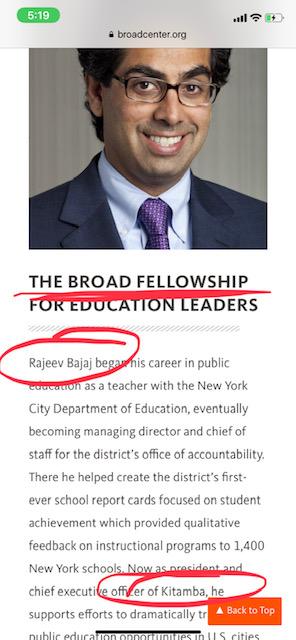
Rajeev Bajaj is a Broadie:

tea2

I researched all of this during my System of Great Schools LinkedIn article in December, I just didn’t see the magnitude of the Kitamba contract at the time:

tea3

Please read my SGS Takeover article again:
https://www.linkedin.com/pulse/privatization-system-great-schools-takeover-lynn-davenport

tea4

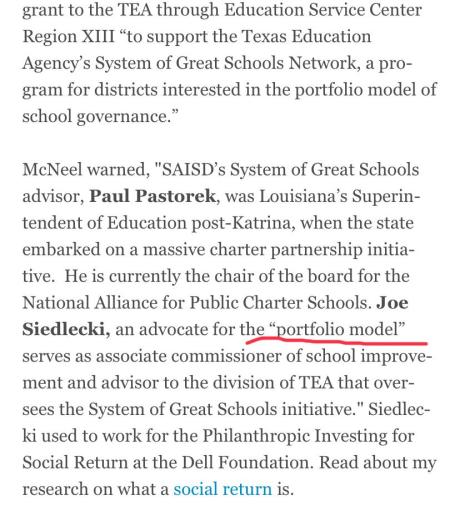
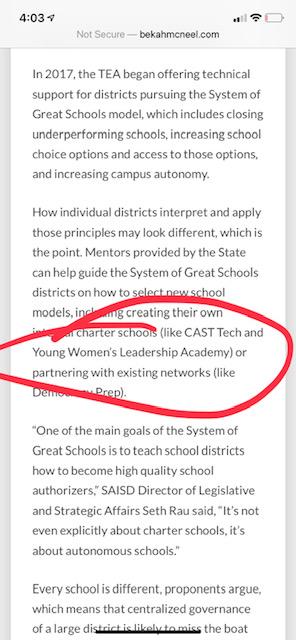
Blogger Bekah McNeel found that, “In 2017 the Laura and John Arnold Foundation gave a two-year $85,000 grant to the TEA through Education Service Center Region XIII “to support the Texas Education Agency’s System of Great Schools Network, a program for districts interested in the portfolio model of school governance.”
http://bekahmcneel.com/in-becoming-a-system-of-great-schools-saisd-is-fighting-for-its-life/

Interesting that Dallas mayoral candidate Lynn McBee’s org was mentioned:

tea5


We need to stop this with the help of Texas AFT, parents, and trustees who see the harm of the portfolio model. We also need to loop in the California union to get their advice. I would like to hire Brett Shipp Media to help expose this. If we don’t stop it, our neighborhood schools, teachers, and elected boards will be eliminated in favor of a charter-like model of “autonomy”.


John Thompson, who recently retired as a teacher in Oklahoma, here reviews Andrea Gabor’s fine book, After the Education Wars. His review appears in two parts. He is interested in Gabor’s critique of why “reform” failed and where we go next.
He writes:
We are near the end of the 21st century’s second decade, and some fervent corporate school reformers finally seem to be understanding that their experiment turned an unconscionable percentage of schools into sped-up versions of a Model T assembly line. We need a new era of humane, holistic school improvement. A first step is reading and discussing Andrea Gabor’s After the Education Wars.  Now that corporate reform failed, Gabor explains, we must learn the lessons of history and “recover the road not taken.”

https://www.kirkusreviews.com/book-reviews/andrea-gabor/after-the-education-wars/

The progressive reformers who preceded the corporate reformers of the last generation operated in a manner that was consistent with the “continuous improvement” philosophy of Edwards Deming. As Gabor and Deming explain about schools and other sectors, “Variation is as ubiquitous as air and water.” Deming said, “Only the employees closest to a given process can identify the variation that invariably diminishes quality.” That is why it was necessary to shake up the systemic hierarchy and “drive fear out of the workplace and foster intrinsic motivation.”

Gabor acknowledges the inherent flaws of the pre-reform education administrative sector. Her deepest dive into that “status quo” was her account of how progressive New York City educators, like Deborah Meier, carved out the holistic and inclusive road which reformers refused to take. Meier et.al battled the district’s “compliance managers.” Their methods embodied “creative noncompliance.” Then, Meier and her era’s reformers personified a value system consistent with Deming’s call for “a participative, collaborative, deeply democratic approach to continuous improvement.”

Meier and other progressive education reformers in New York, Massachusetts, and Leander, Tx, respected the essential role of trusting relationships. They needed educators to unite for a team effort, but they also understood the folly of trying to mandate unanimity. It would have been easier to order all teachers to obey the normative dictum which was embraced by the corporate reformers, and be “on the same page.” But they knew that the alternative to open collaboration would be “resistance, secrecy and sabotage.” If Meier and other school leaders emulated the management model of New York City and other large districts, and mandated teacher compliance, “‘the braver and more conscientious [would] cheat the most, but even the most timid can’t practice well what they don’t believe in.’”

Venture philanthropists like Bill Gates and Mike Bloomberg initially shared some of the values which motivated progressive reformers. Both groups initiated small schools in order to offer more personalized services, and the corporate reformers first seemed to not be bewildered by the key component of continuous improvement – building trust. In a sharp contrast to the reckless pace of change that would soon be imposed on public education, the Gates Foundation visited Meier’s Julia Richmond High School for a year before starting its small school campaign. I was shocked to learn that Gates’ Tom Vander Ark invested so much time in visiting schools. But, as Gabor discovered, “The Gates man was smitten with Julia Richmond, but he didn’t see what was actually happening there.”

A progressive principal told Vander Ark about 25 times that “small is a necessary, but not sufficient.” But, he was apparently so obsessed with “scaling up” reforms that the need for collaboration was subordinated to a focus on “design attributes” that could drive nationwide transformation. Vander Ark was more impressed with the “design coherence” of Success Academy than the Julia Richmond culture of trust. Because of their commitment to rapid transformations, Gates, Bloomberg, and other corporate reformers rejected the essence of Meier’s approach and pushed its “antithesis,” which resulted in the “no-excuses charter movement’s focus on behavioral conformity and control.”

Another factor was the Billionaires Boys Club’s hubris. The reformers “distrust of education culture” was combined with “suspicion – even their hatred – of organized labor and their contempt for ordinary public school teachers.” They displayed “the arrogance that elevated polished, but often mediocre (or worse), technocrats over scruffy but knowledgeable educators.” Eventually, Gabor wrote, “to be an educator in Bloomberg’s New York was a little like being a Trotskyite in Bolshevik Russia – never fully trusted and ultimately sidelined, if not doomed.”

It wasn’t just in New York City where the opportunity to learn from veteran, progressive reformers was lost. Across the nation, the accountability-driven, competition-driven reformers’ well-funded public relations campaigns “turned teacher-bashing into a blood sport.” They then sought to “teacher proof” the classroom. Consequently, canned curriculum and mind-numbing lessons drove much of the joy of teaching and learning out of the nation’s schools.

New York City’s lost opportunity morphed into a national tragedy as technocrats continued to worship data but not recognize that the most important educational factors are immeasurable. Their “Taylorism” was combined with a failure to recognize the dangers of “Schumpeterian” disruption on children. And the more that educators resisted reward and punish policies, the more reformers sought better hammers to force compliance. After tougher principal evaluations did not produce enough obedience, value added teacher evaluations sought to hold every single educator accountable for meeting their quantitative goals. Then, reformers overreached by simultaneously imposing Common Core high stakes tests and accountability metrics that were theoretically but not actually aligned with each other.

I entered the classroom as a 39-year-old rookie, but one who had a decade of experience in the inner city. Nearly 1/5th of my first years’ students would listen, learn, and yet refuse to do a single assignment. They didn’t disrupt our lessons as they often did the classes dominated by worksheet-driven instruction. Clearly, part of their noncompliance was a political statement, and they were glad to say why they resisted and why they would soon drop out of school. The common narrative was that they had been robbed of an education when growing up in our district’s teach-to-the-test era in the wake of “A Nation at Risk.” And they bitterly protested that the worst of the drill and kill was imposed on inner city schools.

This was the early 1990s and a new era of test-driven reform was being organized. During our discussions, I said that if reformers would read Catch 22, they would know that compliance couldn’t be forced, and that the system would respond with destructive games to make the accountability metrics come out right. One of my brightest students, who learned every day but who was so fed up with drill and kill that he would have nothing but zeros in every class when he dropped out, offered a better metaphor. During the famous scene in the comedy, I Love Lucy, Lucy fell behind when boxing chocolates on an assembly line. Teachers and students responded to test-driven reform in the same way, tossing out and even eating the product.

Back then, there was a common phrase which Oklahoma progressives repeated, “Feed the Teachers or They Will Eat the Kids,” which anticipates a second post on Gabor’s account of progressive reformers trying to change that reality in NYC, Massachusetts, and Leandor, Tx, as corporate reformers recreated Lucy’s sped-up assembly lines in NYC, New Orleans, and many or most urban schools. It will also review her proposals for a new era that needs to come After the Education Wars.”

Tune in tomorrow, same time, same place, to read the concluding section of Thompson’s review.

A judge in Berks County, Pennsylvania, ruled that a charter school’s property was not tax-exempt, prompted by some unusual financial arrangements. 

Judge Madelyn S. Fudeman upheld a ruling by the Berks County Board of Assessment Appeals denying I-LEAD Inc. an exemption from property taxes.

The building at 401 Penn St., which houses the I-LEAD Charter School, is assessed at $9.7 million, according to Berks County property records.

The property was placed on Berks County’s September upset tax sale for four years of unpaid property taxes totaling $2.8 million; the unpaid years spanned 2014-17.

The property’s owner, I-LEAD Inc., Philadelphia, was ordered to pay a bond of $500,000 to be removed from the tax sale list, which it did in December…

In her ruling, Fudeman takes I-LEAD Inc. to task, saying it appears to be more of a for-profit operation.

She said the testimony of [CEO David ] Castro and Angel Figueroa, the charter school’s CEO and chief operating officer, “fell far short of establishing” the charter school operates at a loss.

In her ruling, Fudeman noted a revenue-sharing agreement between I-LEAD Charter School and Harcum College.

Harcum is a two-year college offering associate degree that operates from the same building as the charter school.

For every student that I-LEAD referred to Harcum College, I-LEAD would receive 40 percent of tuition and fees received by Harcum, the ruling states.

I-LEAD received more that $8.6 million from Harcum from July 2014 to June 2017…

Castro was paid over $195,000 for the most recent year and Figueroa was paid over $240,000 for the most recent year, court documents showed.

“The salaries paid to Mr. Castro and Mr. Figueroa appears more in line with a profit making institution than a truly charitable organization,” Fudeman said in the ruling.


Peter Greene writes here about an exceptionally silly “study” that Betsy DeVos is using to drum up fading public support for charter schools.

The study, by choice advocates Patrick  Wolf and Corey DeAngelis, attempts to measure “success” by return on investment, converting taxpayer dollars into NAEP scores.

Sounds crazy, no?

Greene writes:

This particular paper comes out of something called the School Choice Demonstration Project, which studies the effects of school choice.

A Good Investment: The Updated Productivity of Public Charter Schools in Eight U.S. Cities pretends to measure school productivity, focusing on eight cities- Houston, San Antonio, New York City, Washington DC, Atlanta, Indianapolis, Boston, and Denver. In fact, the paper actually uses the corporate term ROI– return on investment.

We could dig down to the details here, look at details of methodology, break down the eight cities, examine the grade levels represented, consider their use of Investopedia for a definition of ROI. But that’s not really necessary, because they use two methods for computing ROI– one is rather ridiculous, and the other is exceptionally ridiculous.

The one thing you can say for this method of computing ROI is that it’s simple. Here’s the formula, plucked directly from their paper so that you won’t think I’m making up crazy shit:

Cost Effectiveness=Achievement Scores divided by Per-Pupil Revenue.

The achievement scores here are the results from the NAEP reading and math, and I suppose we could say that’s better than the PARCC or state-bought Big Standardized Test, but it really doesn’t matter because the whole idea is nuts.

It assumes that the only return we should look for on an investment in schools is an NAEP score. Is that a good assumption? When someone says, “I want my education tax dollars to be well spent,” do we understand them to mean that they want to see high standardized test scores– and nothing else?? Bot even a measure of students improving on that test. The paper literally breaks this down into NAEP points per $1,000. Is that the whole point of a school?

It gets worse, and Greene explains why.

I am reminded of a fad in the 1920s to compute the dollar value of different subjects. The curriculum experts of the day calculated that teaching Latin was a total waste of time because it was expensive and produced no return on investment.

The whole thing called “education” got left out of the calculus.


As I reported earlier, I had a long conversation about education policy with top staff in the Bernie Sanders campaign. Among other things, I explained that charters are a first step on the privatization path that leads to vouchers and that charters cause deep cuts to public schools. I emphasized that charter schools are privately managed and areNOT public schools.

I could not have been clearer in warning that charters that get high scores “succeed” by screening out the kids they don’t want.

So Bernie’s campaign issued a statement on public schools this morning. The big message: Reinvest in public schools.

But this is point one:

  • We must make sure that charter schools are truly serving the needs of disadvantaged children.

This ignores the fact that charter schools are not public schools. They are privately managed. They are free to choose their students and free to expel those they don’t want.

This ignores the fact that the NAACP called for a charter moratorium. The ACLU of Southern California criticized charters for discriminating against and excluding students with disabilities and ELLS.  The Southern Poverty Law Center filed suit against charters in Mississippi for seeking to divert public funds from public schools, contrary to the state constitution.

How can the federal government “make sure” that charters are meeting the needs of disadvantaged students when they are free to exclude them and when charter lobbyists write the state laws?

Can Bernie learn?


A teacher at a BASIS charter school shamed a black student by teaching a lesson about the civil rights movement by inviting the class to isolate him.

BASIS is known for its high test scores and its exclusionary practices.

“A Phoenix mother says her 9-year-old son was forced to walk through his class as his teacher and fellow students yelled at, humiliated and berated him during a lesson on school segregation.

“Claudia Rodriguez posted on Facebook that a third-grade teacher at BASIS Phoenix Central singled out her son, who is black, as the class was learning about the civil-rights movement.

“The Head of School had the nerve to tell me that there was some educational value in this incident because it started conversations in the homes of the other kids,” Rodriguez wrote. “I felt the need to speak up so that no other child ever has to feel what my son felt.””