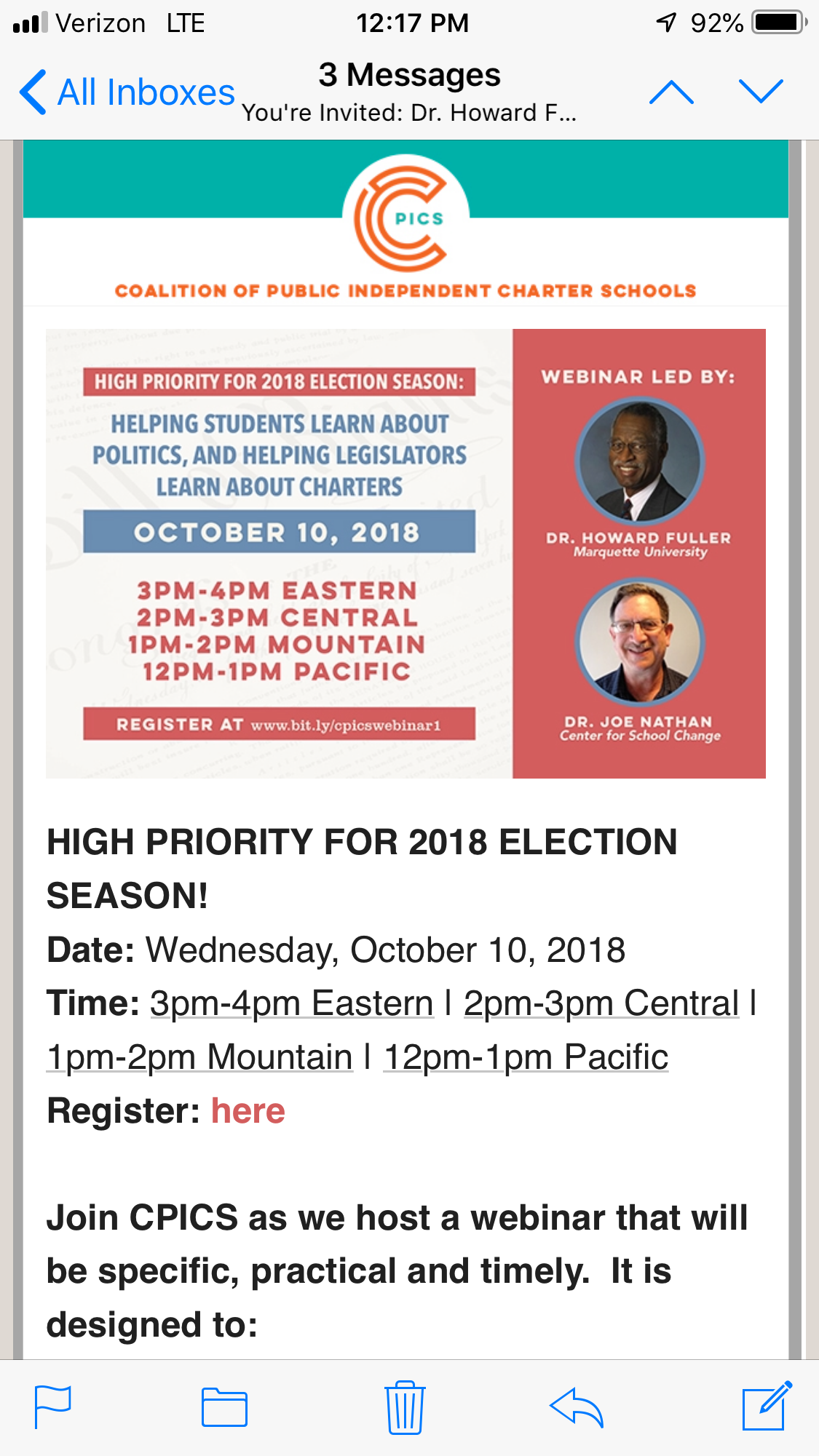
There is still time for you to tune in at 3 pm EST to hear Joe Nathan and Howard Fuller discuss political strategy to promote charter schools and privatization.
Nathan is a week-known Charter advocate.
Fuller is a well-known voucher advocate. His defunct organization, Black Alliance for Educational Options, received millions of dollars annually from pro-voucher, pro-charter groups. In its last year, it had revenues of $8.5 million. Fuller relied on the Rightwing Bradley Foundation to launch him into national activism for vouchers and privatization. Read Mercedes Schneider on BAEO, it’s association with Betsy DeVos’s AMERICAN Federation for Children, and its persistent efforts to privatize public schools.
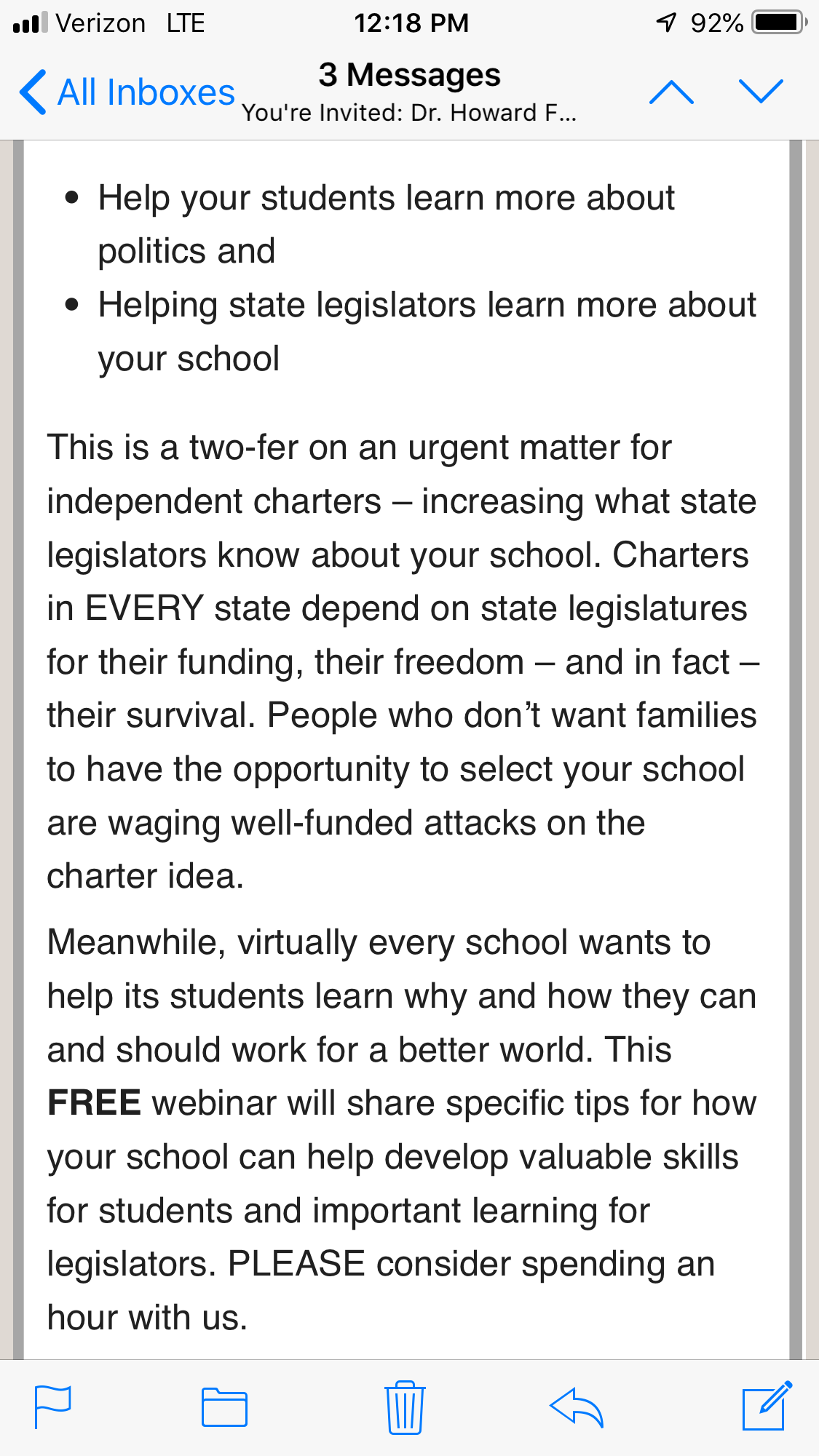
Nathan and Fuller will share their concern about the “well-funded” efforts to stop charter schools and privatization.
I hope they will let listeners know where to find the funding to stop privatization. I’d like to raise some money for the Network for Public Education, which is not “well funded.”
Do you think they will mention the hundreds of millions of dollars spent every year by the Waltons, Eli Broad, Bill Gates, John Arnold, the Koch brothers, the DeVos family, Reed Hastings, Michael Bloomberg, Paul Singer, Dan Loeb, and other billionaires, as well as the U.S. Department of Education, to fund charter schools?
If ever there was a well-funded industry, it is the charter industry.
If ever there was an underfunded opposition, it is those who fight to protect their public schools against the charter vultures.

 Diane Ravitch's blog
The RICH can fund … two tiered system we have … the haves and the have nots.
Charters are about Jim Crow.
LikeLike
Re “Jim Crow. ” This would come as a surprise to Rosa Parks, who spent part of the last decade of her life trying to help create charters in Detroit.
Actually, charters, like district schools, vary widely in who they serve. Some are rural, some urban, some suburban.
LikeLike
Not at all disingenuous, of course, to leave out the fact that charters in those days were still seen as progressive ways to offer private school-type opportunities for poor and minority students. Rosa Parks would most definitely be rolling in her grave if she knew that charters have become vehicles for putting public money into private hands to re-segregate schools.
LikeLike
Dienne, the groups k-12 education groups I mentioned that oppose chartering today are the same groups that opposed them 25 years ago.
President Obama and President Clinton both advocated strongly for district & chartered public schools.
And, as the independent charter coalition demonstrates, there are many progressive educators throughout the country who continue to support chartering.
Here’s a statement of that group’s principles:
https://www.indiecharters.org/principles
Why do you suppose these progressive educators support chartering, along with progressive district public schools?
LikeLike
Who are the “well-funded” groups that are attacking charter schools? Are they as well funded as the Waltons, Michael Bloomberg, Bill Gates, Eli Broad, John Arnold, Michael Dell, Philip Anschutz, Betsy DeVos, the Koch brothers, and your other supporters?
LikeLike
It certainly came as a surprise to me that the idea of creating district schools run by teachers and parents instead of principals – an idea that the president of the AFT had a big hand in imagining – had been co-opted and mangled by wealthy entrepreneurs, turning charters into private schools run by privately selected boards and privately selected principals instead of by teachers and parents. I haven’t forgiven the Clintons and Kennedys yet for encouraging that, and I probably never will. Today’s charters exist within a disenfranchising, plantation ideology – masters and servants. They foster the growth of segregation and underfunding of public schools. MLK and Rosa Parks would indeed be rolling in their graves if they knew the dream of equality had been forsaken for profit. This is in fact Jim Crow 2.0.
LikeLike
You’re not seriously calling Obama and Clinton progressives, are you, Joe?
LikeLike
Joe’s organization is funded by:
Annenberg, Bigelow, Blandin, Best Buy, Bradley, Otto Bremer, Cargill, Carlson, Frey, Bill and Melinda Gates, General Mills, Joyce, Minneapolis, Peters, Pohlad, St. Paul, St. Paul Companies, TCF, Travelers, Rockefeller, Wallin, and Walton Foundations, the Carnegie Corporation, the University of Minnesota, the Minnesota Initiative Funds, and the Minnesota and U.S. Departments of Education.
Of course, he is not paid to write comments here, but he is paid to advocate on behalf of charter schools.
LikeLike
“He is paid to advocate for charter public schools.” Factually incorrect, Diane.
LikeLike
If Walton and Bradley are not paying you to advocate for charter schools, what are they paying you for?
Both are virulently anti-Union.
Bradley is pro-voucher. What does Bradley pay you for?
Neither has an ounce of progressivism. They are pro-Trump organizations that collaborate with DeVos, like Howard Fuller.
LikeLike
Years ago, Walton helped pay for an evaluation of a leadership program that brought together district & charter leaders to learn from each other, and exciting district & charters.
The study helped us understand what participants and their supervisors thought was going well, and what needed to be improved.
Bradley paid for a survey we did with ECS (Education Commission of the States, in 1995. We surveyed 170 charters in 8 states, asking them questions like how many students do you have, what’s the racial composition, how much do you have to start up the school, what’s the academic focus of the school, ,etc.
Click to access Charter-Schools-What-are-they-up-to.pdf
LikeLike
Your website lists Walton and Bradley as current funders of your work.
How much did they give you and for what purpose? What are they funding now?
LikeLike
Don’t remember exact amounts. I explained in previous posts what the money was used for. Neither Bradley nor Walton has funded our work for many years.
LikeLike
Both Bradley and Walton are listed on your website. Not funders to be proud of. Rabid rightwing zealots.
LikeLike
Feedback we received from leadership academy participants was helpful in refining the program. Feedback we received from educators, state legislators and governors indicated that the material gathered in 1995 was helpful.
I disagree with many positions held by Bradley and Walton. They know it.
LikeLike
Which positions of Bradley and Walton do you agree on?
They hate unions.
They hate public schools.
Hitler built the autobahn. Mao built hospitals.
Why did the two most rabid anti-public school foundations give you money?
LikeLike
Diane you’ve asked lots of questions, which i’ve answered. so here are a few for you.
Do you agree that various states have publicly funded schools that are not under the control of locally elected boards? (examples would be state supported schools like those for the blind, students who are hearing impaired, students with special talents in math or art, etc.),
If you agree that such schools exist, do you regard them as part of their state’s public education program?
Since I think you really do care about corruption and the best possible use of tax dollars in education, are you ready to devote as much attention to corruption in district public schools as you have to corruption in charters?
Recently you wrote that you don’t tell k-12 educators what to do. Do you think you followed that in telling Peter and me who are or have been k-12 educators what you think of our work?
I’m leaving now for some meetings with educators but will be back later today. Hope each person who is reading this has a good day, and finds ways to help more youngsters find and develop their special gifts and talents..
LikeLike
Joe,
I don’t tell teachers how to teach.
As a historian who has spent her life studying education policy, I have well-grounded fears of the takeover of education by private corporations, entrepreneurs, grifters, and religious groups. There is far note corruption where there is deregulation, which you advocate. Michigan is the poster state for choice. The only beneficiaries of choice are the for profit operators who manage 80% of charter schools with no accountability.
LikeLike
Diane, I don’t see any response to my question pointing out that there are and have been, for many years, public schools operating in many states outside the control of local boards (they’ve served and are serving groups like students who are blind, or students with hearing impairments, or students with special talents in areas like math or art. These schools do exist, they are public and they are not controlled by local districts.
In terms of you not telling K-12 educators how to teach, the problem for some educators is that the current bureaucratic district system sometimes does NOT allow teachers to teach the way they want. This, for example, is why some educators have created Montessori, or project based, multi-age classroom, or other kinds of charters.
Some districts DO give educators a chance to create within district options. The NYC district 4 (East Harlem) gave Deborah Meier and others that opportunity. The Boston district gave educators (including but not limited to Deb Meier) the opportunity via the Boston Pilot Schools.
But as some of the angry, bitter, frustrated educators point out from time to time on this blog, in at least some cases, districts do not give educators the opportunity to do what they think makes sense. This frustration was part of what led to the first charter law in Minnesota, and to charter laws in other states.
Have some greedy, incompetent people exploited the charter opportunity? Absolutely. There’s lots of work to challenge these folks but clearly more is needed.
One of the encouraging things that has come ouf of chartering is a growing interest in what some call teacher led or teacher powered schools. Both district and charter educators are involved in this growing movement. Teacher unions have and are involved in this effort. Hundreds of people attended conferences on this over the last several years. There’s a meeting in Boston later this year for those interested.
https://www.teacherpowered.org/
LikeLike
I’d call Clinton a moderate. I’d call Obama more progressive. But I think these terms are losing their meaning.
Is it “progressive” to send your children to an expensive private school? Is it “progressive to send your child to a suburban where virtually all the students are white, and virtually none of them are low income? Is it progressive to insist that a woman should be able to control her body, but should not have any options about where to send children to school?
I think thoughtful people disagree about the answers to those questions.
LikeLike
Joe,
You wouldn’t know The Truth if it went down on you,
Jack
LikeLike
Bill Gates provides the funding for charter advocacy. His New Schools Venture Fund published its goal, ” …a diverse supply of different brands on a large scale.” Bill Gates and his Microsoft co-founder spent $1/2 mil. in one election cycle in the state of Washington to defeat judges who had rendered verdicts favorable to public schools.
The Koch’s, Gates, Nathan,…all enemies of democracy.
LikeLike
I would like to hear this. What is the link?
LikeLike
https://zoom.us/webinar/register/WN_88-0aHd9ScyQY0_v_65Z8Q
LikeLike
Joe, if you read this, is there an archived version? And/or will there be a transcript to read? (I find reading to be easier and less time consuming.) Please let us know, eh! Gracias.
LikeLike
Hi Duane, and others, the 1 hour webinar will be post at this website by next Monday
https://www.indiecharters.org/
LikeLiked by 1 person
Thanks, Joe.
LikeLike
Let’s not throw a pity party for the deformers. They are feeling the heat because the pubic has become aware that market based privatization is no real solution. “Reform” has always been an artificial movement led by billionaires and Wall St. The fact that they have repeatedly failed to deliver on their many promises is in the public’s consciousness. Many more people now understand that charters and vouchers undermine public education, and public education remains a value for most families. They also have started to hear about all the misuse of tax dollars related to the charter industry. The deformers are grasping at straws to breathe some life into their fake movement.
As far as a “well funded attack,” this is a laughable assertion. Resistance to privatization has been led by those that comprehend the incredible public asset that public education is. It is led by those that value democracy. Leading the charge are a handful of independent bloggers and academics including the eighty year old academic that writes this blog and helped launch The Network for Public Education. They prove that the pen is mightier than a pack of well funded billionaires trying to wrestle a democratic institution away from the grasp of those that will defend it.
LikeLike
Thank you, Retired Teacher. Note that no one pays me or Peter Greene or Mercedes Schneider or Steven Singer or any of the other bloggers who support public schools. But the billionaires created their own spaces–Education Post and The 74–where writers are well paid to support charters and vouchers.
LikeLike
No one pays me to post, either. I am however, paid a small amount to write a regular column for a group of suburban and rural Mn newspapers.
https://www.hometownsource.com/search/?sd=desc&l=25&s=start_time&f=html&t=article%2Cvideo%2Cyoutube%2Ccollection&app=editorial&nsa=eedition&q=Joe+Nathan
(Scroll down and you’ll see the latest columns) about 1. the FDA’s effort to stop companies from selling e-cigs to students, the new reporting system that Mn is using to report on schools, which I think is too narrow, and the value of parent involvement.
LikeLike
But your organization is funded by the Gates Foundation and other major foundations.
I don’t know of any anti-charter group that is funded by Gates, Walton, Bloomberg, etc.
LikeLike
Joe,
You are funded not only by Gates, but by the notoriously rightwing, anti-union Walton Family Foundation.
Also by the pro-voucher, union-hating Bradley Foundation.
Wow, those are not progressive credentials.
LikeLike
We also were funded by the St. Paul Public Schools, the US Dept of Education under Secretary Richard Riley, and a variety of other groups.
As noted, we were funded to work with both district and chartered public schools.
LikeLike
Sorry, Joe, on this blog and in federal courts and the NLRB, charters are not public schools. They are private contractors. To evade state laws that might require them to recognize teachers’ rights to bargain collectively, charters say in court that they are “not state actors.” That means they say they are not public schools. If that’s their defense in court, I accept it.
LikeLike
Other organizations, including some foundations, are funding anti – charter activities.
By the way, the Center for School Change was funded by Gates to work with districts, as well as charters. Here’s how we helped Cincinnati District Public Schools, in cooperation with the local district, eliminate the graduation gap between white and American students.
Here are 10 strategies that helped make this happen – including the expansion of “community schools” and empowering district educators
https://www.edweek.org/ew/articles/2008/01/09/17nathan.h27.html
How Cincinnati Turned Its Schools Around
And What Other Systems Can Learn From It
By Joe Nathan
January 8, 2008
Despite being plagued by the problems that beset most urban school systems, the Cincinnati public schools have managed to increase the four-year high school graduation rate from 51 percent in 2000, to 79 percent in 2007. Perhaps more important, they have, as of 2007, eliminated the gap between African-American and white students in graduation rates. This feat was accomplished, moreover, as the state of Ohio was raising academic standards and requiring students to pass more-challenging assessments to receive their diplomas.
No one in Cincinnati is satisfied, of course, with a 79 percent graduation rate. But the city’s progress in boosting student achievement is historic, and well worth examining for lessons that may be applicable to other school systems nationwide. Cincinnati is, if not the first, among the first urban districts to eliminate long-standing disparities between students of different races in achieving one of the most meaningful educational markers of all: completing high school.
How did this happen? Over the past seven years, Cincinnati has had a number of partners supporting its school reforms, including the Bill & Melinda Gates Foundation. At the foundation’s suggestion, I began working with the district and its partners in 2000, and my experiences have been eye-opening. This improvement effort is one of the most significant and successful I’ve seen since entering the profession in 1970. Those tackling their own systemwide problems would do well to study what Cincinnati has done. Here, from my perspective, are 10 ideas that worked:
• Visiting highly successful urban schools. Cincinnati reformers not only found this exercise valuable, but they also considered it to be the first step toward change. Educators, parents, students, and community leaders took a firsthand look at public high schools, in New York state and Kansas, that were known to have achieved excellent results with students from low-income families, those with limited English proficiency, and others with special needs. Seeing these schools’ successful programs in action made it clear to the people from Cincinnati what could be accomplished. The conversation then shifted from whether progress was possible, to how it would be achieved.
• Setting a few clear and ambitious goals. In 2000, the Cincinnati schools superintendent and the Gates Foundation agreed that over the next five years, the district would try to increase its graduation rate to 75 percent and cut the racial “graduation gap” in half. Both goals seemed impossibly ambitious then, but both have been met and exceeded. Having high goals, and maintaining an intense focus on them, gave the city’s reform efforts coherency and direction. Each high school developed its own yearly work plan reflecting these goals, along with one or two goals it developed for itself.
• Creating new small schools within larger buildings. This was a central element of the Cincinnati effort. We built on extensive research showing the value of small, focused schools. Several high schools with four-year graduation rates of less than 40 percent in 2000 were subdivided into small schools of choice, open to all, having no admissions tests, and with their own principals. Another low-performing, somewhat smaller high school was divided into small learning communities in which students participated for several hours each day.
• Providing professional development targeted at reading, math, and working effectively with urban youths. Grant money from Gates and other funding sources was used to help pay for these workshops for teachers. They were not one-shot, late-afternoon sessions offered when faculty members were tired or distracted. They often were held in the summer, at pleasant retreat centers. Workshops were sequential and in-depth, with teachers asked to try the techniques explored and modeled at one session to be able to discuss them at the next.
• Respecting teachers. Both the superintendent and the school board agreed that teachers at the lowest-performing schools would be allowed to select the curriculum and professional development they thought would best help them reach their goals. Maintaining this kind of autonomy was not always easy—for the teachers or for those who advised them.
At one point, a national organization with its own curriculum convinced a senior district official that there should be a districtwide adoption of that curriculum. When some of the faculty members and I questioned this proposal, an officer of the organization bluntly told a Gates Foundation representative, “We want Joe Nathan out of Cincinnati.” The foundation looked into the situation, then promised to stay in Cincinnati so long as the district agreed to continue building-level decisionmaking. Senior district administrators and the school board chair decided to honor the original commitment. And both the foundation and the district asked me to stay, which I did.
Cincinnati teachers were treated like professionals are in other fields. In addition to special off-site workshops, there was recognition for schools showing exceptional progress, along with praise—to the news media and face to face—for educators in buildings with significant signs of growth. Veteran and younger educators alike responded with genuine openness, willingness to learn, and a growing belief that major advances were possible.
• Having leadership and teacher encouragement from union officials. The last two presidents of the Cincinnati Federation of Teachers had been high school teachers, and they strongly endorsed the change efforts. This made them effective advocates, offering encouragement, support, and advice for teachers. Any urban district trying similar reform strategies should consider inviting such individuals to meet with people in their district as they try to enlist their own local unions’ help in leading change.
• Fostering partnerships. Partners important to the Cincinnati reform efforts ranged from foundations and universities to corporations, nonprofits, and advocacy groups. They included, in addition to the Gates Foundation, Cincinnati Bell, Xavier University, the local service agency Families Forward, and the KnowledgeWorks Foundation.
Cincinnati Bell employees provided thousands of tutoring hours at one high school, and gave cellphones to students who excelled. Xavier offered summer classroom space and other services to 9th graders from Withrow University High School, helping the young people feel that they belonged in college classrooms. Families Forward shared some of its space with another high school, and its staff members helped families and counseled students facing personal and socioeconomic challenges. KnowledgeWorks provided grants and technical assistance to several Cincinnati high schools, and did advocacy work for both the district and the community.
• Welcoming competition from charter public schools. The Cincinnati school board, district administrators, and city teachers were well aware of the growing competition for students, and this informed their decisions and increased their determination to succeed.
• Making accountability more than a catchphrase. District administrators didn’t just talk about accountability for results. Superintendents Steven J. Adamowski and Rosa E. Blackwell, both dedicated, talented leaders, gave authority to principals and held them responsible. They encouraged effective principals, and removed several others whose schools showed little progress. Out of this, a cadre of excellent principals began to emerge.
• Creating or expanding service-learning programs. These types of opportunities helped the city’s young people see themselves as capable of accomplishing important undertakings and making valuable contributions now. And this new, more positive self-image was certainly a factor in achieving their academic goals. Service-learning programs also helped students see connections between the school curriculum and their own community.
Looking Ahead
The Cincinnati school system still faces challenges. Enrollment has declined (especially at the elementary school level), and the district has significant financial problems. The current superintendent is leaving after having worked more than 30 years in the district, and, beginning in the 2008-09 school year, the city will have its fourth superintendent in eight years.
But with Gates Foundation support, the district is launching a new strategic plan. It includes, among other proposed next steps, the development of a higher education, district, and community partnership to further increase the high school graduation rate, as well as to expand the number of students entering and graduating from some form of postsecondary education.
Yet the teachers, families, students, and community members of Cincinnati already have made historic progress. Over the past seven years, they have recognized that no one approach will produce the gains they seek, and they have used the best available research—plus their openness, courage, and persistence—to produce truly remarkable results.
Joe Nathan directs the Center for School Change at the University of Minnesota-Twin Cities’ Hubert H. Humphrey Institute of Public Affairs. He is solely responsible for these views.
LikeLike
Please explain why you accept funding from Walton, one of the most rightwing anti-public school foundations in nation, and Bradley, which is to the right of Walton and supports vouchers. Both are anti-union. Neither is progressive.
LikeLike
Looks like you’re ignoring the work we did in Cincy. For those interested in how districts, unions and the broader can community can work together to produce a lot of progress, there are lots of lessons.
LikeLike
What part of your work is funded by the rightwing zealots at Walton and Bradley?
They are not known for supporting “good work” but for supporting only programs that agree with their hatred of public schools and unions.
Bradley never supports public schools. Walton is mainly interested in destroying public schools.
Why do these Trumpian zealots support you?
LikeLike
Diane, I answered that question elsewhere but I realize there are lots of posts so I’ll answer again. Walton funded an evaluation to help identify the strengths and shortcomings of a leadership program that we did which involved district and charter educators.
Bradley funded a study we did with Education Commission of the States. That survey, in 1995, asked about 170 charters in 8 states several questions. How many students, what’s the demographic make up of your school, what’s the curriculum focus, how much money did you have to start up, etc.
Click to access Charter-Schools-What-are-they-up-to.pdf
As noted, our Center has worked with districts and charter educators, with community groups, legislators and governors throughout the country.
Some of our work is based on my attendance in 1969 at the Industrial Areas Foundation, led by the late Saul Alinsky, a terrific community organizer. Cesar Chavez was among the many great organizers that Alinsky helped train.
So, for example, we helped put together a national coalition that included people ranging from Herb Kohl and Jonathan Kozol to Jeanne Allen, to successful challenge the NCAA. That coalition included also district and charter educators from across the country.
LikeLike
Typical slippery Joe Nathanism: “No one pays me to post”. Right, they just pay you to promote charters in general, however you need to do that. Just because you don’t specifically get paid by the post like a common troll doesn’t mean that posting isn’t part of your job.
LikeLike
Again, factually incorrect.
LikeLike
Who to believe, Nathan or people who are truthful?
LikeLike
Having worked with legislators and governors in more than 30 states, I’ve learned that lots of money is being spent on various sides of this issue.
Resistance to charters has been led by a variety of local, state and national groups. They include local, state and national school board, school administrator, and union groups. In many cases, these groups have used dues money from members and tax funds allocated to school districts to hire lobbyists and others lobby against chartering.
IN some cases, education groups have helped fund other groups that have criticized charters.
In some places, advocates for low income youngsters and families with some form of disability have been allies of charters. In some cases, they have oppose national groups.
Some foundations have funded college faculty who actively oppose chartering.
As Diane notes, some major foundations have helped fund various individuals and organizations that support chartering or support some schools that are chartered.
All of this is perfectly legal.
For what it’s worth, the organization I direct has received $ to work with district and charter public schools. For example, we’ve received funds from several foundations to help district & chartered Public schools in Minneapolis Paul metro area increase the number of students from low income families participating in various forms of dual high school/college credit programs. We received dollars from the Mn Dept of Education to run a leadership academy that brought together district and charter educators.
LikeLike
“All of this is perfectly legal.”
Something may be perfectly legal while at the same time being grotesquely unjust.
LikeLike
The founder of the Pennsylvania Cyber Charter School was convicted and sent to prison, after stealing $8 million of taxpayers’ money. He wasn’t convicted of theft or embezzlement, he was convicted of tax evasion. The theft seems to be “perfectly legal.” Tax evasion is not.
LikeLiked by 1 person
Disgusting and sad, isn’t it?
LikeLike
Agreed that tax evasion is a crime and deserves to be punished, whoever commits the crime, whether its a founder of charter school, a district official, a union leader or a member of Congress.
LikeLike
Yes, Duane, it is imho, tragic to see public funds spent, for hire police to keep low income families out of a suburban district. It’s grotesque to see public funds used by school boards to try to block or blunt a law allowing high school students to take courses on college campuses. And on and on. Lots of things that are legal are unjust.
LikeLike
And it is unjust to see $400 million in federal funds subsidizing the Waltons and the Gates’ pet projects, when so many other billionaires are doing exactly that. The charter industry doesn’t need federal money. Not one dime.
LikeLike
Glad that President Obama and President Clinton did believe that it was important to provide federal dollars to help create strong early childhood programs for students from low income students, to help students from low income families attending various K-12 schools, provide scholarships to help low income students go to college, and to help start magnet and charter public schools.
LikeLike
“Agreed that tax evasion is a crime and deserves to be punished….”
So by implication you also agree that theft and embezzlement shouldn’t be crimes and don’t deserve to be punished? At least, not when done by charter leaders?
LikeLike
Theft and embezzlement should be punished, whoever commits the crime. What did I say that implied I support theft and embezzlement?
LikeLike
They are not public schools if they are not publicly run.
LikeLike
You wrote, “They are not public schools if the are not publicly run.”
Many states have publicly funded schools serving, for example students who are blind or hearing impaired. Some states have statewide schools that are publicly funded, serving students with special talents in for example, math or art. Some states allow high school students to take all or part of their courses at colleges and universities. None of these institutions are rum by boards elected by the public. But all of them, ultimately, are responsible to the relevant state legislature.
There’s much more to public education that schools run by locally elected boards.
LikeLike
Joseph,
Huh? Please try to make sense when you write. Voting is important. School districts are run by elected officials.
LikeLike
The highest court in the state of Washington ruled that charter schools are not public schools because public schools have elected school boards in state law.
LikeLike
Yes it did. The Washington Supreme Court also ignored the Running Start program – which is not controlled by local boards. Dollars follow students to pay for tuition at Washington State Universities.
http://www.k12.wa.us/OSSI/K12Supports/CareerCollegeReadiness/RunningStart.aspx
This is part of the reason why both a recent Republican and a recent Democratic Washington state attorney general have questioned the decision.
LikeLike
Gates’ Money overwhelms democracy in Washington State. He even tried to knock the Chief Justice of the State Supreme Court off the bench by buying the election, but she and her colleagues won overwhelmingly, despite his efforts and money.
LikeLike
Charter schools are contractors. The government writes the specifications. If charters were public their records would not be protected as proprietary business information.
LikeLiked by 1 person
Enough with the kumbaya “I’ve worked with both sides” dissembling. You’re paid to promote school privatization. One of the fundamental strategies of school privatizers is using weasel words to redefine public to mean publicly-funded rather than publicly controlled. That way private contractors (charter schools) are “public”. You’ve made your choice and accepted the money. You own it.
Your motives couldn’t be more transparent. Stop trying to insult everyone’s intelligence. Your side has shown nothing but contempt and/or indifference to public school families. The public has finally figured out the game. We’re not stooges of teacher unions and we’re not going to let you and your billionaire benefactors steam roll us any longer. Buckle up buttercup. Public school families aren’t going to back down just because you and your friends on Gates’ et al payroll got your feelings hurt.
LikeLike
Our children all attended urban district public schools, and I was an urban district public school teacher and administrator. My wife was an urban district teacher. I also was a local PTA president and a member of the board of the Mn PTA.
Incidentally, the current president of the Mn PTA has children at both a district and a charter public school. She’s on the side of families. She (and I) reject the idea that there’s a district and a charter side. For us, it’s much more complicated. And for what it’s worth, we strongly oppose virtually everything Trump is doing.
The webinar today was not about someone’s feelings “being hurt.” It was a discussion about how to use strategies pioneered by some school districts to help state legislators learn more about the realities of public schools.
As district public school district, I did several things that we discussed today.
LikeLike
A rat enters a maze to get pellets. Then, he does what it takes to get the pellets.
LikeLike
They are complaining about funding in the wake of the Janus decision. Now that’s irony!
LikeLike
And I bet they are joyful about this legislation and will support full hearings:
https://www.huffingtonpost.com/entry/virtual-charter-schools-report-investigation_us_5bb54ec2e4b028e1fe3a5985
LikeLike
Sorry, Joe, it’ll never make any kind of economic sense to educate the public’s kids other than by pooling public funds to support one school system per town school district. You gotta problem w/your district’s schools, address it thro your publically-elected School Board. In my NJ town, if you can show your kid can’t get equal access to adequate ed, you can sue the district: they will pay your tuition to a special school at taxpayer expense. And if that happens often enough– as it did in my town w/autistic kids– your district will open a special autistic program– cuz it’s cheaper than paying freight for private school.
Or, another example: town parents w/LD-devptlly-delayed kids got fed up w/insufficient SpEd services in mid/hisch, & got authorization for a charter. Enrollment was insufficient so it folded in 3 yrs– but district got the message & initiated a mid/hisch “Bridge Program” for LD/devptlly-delayed students.
If this model doesn’t work elsewhere I challenge state/ local per-pupil spending. & if locale is economically depressed, I challenge fed-aid formula. Red states – underfunded ed – elections have consequences. Please don’t pretend that shell games w/local taxes to support 2-&3-tier schsys are anything but temporary bandaids for a few which deprive others.
LikeLike
The money quote: “Please don’t pretend that shell games w/local taxes to support 2-&3-tier schsys are anything but temporary bandaids for a few which deprive others”
Notice Joe & his charter funders conveniently ignore children with significant disabilities & IDEA’s core principles. It’s illegal for any public school to deny education based on disability.The courts have deemed suspensions as denial of education services to children with disabilities, yet charters suspend children with disabilities at alarming rates. I’m waiting for the day when a parent of a child with autism or other significant disability sues a charter school and the hedge fund investors in it for discrimination based on disability.
LikeLike
JC, we’ve worked with a number of parents whose children have disabilities to help create schools that more effectively serve those students. Some are district, some are chartered.
For example, some families, fed up with years of battling with traditional districts, created an elementary and a secondary charter that featured use of American Sign Language – an option not available in St. Paul at the time. Some families, frustrated with years of battling with districts, created a metro Minneapolis school that works with youngsters on the Autism spectrum.
On the other hand, some of the families that created district Montessori options were families with youngsters having various forms of disability who felt their children would do far better in a Montessori program. The local district was willing to work with those familie to create a Montessori elementary option. That was so popular that the district created a second Montessori elementary school. Some parents reported their youngsters did far better with the Montessori (district) school than in more traditional schools.
Then parents asked the district for a middle school Montessori option. The district refused for a decade. So we helped create a Montessori junior senior high school (based in part on a Montessori junior-senior high school that the Cincinnati district had created).
There’s now a national center helping charters (and interested district) schools to more effectively serve students with special needs. Info here:
http://www.ncsecs.org/
LikeLike
“Some” and “a number” is exclusive by definition. Those students you do choose (make no mistake your charter network does the choosing) lose their rights and protections guaranteed by IDEA. Your charter boards are not required to develop & meet the IEPs of every child with a disability in the district. Segregating by ability is an old trick from the 19th century. Charter PR has simply perfected its sales pitches to vulnerable families.
LikeLike
JC, 2 quick things. First, I am not a part of any charter network. The organization I direct works with both district and chartered public schools. Also, unlike some who post here, our 3 children attended urban district public schools, k-12. And all 3 of our children have at one point or another, worked for that district. Also, I am married to a woman who taught in that district for more than 30 years.
Re issues of students with special needs…..no state charter law permits charters to evade federal law – such as the “Education of all handicapped” law. Students do not give up their rights under this federal legislation when they attend a chartered public school.
LikeLike
Joe, you forgot that charters frequently suspend kids with disabilities and do it at such rates that their parents remove them voluntarily. That’s why the federal GAO issued a report criticizing charters for underenrolling students with disabilities, a finding repeated in many studies.
LikeLike
No, I am not forgetting this. I think it is a very bad practice. I’m also not forgetting that
* Some district public schools in your city – NYC – and other large cities – screen out students who are not able to do extremely well on traditional standardized tests
* Some traditional districts say they can not handle some students with disabilities so they set up special schools for such youngsters, sometimes in cooperation with other districts.
* Some parents with students having special needs have become so frustrated with traditional districts that they have helped create chartered public schools to serve their youngsters.
* Some educators have worked with families and community groups to create new public schools – either district or charter – to work with students having various forms of disabilities, in part because they are frustrated with the way traditional districts work (or don’t work) with these students. Some of these are alternative district schools, some are chartered public schools.
All of this is part of the complex truth about working with students with special needs.
How do you feel about developments described above, Diane?
LikeLike
All of this is an excuse for privatizing public schools.
Whataboutism.
Go look in the mirror, Joe.
You are doing DeVos’ work for her.
LikeLike
Actually, I’m standing with millions of families and educators who recognize that there is no single best way to organize learning and teaching.
Like many in the new progressive charter coalition, we’ve made it clear that we oppose virtually everything that DeVos has proposed.
https://www.indiecharters.org/
LikeLike
JC, while I agree that in some states the discrimination of students with disabilities is very real, it is not the case everywhere. Here in Minnesota an interesting trend is developing where parents of students with disabilities are seeking out charter schools. The statewide average for students with disabilities in traditional districts schools 14.1% vs 13.5% statewide in charter schools http://www.mncharterschools.org/_uls/resources/A_Primer_on_Minnesota_Charter_Schools__2.pdf (page 2), but here in the metro area that percentage is significantly higher. Our school has averaged between 45-50% for the last five years (the majority of those students with ASD), and many schools are even higher, with some schools specifically designed for students with disabilities.
LikeLike
Bethree5,
Your argument that the only way to educate students is to have one monopoly school per community and not provide parents and students with any choice is like saying your community should only have a Walmart because it’s more economical. You use the example that if parents are not happy they can sue the district or work within the system to change it, but we all know that school districts don’t move fast enough to actually address the issue in a time that would matter for that family. We live in a world of abundant choices in every other area except education because a group of protectionist think that just because a kid lives in a specific zip code that the kid belongs to them. As former Minnesota State Superintendent Robert Wedl recently reminded me, district schools don’t have kids, charter schools don’t have kids, parents have kids and they are the only ones who should decide where their kids go to school.
LikeLike
Stop the deceit, Peter, in referring to community schools with democratically elected board members as monopolies. Take your vocabulary that applies exclusively to businesses and direct it at Microsoft, where the CEO of the company appeared before a judge on the actual charge of running a monopoly.
You are a self-serving leech just like John Arnold and Bill Gates. The public knows corporations afford them no control. Insurance companies collude to deny them coverage for pre-existing conditions, insurance companies collude using poor credit reports to jack up their car and home owners’ policy rates. Facebook dictates the terms of its service. Corporations force customers into arbitration denying them their day in court. Why are all of the gas prices on a single corner, the same, regardless of company name?
You and your related slime have turned America into an oligarchy. The last vestige of local democratic control is now your target. You are wished an eternity in hell for trying to rob the citizens of it. And so are the Koch’s and their ALEC and ACCE.
The sacrifices made for American democracy are demeaned by your very existence.
LikeLike
Peter, you and I know how you are, and what you accomplish. Thanks for doing that.
Easy to call names. Tough to make a difference, as you do. Perhaps others on this board do to. Hard to know, as so much of the energy is devoted to personal attacks.
LikeLike
Donald Trump “makes a difference”, too. It all depends on whether you are “trying to make a difference by serving the needs of very rich people instead of the needs of children.
I am shocked at the nasty language you have used to try to attack public schools. You sound remarkably like Trump and K shouting from your positions of power and attacking the people who oppose them as George Soros-funded fakes. You win and rake in the money and you still can’t stop working to undermine public schools and claiming all critics are paid crisis actors.
That tells me that undermining public schools and those who support them is VITAL to you. Since you could easily do the work you CLAIM you want to do — teach kids with the huge fortune given to you to run your schools — without deliberately trying to harm the kids in public schools by undermining them, I have to assume that a very big part of your work is to attack and hurt public schools.
If you don’t see the parallels with Trump, you are just kidding yourself You’d sell out kids for a dime and tell yourself you were doing it for the OtHER kids who just happen to be profitable for you to teach.
I see you as I see Susan Collins. I have no idea if you kid yourself that your attacks on vulnerable institutions are truthful, or if you just feel the need to pretend there is a reason that you do the things you do (or in her case, vote the way she does). But you don’t fool anyone with a heart who actually cares about ALL children. If you did, you would not sound just like Susan Collins and Donald Trump attacking that “Soros-funded” opposition. Like Trump, you are so certain you are right — or you don’t really care as long as you profit — that you don’t even look at the harm you do.
So carry on sounding like Trump and attacking that “Soros-funded” charter school opposition. Because pretending that the parents whose kids are shown the door at your charters or people who watch the lies and wonder why liars are rewarded at charters are all “paid” to have that opinion is projecting your own values on others. You are paid handsomely to promote your views. You really are no better than the Republican Party whose pure embrace of victimhood as they roll over the little guys and flex the powerful muscles their billionaire supporters give them sounds very similar to your own claims of victimhood.
You claim there is a huge left wing well-funded conspiracy to bring down charters, just like there was one to bring down Justice K. There isn’t. It is Americans who opposed Justice K and who oppose charters. Your claim to victimhood is as appalling as watching your friends in the Republican party do the same.
LikeLike
As a huge critic of Trump and a long time Democratic party activist (including campaign manager of two successful mayoral campaigns in St. Pau)l, I’ll just respond briefly.
People on the political left have various views about chartering, as they had various views about alternative schools in the 70’s, 80’s and 90’s. Some of us on the political left helped create and worked in alternative district schools (East Harlem District 4 in NYC being a great example), or the Pilot Schools in Boston, or the Metro School in Chicago, or the Open School in LA.
Mary Anne Raywid, a Hofstra University professor, was one of the very few college of ed professors who supported and encouraged district alternatives. She wrote a lot about them – their successes and shortcomings. Many college of ed faculty criticized them.
As an example, a group of mothers and educators in St Paul convinced the district to open a K-12 “open school” in the fall of 1971. For many years the University of Minnesota refused to allow UofM education students to student teach at the school.
Sadly, the bureaucracy battled and in many cases closed many of those alternative district schools, despite success of many of them. As widely respected education researcher Dr. John Goodlad wrote many years ago, “the cards are stacked against deviation and innovation.”
Click to access el_198304_goodlad2.pdf
Some districts have encouraged teachers to create new options. Some districts DO listen to, respect and empower educators. That’s marvelous.
LikeLike
Peter, who perpetuates the Koch myth that the US operates as a free market is a useful tool for the oligarchy. Open Markets Institute’s information is corroborated by evidence and is compelling.
One million Irish starved to death because of Koch-type “free choice markets” which are anything but, just as the charter school monopoly is a plot envisioned by men like Reed Hastings. The Gates’ agenda, “…different brands on a large scale.” (Philanthropy Roundtable)
LikeLike
No, Peter, it’s like saying that your community should have only one police force paid for with public funds and one fire department.
Walmart is not paid for with public funds. Poor analogy.
NYC has competing fire departments in the early 19th century. The fire companies would rave to see who could get to the fire first. Often two companies arrived at the same time. They usually got into a brawl and fought each other while the building burned down. The city decided that competition for public services was a bad idea.
LikeLike
So Diane, would you say to the parents and families who sent their children to Northwest Passage that they are wrong to advocate for their kids, that although some have tried for years to get the traditional suburban districts to respond to their youngsters? Would you eliminate this option?
LikeLike
I would say that all Public money goes to public schools that have an elected school board andare accountable and transparent. If parents want a private school education, they should pay for it or ask for a scholarship.
If you don’t like the local police, should you get public money to hire a security guard?
Joe, you are just like Charles. You say the same things over and over while defending the most egregious practices by segregated, non-union charter schools. You take billionaire money to destroy public education. You think you are a progressive. Segregated schools are not progressive. Non-unions hooks arevnot progressive. Walton and Gates are not progressive. Bradley promotes vouchers. Go haunt someone else’s Blog.
LikeLike
Peter, Thanks for working with, and helping youngsters, with whom traditional schools have not succeeded. Thanks for seeing all of a youngster, not just test scores. Thanks for not just talking about progressive principles, but using them.
http://nwphs.org/about-us/
Northwest Passage High School, Charter School District 4049, is a public charter school authorized by Bethel University located in Coon Rapids, Minnesota. Our curriculum combines advisory, inquiry driven project based learning, interdisciplinary seminars and expeditions. We strive to teach students to become independent learners with the skills to be successful in the 21st century.
LikeLike
The school that Peter describes is an example of a group of educators recognizing that traditional district suburban public schools were not doing a great job of serving all students with special needs. So these educators created a project based school that has been very popular with some students and families. It happens to be a charter.
LikeLike
Howard Fuller, subject of the WaPo article, “Civil rights warrior or billionaire’s tool?”
Howard Fuller of Catholic Marquette University.
Howard Fuller “saluted” by the Center for Education Reform, an organization funded by John Arnold, Gates, Broad, Fishers, Milken, Waltons and Whitney Tilson.
LikeLike
The Center for Education Reform, Howard Fuller’s fan club, gave Ohio a 75% rating on school choice. It’s been a hard won honor. In order to achieve the accolade, Ohioans were fleeced of $1 bil dollars by charter operators and Ohio’s state government was corrupted by charter operators. And, it’s been proven that a substantial number of students that Ohioans paid to educate in the virtual film flam schools never got an education, at all.
LikeLike
Linda, we agree that there was a lot wrong in what happened with many of the charters in Ohio. That’s not Howard’s responsibility.
In fact, imho, Howard has been one of the folks pushing for and demanding greater accountability for public funds and student needs in ALL of public education, district, charter and private.
LikeLike
Another layer of accountability in a corrupt business is another opportunity for bribery and graft. Check the abuses of the state political appointees who were acting as charter monitors. They changed the data to make the charters look better.
Don’t waste more education tax dollars on a morass of greed, when there is an accountable, democratically elected, local, public common good.
80% of Michigan charters are for-profits- GREED at the expense of kids and taxpayers.How much of taxpayer’s money is spent on advertising for charters? 25,000 students in Michigan’s virtual schools fail to complete even one class. Michigan’s record is known to Fuller, who is employed by Marquette University, right?
LikeLike
Linda, you’d have to ask Howard that question.
One of the reasons for the new independent charter coalition is that many of us are angry about abuses by some who have created charters.
LikeLike
Howard has been in the pay of the Bradley Foundation for so long that I think he lost his moorings.
He got millions every year to persuade African Americans that vouchers are great.
Does he know that the NAACP called for a moratorium on charters and loathes vouchers?
LikeLike
Here’s what he wrote on that subject: https://www.the74million.org/article/howard-fuller-advancement-the-second-a-in-naacp-should-apply-to-our-children-too/
LikeLike
“Some,” that’s funny- 80% of charters in Michigan are for-profit.
Is there a point to asking for a defense of the indefensible?
LikeLike
JN = multiple internet troll tactics in this post
LikeLike
Here’s the thing Diane, I don’t sit in my office all day long throwing out hate and misinformation, I live and work in the real world and try to make a difference with the students I serve. I really don’t concern myself with obstructionist such as yourself and others on this board, I focus on what is best for my students, and often what is best for them is not their district school. Many of them didn’t thrive in the large schools with 3000 students and 35 kids in a class (and don’t spread the lie that it is because charter schools are stealing their money, we can maintain a 16:1 ratio with 85% of the dollars and still pay our teachers competitively, district schools could do it too). Many of our students and their parents don’t feel like they are being accommodated, nearly 50% of our students are receiving special education services with the majority being on the autism spectrum. Many of our students, especially our GLBTQ students, were bullied in their home schools and they didn’t feel like enough was being done or they could be safe going to school. Many of our students come in a year or two behind in credits and just need a fresh start. And even more of our students just simply want a different educational option than their home district was providing. I wish you could recognize that the majority of charters are independent schools, with democratically elected boards, many of which have teacher majorities, that are trying to fill an unmet need for students and families. I challenge you to read Wayne Jennings book School Transformation. Dr. Jennings outlines his 60 year career as an educator, and his work in traditional district schools, alternative learning centers and charter schools, and shared ways that all schools can better serve children. I have one better, I challenge you to get out of your office and visit some of the schools you think you understand. Talk to the teachers, talk to the parents, but most importantly talk to the students. Who knows it might just change your perspective.
LikeLike
Bottom line:
There is no reason you could not have supported a CHOICE school that served those same types of students as part of the public school system, instead of “competing” with them.
I get that privileged parents want to start a taxpayer financed school where they can get rid of all students they don’t want in their kids’ school. I get that poor parents see a charter school that will offer their child a seat — IF they don’t cost too much and will cut into the charter’s profits — and believe that is the only choice.
If we dumped Obamacare and instead allowed private insurance companies to offer health insurance only to the healthy people they wanted to insure, you could make the same kind of arguments. “We have some patients who weren’t happy so we have to offer this.”
In fact, given the political clout you have, there is no reason you couldn’t work within the system to establish those same types of schools.
The problem is that because YOU and the charter industry see everything as a competition, the entire charter school movement is incentivized to act in horrific ways to “prove” they are superior.
You can’t be part of the system because those reprehensible practices aren’t allowed. There may be certain types of schools within the system that exclude (like g&t) or target certain kids (performing arts school). But the huge difference is that not one of the schools is run by people like you who see themselves COMPETING for bragging rights.
Your incentives are all wrong. Well, they are certainly ideal for greedy grownups. They are just all wrong for ALL kids. And just because you promote a system that helps a few kids a little – and a lot of greedy adults a lot — this system you promote comes at the expense of the rest of the students that you don’t want to teach.
Letting private insurance insure only the healthiest Americans and dump the children who get cancer is great for the healthiest Americans if they get a tiny little extra that they wouldn’t get if the insurance company didn’t dump the children who get cancer. But that does not make it right.
LikeLike
‘Get out of your office”? Who do you think you are posting at? Most posters here are or were teachers. They’ve spent more time with other people’s children than the .01%ers from the charter industry.
LikeLike
“I really don’t concern myself with obstructionist such as yourself and others on this board.”
Please tell me how pointing out falsehoods and errors, disseminations and prevarications, abuses and harms to children as many of us “others” do here should be considered obstructionist. Gracias.
LikeLike
Peter,
I have no problem with someone providing private education services. More power to them, but don’t expect my tax dollars to pay for your private business of a charter school. Don’t get me wrong, I grew up in K-12 Catholic private schools and they didn’t receive any tax dollars-as it should be. So why do you expect the rest of us, through our taxes paid to fund your private business venture? I wish you luck in that supposed free market of private schools.
LikeLike
Duane Peter works with many youngsters pushed out or encouraged to leave by the district. For more than 30 years, much of my work has been with alternative school educators around the country. They have created district and in the last 25 years, chartered public schools to work with these youngsters. This push out and encouragement to leave has happened in rural, urban and suburban districts.
Some of these alternative school educators have chosen to stay within the district structure. Some have chosen to create charters, in part because of hostility within some districts to teachers who want to carry out different approaches, such as the ones that Peter described.
Interdisciplinary classes, using the world as a place to learn, empowerment of teachers to use their best ideas, are among the ideas often praised on this blog. In some districts those ideas are welcome. In some they are strongly resisted.
LikeLike
“This push out and encouragement to leave has happened in rural, urban and suburban districts.”
Perhaps because I have worked in a suburban/rural and rural district wherein I never, yes never, saw any student “pushed out” I have trouble understanding how schools (other than private schools) would do so considering the constitutional mandates for public education. The two districts where I worked did their damnedest to keep students in school, offering alternatives to the “regular” schools in the district.
So, again, I don’t see the need for private tax funded “charter” (what a loaded term these days, eh, bastardized from the original meaning) schools which take tax monies away from the districts hindering their ability to provide the services needed by all students. I have no problem with someone opening a school. But that private school is not public, and should not be funded by taxpayers. Hey, invest your money, supply the service and if it’s good enough it can survive in that vaunted “free market” of private school. If not, well then. . . we know it will go under.
Now what has killed the teaching profession and student learning are the standards and testing malpractice mandates and the adminimals and GAGA Good German teachers who implement those malpractices all the while knowing, and acknowledging in private, all the harms to the teaching and learning process and the violations of the students’ being. In my thinking we need to get out of that malpractice regime, probably through civil disobedience by not complying, not implementing those malpractices until we can force the politicians to change the law.
LikeLike
Duane I’m not sure what state you are in. there are alternative (district) schools in many states, And some states have alternative schools created by groups of rural districts. If you want to tell me which state you are in, I can check to see if there is an alternative school association. Or you could check. Google is an incredible tool, right (although just because it’s on the internet does not mean it’s true or acurate).
LikeLike
I’m from the Show-Me State!
LikeLike
Here’s a list of Missouri Alternative Schools I can not independent verify the info. But I did check on 3 schools and they do exist. They are in different parts of the state.
https://www.publicschoolreview.com/missouri/alternative-public-schools
By the way, I grew up in Wichita, Kansas and spent lots of time in your beautiful, complicated, state.
LikeLiked by 1 person
Thanks for the info, Joe.
LikeLike
Glad to share, Duane. Also glad to learn.
LikeLike
A quick purview and I see the two public school district’s (in which I taught) alternative schools are not included on that list. I wonder how many more public school district’s alternative schools are not listed.
LikeLike
I went back over it and did find (not in the spot I originally looked) the one alternative school in one of the districts in which I taught, but not the other. I wonder if it isn’t a matter of nomenclature. There are probably others.
LikeLike
Agreed, Duane, that it may be a matter of nomenclature. I looked on the Missouri (state0 Dept of ed website for alternative schools but could not find a list. https://dese.mo.gov/quality-schools/alternative-schools
In any case, over 40 years I’ve attended state and national alternative school meetings all over the country. One of the common themes from educators is how some districts push students out
On the positive side of things, the Minnesota Association of Alternative Programs hosts a series of meetings around the state, and then a statewide meeting, where outstanding work by alternative school students is displayed and honored.
Some of these schools are district run, some are charters. It’s a wonderful program for these “at risk” youngsters and a great (volunteer) effort by these educators.
http://www.maapmn.org/MAAPStarsSpringConf.html
LikeLiked by 1 person
Peter, the readers of this blog are mostly teachers and retired teachers. I read every comment—more than half a million of them—and learn from my readers.
LikeLike
Notice how Peter ricochets between being a Koch economist (then, when called out about it) puts on his other face, “It’s all for the vulnerable kids.” -very similar to ECOT’s and Fordham’s PR.
LikeLike
“PTA dad takes on Republican who got thousands from charter schools”. Share Blue
LikeLike
The same education dribble people we have been hearing about for decades. We have a country that doesn’t believe in public schools but believes in dribble. Very sad but these parents are the ones being fooled time and time again. Charters are not golden coins but swamp currency. Can put lipstick on a pig and it is still a pig
LikeLike
Diane, Joe has mentioned our school Northwest Passage High School (with permission) so I will speak for it. Our school board is publicly elected, by the parents and teachers of our independent district as outlined by state statute. We are also a teacher majority board with five teachers two parents and two community members. We are a teacher led school so we don’t feel the need for a union. All of our records are transparent, if you would like I can post our annual audit. As a small school of 180 students we fill a niche, and provide opportunities for students that their local district high school of 2500-3000 students isn’t. Currently we serve between 45-50% students receiving special education and over 85% of our students start at their home district and are not successful for a multitude of reasons. Society often views them as throw away kids, and yes despite what some people believe district schools do counsel kids out. Charter schools such as ours and many others are public and they serve an important role in assuring that students earn a high school diploma and have great lives. Would you deny them that?
P.S. There are many folks in communities of color that wish they had another option for their current police force.
LikeLike