Archives for the month of: March, 2017

Fox News reports that Trump voters will face large increases in the cost of medical coverage under the plan proposed by Trump and the GOP.


Raising a political problem as much as a financial one, newly released budget estimates show elderly Americans could be hit hard by premium hikes under Republicans’ ObamaCare repeal bill — affecting a key constituency for President Trump.

The Congressional Budget Office report released Monday shows 64-year olds making $26,500 would see premiums increase by an estimated 750 percent by 2026.

Under current law, they pay $1,700. But according to CBO projections, under the new bill, this group would have to pay almost $14,600—more than half their income.

Office of Management and Budget Director Mick Mulvaney pushed back Tuesday when asked about a Politico report suggesting the “clear losers” of the American Health Care Act would be Trump voters between the ages of 50 and 64, right below the Medicare eligibility age of 65.

The AARP disagreees with Mulvaney.

Paul Hill is founder of the Center for Reinventing Public Education and a professor at the University of Washington. When I was on the other side of education debates, I served with Paul on the Koret Task Force at the Hoover Institution. He is one of the nicest people I know but we now disagree about the value of choice as a means of “reinventing” public schools. Paul is the creator of the idea of portfolio school districts, where the school board is supposed to treat schools like a portfolio of stocks, closing “bad” ones and opening new ones to replace them.

In this article, Paul Hill maintains that DeVos will not have the money to achieve her voucher agenda.

http://www.huffingtonpost.com/entry/58c83826e4b0816ed87b5e43

He says that if she turns the $15 billion in federal money for poor kids, that comes out to only $600 per student, and that is not enough to fund vouchers or to induce people to open new schools to accept voucher students.

He does not deal with the recent spate of reports showing that vouchers don’t have a positive effect on academic outcomes for kids who get them, and in some major studies, have actually been shown to lower the test scores of low-performing students. So he deals not with whether vouchers will help kids but whether the federal funds are sufficient to make them happen.

He writes:

“Betsy DeVos’ most fervent supporters and opponents agree on one thing: that she would like to divert federal funds from existing public schools and cause a mass migration into private schools. But simple arithmetic tells us that these expectations about what she can accomplish—or destroy, depending on your point of view—are wildly inflated.

“The federal government doesn’t spend nearly enough money in education to have such a big effect. Federal Title I funding to local education agencies, the main tool at the Department of Education’s disposal, totals $15 billion. If DeVos were able to turn all that money into private school vouchers for students currently receiving Title I services, each eligible family would get about $600. If the same money were spread among all public school students, a voucher would be worth less than $300.

“That kind of money doesn’t cover private school tuition, which starts at about $10,000 a year. With a $600 voucher, a few families who were on the cusp of affording private education could decide that the little bit of extra money was enough to allow them either to stay in or transfer to private school. Those families might stabilize or even slightly increase enrollment in private schools. It’s unlikely that many families now attending free public schools would decide that a small discount—$600 represents about 6% of average tuition—justifies ponying up the remaining $9,600.

“The Trump administration has floated a fallback proposal, tuition tax credits for anyone who contributes to a voucher program. Donors could reduce their taxes by a dollar for every dollar they give. This approach—correctly called a tax expenditure—would have exactly the same effect on the federal government’s bottom line as a government-operated voucher program would. Readers can judge whether a deficit-conscious Republican Congress is likely to approve a tax credit that adds more than $15 or $20 billion annually to the national debt.

“Vouchers (whether funded directly or via tuition tax credits) could benefit communities that have struggling but high-quality private schools that might be preserved rather than being lost entirely. But whether a modest-sized program can do anything more than help fill up existing private schools depends on the answers to a few questions. Once existing private schools reached their current capacity, would they expand to take more students, or would new private schools emerge? Would entrepreneurs be willing to start schools knowing that even with their vouchers, families would have to pay almost full tuition? Would those schools be good enough to keep the families they attract and to grow to an economically sustainable size?”

I question whether there are a significant number of struggling but high quality private schools to accept voucher students. The good private schools have few, if any, empty seats. Not many want to accept kids with low test-scores, no matter how much voucher money they bring.

I am not as sanguine as he about the poor prospects for vouchers. I agree that the federal money is symbolic but it may be a stimulus to state’s to add their supplement, bringing the voucher up to $5,000 or $7,000. This still is not enough for voucher students to gain entry to good private schools but it might be enough for mediocre religious schools with u certified teachers.

Even if the vouchers don’t make much of a dent, DeVos’s advocacy for charters will stimulate stages to open more of them, despite the dismal record of charters in DeVos’s home state of Michigan. And of course we can count on her to bad-mouthnpublic schools in every public appearance. She will be sly. She will say she favors great schools of every kind, because she is all for the kids. She even likes “great public schools,” but she has never seen one. She will ignore the large body of research about the failure of voucher schools as well as the research showing that charter schools get results no different from public schools, and some are far worse than public schools. She certainly doesn’t care about charters’ high teacher attrition or about their unfortunate practice of excluding children with disabilities.

So while she is unlikely to achieve her lifelong dream of getting rid of public schools, she will have a bully pulpit to bash public schools. This is unjhealthy for our society and our democracy. Friends of public education should not forget that DeVos is a dedicated enemy of public schools. Ignore her honked words. Don’t be deceived. She will not change her views.

Angie Sullivan teaches first- and second-grade students in a Title 1 school in Carson County, Nevada. She sends her email reports to legislators and journalists. She is the conscience of Nevada.

She writes:


Attached is a report I put together in an attempt to review what data I could find on Nevada Connections Academy.

I did include some research on the parent corporation also for background which may or may not give you insight into the Nevada Connections Academy.

Opened in 2007 – Nevada Connections has never been successful.

Ten years later the Nevada Charter Authority is attempting to shut down this charter because of poor graduation rates.

Ten years.

I have been studying this information for months and have yet to see any accountability by Nevada Charters. Claims that they can be closed are not backed by real evidence. Nevada Charters close due to bankruptcy and fraud. They do not close due to severe and consistent academic under-performance.

As you review the data – you will notice that in most years and most grade levels half or more of the students are failing.

Graduation rates have been abysmal.

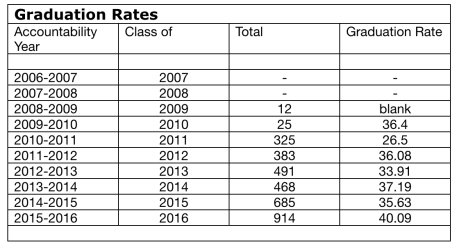
If I am reading the hard to understand reports correctly, in 2016 Nevada most likely paid $6,000 X 2400 = $14,400,000 to Nevada Connections Academy for High School Seniors and 40% or 914 graduated.

Total enrollment in Nevada Connections Academy was report at 2,851. Overall the Nevada Tax Payer spend $17,106,000 for less than half its students to be proficient.

The school also has a swinging door with half its students turning over. Due to lack of regulation and oversight – plus the “missing” students every year at testing time – I have to ask if the Nevada Tax Payer is paying for students not even in the program any longer.

nevada graph

Understandably parents and students do not want their charter school to close.

Parent and students do not want my public school to close either. Yet, I am held accountable. My school can be turned around or taken over by the Achievement School District. This failing charter has been doing poorly for 10 years and what has happened?

Nothing.

Parent and students base their “choice” of school on things other than standardized testing and numbers. I understand this very well. And they will protest if this school is closed. However, I am using this an example which is fairly similar to half of Nevada’s Charters which are on the lowest performing list.

Half of Nevada’s charters are on the lowest performing list. The worst graduation rates in the state are in the State Public Charter School System.

This charter is one of many in Nevada not doing well.

Half of Nevada’s charters are on the lowest performing list.

Parents need access to charter information at the same level public schools are required to give information to parents. In an annual report published on-line. Charters which spend on marketing to produce enrollment numbers need to be giving their data and graduation rate information to student prior to enrollment. No one should have to dig around in the Nevada Report Card for a month to try to determine if a school is academically achieving. If these charters are actually serving students not expected to graduate – if they are alternative schools – they should tell parents up-front the likelihood of graduating from these schools.

Charters need to be audited. Public schools have the SAGE Commission. Charters should have a similiar body which looks at return on investment and other financial measures.

I just attempted to watch an audit or something like an audit on-line from the charter authority.

https://manage.lifesizecloud.com/#/publicvideo/975a6334-1f01-4734-9678-cc6042d30f29?vcpubtoken=2021a45f-3957-40df-97a4-8cc8d9196bdb

Besides cheerleading for charters – I’m not sure the audit produced much information. It certainly did not expose anything I have discovered in the last few months. Watch the video for yourself and ask yourself if the Nevada Charter Authority is able to hold any of Nevada’s Charters accountable with the information presented.

Due process is the reason charters are not closing?

Perhaps there is simply zero political appetite to close a perpetually failing charter?

While charters may protest accountability in the name of freedom and choice. . . this needs to be balanced by accountability to the tax payer who pays the bills.

It is not fair to have a strict accountability system for public systems while charters are allowed to run amuck in the state of Nevada.

The unfairness of a legislated system that turns public schools into charters but does nothing about all the failing charters spending million in tax payer money in the state – is foul.

The Nevada Charter System is a failing school system in the state. That is clear according the data.

If Nevada Connections cannot be closed after 10 years of failure, which charter will ever be held accountable?

Angie

See the whole report here.

The blog “Seattle Education” interviews Professor Kenneth Zeichner about the “Relay Graduate School of Education,” which exists solely to dispense credentials of dubious value to charter school personnel.

The message “#rejectrelay.”

“Ken Zeichner is the Boeing Professor of Teacher Education at the University of Washington. He is a member of the National Academy of Education and a Fellow at the National Education Policy Center at the University of Colorado.

“A former elementary teacher and longtime teacher educator in NY, Wisconsin, and Seattle, his work has focused on creating and implementing more democratic models of teacher preparation that engage the expertise of local communities, K-12 educators and university academics in preparing high quality professional teachers for everyone’s children.

“He has also challenged the privatization of K-12 schools and teacher education by exposing the ways in which venture philanthropy has sought to steer public policy in education, and the ways in which research has been misused to support the privatization process. His new book “The Struggle for the Soul of Teacher Education” will be published later this year by Routledge….”

It is a fascinating interview. It begins like this:

As an introduction, could you explain for our readers: What is the Relay Graduate School of Education and why we should be concerned.

“Relay Graduate School of Education is an independent institution not affiliated with a legitimate college or university that prepares new teachers and principals and provides professional development services for teachers and principals to school districts and charter networks. It was founded in 2007 by three charter school networks (Uncommon Schools, KIPP, and Achievement First) within Hunter College’s Education School and became independent in 2012 changing its name to Relay Graduate School of Education.

“Until recently, its teacher preparation programs were all “fast tracks” preparing uncertified teachers who were fully responsible for classrooms after only a few weeks of preparation. Among those who they prepared were many TFA (Teach for America) teachers in NYC. Recently, they have begin offering a “residency” option in certain locations where during the first year of the two year program their teachers are not fully responsible for classrooms and are mentored by a licensed teacher. In both the fast track and residency versions of the program teachers receive a very narrow preparation to engage in a very controlling and insensitive form of teaching that is focused almost entirely on raising student test scores. Relay teachers work exclusively with ‘other people’s children’ and provide the kind of education that Relay staff would never accept for their own children. The reason that I use Lisa Delpit’s term “other people’s children” here is to underline the point that few if any Relay staff and advocates for the program in the policy community would accept a Relay teacher for their own children. Most parents want more than a focus on standardized test scores for their children and this measure becomes the only definition of success in schools attended by students living in poverty.

“The evidence is clear that the kind of controlling teaching advocated and taught by Relay has often resulted in a narrowing of the curriculum (1), and in some cases in “no excuses” charters, in damage to the psychological health of children as evidenced in research of Joan Goodman at Penn in Philadelphia.(2)

“We should be worried about Relay because it prepares teachers who offer a second class education to students living in poverty, and in my opinion based on examining the evidence, it contributes to exacerbating existing educational inequities in both student opportunities to learn and in the equitable distribution of fully prepared professional teachers.(3)

“According to their website, it appears Relay was founded by three charter
school networks: Uncommon Schools, KIPP, and Achievement First. Can you explain for our readers what student populations these charters serve and their approach to student instruction?

“These charters exclusively serve students living in poverty, most of whom are of color. Relay teachers also work in other charters however, and in some cases they may also teach in public schools.

“Relay originally received NY State approval when they were still part of Hunter College.They have used this approval and their accreditation by the Council for Accreditation of Educator Preparation the Middle States Commission on Higher Education Accreditation to gain approval to operate in other states. One could legitimately raise the question- how can a program gain approval from states and accrediting agencies that prides itself in having no theory, where few if any of its instructors have advanced degrees in education, and where much of what most people believe teachers need to know and learn how to do is missing from their curriculum, The answer is that Relay is very good at packaging and selling itself to others as offering successful teacher education programs despite the lack of any credible evidence supporting their claims. Their mumbo jumbo and smoke and mirrors game did not work however, in either CA or PA where the states ruled that Relay’s programs did not meet their state standards for teacher education programs.

One of the more shocking parts of the Relay story is the use of Doug Lemov’s book Teach Like A Champion (TLC) as an instructional bible for the Relay program. Can you explain who Doug Lemov is and why TLC is such a toxic approach to student instruction.

“Doug LeMov is currently a “faculty member” at Relay and the managing director at Uncommon Schools, one of the charter networks that formed Relay. Lemov’s “Teaching like a Champion” is the basis for the Relay teacher education curriculum. These generic management strategies are highly controlling and are dangerous when they are the main part of what teachers receive in their preparation. Relay has argued that the choice is between theory or practice and that they focus on practice. This is a false choice, and while I agree that teacher education needs to focus on practice, and that some of these strategies are useful if they are used in the proper context, it matters what practices you focus on. Additionally, teacher preparation also has to provide teachers with theoretical background in learning, development, assessment, language, and so on. There is no attention to context, culture, or even subject matter content in LeMov’s strategies. There is also no credible research that supports their use with students.

Relay’s list of philanthropic investors reads like a who’s who of education reform. The Gates Foundation is on the list, along with the Walton Foundation, and The Learning Accelerator – which is all about blended learning and the development of human capital. What do you think these groups hope to gain by supporting Relay?

“Yes, Relay has been heavily supported by philanthropists like the Gates and Schusterman Foundations and by venture philanthropists such as the New Schools Venture Fund as well as by individual hedge fund managers.(4) The funding of non-college and university programs that are linked to charter school networks helps these individuals and organizations further their goals of deregulating and privatizing public schools. As the charter networks continue to expand across the country and replace real public schools, there is more of a need for teachers who want to work in these schools that are often tightly regimented. Many graduates of professional teacher preparation programs in colleges and university do not want to work in these charter schools. Foundations that want to expand the proportion of charter schools throughout the country must help create a parallel set of charter- teacher education programs to prepare teachers for charter schools.”
Scholars Preston C. Green III, Bruce D. Baker, and Joseph Oluwole investigate whether the charter industry is repeating the errors of Enron.

Their peer-reviewed article appears in the Indiana Law Journal.

Here is the abstract:

“In 2001, Enron rocked the financial world by declaring bankruptcy due to the effects of an accounting scandal. Special purpose entities (SPEs) were instrumental to Enron’s demise. Enron parked assets in the SPEs to improve its credit rating.

“Enron violated accounting principles by not revealing that its SPE partnerships were related-party transactions. Andrew Fastow, who was Enron’s CFO, made millions of dollars by managing the SPEs. He also used these illegal proceeds to invest in other ventures. Enron’s gatekeepers failed to protect against this accounting fraud.

“Related-party transactions are now posing a threat to the charter school sector. Similar to Fastow, individuals are using their control over charter schools and their affiliates to obtain unreasonable management fees and funnel public funds into other business ventures.

“In this article, we discuss how some charter school officials have engaged in Enron-like related-party transactions. We also identify several measures that can be taken to strengthen the ability of charter school gatekeepers to protect against this danger.

“This article is divided into four parts. Part I describes how Fastow used his management of Enron and the SPEs to obtain illegal profits. Part II discusses why financial sector gatekeepers failed to stop these related-party transactions. Part III shows how charter school officials are benefitting from their control over charter schools and their affiliates in a manner similar to Fastow. Part IV analyzes pertinent statutory and regulatory provisions to identify steps that can be taken to increase the gatekeepers’ ability to protect against harmful related-party transactions.”

Recently Trump and DeVos gushed over the Florida tax credit voucher program and featured a graduate of one student who graduated from a voucher school.

This inspired Mercedes Schneider to look at the academic record of Florida’s voucher schools. It is not impressive.

Voucher schools are supposed to save students from failing schools. But most of the state’s voucher students do not come from F-rated schools or even D-rated schools. Most come from schools rated A, B, or C.

She looked at the school that produced the young woman who attended Trump’s first address to Congress. She is surely a fine young woman but her school is not. It is certainly no model of success.

She writes:

“Let us consider the gain scores of Esprit de Corps Center for Learning, the school that Denisha Merriweather attended via tax credit.

“In 2014-15 , 44 students completed assessments that produced gain scores. (The researchers cautioned about the stability of gain score results when the number of students tested is below 30. Thus, Esprit de Corps meets the 30+ test-taker condition.)

“In 2014-15, Esprit de Corps’ average gain score was -3.66 national percentile ranking points in reading and -13.52 in math.

Its average gain score from 2012-13 to 2014-15 (three years) was -0.65 national percentile ranking points in reading and -2.69 in math.

“In an effort to obtain more information on Esprit de Corps’ math gain score history, I consulted a few more FTC reports from previous years.

“According to the 2013-14 FTC report, Esprit de Corps fared better in 2013-14: 0.03 in reading (remember, a zero gain is right at the national average) and 6.9 in math (calculations based on 43 student assessments). However, its three-year average gain scores (2011-12 to 2013-14) in both reading and math were -0.65 and -2.69, respectively, which indicates lower gains in previous years, especially in math.

“In 2012-13, Esprit de Corps had only a slightly negative math gain score (-1.3), and a slightly positive reading gain (1.3). Still its three-year combined gain score in math (2010-11 to 2012-13) was notably negative (-4.3). Three-year reading was close to zero (0.3). (Score based on 47 student assessments.)

“In 2011-12, Esprit de Corps’ math scores were again especially low (-12.4), and its reading gains were also negative (-2.6) based on 47 student assessments. And again, its three-year average gain in math (2009-10 to 2011-12) was particularly low: -3.8. Its reading gain was negative but close to zero: -0.20.

“Esprit de Corps has an arguably established history of negative gains in math, as confirmed by its three-year scores from 2009-10-to-2011-12 to 2012-13-to-2014-15.

“This school-level reality complicates pitching Florida vouchers via tax credits as an across-the-board, superior public school alternative based on test score outcomes.

“Nevertheless, it seems that the push for vouchers in the DeVos era is one conveniently deaf to evidence and infused with the superiority of ideology.”

Mercedes Schneider is a careful analyst of tax filings. Although Trump doesn’t have to make his tax returns public, thus revealing any potential conflicts of interest, the law requires charitable organizations to release their financial filings (called their 990 form) with the Internal Revenue Service.

In this post, Schneider reviews the finances of Step Up for Students, which receives donations from corporations to provide vouchers for Students. The corporations, in turn, get a tax credit for their donations. This is Florida’s way of circumventing a provision in the state constitution that forbids spending public money on religious schools. By giving gifts to Step Up, the business supplies the money for the voucher to a third party, not a religious school. Step Up uses the money mostly for religious schools. Many D.C. Insiders think this is the plan that DeVos and Trump will use as a national template because it bypasses thorny Constitutional issues. It is called a “tax credit” program, but it is in reality a way to finance vouchers.

Florida Voucher Nonprofit, Step Up for Students: A Tale of 15 Tax Forms

Last night, I waited in great anticipation for the start of the great blizzard of 2017. I enjoy big weather events, especially if I am physically safe. I like to watch thunderstorms. I was excited to wait for the howling winds and rapidly falling snow we were promised. I read this article, which made me laugh out loud (for the first page or so). It is about losing things, misplacing your keys, your wallet, your cell phone. That is the kind of thing I do often. I have attached an electronic device to my wallet and keys (called Tiles) to help find these things when they are lost. After hearing what Kellyanne said about being under surveillance by your microwave, I wonder if my keys and wallet are watching me. But I digress.

I saw the first snowflakes about 1 am, then went to sleep. When I woke up, I saw we were not getting a blizzard. The track of the storm shifted west, sparing us 2′ of snow. What we got was ice, snow, and slush. So much for the science of forecasting. Since I am in the midst of reading “Weapons of Math Destruction,” I understand that there are many variables that could not be predicted with certainty. So, bringing it back to education, I thought about how absurd the concept of VAM (value-added measurement or modeling) is. If weather scientists can’t accurately predict a weather event just a few hours before it happens, why do economists think they can accurately measure something as elusive as “teacher quality” by aggregating changes in student test scores over a period of years without accounting for the hundreds and thousands of unmeasured variations in students’ lives, th classroom, the school, etc.?

See how easy it was to go from the blizzard that fizzled to the flaws of teacher evaluation?

Time to check my chicken soup.

The business interests of the Trump family pose many possibilities for conflicts of interest. Jared Kushner is married to Ivanka Trump, the president’s daughter. Jared Kushner is a trusted advisor to the president. A politically connected Chinese firm just bought a New York City property from Jared Kushner’s family on favorable terms.

“A company owned by the family of Jared Kushner, President Donald Trump’s son-in-law and senior adviser, stands to receive more than $400 million from a prominent Chinese company that is investing in the Kushners’ marquee Manhattan office tower at 666 Fifth Ave.

“The planned $4-billion transaction includes terms that some real estate experts consider unusually favorable for the Kushners. It provides them with both a sizable cash payout from Anbang Insurance Group for a property that has struggled financially and an equity stake in a new partnership.

“The details of the agreement, which is being circulated to attract additional investors, were shared with Bloomberg. It would make business partners of Kushner Cos. and Anbang, whose murky links to the Chinese power structure have raised national security concerns over its U.S. investments. In the process, an existing mortgage owed by the Kushners will be slashed to about a fifth of its current amount.”

Jared says there is no conflict of interest because he sold his shares to his family members.

This is a new definition of conflict of interest since family members are not independent or arm’s length.

I have been bombarded by people in Hawai who are concerned that Michelle Rhee and her husband, the former Mayor of Sacramento Kevin Johnson, have arrived to advise state officials about education reform. Several sent this article.

I recall that Mr. and Mrs. Johnson were invited five years ago to lecture at the University of Hawaii on the subject of ethics in education.

I am hoping to visit Hawaii for the first time next January or February and check out the water supply. Or is it something they are smoking?