Archives for the month of: October, 2015

The Badass Teachers association responded to Arne Duncan’s mea culpa on testing with this statement:

FOR IMMEDIATE RELEASE: October 24, 2015
More information contact:
Marla Kilfoyle, Executive Director BATs or Melissa Tomlinson, Asst. Executive Director BATs
Contact.BATmanager@gmail.com

Today the Obama Administration released a statement calling for “a cap on assessment so that no child would spend more than 2 percent of classroom instruction time taking tests. It called on Congress to ‘reduce over-testing’ as it reauthorizes the federal legislation governing the nation’s public elementary and secondary schools.” (http://www.nytimes.com/2015/10/25/us/obama-administration-calls-for-limits-on-testing-in-schools.html?_r=0)

The Badass Teachers Association, an education activist organization with over 70,000 supporters nationwide, are reluctantly pleased with this announcement. Our vision statement has always been to refuse to accept assessments, tests and evaluations created and imposed by corporate driven entities that have contempt for authentic teaching and learning. Our goals have always been to reduce or eliminate the use of high stakes testing, increase teacher autonomy in the classroom, and include teacher and family voices in legislative decision-making processes that affect students.

Since No Child Left Behind and Race to The Top we have seen our children and communities of color bear the brunt of the test obsession that has come in with the wave of Corporate Education Reform. When resources should have been used for funding and programming, politicians and policy makers were focusing on making children take more tests in hopes that equity in education would occur. It didn’t work, and it will not work. We know as educators you cannot test your way out of the education and opportunity gap. The blame and punish test agenda has not closed either the education or opportunity gap . We are reluctantly pleased that the President and his administration are finally taking a stand, but sadly the devastation has already been done. We are confident that if the President and his administration make a commitment to work with educators, parents, and students we can fix it and make it right.

“Although this is a step in the right direction I feel we need to see what the policy is before we count this as a win. Given his actions in New York, I have no reason to trust John King, and I’m concerned that this is a ploy to get teachers on the side of Democrats aka Hillary Clinton.” – BAT Board of Director Member Dr. Denisha Jones

“The policy that stems from this statement needs to be mindful that important discussions about exactly what kind of testing is most beneficial to our students. BATS advocates for teacher-driven tests with immediate and relevant feedback that can be used to drive current instructional practices.” – BAT Assistant Executive Director Melissa Tomlinson

“The policies of Sec. Duncan and the USDOE have caused an immense amount of damage to our educational system, student morale, and teacher morale. I am very reluctant to be happy about this announcement and will watch closely as to what the President plans to do to fix the damage that has been done. Will he stand up to Corporate Education Reform? Will he end the test, blame, punish system for schools, students, and teachers? Will he return the elected school board? Will he end mass school closings?” – BAT Executive Director Marla Kilfoyle

The Badass Teachers Association would like to extend its voice and expertise to help get public education on the right track. Together we can work towards the real solutions that will make great schools for all children. We will be watching closely as this unfolds.
FairTest                         National Center for Fair & Open Testing                                                                                                                                                                                                                      
for further information:                                                                 

Bob Schaeffer (239) 395-6773

                   cell (239) 699-0468

for immediate release Saturday, October 24, 2015

GRASSROOTS ASSESSMENT REFORM MOVEMENT

REACTS TO OBAMA ADMINISTRATION STATEMENT,

SCHOOL CHIEFS SURVEY ON STANDARDIZED TESTING OVERKILL


The Obama Administration’s weekend statement calling for “fewer and smarter” tests “belatedly admits that high-stakes exams are out of control in U.S. public schools but does not offer meaningful action to address that very real problem,” according to the National Center for Fair & Open Testing (FairTest), a leader of the country’s rapidly growing assessment reform movement.
FairTest Public Education Director Bob Schaeffer explained, “The new Council of Great City Schools study to which the Obama Administration responded, reinforces widespread reports by parents, students, teachers, and education administrators of standardized testing overuse and misuse. Documenting testing overkill is, however, just the first step toward assessment reform.”
“Now, is the time for concrete steps to reverse counter-productive testing policies, not just more hollow rhetoric and creation of yet another study commission,” Schaeffer continued. “Congress and President Obama must quickly approve a new law overhauling ‘No Child Left Behind’ that eliminates federal test-and-punish mandates. State and local policy makers need to heed their constituents’ ‘Enough is enough!’ message by significantly reducing the volume of standardized exams and eliminating high-stakes consequences. That will help clear the path for the implementation of better forms of assessment.”
Founded in 1985, FairTest advocates for valid, equitable and meaningful assessment of students, teachers and schools. The organization predicted negative “fallout from the testing explosion” when No Child Left Behind and similar state policies were adopted. FairTest works closely with grassroots education stakeholders around the country to reform national, state and local testing policies.

The Obama administration acknowledged that students are spending too much time on testing and recommended that no more than 2% of classroom instructional time be devoted to testing.

Apparently the administration is reacting to bipartisan opposition and widespread parent protests against the diversion of time and billions of dollars to high-stakes testing. Public sentiment, as recorded in recent polls, opposes the overuse of standardized testing.

In addition, the Times reports, the administration was reacting to a new report from the Council of Great City Schools, which found that the current regime of testing has not improved achievement.

You might say that the Obama administration is lamenting the past 13 years of federal policy, which mandated annual testing, and made test scores the determinative factor in the evaluation of teachers, principals and schools.

In short, the Bush-Obama policies have been a disaster.

This is a classic case of too little, too late. Think of the thousands of teachers and principals who were unjustly fired and the thousands of pubic schools wrongly closed when they should have gotten help. This administration and the George W. Bush cannot be absolved for the damage they have done to American education by issuing a press release.

The story says:

“Faced with mounting and bipartisan opposition to increased and often high-stakes testing in the nation’s public schools, the Obama administration declared Saturday that the push had gone too far, acknowledged its own role in the proliferation of tests, and urged schools to step back and make exams less onerous and more purposeful.

“Specifically, the administration called for a cap on assessment so that no child would spend more than 2 percent of classroom instruction time taking tests. It called on Congress to “reduce over-testing” as it reauthorizes the federal legislation governing the nation’s public elementary and secondary schools.

“I still have no question that we need to check at least once a year to make sure our kids are on track or identify areas where they need support,” said Arne Duncan, the secretary of education, who has announced that he will leave office in December. “But I can’t tell you how many conversations I’m in with educators who are understandably stressed and concerned about an overemphasis on testing in some places and how much time testing and test prep are taking…”

“And even some proponents of newer, tougher tests said they appreciated the administration’s acknowledgment that it had helped create the problem, saying it did particular damage by encouraging states to evaluate teachers in part on test scores.

“But the administration’s so-called “testing action plan” — which guides school districts but does not have the force of law — also risks creating new uncertainty on the role of tests in America’s schools. Many teachers have felt whiplash as they rushed to rewrite curriculum based on new standards and new assessments, only to have politicians in many states pull back because of political pressure.

“Some who agreed that testing has run rampant also urged the administration not to throw out the No. 2 pencils with the bath water, saying tests can be a powerful tool for schools to identify weaknesses and direct resources…

“What happens if somebody puts a cap on testing, and to meet the cap ends up eliminating tests that could actually be helpful, or leaves the redundancy in the test and gets rid of a test that teachers can use to inform their instruction?” asked Michael Casserly, the executive director of the Council of the Great City Schools, an organization that represents about 70 large urban school districts.

“The administration’s move seemed a reckoning on a two-decade push that began during the Bush administration and intensified under President Obama. Programs with aspirational names — No Child Left Behind, Race to the Top — were responding to swelling agreement among Democrats and Republicans that higher expectations and accountability could lift the performance of American students, who chronically lag their peers in other countries on international measures, and could help close a chronic achievement gap between black and white students….

“But as the Obama administration pushed testing as an incentive for states to win more federal money in the Race for the Top program, it was bedeviled by an unlikely left-right alliance. Conservatives argued that the standards and tests were federal overreach — some called them a federal takeover — and called on parents and local school committees to resist what they called a “one size fits all” approach to teaching.

“On the left, parents and unions objected to tying tests to teacher evaluations and said tests hamstrung educators’ creativity. They accused the companies writing the assessments of commercializing the fiercely local tradition of American schooling.

“As a new generation of tests tied to the Common Core was rolled out last spring, several states abandoned plans to use the tests, while others renounced the Common Core, or rebranded it as a new set of local standards. And some parents, mostly in suburban areas, had their children opt out of the tests.

“Mr. Duncan’s announcement — which was backed by his designated successor, John B. King Jr. — was prompted in part by the anticipation of a new survey from the Council of the Great City Schools, which set out to determine exactly how much testing is happening among its members.

“That survey, also released Saturday, found that students in the nation’s big-city schools will take, on average, about 112 mandatory standardized tests between prekindergarten and high school graduation — eight tests a year. In eighth grade, when tests fall most heavily, they consume an average of 20 to 25 hours, or 2.3 percent of school time. The totals did not include tests like Advanced Placement exams or the ACT.

“There was no evidence, the study found, that more time spent on tests improved academic performance, at least as measured by the National Assessment of Educational Progress, a longstanding test sometimes referred to as the nation’s report card.”

Brian Malone created a powerful documentary about the corporate assault on public education, called “Education Inc.”

It will be shown Sunday:

Education, Inc.
Premiers Sunday, October 25, 2015 6pm
FreeSpeech TV (Check local listings)
or stream it live here:

Free Speech TV

followed by:
Education Inc. Roundtable, 7pm

Our frequent commentator, Laura H. Chapman, here reflects on the current view of the role of higher education–not as a place of exploration and liberal learning, but as a preparation for the global workplace.


She writes:


For higher education, some new metrics from USDE were supposed to show “best value education” meaning cost versus payoff for graduates in paychecks–return on investment. The policy was marketed as being “transparent” for the benefit of customers of education. Even without formal requirements from USDE, the governors in more than one state are pushing for the same thing. Ohio’s Kasich is among them, but he wants evidence of economic payoffs for Ohio.


This “economic outcomes only” philosophy will turn many public institutions of higher education into something like trade schools, kill off studies in the arts and humanities, tank basic research, and take the short-term political gain from this “transformative strategy” pretending there are no historically informed and valid sources of information on the benefits produced by these institutions, not just economic.


The virtues of the university as a vibrant source of new knowledge have been channeled into the business of learning to be an entrepreneur, doing the elevator pitch, getting the business plan in place and getting capital for a start up and go for it, then do your deals. Lots of very wealthy people and some fantastic achievements have come from this way of looking at the value of higher education. Donald Trump knows this drill, flaunts it, runs for President on it. Meanwhile the university as a reservoir of uncommon knowledge and expertise, well spring of new knowledge, and safe haven for learning what others have thought (and why), learning to question what you think, and learning what life may offer beyond a job–all of that is being portrayed as a lost cause.


That lost-cause view is evident in The American Enterprise Institute’s recent publication: “An Education Agenda for 2016: Conservative Solutions for Expanding Opportunity.” This 92 page report is telling its audience to ridicule “traditional” college curricula, tenured faculty, and middle class college students who “graduate from college completely unprepared to deal with the hazards, hassles, inconveniences, and disappointments of the real world.”


The report recommends that politicians stereotype college educators, say that they “see their students as mere children who are to be protected from the adult word, including through the use of strictly enforced, politically correct speech codes.”


The report freely recommends that colleges and universities be described as expensive venues that “offer whatever educational programs their tenured faculty are willing and able to teach, regardless of actual workforce needs.”


This is the attack language of persons who are among the intellectual elite in our nation.


They have learned that it works. There are no penalties for being rude, crude, and shortsighted and also a graduate of Harvard, Yale, Brandeis, Dartmouth, the University of Chicago, Columbia University, or Notre Dame. Just throw out this stereotyping language to dismantle public education.


The bios of the authors of this agenda indicate that, collectively, they attended seventeen different universities. Seven of these are public.


I am not certain that there are any voices left to be advocates for aims in higher education broader than an immediate payoff in paychecks. It is clear that one of the major conservative solutions for expanding “opportunity” to be in charge of education policy is to use a bully pulpit of privilege to demean the work of faculty and public colleges and universities.


Bottom line: The intellectual elite are marketing anti-intellectualism in order to gain control of national policy in education. They do not want to be the company of well-informed citizens who can discern the difference between spin and substance.

Tennessee was one of the first states to win Race to the Top funding, but most districts have not been willing to offer bonuses for higher test scores, as the authors of RTTT hoped. In fact, the number of districts doing so is declining.

Four years after receiving permission to tie teacher pay to their performance, some school districts are moving away from paying teachers based on their evaluations.

“Four districts changed their teacher pay plans in the first year after legislators passed a 2010 law to allow districts to tie salaries to teacher evaluations. The law was part of Tennessee’s successful effort to win federal education funding through the Obama administration’s Race to the Top grant program.
“That number shot up to 57 districts — out of 142 statewide — in 2014 but fell this year to 54, state officials told lawmakers in Nashville on Wednesday.
“Officials did not say which districts had opted out, or why the pace of districts adopting performance-pay plans had slowed.
“But the stagnation could signal that superintendents and school boards are hesitant about putting too much stock in the state’s teacher evaluation system, which was among the first in the nation to use standardized test scores….
“Merit pay is just one of several options available to districts to differentiate pay under a rule that the State Board of Education revised in 2013. The most common option in Tennessee is paying teachers more to teach at high-needs schools, or in subjects where there is a dearth of qualified teachers.
“Officials at the Board and the Department of Education view differentiated pay as a means to attract and retain effective teachers, whom they say do not always have experience or advanced degrees.

“But many educators say teacher pay just needs to be raised in general.”

At the ten-year anniversary of Bill Gates’ pledge to solve the problems of the world, the great man said four times that he was “naive.”

Sandi Doughton of the Seattle Times writes:


When he took the stage this fall to celebrate the 10th anniversary of his signature global health research initiative, Bill Gates used the word “naive” — four times — to describe himself and his charitable foundation.

It was a surprising admission coming from the world’s richest man.

But the Microsoft co-founder seemed humbled that, despite an investment of $1 billion, none of the projects funded under the Gates Foundation’s “Grand Challenges” banner has yet made a significant contribution to saving lives and improving health in the developing world.

“I was pretty naive about how long that process would take,” Gates told a gathering of nearly 1,000 people in Seattle.

Launched with fanfare a decade ago, the original Grand Challenges program mobilized leading scientists to tackle some of the toughest problems in global health. Gates handed out nearly half a billion dollars in grants to 45 “dream teams” of researchers working on everything from tuberculosis drugs and new vaccine strategies to advanced mosquito repellents and bananas genetically engineered to boost nutrition.

But five years in, Gates said he could see that it would be at least another decade before even the most promising of those projects paid off.

Not only did he underestimate some of the scientific hurdles, Gates said. He and his team also failed to adequately consider what it would take to implement new technologies in countries where millions of people lack access to basic necessities such as clean water and medical care.

While continuing to support a handful of the “big science” projects, the foundation in 2008 introduced a program of small, highly focused grants called Grand Challenges Explorations.

With headline-grabbing goals like condoms that feel good and waste-to-energy toilets, the explorations initiative has probably garnered more media attention than anything else the giant philanthropy has undertaken.

But none of those projects has yet borne fruit, either….

All of the original projects yielded good science, and many produced new understanding or tools likely to prove valuable down the road. But the foundation estimates only 20 percent are on track to have a real-world impact — a rate Gates said is in line with what he expected going in.

Among his favorite projects is an effort to eliminate Dengue fever by infecting mosquitoes with bacteria that block disease transmission. Another is a spinoff biotech working on a probiotic to cure cholera.

But critics say projects like those demonstrate the foundation’s continuing emphasis on technological fixes, rather than on the social and political roots of poverty and disease.

“The main harm is in the opportunity cost,” said Dr. David McCoy, a public-health expert at Queen Mary University, London. “It’s in looking constantly for new solutions, rather than tackling the barriers to existing solutions.”

The toll of many diseases could be lowered simply by strengthening health systems in developing countries, he said. Instead, programs like Grand Challenges — heavily promoted by the Gates Foundation’s PR machine — divert the global community’s attention from such needs, McCoy argues….

When several Gates-funded, high-tech toilets were installed in the Indian city of Raichur last year, at a cost of about $8,000 each, residents refused to use them. Many of the other toilet prototypes funded through Grand Challenges are so complex, with solar panels and combustion chambers, they would never prove practical, said Jason Kass, founder of Toilets for People, a company that sells simple, composting toilets to nonprofits in the developing world.

“If the many failed development projects of the past 60 years have taught us anything, it’s that complicated, imported solutions do not work,” Kass wrote in a New York Times Op-Ed entitled “Bill Gates Can’t Build a Toilet.”

But senior program officer Doulaye Koné said the foundation is looking beyond technology this time. The goal is to mass-produce the toilets to bring the price down, then foster a self-sustaining system in which private companies install and service the units for a small fee….

While the Gates version is still looking for its first home run, some of the spinoffs have already logged modest successes.

Production is expected to start soon on a USAID-backed device invented by an Argentine car mechanic to ease difficult births. And the agency estimates that 5,000 young lives in Nepal have already been saved by a low-cost antiseptic gel used to swab the umbilical cord after birth.

USAID Administrator Raj Shah, a former top Gates Foundation official, said he and his staff applied lessons learned at the foundation to ensure their version would yield payoffs.

“We proudly borrowed the idea,” Shah said. “But we designed our Grand Challenges program to have impact quickly, at scale.”

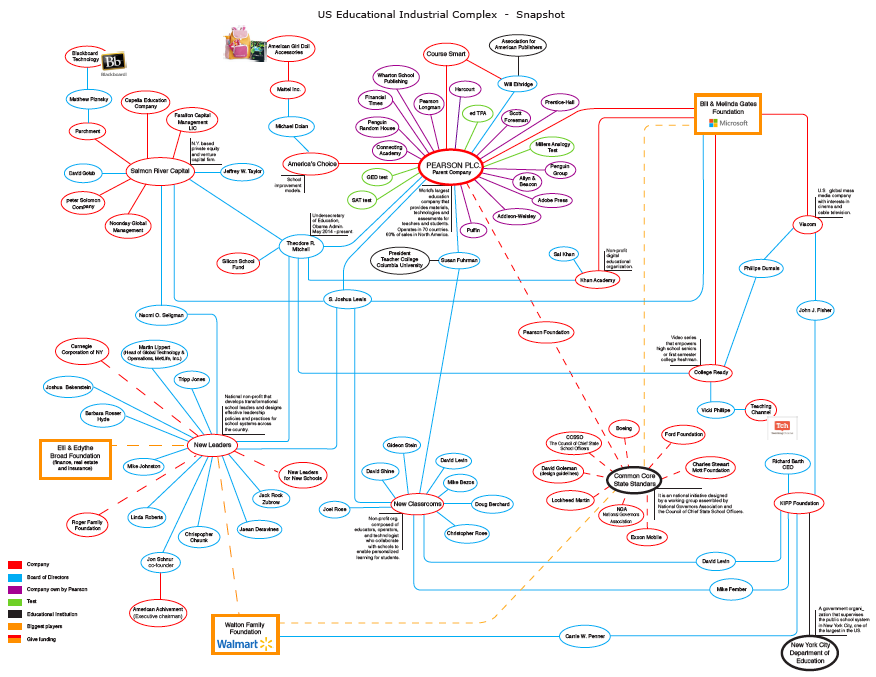
Dipti Desai is a professor of the arts and art education at New York University. She teaches both pre-service and in-service art teachers. As she watched what was happening in the world of education, she decided to create a graphic to illustrate the “Educational Industrial Complex.” Readers may know that when President Dwight D. Eisenhower was leaving office after his second term, he warned voters to be wary of the “Military Industrial Complex.” Who knew that in 2015 we would have to keep our eyes on the “educational industrial complex,” a combination of corporations, philanthropies, government agencies, and the organizations that promote privatization and high-stakes testing?

edcomplex


The report can be downloaded here.

Lisa Haver, a public school activist in Philadelphia, describes the deliberate process of destroying her city’s public schools. The superintendent, William Hite, is doing what Broad Academy graduates do: closing public schools without heeding the views of parents or communities.

It is one of the saddest stories about the hoax of “reform” that you are likely to read. If closing schools is the same as “reform,” then we have surely fallen down the rabbit-hole into a world where words mean nothing or mean the opposite.
It appears, though, that disruption and failure are not a deterrent to repeating mistakes in the School District of Philadelphia. Superintendent William Hite unveiled a plan earlier this month to reform 15 district schools at an estimated cost of $15 million to $20 million. Some will be part of the Hite-created Transformation Program, in which curricular and personnel changes, including forcing out the entire faculty, can be imposed with no public hearings or vote by the SRC. Others will be placed into the Renaissance Network, which is the administration’s way of giving up on a school it has done little to improve and kicking it to the curb for a private company to pick up. Some will have several grades added at once, as Roosevelt did, changing its mission and climate overnight. Contrary to promises made by Hite at public meetings, two schools will be closed permanently. Enrollment and class size in nearby schools will almost certainly increase.
The hurried approval process will give parents little chance to have any say in the future of their children’s schools. Teachers and staff have been shut out of the process altogether, even though many will be forced out of schools whose communities they have been part of for years. But since the decisions about which schools will be overhauled, and how, have already been made at the top, what purpose do these meetings serve other than window-dressing – until the inevitable rubber-stamping by the SRC?

There is a reason for the adjective “public” that comes before “schools.” The schools belong to the public, not to Eli Broad, Bill Gates, or the current superintendent. Philadelphia needs a leader to save its schools, not to close them down.
Read more at http://www.philly.com/philly/opinion/20151021_Rushed_reforms_fail_our_schools.html#K1to1arKAvoKA0jY.99

On Saturday, the people of Louisiana will vote on many races. Among the most important will be the races for state board of education.

The Network for Public Education Action Fund has endorsed Lotte Beebe, Lee Barrios, and Jason France.

This article describes what is at stake.

Out of state billionaires have put up nearly $1 billion to impose privatization.

The several local candidates have about $50,000 among them.

The question is whether big money can defeat democracy and secure control of Louisiana’s schools and children.