Archives for the month of: April, 2014

A few years ago, Michigan governor Rick Snyder decided that the best way to fix the financial problems of districts in deficit was to put them under the control of an emergency manager to straighten out their finances. Some districts, however, are so poor that they don’t have enough money to educate their children. It is the state’s duty to help them.

In 2011, an emergency manager decided to give the Muskegon Heights school district to a for-profit charter chain, called Mosaica. It has not been profitable, and the district’s deficit continues.

Mosaica just received an emergency bailout from the state because it couldn’t meet its payroll. The corporation ended its first year in deficit because of the cost of repairs.

Years of deferred maintenance required expenditures of $750,000 to bring the buildings up to code. Meanwhile revenues have shrunk as enrollment dropped from 1400 to 920.

Lingering question: why did the state allow this impoverished, largely African American school district to fall into such shabby condition? Will for-profits be more cautious in the future about taking over neglected districts? Or will they have a commitment from the state for subsidies that were not available to the school district when it had an elected board?

Many years go, when I was a Fellow at the conservative Manhattan Institute, I got o know Sol Stern, who has been at that think tank for many years. Sol has an interesting history. Back in the radical 1960s, he was an editor at the leftwing Ramparts. At some point, he had a political-ideological conversion experience, and he became a zealous conservative. He is a journalist, not an educator. He writes about what interests him. Ten years ago, he wrote a book advocating school choice, called Breaking Free. In 2011, he wrote a book about Israeli-Palestinian relations, called “A Century of Palestinian Rejectionism and Jew-Hatred.” one thing about Sol Stern: He has strong opinions.

At the moment, his strong opinions are focused on fervent advocacy for the Common Core. Stern thinks that the Common Core implements the ideas of E.D. Hirsch, Jr. Hirsch believes that kids should learn lots of background knowledge, which will not only make them smarter but enable them to read and understand increasingly difficult text. I agree that background knowledge matters, so long as it is developmentally appropriate, that is, comprehensible to the child. And I don’t see Comon Core as the fulfillment of E.D. Hirsch’s vision. After all, David Coleman–widely acknowledged as the “architect” of he Common Core–advocates “close reading,” in which a student deciphers text without reference to any background knowledge. One example would be a student reading the “Gettysburg Address” without reference to or knowledge of the Civil War or Lincoln or the battle it commemorates. I think Hirsch would insist that context and background knowledge are crucial for comprehension. I am not sure that Stern understands the Commn Core standards but he has now made it his business to defend them and to attack those who doubt their excellence.

Stern got into a heated debate with Peter Wood, the president of the National Association of Scholars, who does not believe–as Stern and Arne Duncan insist–that development of CCSS was “state-led.” They have other differences, but it is amusing to see Stern, one of our most conservative education commentators, defend Duncan and CCSS.

Now comes Mercedes Schneider to dissect Sol Stern’s take on the Common Core. It’s fair to say that she knows a lot more about the Core than Sol Stern. Stern doesn’t really understand that the CCSS does not embody Hirsch’s Core Knowledge. And it must surely pain him to realize that one of he best-selling books about the Common Core was written by Lucy Calkins of Teachers College, one of Stern’s arch enemies (he hates Balanced Literacy, loves phonics).

Bottom line: CCSS has created strange alliances.

Amanda Potterton of Arizona State University presented this paper at the recent annual meeting of the American Educational Research Association. Now that these charter chains are going national, it is a good time to review them.

Potterton writes:

Last November, I wrote a commentary published in Teachers College Record about two “highly performing” charter school management organizations (CMOs) in Arizona, BASIS and Great Hearts Academies; I summarize the findings below. These top-ranked schools rarely serve all students. When the demographics of these schools are compared to demographics of all public school students in the state, it is clear that disadvantaged students are vastly underserved by these schools. This is a critical issue that should be considered alongside enthusiastic calls for increasing the numbers of charter schools.

I compared the demographics of these schools using the most recent data available(2010-11) in Common Core of Data (CCD) (U.S. Department of Education, 2013). The BASIS schools I examined did not serve any students who received free or reduced lunches (a common indicator of family poverty), or who were English Language Learners. In comparison, 45% of Arizona’s public school students received free or reduced lunchand 7% were English Language Learners. Few students who had Individualized Education Plans (IEPs) attended BASIS schools, compared to 12% of Arizona’s total student population. Similarly, the Great Hearts Academy schools provided little to no service to students with special needs and to those who were English Language Learners. Five English Language Learners attended Great Hearts schools, four of whom attended Teleos Preparatory Academy. With the exception of Teleos Preparatory Academy, which serves a diverse population of students, all of these top-ranked schools served between 53% and 86% white students. In comparison, 43% of Arizona’s public school students are white. On the other hand, American Indian students, Hispanic students and Black students were underrepresented at these schools compared to state averages (except for Teleos Preparatory Academy, whose majority percentage of students were Black/ non-Hispanic). Among the schools noted above, Teleos serves the greatest number of poor and minority students. According to state accountability data, student achievement at Teleos is lower than student performance at the other Great Hearts Academy schools (Arizona Department of Education, 2013). Producing high test scores with low income minority children is apparently as hard for charter schools to do as it is for regular public schools.

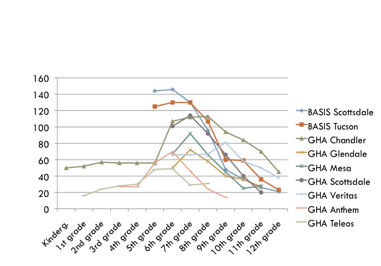
I also highlighted some recent reports about BASIS schools that document questionable methods for enrollment procedures, high attrition rates, and methods including “counseling out” of students who might negatively affect average school performance rankings (Safier, 2013; see also Welner, 2013). The figures above suggest that “highly-ranked” BASIS schools serve a privileged demographic; Safier’s story suggests that they likely select even further amongst that privileged group. Visually striking declines in student enrollment at Arizona’s BASIS and Great Hearts schools in 2010-2011 are evident in the figure below:

Enrollment Declines: Arizona’s BASIS and Great Hearts Schools
enrollment

Other researchers have highlighted declining enrollment numbers in the years nearing graduation at BASIS schools (see, for example, Casanova, 2012). BASIS school representatives responded (BASIS_Communications, 2012) by challenging interpretations of the low numbers shown in the data, albeit without adequately addressing Casanova’s main concern about the “enrollment drop across grades.” Casanova’s analysis highlights the low numbers of enrolled students in the upper grades. The graph displayed above raises a question of basic comparability: is it even fair to include these schools in a comparison with Arizona’s public schools, since they are not drawing a representative population of Arizona’s public school students?

Finally, Ann Ryman (2012) documented business practices within BASIS and Great Hearts Academy schools that reveal potential conflicts of interest between board members and owners (see, also, these comments from Gene V Glass, 2012, here and here). These charter school organizations make large profits at the expense of the government and community members, through fees, book purchases, and building contracts. Other investigators have highlighted questionable practices that provide considerable access to policy makers who influence Arizona’s lawmakers. For example, Mercedes Schneider (2013) created a map of Great Hearts political connections, highlighting significant access between CMO executives and policy makers who influence laws, including members at the Goldwater Institute and the American Legislative Exchange Council (ALEC).

The connections between executives of CMOs and policy leaders who influence lawmakers further complicate the problems of educational inequality and appear to provide charter schools with unfair competitive advantages. Children and taxpayers are the losers when public education dollars are at stake.

Citation:

Potterton, A. U. (2013). A citizen’s response to the President’s charter school education proclamation: With a profile of two “Highly Performing” charter school organizations in Arizona. Teachers College Record. Retrieved from http://www.tcrecord.org/Content.asp?ContentID=17309

References:

Arizona Department of Education (2013). Teleos Preparatory Academy > Great Hearts Academies- Teleos Prep. Retrieved from http://www10.ade.az.gov/ReportCard/SchoolSummary.aspx?id=90143&ReportLevel=1

BASIS_Communications. (2012, April 13). Re: The newest problem with graduation rates. [online forum comment]. Retrieved from http://www.washingtonpost.com/blogs/answer-sheet/post/the-newest-problem-with-graduation-rates/2012/04/12/gIQAwsH2DT_blog.html

Casanova, U. (2012, April 13). The newest problem with graduation rates. Retrieved from http://www.washingtonpost.com/blogs/answer-sheet/post/the-newest-problem-with-graduation-rates/2012/04/12/gIQAwsH2DT_blog.html

Glass, G. V. (2012, November 18). May I have the envelope please. And the Pulitzer for education reporting goes…. Retrieved from http://ed2worlds.blogspot.com/2012/11/may-i-have-envelope-please-and-pulitzer.html

Glass, G. V. (2012, December 2). “Judge us by our results”. Retrieved from http://ed2worlds.blogspot.com/2012/12/judge-us-by-our-results.html

Ryman, A. (2012, October 12). Insiders benefiting in charter deals. Retrieved from http://www.azcentral.com/news/articles/20121016insiders-benefiting-charter-deals.html

Safier, D. (2013, April 17). BASIS charter’s education model: Success by attrition. Retrieved from http://blogforarizona.net/?p=645

Schneider, M. (2013, March 25). Arizona education: A pocket-lining, “conflict of interest” mecca. Retrieved from http://deutsch29.wordpress.com/2013/03/25/arizona-education-a-pocket-lining-conflict-of-interest-mecca/

U.S. Department of Education. Institute of Education Sciences, National Center for Education Statistics. (2013). Search for schools, colleges, and libraries. Retrieved from http://nces.ed.gov/globallocator/

Welner, K. G. (2013, April). The dirty dozen: How charter schools influence student enrollment. Teachers College Record. Retrieved from http://nepc.colorado.edu/publication/TCR-Dirty-Dozen

In recent years, Indiana has gone overboard for charter schools, believing that they held the secret to raising the test scores of low-income students.

But blogger Steve Hinnefeld analyzed the passing rates by income levels and discovered that public schools outperform charter schools in Indiana.

He wrote:

“I merged Department of Education spreadsheets with data on free and reduced-price lunch counts and ISTEP-Plus passing rates. Then I sorted by free-and-reduced-lunch rates and focused on schools where 80 percent or more students qualified for lunch assistance. Results include:

“For charter schools: Average passing rate for both E/LA and math, 48 percent; passing rate for E/LA, 62.3 percent; passing rate for math, 62.5 percent.

“For conventional public schools: Average passing rate for both E/LA and math, 57.2 percent; passing rate for E/LA, 64.1 percent; passing rate for math, 68.1 percent.

“The data set includes only schools that enroll students in grades 3-8, who take ISTEP exams; it excludes high schools and many primary-grade schools. I also tried to screen out nonstandard schools such as juvenile detention centers and dropout recovery schools.”

He also reported that fewer charter schools get high grades from the state than public schools.

Not what you would call a high-performing sector, despite the boasting and promises.

Stephanie Simon writes in Politico.com that Arne Duncan is not really in favor of Common Core. Common what? Common who? Never heard of it. Ah, how soon politicians forget what they said last week, last month, last year. And they expect us to forget too.

She writes:

“COMMON CORE LOSES ITS BIGGEST CHEERLEADER: It was less than a year ago that Education Secretary Arne Duncan delivered a no-holds-barred defense of the Common Core in a speech to newspaper editors. He cited example after example of the benefits of common standards: Teachers in different states could use the same lesson plans; children of military personnel could move across country “without a hitch” in their schooling; and, first and foremost, “a child in Mississippi will face the same expectations as a child in Massachusetts.” In short: “I believe the Common Core State Standards may prove to be the single greatest thing to happen to public education in America since Brown v. Board of Education,” Duncan said.
— That was then. This was Tuesday: “Just to be very clear with this group,” Duncan told the House Appropriations Committee, “I’m just a big proponent of high standards. Whether they’re common or not is sort of secondary.”
— Duncan immediately added that his stance was “not news.” And his spokeswoman, Dorie Nolt, later pulled up audio from a press breakfast in January where Duncan was asked about whether the term “Common Core” was politically radioactive. “We’re not interested in the term,” he responded then. “We’re interested in high standards. There are a couple ways to come at it.” Indeed, the administration has never required states to adopt the Common Core; it just offered financial and policy incentives to adopt higher standards – and embracing the Common Core happened to be by far the quickest and easiest way to hit that bar.”

So what gives?

Here are some possibilities:

1. The Common Core standards have become so controversial that Duncan wants to pretend he had nothing to do with them.

2. Duncan has been warned by his advisors that his support and Obama’s is actually dragging down the poll numbers for the Common Core so the best way to help them is to back off.

3. Someone is planning to sue the U.S. Department of Education for illegally interfering in curriculum and instruction by supporting the Common Core, so Duncan must pretend he had nothing to do with their swift adoption by 45 states. His lure of $4.3 billion was just a coincidence.

4. Duncan realized that his cheerleading contradicted his insistence that the Common Core was “state-led.”

Can you think of another reason that Duncan forgot that only a year ago he said the Common Core was the most important development since the Brown decision?

Parent leaders from across Néw York City are rallying tomorrow at 4 pm to protest Governor Cuomo’s deal to give more space, more money, and free rent to the charters that enroll 6% of the children in the city’s schools. This giveaway to billionaire-funded charters occurs at the same time that many public are overcrowded, and class size is at its highest point in 15 years.

BREAKING:

Rally at NY Public Library and March On Governor Cuomo’s Office Tomorrow to Draw Hundreds of Outraged Parents from All Over City

Elected Parent Leaders from Citywide and Community Education Councils Across five boroughs Unite Against Gov. Cuomo’s Attacks on Public Education and Demand Fair Treatment of Public School Students

In an unprecedented show of unity, elected parent leaders and public education advocates from all five boroughs will gather to say all kids matter and to protest the selling off of public school buildings by Governor Cuomo and the State Senate leaders to the charter school lobby, by giving preferential rights and funding to the 6% of New York City students in charter schools while the needs of 1.1 million public school students remain unmet.

WHEN: Thursday, April 10, at 4 PM.

WHERE: Steps of the NY Public Library, Fifth Ave. at 41st Street. Following the rally participants will march to the Governor’s Office at 633 Third Avenue at 40th Street.

VISUALS: Parents, advocates, and students holding balloons, signs and flashing fake money.

WHO: Council Education Chair Danny Dromm, State Senator Bill Perkins, NAACP Head Hazel Dukes, former Council Education Chair Robert Jackson, other Council Members, parents, advocates and students, led by Community Education Councils and Citywide Councils from all five boroughs, elected by parents to represent their 1.1 million public school children.

WHAT: Community Education Council members, parents, advocates, and students, educators and elected officials protest how Governor Cuomo and legislative leaders are creating a two-tiered education system, in which the charter school lobby will now be given veto power over New York City’s public school buildings, and any new or expanding charter will be provided free on-demand public school space or private accommodations paid for by the city. Meanwhile, public school students – a majority of whom sit in overcrowded classrooms, buildings and trailers – have no such rights, and still wait for the equitable funding from the State as promised by the state’s highest court in the Campaign for Fiscal Equity decision.

Co-sponsored by Citywide and Community Education Councils; Alliance for Quality Education (AQE); Brooklyn New School PAC; Change the Stakes; Class Size Matters; ICOPE (Independent Commission on Public Education); MORE; New York Communities for Change (NYCC); New York Lawyers for Public Interest; NYCORE; NYCpublic.org; ParentVoicesNY; Parent Leaders of Upper Eastside Schools (PLUS); Partnership for Student Advocacy; Teachers Unite; Time Out from Testing, WAGPOPS (list in formation)

Yesterday I gleefully reported that Karen Klein, who writes editorials about education for the Los Angeles Times, had opted her own daughter out of the state test. The Los Angeles Times has supported most aspects of what is called “reform ,” so I was glad to see that Klein had realized how the current overuse of testing had undermined the love of learning , not only for her child, but for all children. Far be it from me to criticize anyone for changing their mind. Klein has a powerful role, and her epiphany could signify a recognition by the LA Times of the harm that standardized testing inflicts when allowed to become both the measure and the goal of education.

Robert Skeels was not so forgiving.

He writes:

“I’m glad that you’re sparing your own child the abject effects of this year’s test. However, I recall sitting across a table from you in early 2013 when you conducted the school board endorsement interviews and having to endure your scoffing at me for suggesting that we end the high-stakes standardized test regime for all students. Your exact words were “if we do that, we’d go back to the ‘Johnny Can’t Read’ days.” I remember how astonished I was that a professional journalist covering education could be so ignorant of pedagogy that they’d cite Flesch’s right-wing phonics garbage as their defense of the unholy policy trio of No Child Left Behind, Race to the Top, and Common Core State Standards.

“So don’t expect those of us who have been trying to defend all children from the effects of standardized tests—the worst of which robs them of that very fleeting joy of learning—to welcome you aboard. Unlike your offspring, privileged in every regard, there are countless other children who have had their opportunity to love learning stolen by mind numbing test preparation in the name of profits and propaganda.”

I understand Skeels’ anger. But I will welcome the repentant sinner into the fold with open arms if she does understand that her decision was not just about what’s best for her child but what’s best for all children. If her views change the LA Times’ editorial policy on high-stakes testing, then I count it as a signal victory for those who have fought this issue for many years, including Robert Skeels.

I know how hard it is to change sides, to admit error, to admit in public that you were wrong.

Those who oppose the current misuse of testing should seek more converts and welcome them with own arms.

Charter schools regularly mobilize students and parents, put them on buses, and ship them to legislative hearings dressed in identical tee-shirts to lobby for more charter schools or more funding. This works to the benefit of the billionaire hedge fund managers who control these charters, as it expands their power to create even more racially segregated schools while boasting of their leadership in “civil rights” activism. These tactics also demonstrate that charter schools are not public schools. No state would allow a superintendent or a principal to bus their students and parents to demand more funding. This is nothing more than a cynical use of children as political pawns.

The article included a graph showing the rapid growth of charter schools, which was abetted by the Obama administration’s Race to the Top. States had to lift their cap on charters to be eligible for RTTT’s $4.3 billion in funding. To show how bipartisan this effort is to create more segregated schools, note that the CEO of the National Alliance for Public Charter Schools, Nina Rees, previously worked as a senior education advisor to Vice President Dick Cheney.

The hearings occur with this backdrop: top officials at UNO, Chicago’s largest charter chain, resigned after disclosure of alleged nepotism and conflicts of interest in spending $98 million of state funds for new construction; the Chicago Sun-Times published a study showing that charters do not outperform district public schools; the Noble Network of charter schools, financed by some of the city’s wealthiest citizens, collected $400,000 in fines for minor disciplinary infractions from low-income families.

This story appeared in the Wall Street Journal:

Charter-School Fight Flares Up in Illinois

Protesters Rally at Capitol to Denounce Bills That Would Curb Growth of the Public Schools

By STEPHANIE BANCHERO
April 8, 2014 9:16 p.m. ET

Hundreds of protesters filled the rotunda of the Illinois State Capitol on Tuesday denouncing nearly a dozen bills that would curb the growth of charter schools—the latest scuffle over expansion of the independently run public schools, which are spreading nationwide.

The Illinois legislature is considering 11 bills that would, among other things, limit where charter schools can be located, ban them from marketing themselves to students, and abolish a commission that has the power to overrule local school boards and grant charter licenses. The skirmish follows recent charter flare-ups in Massachusetts, Tennessee and New York, where Gov. Andrew Cuomo and New York City Mayor Bill de Blasio got into a standoff over the schools.

Teachers unions often oppose charters—funded by taxpayers but run by independent groups—because they typically hire nonunion workers and, labor leaders argue, drain money from struggling traditional public schools. Proponents say charter schools offer parents a choice and are free to adopt innovations such as instituting a longer school day and year, or laying off teachers based strictly on performance.

Andrew Broy, president of the Illinois Network of Charter Schools, said this year’s legislative session is the “worst session for charter schools in the history of Illinois” and said passage of the bills could be the “death knell” for charter expansion. “These bills…weaken the communities that charter schools serve, which, in Illinois, are mainly African-American and Latino.”

Others say the bills, many of which are being pushed by teachers unions, are necessary to boost accountability and provide a check on charter-school growth. Karen Lewis, president of the Chicago Teachers Union, said charters exacerbate inequality and segregation in schools by “skimming off” more advantaged students. She also noted data showing Chicago charters, on average, have higher suspension and expulsion rates than other city schools.

“Charters are being used to destroy traditional public schools and, in this budgetary climate, we see no reason to open more of them,” she said.

In the past decade, the number of charter schools more than doubled to 6,440 nationwide and student enrollment more than tripled to an estimated 2.6 million, according to the National Alliance for Public Charter Schools, a nonprofit that advocates for charters. Still, that is only about 5% of total public-school K-12 enrollment in the U.S., according to the group.

Nina Rees, the group’s president, said charters’ rapid growth makes them a prime target for opponents, and she worries that a “union win” in Illinois could “embolden” those in other states. “It could send a message that if they [unions] gather enough momentum and coalesce, they can win,” she said.

Ms. Rees and others also are concerned that the recent skirmishes highlight a political divide among Democrats, who had been seen as increasingly supportive of charters. Both Mr. de Blasio, who sought to rein in charters, and Mr. Cuomo, who wants to see them flourish, are Democrats. The governor eventually negotiated a budget deal mandating that the city provide charters space inside traditional school buildings, but also included money for expansion of regular public-school pre-K programs, which the mayor wanted.

In Chicago, shrinking public-school enrollment and the budget deficit prompted Mayor Rahm Emanuel to close about 50 schools last year. But the board of education, appointed by the mayor, this year approved opening seven new charters, incensing the teachers union and many community activists. A few months later, the state launched an investigation into spending at one of the city’s largest charter organizations.

Charter tensions, which had been largely confined to Chicago, moved to the suburbs when a group tried to open an online charter school last spring that would draw students—and revenue—from 18 communities. Local school boards voted it down, but the group appealed to a new state commission with the power to overrule the local bodies. State lawmakers enacted a moratorium on virtual schools so the issue became moot.

But Rep. Linda Chapa LaVia, a Democrat who represents some of the suburban districts, said the specter of a commission trumping local wishes prompted her to file a bill to eliminate it, only a few years after she voted to create it. Ms. Chapa LaVia said she didn’t realize at the time the group would have “so much power” and said she opposes “an outside authorizer who can overrule a school board.”

Lucy Reese, who attended Tuesday’s rally and is the mother of two charter-school students, said parents should have the right to choose the best school for their children. “I am not going to get a lot of second opportunities when it comes to educating my kids,” she said.

Write to Stephanie Banchero at stephanie.banchero@wsj.com
In a big step forward for real school reform, Néw York City Schools Chancellor Carmen Farina announced that promotion would no longer be based in a single standardized test, but on multiple measures. This is a major change from the Bloomberg era, when test scores were the single most crucial determinant of whether students would be promoted or failed.

Here is the announcement:

CHANCELLOR FARIÑA ANNOUNCES NEW PROMOTION POLICY FOR STUDENTS IN GRADES 3-8

Multiple Measures to Replace State Test as Driver of Promotion Decisions

Schools Chancellor Carmen Fariña today announced changes to the Department of Education’s promotion policy for students in grades 3-8 with standard promotion criteria. The proposed new policy, upon approval of the Panel for Educational Policy (PEP), would go into effect this school year in order to comply with recent changes in State law and to allow educators to make decisions about the students they know best while maintaining high standards. The policy will be voted on at the PEP meeting in May.

“We have listened and worked closely with families, teachers and principals to establish a new promotion policy that complies with State law and empowers educators, takes the temperature down around testing, and keeps rigorous standards in place,” said Schools Chancellor Carmen Fariña. “This new way forward maintains accountability, but mitigates the unintended consequences of relying solely on a single test. Through a comprehensive evaluation of student work using multiple measures, our new policy is a step forward for students, parents, and schools.”

“It’s absolutely vital that students are ready to succeed in the next grade when they are promoted. The best way to do that, as the governor and legislature have affirmed, is to use multiple measures to make sure students are ready for promotion,” said New York Education Commissioner John King. “We’ll work together with NYCDOE to make sure all our students are on the path to college and career readiness.”

Ten years ago, the DOE implemented a student promotion policy based on State exam scores. That approach, while intended to raise expectations for all students, often led to teachers “teaching to the test” and caused a great deal of anxiety in school communities.

Going forward, instead of having student promotion from one grade to the next based solely on exam results, teachers and principals will now determine which students are at risk of not making sufficient progress based on a more comprehensive, authentic review of their classroom work in addition to their test scores. This shift to multiple measures represents another important step toward aligning our teaching with the more rigorous Common Core standards. This new approach will bring New York City in accordance with other districts in the State and with the recent changes to the State law.

To develop the new policy, the Department consulted with and gathered feedback from families, teachers, principals, and education advocates. Many identified that, under the current policy, a student’s body of work over the course of the entire year was overlooked in favor of a single, standardized exam. To remedy those concerns and incorporate multiple measures in accordance with State law, the DOE plans to implement several important changes:

· Empowering Educators – Based on a review of student work from the year, teachers and principals will identify the students they believe may be at risk of not being able to succeed in the next grade, even with support. State test results for the lowest-performing students will continue to be shared with schools in June. Schools may use this information as one of multiple pieces of evidence to assess student readiness for the next grade level, but they may not use it as the primary or major factor in those decisions.

· Authentic Student Work – Teachers will complete promotion portfolios for students identified for possible retention. The guidance provided to schools about this process will be revised so that student promotion portfolios align to the Common Core, represent real classroom learning, and incorporate student work already completed throughout the school year.

· Consistent, Rigorous Standards – The reviews of student portfolios in schools across the city will be judged against clear, consistent, criteria aligned to the Common Core. Superintendents will oversee this process for their schools.

“The NYC Department of Education’s new promotion policy reflects the best available research and is good common sense,” said Dr. Linda Darling Hammond, Professor of Education at Stanford Graduate School of Education. “Students are more than test results, and this sound policy reflects that fact. Promotion decisions will be based on multiple measures and will consist of a comprehensive review of the skills they’ve learned in the classroom. In addition, children will receive more useful supports to improve their skills so they can progress on a solid foundation.”

“The new promotion policy recognizes the scientific consensus that promotion and retention decisions should never be based solely on a child’s performance on a single standardized test,” said Dr. Aaron Pallas, Professor of Sociology and Education at Teachers College at Columbia University. “This change returns the responsibility of assessing a child’s readiness for the next grade to the educators most knowledgeable about his or her academic performance throughout the school year — the child’s teacher and principal.”

“Although the old policy was designed to end social promotion through grade retention, thousands of students were still entering high schools throughout New York City unprepared academically,” said Dr. Pedro Noguera, Professor of Education at Steinhardt School of Culture, Education and Development at New York University. “The Chancellor’s proposal will provide schools with a broader range of tools with which to assess a student’s performance. If these can be combined with effective, early interventions, we should see a significant increase in the number of students who graduate from high school college ready.”

As in past years, students whose promotion portfolios demonstrate that they are not ready for the next grade level, even with support, will be recommended for summer school. Superintendents will review school-level decisions before they are finalized. In the past, when students completed summer school, their promotion was ultimately tied to a second standardized test in August. This year, student work from summer school will be incorporated into the promotion portfolio. Principals will review these portfolios in August and make a holistic promotion decision for each student. Superintendents will continue to review promotion appeals for cases in which a parent disagrees with the principal’s decision.

In 2013, consistent with prior school years, approximately 10% of students in grades 3-8 were recommended for summer school, with 2.5% ultimately retained. The DOE anticipates consistent levels of retention with this new approach.

Students with disabilities and English language learners who have different promotion criteria will not be impacted by this change in policy. Moreover, the promotion policy for students in grades K-2 and high school will remain consistent with previous years.

The new policy requires a revision to the Chancellor’s Regulation A-501, which will be voted on by the Panel for Educational Policy at its May 29, 2014 meeting. If the PEP approves the policy, the revised policy will go into effect this year.

Jersey Jazzman reports on Camden’s portfolio district plan.

What does that mean? More charters.

What is the secret of their success?

Excluding children with disabilities.

Excluding the kids with the highest needs.

Doesn’t federal law prohibit this?

Apparently this is not a priority for the U.S. Department of Education or the Obama administration.

As hedge funders will sometimes acknowledge, those kids are not our problem.