Archives for the year of: 2014

This is the most absurd “report” yet. This organization says that the U.S. does not have an “efficient” school system. Finland has the most efficient school system. What can we do to become more efficient? Cut teachers’ salaries and increase class size.

Funny, when I visited Finland in 2011, I saw many classes, none larger than 16. Teachers’ pay is equivalent to U.S. pay.

“The Efficiency Index –which education systems deliver the best value for money? was released today.

US ranks nineteenth out of thirty countries in new ranking of education system efficiency

Released 19.01 EDT Thursday September 4 2014

The US ranks in the bottom half of a new international comparison of the efficiency of education systems across OECD countries – lower than Japan, Korea and many northern European countries.

The Efficiency Index –which education systems deliver the best value for money?, commissioned by GEMS Education Solutions, is the first comprehensive international analysis that looks at how efficiently education budgets are allocated in each country.

It ranks 30 OECD countries based on their expenditure on teacher costs, which account for 80 per cent of education budgets, and the pupil outcomes they achieve. In this way, it calculates which system generates the greatest educational return for each dollar invested.

The report is written by Professor Peter Dolton, Professor of Economics at Sussex University and a Senior Research Fellow at the Centre for Economic Performance, London School of Economics; Dr Oscar Marcenaro Gutie�rrez, Associate Professor at the University of Ma�laga; and Adam Still, Education Finance and Development Specialist at GEMS Education Solutions.

The index ranks Finland as the most efficient country in the OECD. According to the index’s econometric model, which calculates the proven statistical link between teacher salaries or class size and PISA scores, the US could match Finland high PISA’s results and still make efficiency savings by increasing class sizes and making a modest cut in teacher salaries. It finds that these results could be achieved even if the US was to increase its pupil/teacher ratio by 10 per cent.

Alternatively, if it were more efficient, the US could match Finland’s PISA results and still reduce teacher salaries by 4.7 per cent from the US average teacher salary of $41,460 to $39,520. The index argues that the US should consider addressing both teacher salary and class sizes to improve its education efficiency. As the largest country in the OECD, its overall education spend is five times that of any other country in the study and its teacher salaries are comparatively high.

The report stops short of advocating particular changes to salaries or class size in each country. It makes clear that there may be labour market, cultural, economic or political reasons why this ‘maximum’ efficiency is not possible without negative consequences. The authors have not examined the practical impact of such changes in each country. However, by showing how far countries fall short of the OECD’s most efficient system, the index provides an instructive point of comparison when Governments are allocating budgets.

The report groups the countries according to their efficiency:

1. Elite Performers: Finland, Japan and Korea score very well in both the efficiency and quality stakes.

2. Efficient and Effective: Australia, Czech Republic, New Zealand and Slovenia are all performing relatively well on efficiency and producing high PISA scores.

3. More Effective than Efficient: Overspending (too high salaries) or bloated (too many teachers): Austria, Belgium, Denmark, Germany, Ireland, Italy, Netherlands, Portugal, Spain, Switzerland. These countries perform better in terms of quality than efficiency. This may be because their system generates other outcomes that aren’t captured by PISA rankings. Alternatively, it may be because their systems are over-resourced beyond the threshold required to achieve high educational outcomes.

4. More Efficient than Effective: Underspending or underperforming: Czech Republic, France, Hungary, Iceland, Israel, Norway, Sweden, UK and USA. These countries are more efficient than educationally effective. This could be because they have resource constraints that prevent them from improving quality such as low salaries may prevent the recruitment of highly skilled teachers. Alternatively, if extensive resources are already being spent, it could that the education system is flawed – and that policy changes, rather than additional resources, would improve education outcomes.

5. Inefficient and Ineffective: Brazil, Chile, Greece, Indonesia, Turkey These systems are inefficient and at the same time fail to produce good pupil outcomes.

The report finds that changes to teacher salary and pupil teacher ratio can improve efficiency because, out of 63 different inputs into the education system – from teaching materials to infrastructure – these were the only two that had a statistically significant impact on pupils’ PISA scores.

This is a powerful insight for policy makers since, unlike a child’s socio-economic background, parental support, or a child’s aspirations, governments have the policy levers to change both teacher salary and class sizes.

The report acknowledges that some countries, such as Switzerland and Germany, which both spend lavishly on their education system and achieve good results, may choose to pursue policies in which educational efficiency is not their priority. For instance, they may feel that PISA does not capture all the student outcomes that their system is aiming for.

Together, the 30 OECD countries in the study spent $2.2 trillion dollars on their education systems each year, and the average proportion of GDP that countries spend on education has been rising for decades. In an environment where state education budgets are likely to continue to be stretched and face competition from other spending priorities, the Efficiency Index sheds light on the effectiveness of the spending choices that policy-makers are currently making.

KEY FINDINGS:

Over the last 15 years Finland’s education system has been the most efficient in the OECD. Other high performers include Korea, Japan and Hungary and the Czech Republic. In contrast, Mediterranean countries such as Greece, Spain, Portugal and Italy exhibit low efficiency.

Excellent outcomes are still possible with relatively large class sizes – despite a focus on reducing class-sizes in many western education systems. Finland and Korea, the two countries studied with the most efficient education systems, achieve good results, have relatively large class sizes – the 3rd and 5th largest of the OECD countries – and pay teachers moderate wages.

The US is in the bottom third of the efficiency index. As the biggest OECD country, it has an overall education spend five times higher than any other country in the study and pays very high teachers salaries.

Countries can be inefficient if they both underpay or overpay teachers. Some countries such as Indonesia and Brazil are inefficient because their low teachers pay makes it hard to recruit and retain high-calibre individuals into the profession. Modest extra expenditure would result in significantly better educational outcomes. Equally, higher salaries given to teachers who are already achieving excellence, such as those paid in Switzerland and Germany, may fail to increase performance and therefore harm efficiency.

In general those countries that demonstrate high efficiency also attain high educational outcomes. Five out of the top ten countries in the Efficiency Index are also in the PISA top ten.

Chris Kirk, Chief Executive, GEMS Education Solutions:

“GEMS Education Solutions commissioned the efficiency index to inform the debate about which items of educational expenditure are likely to make the greatest impact on the attainment of children.

It allows us to see which systems around the world produce the best results per pound, providing a data driven analysis that can inform policy choices. It clearly shows that some countries spend their available resources more efficiently than others.

“At a time at which many countries are struggling with tight public budgets. It also sends an important message to poorer countries that significant educational improvement is possible even with limited investment.”

When local school board members in Lee County and Palm Beach County began talking about opting the entire district out of state testing, the state warned them they would face punishment if they dared.

“But the district better be prepared to pay the price of skipping the new exam — quite literally. Skip the exam and the state is likely to withhold money.

“The ramifications could be pretty dramatic for a district that wanted to do this,” says Florida Department of Education spokesman Joe Follick. “This is uncharted waters. No districts have done this.”

“Follick added the state could withhold state funds, grants and lottery money. Lawmakers could decide on additional sanctions, he said. Most K-12 public school operations are funded through the state.

“School board members say opting out an entire school district is unlikely.

“I believe in assessment,” Palm Beach school board member Karen Brill said last week. “I believe in testing that’s used for measurement, not punishment. I believe that we as a district need to research opting out from the new Florida Standard Assessments.

“Sometimes it takes an act of civil disobedience to move forward.”

A large coalition of parent and educator groups in New York State developed a scorecard for voters in the Democratic primary on September 9 and the general elections in November. They concluded that Governor Andrew Cuomo was the candidate likeliest to support privatization of public education. Here is their press release:

FOR IMMEDIATE RELEASE:

More information contact:

Eric Mihelbergel (716) 553-1123; nys.allies@gmail.com
Lisa Rudley (917) 414-9190; nys.allies@gmail.com

NYS Allies for Public Education (NYSAPE) http://www.nysape.org

Governor Cuomo’s Education Positions Aligned to Privatize Public Education

New York State Allies for Public Education (NYSAPE), a coalition of more than fifty parent and educator advocacy groups throughout the state, released a scorecard http://www.scribd.com/doc/238348598/NYSAPE-Gubernatorial-Candidate-Scorecard-2014 comparing the key education positions of the candidates running for Governor. NYSAPE personally communicated with all the candidates’ campaign teams. NYSAPE is committed to communicating the most accurate information on issues that matter to parents, teachers, and other friends of public education. New Yorkers who care about public education will have a clear choice for the Democratic primary on September 9 and for the general election on November 4.

Governor Cuomo is the only candidate among the five who supports the Common Core standards. When it comes to the hot-button issue of teacher tenure, Rob Astorino opposes the law as it stands now. Zephyr Teachout, Howie Hawkins, and Randy Credico support teacher tenure. However, the Governor is noncommittal as his reply was, “Any change to the current law would have to be carefully reviewed”. Similarly, the four challengers are opposed to keeping John King as Education Commissioner. The Governor’s response to NYSAPE was, “It is inappropriate to comment on specific individuals in this context”.

The four challengers also oppose APPR, which ties teacher evaluation to student test scores, while the Governor, a prime sponsor of the law which created the system, fully supports it. All candidates support significantly rolling back time spent on standardized testing. However, the Governor claims that the recent legislation banning K-2 testing and capping test prep time will significantly roll back testing. In reality, it does nothing to reduce standardized testing time for 3rd through 8th grade students.

As to education spending, the Governor opposes fully funding Foundation Aid, Rob Astorino is noncommittal and said “it depends on the state’s financials”, while the other three candidates – namely Zephyr Teachout, Randy Credico and Howie Hawkins – all support full funding. The candidates are similarly polarized when it comes to charter schools. The Governor supports the expansion of charter schools; Astorino who supports charters schools is noncommittal to the expansion, while the other three candidates do not support their expansion.

Lisa Rudley, Westchester County public school parent and founding member of NYSAPE said, “Governor Cuomo has failed to listen to parents and he continues to ignore our concerns. Unlike every other candidate, he does not oppose keeping John King as Commissioner, who has disrespected our views when it comes to our opposition to the Common Core and our need to protect our children’s privacy.”

Jeanette Deutermann, Nassau County public school parent and founder of Long Opt Out said, “We must put an end to the test obsession that has hijacked our classrooms. It’s clear from this scorecard that Governor Cuomo, while he claims he supports a significant rollback, his record says otherwise.”

“The governor boasts the passage of four on-time budgets in a row and that he closed the budget gap. Do not be fooled; these claims are self-serving at best. Cuomo siphoned billions of precious dollars away from public education to satisfy cronyism and business interests. We must remember this come September’s Democratic primary election and November’s general election,” said Anna Shah, Dutchess County public school parent.

“Governor Cuomo used his power in Albany to subsidize charter schools in NYC at the expense of our public schools and against the wishes of our democratically-elected mayor,” said NYC public school parent, Nancy Cauthen. “Our neighborhood public schools are hugely overcrowded, with thousands of students sitting in trailers or on waiting lists for kindergarten. And now city taxpayers will have to provide charter schools space in our public school buildings on demand or pay for their rent in private space,” Cauthen further stated.

“NYSAPE is providing this scorecard because it is imperative that voters in New York understand the positions of each candidate running for Governor. APPR, the teacher evaluation system imposed by the Governor, is harming students and teachers who are unfairly judged by this damaging system,” said Katie Zahedi, Dutchess County principal at Linden Avenue Middle School in Red Hook, New York.

“I find it startling that Governor Cuomo won’t commit to supporting teacher tenure, but says that he would have to ‘carefully review’ the law. It is only because of tenure that teachers have the courage to stand up for their students when student rights are abused,” said Chris Cerrone, Erie County public school parent, special education teacher, and Springville-Griffith Institute CSD Board Member.

Tim Farley, Columbia County public school parent, educator, and member of NYSAPE said, “The current Governor refuses to listen to the concerns of parents and educators from across the state to make major course corrections in his educational policies. We demand an end to high-stakes testing and the flawed APPR system, and we want our children’s sensitive data protected once and for all. If he refuses to listen, we will put someone else in office who will.”

###

A district court judge in Baton Rouge ordered State Superintendent John White to release information about setting cut scores.

Veteran educator Mike Deshotels posted this on his blog:

“Breaking News: On Thursday, August 28, Judge Bob Downing of the 19th Judicial District Court in Baton Rouge ordered State Superintendent John White and the LDOE to produce detailed information about the setting of cut scores for the Mastery level student ratings for the 2014 Spring LEAP test that was designed to be more aligned with the Common Core standards. The LDOE had already released the minimum percentages of correct answers used for the setting of Basic level ratings just before the lawsuit demanding this information was filed. John White was found to be in violation of the public records law for refusing to release the score setting percentages on the 2014 LEAP test and for failing to produce the written communications with the testing company relating to the setting of cut scores. The LDOE was also required to pay all court costs and attorney’s fees necessary to the prosecution of my public records lawsuit filed to extract this vital information from White, the LDOE, and the testing company. This post on The Louisiana Educator Blog had already analyzed the drastic lowering of the minimum percentage of correct answers on some areas of LEAP apparently designed to imply that Louisiana students were doing just fine on the new CCSS aligned tests. Apparently manipulation of test scores to produce predetermined results has now become standard operating procedure in the implementation of Common Core. The video referred to above shows how scores were set in New York to create the perception of failure of the entire New York state system.”

It is striking and sad that judges are now deciding basic education issues or that people have to appeal to judges to get basic information that ought to be available to the public.

This post by Jersey Jazzman is part of a dialogue about Cami Anderson’s “One Newark” plan to close public schools and open charter schools in their place, without consulting with the school board or the community. Mark Weber, aka Jersey Jazzman, asks, whether the plan is racist? Does it have a disparate impact on black students and black teachers? Jersey Jazzman says yes.

Anthony Cody was not heartened by Marc Tucker’s vision of a new accountability system with fewer tests. In this post, he explains why. If ever there was a need for close reading, he believes, this is it.

Cody writes:

“Tucker’s plan is confusing. In a proposal in which accountability remains closely tied to a set of high stakes tests, Tucker cites the “Failure of Test-based Accountability,” and eloquently documents how this approach doomed NCLB.

“Tucker speaks about the professionalization of teaching, and points out how teaching has been ravaged by constant pressure to prepare for annual tests. But his proposal still seems wedded to several very questionable premises.

“First, while he blames policymakers for the situation, he seems to accept that the struggles faced by our schools are at least partly due to the inadequacy of America’s teachers. I know of no objective evidence that would support this indictment.

“Second, he argues that fewer, “higher quality” tests will somehow rescue us from their oppressive qualities. He also suggests, as did Duncan in 2010, that we can escape the “narrowing of the curriculum” by expanding the subject matter that would be tested.

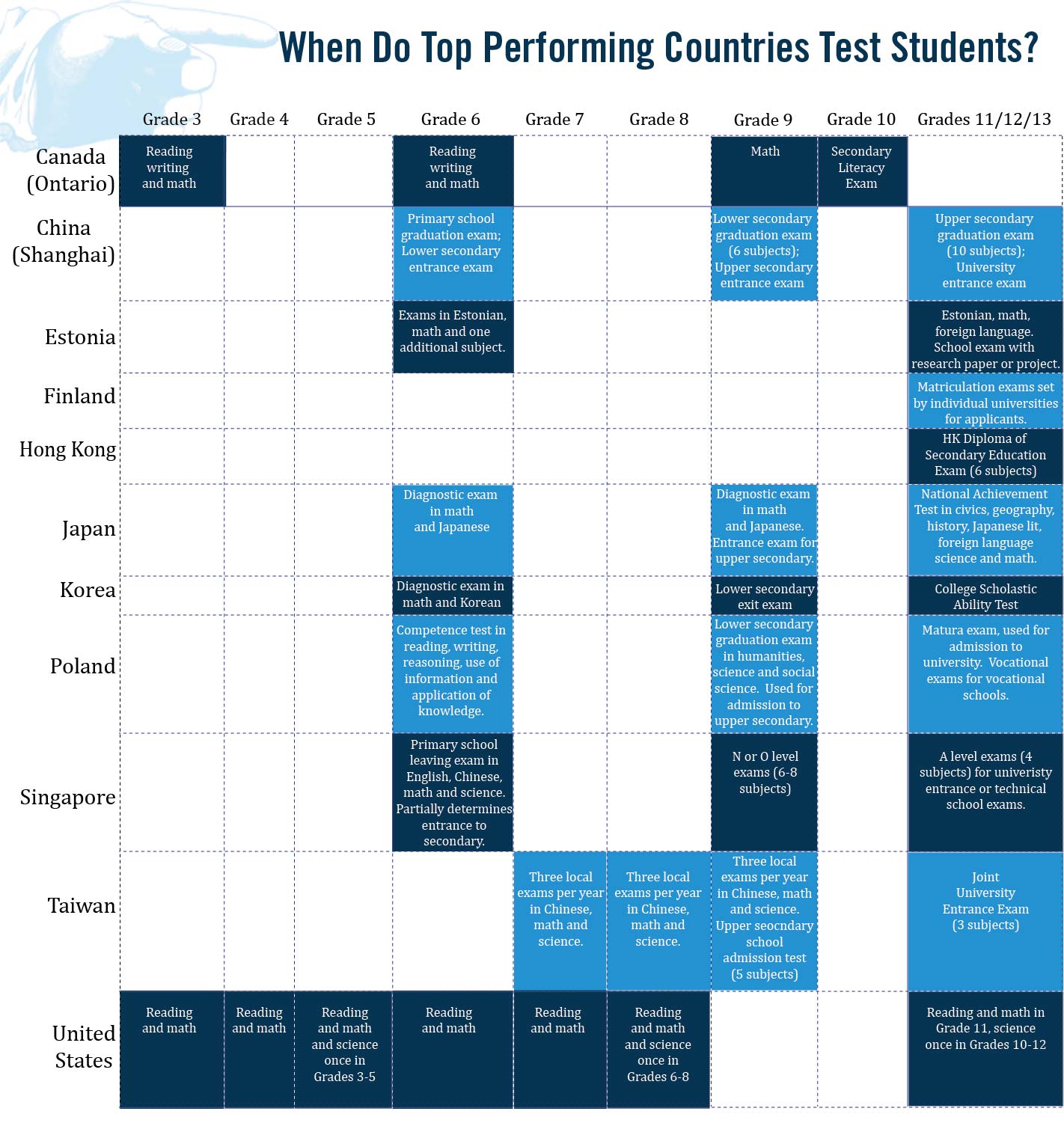
“It is worth noting that many of the Asian countries that do so well on international test contests likewise have fewer tests. This chart shows that Shanghai, Japan and Korea all have only three big tests during the K12 years. However, because these tests have such huge stakes attached to them, the entire system revolves around them, and students’ lives and family incomes are spent on constant test preparation, in and out of school.

“Third, and this is the most fundamental problem, is that Tucker suggests that the economic future of our students will only be guaranteed if we educate them better. Tucker writes:

“Outsourcing of manufacturing and services to countries with much lower labor costs has combined with galloping automation to eliminate an ever-growing number of low-skilled and semi-skilled jobs and jobs involving routine work.

“The result is that a large and growing proportion of young people leaving high school with just the basic skills can no longer look forward to a comfortable life in the middle class, but will more likely face a future of economic struggle.

“This does not represent a decline from some standard that high school graduates used to meet. It is as high as any standard the United States has ever met. And it is wholly inadequate now. It turns out, then, that we are now holding teachers accountable for student performance we never expected before, a kind and quality of performance for which the present education system was never designed. That is manifestly unfair.”

“Tucker then repeats what has become the basic dogma of education reform. The economy of the 21st century demands our students be educated to much higher levels so we can effectively compete with our international rivals. Education — and ever better education to ever higher standards — is the key to restoring the middle class.”

But Cody objects:

“I do not believe the economy of the 21st century is waiting for some more highly educated generation, at which time middle class jobs will materialize out of thin air.

“Corporations are engaged in a systemic drive to cut the number of employees at all levels. When Microsoft laid off 18,000 skilled workers, executives made it clear that expenses – meaning employees, must be minimized. Profits require that production be lean. There is no real shortage of people with STEM degrees.

“On the whole, it is still an advantage for an individual to be well educated. But the idea that education is some sort of limiting factor on our economic growth is nonsense. And the idea that the future of current and future graduates will be greatly improved if they are better educated is likewise highly suspect.

“Bill Gates recently acknowledged in an interview at the American Enterprise Institute, “capitalism in general, over time, will create more inequality and technology, over time, will reduce demand for jobs particularly at the lower end of the skill set.”

“This is the future we face until there is a fundamental economic realignment. Fewer jobs. Continued inequality and greater concentration of wealth.”

Cody argues for a different vision, in which accountability goes far beyond teachers and schools:

“For far too long educators have accepted the flagellations of one accountability system after another, and time has come to say “enough.”

“We need to learn (and teach) the real lesson of NCLB – and now the Common Core. The problem with NCLB was not with the *number* of tests, nor with when the tests were given, nor with the subject matter on the tests, or the format of the tests, or the standards to which the tests were aligned.

“The problem with NCLB was that it was based on a false premise, that somehow tests can be used to pressure schools into delivering equitable outcomes for students. This approach did not work, and as we are seeing with Common Core, will not work, no matter how many ways you tinker with the tests.

“The idea that our education system holds the key to our economic future is a seductive one for educators. It makes us seem so important, and can be used to argue for investments in our schools. But this idea carries a price, because if we accept that our economic future depends on our schools, real action to address fundamental economic problems can be deferred. We can pretend that somehow we are securing the future of the middle class by sending everyone to preschool – meanwhile the actual middle class is in a shambles, and college students are graduating in debt and insecure.

“The entire exercise is a monumental distraction, and anyone who engages in this sort of tinkering has bought into a shell game, a manipulation of public attention away from real sources of inequity.”

Cody says:

“We need some accountability for children’s lives, for their bellies being full, for safe homes and neighborhoods, and for their futures when they graduate. Once there is a healthy ecosystem for them to grow in, and graduate into, the inequities we see in education will shrink dramatically. But that requires much broader economic and social change — change that neither policymakers or central planners like Tucker are prepared to call for.”

Tom Moran, chief editorial writer for the Star-Ledger of New Jersey, responds here to the open letter written by three New Jersey bloggers, posted on their sites, and at blue jersey.com.

Here is Jersey Jazzman’s reply to Moran.

Moran was offended by the tone of the bloggers’ letter to him. The bloggers are offended by Cami Anderson’s One Newark” plan, which seeks to charterize large numbers of Newark’s public schools without consulting the Newark community.

Thank you to Politico magazine for naming me one of the Top 50 political figures whose ideas are making a difference.

The bio says “For standing up for teachers, not tests.”

I am honored to be in such illustrious company!

Marc Tucker writes that we test students more than any of the high-performing nations in the world.

Here is a graph that demonstrates the differences.

Tucker proposed a new accountability system for the U.S. that puts us more in line with common practice.

Here are his key points:

“The ideas outlined by Marc Tucker in Fixing Our National Accountability System signify a departure from conventional thinking on the issue of accountability. Rather than focus on punishing teachers for the results of a system that others designed, the core components of this report rest on three fundamental principles:

1) Testing: Instead of testing all of our students every year with low-quality tests, students would take high-quality accountability tests, covering a full core curriculum, only three times in their school career. In some off years, tests in math and ELA would be administered only to samples of students by computer and would not carry high stakes for teachers or students.

2) Use of Data: Data from these tests would be used to identify schools that might be in trouble, and to deploy a team of expert educators to assist in resolving the issues with the help of districts and/or states. This data would be available to the general public but it would not include a rank or grade.

3) Policies for Professionals: Enact policies that make it attractive for our nation’s strongest teachers and principals to work in the most at-risk schools – these very same policies would also make teaching an attractive career for some of our best high school graduates and transform teaching into a high status profession.”

Troy A. LaRaviere is principal at Blaine Elementary School. In this article in the Chicago Sun-Times, he explains how the city’s public schools got higher test scores than the city’s well-funded, politically favored charter schools. To my knowledge, the Chicago Tribune–a cheerleader for charters– has not reported this story, nor has Mayor Rahm Emanuel acknowledged it. Please let me know if I am wrong.

LaRiviere writes:

“In terms of assessing the effectiveness of charter schools, I believe the most accurate comparison is to public magnet schools since both charters and magnets have lottery admissions processes that increase the likelihood of enrolling students with involved parents. In essence, charters are privately run magnet schools and therefore should be measured against publicly run magnet schools. I believe that turnaround schools should be compared to neighborhood schools since they both must accept students within their attendance boundaries. Using the Sun-Times results, the comparisons are as follows:

“READING

* The most dramatic performance gaps are in reading, where the public magnet school growth percentile is 83, while the charter score is 48.

* The public neighborhood percentile is at 75, while turnarounds are at 51.

* Although neighborhood schools must enroll any student in their attendance boundary, their students’ reading growth percentile is 27 points higher than that of lottery-driven charters schools. Neighborhood schools are at 75 and charters are at 48.

“MATH

* In math, the public magnet school growth percentile is 67, while the lottery-driven charter schools are at 49.5 — over 17 points lower.

* The neighborhood school growth percentile is at 55 while the turnaround school percentile is at 43 — 12 points lower.

* Even with their admissions limitations, public neighborhood schools outperformed the growth in lottery-driven charter schools by more than five percentile points, with neighborhood and charter schools at 54.9 and 49.5 respectively.

“A simple look at a list of the schools reveals even more. Of the 490 Chicago schools for which elementary grade MAP data was available, 60 of those schools are charter (12 percent), 24 are turnaround (5 percent), and 406 (83 percent) are traditional public schools. When sorted by growth percentile rank, I found the following:

* Although charters and turnarounds make up 17 percent of district schools, they account for none of the 60 schools with the highest growth percentiles.

* Of the 30 lowest performing schools in CPS more than half are charters or turnarounds.

* Of the 10 lowest-performing schools in CPS, seven are charters or turnarounds.

* Nearly nine out of 10 charter/turnaround schools are in the bottom half of CPS performance.

“In summary, charters and turnarounds are overrepresented among the schools with the lowest student growth, and not represented at all among schools with the highest student growth.”