Archives for the year of: 2014

Parents and teachers in New York are angry bout the state tests. There are protests and demonstrations taking place outside many schools. Last year, when the state gave the first Common Core tests, the scores plummeted. Only 31% of the students in grades 3-8 passed because the passing mark was set artificially high by State Commissioner John King, who sends how own children to a private Montessori school that does not take the Common Core tests.

Why the outrage?

Liz Phillips, principal of PS 321 in Brooklyn, explains in this article. She can’t describe the questions because she is under a gag order imposed by the state and test maker Pearson. Neither she nor the teachers understand why the tests lasted more than three hours.

Not allowed to discuss the content of the test, she writes:

“In general terms, the tests were confusing, developmentally inappropriate and not well aligned with the Common Core standards. The questions were focused on small details in the passages, rather than on overall comprehension, and many were ambiguous. Children as young as 8 were asked several questions that required rereading four different paragraphs and then deciding which one of those paragraphs best connected to a fifth paragraph. There was a strong emphasis on questions addressing the structure rather than the meaning of the texts. There was also a striking lack of passages with an urban setting. And the tests were too long; none of us can figure out why we need to test for three days to determine how well a child reads and writes.”

Teachers, principals, and schools will be evaluated based on these flawed tests.

Next year, New York will very likely use the PARCC tests, the federally funded tests given online. What a bonanza for the tech industry!

There ought to be a law: every member of the New York Board of Regents, the Governor, and every legislator should take the eighth grade tests and publish their scores. If they don’t pass, they resign.

What if we have been looking for the wrong qualities in teachers?

What if test scores matter no more than non-cognitive behaviors, skills, and learnings?

Kirabo Jackson of Northwestern University has published a study showing that test scores may not be the most important measure of teaching.

Consider the findings of this North Carolina study in 2012:

This paper presents a model where teacher effects on long-run outcomes reflect effects on both cognitive skills (measured by test-scores) and non-cognitive skills (measured by non-test-score outcomes). In administrative data, teachers have causal effects on test-scores and student absences, suspensions, grades, and on-time grade progression. Teacher effects on a weighted average of these non-test score outcomes (a proxy for non-cognitive skills) predict teacher effects on dropout, high-school completion, and college-entrance-exam taking above and beyond their effects on test scores. Accordingly, test-score effects alone fail to identify excellent teachers and may understate the importance of teachers for longer-run outcomes.


We previously learned that Pearson hires people to score tests by advertising on Craig’s List.

Now we find that other testing companies are hiring test scorers through Kelly Temps.

So you thought your child’s make-or-break test was scored by a retired teacher. Think again. The odds are that the written answers will be quickly skimmed and scored by someone with a BA working for just above the minimum wage.

The Education Law Center noted in 2012 that there was a pattern to the distribution of Race to the Top grants:

The states and districts with the most unequal funding won a large share of RTTT grants.

ELC writes:

Since 2009, the US Department of Education’s (USDOE) Race to the Top (RTTT) initiative has given billions in federal funds to states conditioned on launching various education reforms. The USDOE has awarded these grant funds without regard to how equitably the states fund their schools. States control 90% of all school funding, and successful reform requires adequate resources, especially in districts serving high concentrations of low-income students and students with special needs.

In early December, USDOE announced another round of RTTT grant awards, this time to 16 local school districts or groups of school districts. The 16 award winners will share $400 million to support USDOE school reform priorities.

Once again, the RTTT grant process ignores the key precondition for sustaining any meaningful education reform — a fair and equitable state school finance system. The winning RTTT districts are in 12 states, all of which have serious deficiencies in the way they fund schools. Some of the districts are in states with the most inequitable school funding in the nation.

When Mayor Bill de Blasio was being hammered by $5 million of emotional attack ads accusing him of “evicting” 194children from one of Eva Moskowitz’s Success Academy schools in Harlem, the Mayor called Paul Tudor Jones to plead for a truce.

Paul Tudor Jones is a billionaire hedge fund manager who is heavily invested in privately-managed charter schools. He manages $13 billion in his business. Being so very rich and successful, he decided to fix poverty. He created the RobinHood Foundation to raise money from his rich buddies, and it has done some good work. It raises $80 million in a single night at its nnual dinner.

Jones now has a big goal. He wants to save public education.

Never having been a teacher nor a public school parent (not clear if he ever attended a public school), he nonetheless feels fully qualified to redesign American education based on the same principles he learned as a successful hedge fund manager.

The money of Jones and his friends is now used to destroy a basic democratic institution, which they don’t like. Their money supports schools that cherry-pick students who are winners, just as they manage their investments. The idea of equal opportunity has no role in his world.

That may be why the negative TV commercials about de Blasio never explained that no students were being evicted from charter schools; they wanted more space to grow a middle school in PS 149 in Harlem, which meant the actual eviction of students with severe disabilities.

But in the world of Paul Tudor Jones, students with disabilities don’t count. They are not winners. They must be evicted to make more room for kids with high scores.

Aren’t we lucky to have Paul Tudor Jones to redesign American education? To tell us how to train teachers?

A few years ago, Michigan governor Rick Snyder decided that the best way to fix the financial problems of districts in deficit was to put them under the control of an emergency manager to straighten out their finances. Some districts, however, are so poor that they don’t have enough money to educate their children. It is the state’s duty to help them.

In 2011, an emergency manager decided to give the Muskegon Heights school district to a for-profit charter chain, called Mosaica. It has not been profitable, and the district’s deficit continues.

Mosaica just received an emergency bailout from the state because it couldn’t meet its payroll. The corporation ended its first year in deficit because of the cost of repairs.

Years of deferred maintenance required expenditures of $750,000 to bring the buildings up to code. Meanwhile revenues have shrunk as enrollment dropped from 1400 to 920.

Lingering question: why did the state allow this impoverished, largely African American school district to fall into such shabby condition? Will for-profits be more cautious in the future about taking over neglected districts? Or will they have a commitment from the state for subsidies that were not available to the school district when it had an elected board?

Many years go, when I was a Fellow at the conservative Manhattan Institute, I got o know Sol Stern, who has been at that think tank for many years. Sol has an interesting history. Back in the radical 1960s, he was an editor at the leftwing Ramparts. At some point, he had a political-ideological conversion experience, and he became a zealous conservative. He is a journalist, not an educator. He writes about what interests him. Ten years ago, he wrote a book advocating school choice, called Breaking Free. In 2011, he wrote a book about Israeli-Palestinian relations, called “A Century of Palestinian Rejectionism and Jew-Hatred.” one thing about Sol Stern: He has strong opinions.

At the moment, his strong opinions are focused on fervent advocacy for the Common Core. Stern thinks that the Common Core implements the ideas of E.D. Hirsch, Jr. Hirsch believes that kids should learn lots of background knowledge, which will not only make them smarter but enable them to read and understand increasingly difficult text. I agree that background knowledge matters, so long as it is developmentally appropriate, that is, comprehensible to the child. And I don’t see Comon Core as the fulfillment of E.D. Hirsch’s vision. After all, David Coleman–widely acknowledged as the “architect” of he Common Core–advocates “close reading,” in which a student deciphers text without reference to any background knowledge. One example would be a student reading the “Gettysburg Address” without reference to or knowledge of the Civil War or Lincoln or the battle it commemorates. I think Hirsch would insist that context and background knowledge are crucial for comprehension. I am not sure that Stern understands the Commn Core standards but he has now made it his business to defend them and to attack those who doubt their excellence.

Stern got into a heated debate with Peter Wood, the president of the National Association of Scholars, who does not believe–as Stern and Arne Duncan insist–that development of CCSS was “state-led.” They have other differences, but it is amusing to see Stern, one of our most conservative education commentators, defend Duncan and CCSS.

Now comes Mercedes Schneider to dissect Sol Stern’s take on the Common Core. It’s fair to say that she knows a lot more about the Core than Sol Stern. Stern doesn’t really understand that the CCSS does not embody Hirsch’s Core Knowledge. And it must surely pain him to realize that one of he best-selling books about the Common Core was written by Lucy Calkins of Teachers College, one of Stern’s arch enemies (he hates Balanced Literacy, loves phonics).

Bottom line: CCSS has created strange alliances.

Amanda Potterton of Arizona State University presented this paper at the recent annual meeting of the American Educational Research Association. Now that these charter chains are going national, it is a good time to review them.

Potterton writes:

Last November, I wrote a commentary published in Teachers College Record about two “highly performing” charter school management organizations (CMOs) in Arizona, BASIS and Great Hearts Academies; I summarize the findings below. These top-ranked schools rarely serve all students. When the demographics of these schools are compared to demographics of all public school students in the state, it is clear that disadvantaged students are vastly underserved by these schools. This is a critical issue that should be considered alongside enthusiastic calls for increasing the numbers of charter schools.

I compared the demographics of these schools using the most recent data available(2010-11) in Common Core of Data (CCD) (U.S. Department of Education, 2013). The BASIS schools I examined did not serve any students who received free or reduced lunches (a common indicator of family poverty), or who were English Language Learners. In comparison, 45% of Arizona’s public school students received free or reduced lunchand 7% were English Language Learners. Few students who had Individualized Education Plans (IEPs) attended BASIS schools, compared to 12% of Arizona’s total student population. Similarly, the Great Hearts Academy schools provided little to no service to students with special needs and to those who were English Language Learners. Five English Language Learners attended Great Hearts schools, four of whom attended Teleos Preparatory Academy. With the exception of Teleos Preparatory Academy, which serves a diverse population of students, all of these top-ranked schools served between 53% and 86% white students. In comparison, 43% of Arizona’s public school students are white. On the other hand, American Indian students, Hispanic students and Black students were underrepresented at these schools compared to state averages (except for Teleos Preparatory Academy, whose majority percentage of students were Black/ non-Hispanic). Among the schools noted above, Teleos serves the greatest number of poor and minority students. According to state accountability data, student achievement at Teleos is lower than student performance at the other Great Hearts Academy schools (Arizona Department of Education, 2013). Producing high test scores with low income minority children is apparently as hard for charter schools to do as it is for regular public schools.

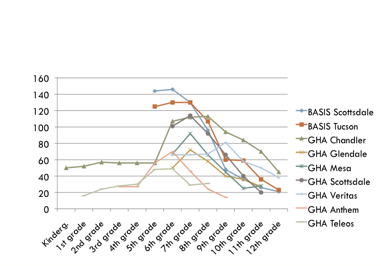
I also highlighted some recent reports about BASIS schools that document questionable methods for enrollment procedures, high attrition rates, and methods including “counseling out” of students who might negatively affect average school performance rankings (Safier, 2013; see also Welner, 2013). The figures above suggest that “highly-ranked” BASIS schools serve a privileged demographic; Safier’s story suggests that they likely select even further amongst that privileged group. Visually striking declines in student enrollment at Arizona’s BASIS and Great Hearts schools in 2010-2011 are evident in the figure below:

Enrollment Declines: Arizona’s BASIS and Great Hearts Schools
enrollment

Other researchers have highlighted declining enrollment numbers in the years nearing graduation at BASIS schools (see, for example, Casanova, 2012). BASIS school representatives responded (BASIS_Communications, 2012) by challenging interpretations of the low numbers shown in the data, albeit without adequately addressing Casanova’s main concern about the “enrollment drop across grades.” Casanova’s analysis highlights the low numbers of enrolled students in the upper grades. The graph displayed above raises a question of basic comparability: is it even fair to include these schools in a comparison with Arizona’s public schools, since they are not drawing a representative population of Arizona’s public school students?

Finally, Ann Ryman (2012) documented business practices within BASIS and Great Hearts Academy schools that reveal potential conflicts of interest between board members and owners (see, also, these comments from Gene V Glass, 2012, here and here). These charter school organizations make large profits at the expense of the government and community members, through fees, book purchases, and building contracts. Other investigators have highlighted questionable practices that provide considerable access to policy makers who influence Arizona’s lawmakers. For example, Mercedes Schneider (2013) created a map of Great Hearts political connections, highlighting significant access between CMO executives and policy makers who influence laws, including members at the Goldwater Institute and the American Legislative Exchange Council (ALEC).

The connections between executives of CMOs and policy leaders who influence lawmakers further complicate the problems of educational inequality and appear to provide charter schools with unfair competitive advantages. Children and taxpayers are the losers when public education dollars are at stake.

Citation:

Potterton, A. U. (2013). A citizen’s response to the President’s charter school education proclamation: With a profile of two “Highly Performing” charter school organizations in Arizona. Teachers College Record. Retrieved from http://www.tcrecord.org/Content.asp?ContentID=17309

References:

Arizona Department of Education (2013). Teleos Preparatory Academy > Great Hearts Academies- Teleos Prep. Retrieved from http://www10.ade.az.gov/ReportCard/SchoolSummary.aspx?id=90143&ReportLevel=1

BASIS_Communications. (2012, April 13). Re: The newest problem with graduation rates. [online forum comment]. Retrieved from http://www.washingtonpost.com/blogs/answer-sheet/post/the-newest-problem-with-graduation-rates/2012/04/12/gIQAwsH2DT_blog.html

Casanova, U. (2012, April 13). The newest problem with graduation rates. Retrieved from http://www.washingtonpost.com/blogs/answer-sheet/post/the-newest-problem-with-graduation-rates/2012/04/12/gIQAwsH2DT_blog.html

Glass, G. V. (2012, November 18). May I have the envelope please. And the Pulitzer for education reporting goes…. Retrieved from http://ed2worlds.blogspot.com/2012/11/may-i-have-envelope-please-and-pulitzer.html

Glass, G. V. (2012, December 2). “Judge us by our results”. Retrieved from http://ed2worlds.blogspot.com/2012/12/judge-us-by-our-results.html

Ryman, A. (2012, October 12). Insiders benefiting in charter deals. Retrieved from http://www.azcentral.com/news/articles/20121016insiders-benefiting-charter-deals.html

Safier, D. (2013, April 17). BASIS charter’s education model: Success by attrition. Retrieved from http://blogforarizona.net/?p=645

Schneider, M. (2013, March 25). Arizona education: A pocket-lining, “conflict of interest” mecca. Retrieved from http://deutsch29.wordpress.com/2013/03/25/arizona-education-a-pocket-lining-conflict-of-interest-mecca/

U.S. Department of Education. Institute of Education Sciences, National Center for Education Statistics. (2013). Search for schools, colleges, and libraries. Retrieved from http://nces.ed.gov/globallocator/

Welner, K. G. (2013, April). The dirty dozen: How charter schools influence student enrollment. Teachers College Record. Retrieved from http://nepc.colorado.edu/publication/TCR-Dirty-Dozen
In recent years, Indiana has gone overboard for charter schools, believing that they held the secret to raising the test scores of low-income students.

But blogger Steve Hinnefeld analyzed the passing rates by income levels and discovered that public schools outperform charter schools in Indiana.

He wrote:

“I merged Department of Education spreadsheets with data on free and reduced-price lunch counts and ISTEP-Plus passing rates. Then I sorted by free-and-reduced-lunch rates and focused on schools where 80 percent or more students qualified for lunch assistance. Results include:

“For charter schools: Average passing rate for both E/LA and math, 48 percent; passing rate for E/LA, 62.3 percent; passing rate for math, 62.5 percent.

“For conventional public schools: Average passing rate for both E/LA and math, 57.2 percent; passing rate for E/LA, 64.1 percent; passing rate for math, 68.1 percent.

“The data set includes only schools that enroll students in grades 3-8, who take ISTEP exams; it excludes high schools and many primary-grade schools. I also tried to screen out nonstandard schools such as juvenile detention centers and dropout recovery schools.”

He also reported that fewer charter schools get high grades from the state than public schools.

Not what you would call a high-performing sector, despite the boasting and promises.

Stephanie Simon writes in Politico.com that Arne Duncan is not really in favor of Common Core. Common what? Common who? Never heard of it. Ah, how soon politicians forget what they said last week, last month, last year. And they expect us to forget too.

She writes:

“COMMON CORE LOSES ITS BIGGEST CHEERLEADER: It was less than a year ago that Education Secretary Arne Duncan delivered a no-holds-barred defense of the Common Core in a speech to newspaper editors. He cited example after example of the benefits of common standards: Teachers in different states could use the same lesson plans; children of military personnel could move across country “without a hitch” in their schooling; and, first and foremost, “a child in Mississippi will face the same expectations as a child in Massachusetts.” In short: “I believe the Common Core State Standards may prove to be the single greatest thing to happen to public education in America since Brown v. Board of Education,” Duncan said.
— That was then. This was Tuesday: “Just to be very clear with this group,” Duncan told the House Appropriations Committee, “I’m just a big proponent of high standards. Whether they’re common or not is sort of secondary.”
— Duncan immediately added that his stance was “not news.” And his spokeswoman, Dorie Nolt, later pulled up audio from a press breakfast in January where Duncan was asked about whether the term “Common Core” was politically radioactive. “We’re not interested in the term,” he responded then. “We’re interested in high standards. There are a couple ways to come at it.” Indeed, the administration has never required states to adopt the Common Core; it just offered financial and policy incentives to adopt higher standards – and embracing the Common Core happened to be by far the quickest and easiest way to hit that bar.”

So what gives?

Here are some possibilities:

1. The Common Core standards have become so controversial that Duncan wants to pretend he had nothing to do with them.

2. Duncan has been warned by his advisors that his support and Obama’s is actually dragging down the poll numbers for the Common Core so the best way to help them is to back off.

3. Someone is planning to sue the U.S. Department of Education for illegally interfering in curriculum and instruction by supporting the Common Core, so Duncan must pretend he had nothing to do with their swift adoption by 45 states. His lure of $4.3 billion was just a coincidence.

4. Duncan realized that his cheerleading contradicted his insistence that the Common Core was “state-led.”

Can you think of another reason that Duncan forgot that only a year ago he said the Common Core was the most important development since the Brown decision?