Archives for category: Teachers

Ed Johnson, a close observer and frequent critic of the Atlanta public schools, writes here about the superintendent’s plans to adopt models developed by Eli Broad and the Waltons to transform the public schools into a business.

Johnson is a believer in the collaborative philosophy of W. Edwards Deming.


December 2019

Journey of Transformation: Atlanta schools to “buy” teachers by “price tag”

  • “Thinking about human beings as interchangeable commodities for sale, or abstract units of labor power, would lead merchants and planters to see human capital in much the same way that they saw animals.  And, by the time a young apprentice became a partner, he would feel ‘no more remorse in fitting out a ship for the purpose of trading in human flesh, than he would have done in sending her to catch whales or seals.’”
  • —Caitlin Rosenthal. Accounting for Slavery: Masters and Management. Kindle Edition, location 1153.
Last month, Atlanta superintendent Meria Carstarphen, Ed.D., gave a presentation to the Atlanta Board of Education Budget Commission on FY 2021 budgeting for what she calls “Student Success Funding,” or SSF.  The Budget Commission is a standing committee of the Board that meets monthly.

At one point during the presentation, Dr. Carstarphen invited the Chief Financial Officer (CFO) of the Atlanta Public Schools system (APS) to more adequately explain a matter that see, Dr. Carstarphen, suggested to enquiring commission members she had already explained well enough (my insertions):

  • (50:30-51:00) “… the way the schools purchase back their positions … we allocate the dollars and they buy their teachers back.  The price tag we put on those teachers is an average salary … and all schools buy back [teachers] at that rate.  What we know, what we’ve seen is that the schools that have the highest needs … have teachers that have either less experience or they don’t have the high degrees and, for whatever reason, they are ‘cheaper.’  … So what we would like to propose is … allowing those schools to buy their positions back at the actual average [value of the price tags we put on teachers] for their school.”
Despite the Board’s decision to non-renew her employment contract beyond the current school year, Carstarphen, by her presentation, makes clear she continues to advance her Journey of Transformation of APS.

When finished—and it can be finished, we must now understand—the journey will have brought APS to a permanent state of being “run like a business” and, in that state,  destroyed as the democratically governed public good is it supposed to be.

Thus the word “finish” must now be understood as signifying something real and consequential.  To continue thinking the word means something rhetorical or non-specific poses a grave risk to ever reclaiming and restoring APS as the public good it is supposed to be.

Entangled actors

In their joint report, The Strategic CFO: A Guide for School Districts, billionaire Eli Broad’s The Broad Center and Education Resource Strategies (ERS) lay out the essence of the matter as related to SSF.

So, too, does the partnership of ERS and APS, in the joint presentation, Student Success Funding: [APS] A District in Transformation.

Moreover, the APS CFO talks about student-based budgeting in the ERS Q&A, Student-Based Budgeting Takes Root in Atlanta.

ERS is a consultancy that says it helps clients to maximize—operative word, “maximize”—usage of capital resources, including “human capital.”  But as the Taguchi Loss Function teaches, maximal usage of a resource that is a system rapidly drives down the value and usefulness of the resource to point of it becoming a great source of waste.  In what follows, remain mindful that an individual “human capital” (e.g., an individual teacher) is a system.

And then there is the Walton Family Foundation’s 2017 grant of $350,000 to APS “To support research related to student[-]based budgeting” (my emphasis).  Research?  For what purpose, as related to student-based budgeting?  Maybe to establish the effectiveness of student-based budgeting and to use APS as a guinea pig in experiments to do that?  Was not the effectiveness of student-based budgeting a given?  Again, the APS CFO talks about student-based budgeting in the ERS Q&A noted above.

Thus we have Eli Broad, a private actor, in partnership with ERS, a private actor.  And we have ERS, a private actor, in partnership with APS Leadership, a public actor.  And we have APS Leadership, a public actor, in partnership with the Waltons and Eli Broad, both private actors.  This then means the public cannot know and trust the motives and behavior of any of the actors independently of each other; the actors are entangled.

Innately born systems thinking children learning to picture entanglement

So, how might we model and think about APS Leadership, ERS, Eli Broad, and the Waltons being entangled on the matter of student-based budgeting or, more relevantly, what Carstarphen calls Student Success Funding, or SSF?

Well, on a recent tour of Beecher Hills Elementary School, an Atlanta public school, goosebumps popped up when I noticed on a wall a display showing children were learning to “Organize our thinking using Venn Diagrams.”  (I regret I failed to take a snapshot.)

So let’s take the children’s lead, here, and make and use a simple Venn diagram to organize seeing and thinking about SSF being a common motive of the entangled actors as well as to represent a “finish”-able end to the superintendent’s Journey of Transformation of APS.
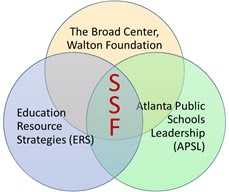
We might also recognize that thinking about SSF begs also thinking about a situation like that of Carstarphen having been superintendent in Austin, Texas, but all over again here in Atlanta.

Fortunately, a seemingly democracy-practiced Hispanic citizenry of Austin lead putting an end to her machinations and operating in cahoots with Eli Broad and the charter schools industry, soon enough.

In contrast, however, an apparent consumer-craving Black Atlanta citizenry, intersecting, Venn diagram-wise, with a paternalistic White Atlanta citizenry, is demanding destruction of APS as a public good, both actively and passively, as by silence.  Such Black and White behaviors continue to intersect as Atlanta elites’ old fashioned but still functioning Atlanta Compromise, which lets Eli Broad, et al., know Atlanta is an easy mark, I suggest.

  • “The leading figures in the actual Civil Rights Movement explicitly challenged the idea that the free market could deliver Black people from racism.” (p. 82) …
  • “Corporate education reform favors privatization and ‘free market’ solutions to school governance (‘running schools like a business’ and so on) and is, therefore, necessarily antithetical to the ethos of trade unions and of collective bargaining.” (p. 83)
  • –Brian Jones, Keys to the Schoolhouse: Black Teachers, Privatization, and the Future of Teacher Unions, Academia; accessed 4 Dec 2019.
Similarly, persons that preach a selfish, free market, “by any means necessary” ideology of education for children labeled Black–for example, as do the people of the Black organization known as BOOK (Better Options for OUR Kids), with funding by the Walton Family Foundation, support by the United Negro College Fund (UNCF), and now propaganda distribution by The 74–are so horribly racially insular as to pose a real and present existential threat to the human development and dignity of the very children they so loudly profess to care about.

But then such racially insular people show it’s not the human development of the children they care that much about.  Rather, such racially insular people show they care mostly about the children developing as a race, a race to forever believe and perpetuate it is oppressed, and a race to forever believe and perpetuate “white supremacy” is something real.  Such racially insular people show they care about developing the children just as Eli Broad and the Waltons and similar others would have it.

Anticipating intended effects

Whether the matter is framed to be about student-based budgeting or Carstarphen’s euphemistically named Student Success Funding, or SSF, some essential effects to anticipate from the superintendent’s Journey of Transformation of APS are:
  • schools turned into and managed as free market performance centers
  • principals turned into and managed as free market schoolhouse CEOs and marketers
  • teachers turned into and managed as free market fungibles to be bought and sold, as needed
  • schools and school facilities opened, closed, and sold off, as needed, to maximize usage of capital; alternatively, the portfolio model by the marketing name, “Excellent Schools”
Thus we might now understand Carstarphen’s response to non-renewal of her employment contract that she has yet to “finish the work” she was hired to do.  We might now understand her Journey of Transformation of APS can indeed reach the state of being “finished,” taking a total of about 15 years, she now says.  And when finished, all schools—public, partner, charter—will be running not just like an ordinary business but running like a conglomerate of businesses on the style of Warren Buffet’s Berkshire Hathaway conglomerate, for example, capable to generate its own internal market.

APS central office will function as the conglomerate business controlling all other businesses and each individual school will have the ballyhooed “freedom and autonomy in exchange for accountability” to function like a specialized business or branch (i.e., theme school, academy, whatever).  Still, each specialized business (i.e., each school) will be subject to certain common business management practices (think again about the Beecher Hills kids learning to make and use Venn diagrams) that originate with the controlling business (i.e., APS central office) for maximizing performance at that level.

For example, individual businesses (i.e., schools) will be subject to being opened, closed, and sold off, as needed, so as to continually maximize any or all of their financial performance, customer traffic (i.e., school enrollment), consumer satisfaction (i.e., illusory parental school choice), and other matters.  Teachers will be reduced to fungible commodities to be bought and sold at the cheapest, competitive price the internal market will pay, so different specialized businesses (i.e., schools) can also continually work at maximizing usage of the human capital they have bought—all the while generating enormous amounts of squander as well as waste of human potential.

Good, effective business marketing (i.e., lying) required

What the Walton Family Foundation calls “student-based budgeting” is also know by other conceptually accurate names, including student-based allocation, weighted student funding, and fair student funding.  But now comes Carstarphen’s marketing name, Student Success Funding, which gives no conceptual clue about the reality of the matter.

Naming the matter “Student Success Funding” makes for good business marketing.  The nature of such business marketing—and all that such business marketing implies, including manipulating consumers to believe they need something when they don’t, to consume something when they shouldn’t, to not consume something when they should, etc.—keeps with Atlanta school board chairman Jason Esteves marketing The City Fund’s truthfully named “portfolio model” by the catchy name, “Excellent Schools.”

Carstarphen’s apparent jovial easiness with business marketing leaves no doubt of it harkening back to even when “human capital” was sold at auction based on the financial accounting value, or “price tag,” owners and managers of the human capital had recorded in their “price lists.”  Carstarphen has been repeatedly advised, in public Board meetings, to let go the “human capital” language and remove it from strategic planning.  But she refuses to do that, and now we might see that the entangled SSF actors suggest why she refuses: they all stand to benefit from destroying APS as a public good.

It is also obvious that the superintendent’s carefree morals and ethics about marketing allow her to effectively be okay with the management of schools as free market performance centers, to be okay with teachers as buyable and sellable commodities, to be okay with students as customers, and to be okay with parents as consumers of schools they would choose as if choosing a Happy Meal from a McDonald’s menu price list.

And, most disturbingly, to be okay with continuing to manipulate children into marketing the “APS brand” as entrants in the Superintendent’s Annual Winter Card Contest.  Why any parents would allow their child to be used in this way is puzzling.

Similarly, perhaps following Carstarphen’s lead or command, some Atlanta public school principals have taken to talking about their school as a competitive “brand,” as if doing that is necessary to compete with the KIPP brand, the Kindezi brand, the Atlanta Neighborhood Charter School brand, etc.

  • “Two years ago I realized ANCS was a direct competition.  I had to figure out how to make parents see my school as a viable option for parents.  I don’t want it to be a competition about which is better but what fits best for my kid.  How can we make sure that Parkside is a viable neighborhood school of choice?”
  • —Principal, Parkside Elementary School, 29 Aug 2019

Funding Atlanta public schools to improve

However, funding APS as the public good it is supposed to be and budgeting for that is immaterial to the entangled SSF actors—APS Leadership, ERS, Eli Broad, the Waltons.  And let’s not forget Bill Gates.  “What about Bill Gates?,” Carstarphen once asked me in a meeting in the midst of my trying to help her understand the golden opportunity her becoming Atlanta superintendent held for her to not do in Atlanta as she had tried to do in Austin.  To understand that APS needs, has always needed, and always will need, improvement, not one-off turnaround.  Fool’s errand on my part because, obviously, Eli Broad, et al., came to Atlanta with her.

The Austin Chronicle put it this way about Austin’s citizenry seeing her to the exit door:

“[Carstarphen] never understood or cared for the public mood.”
The table below lists and gives a short description of so-called “ERS Principles” the APS Leadership have apparently adopted, as given.  However, not one reference so far discovered even suggests that any ERS Principle represents a fundamental truth or proposition based in reality.  Rather, each principle inscribes, arguably, a statement of belief about free market ideology suitable for marketing SSF.
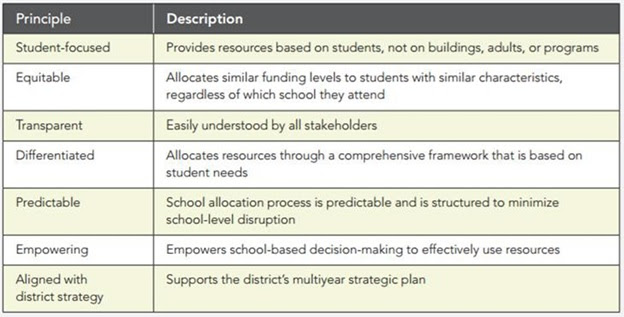
References about SSF, variously named, warn:
  • SSF is complex (e.g., this by ERS, itself)
  • SSF is fraught with implementation challenges (e.g., this)
  • SSF lacks research-based evidence that it works (e.g., this, which references APS)
  • SSF reproduces racial inequality that undermines funding equity (e.g., this and this)
  • SSF requires principals to be competently burdened “school CEOs” more so than knowledgeable leaders of educational practice and improvement

Open a window onto morals and ethics of SSF

To bring clarity and transparency to SSF in a way that exposes it for what it is, Carstarphen might engage her Accountability and Information Technology Division to model SSF as either or both a data model, so as to expose, as MLK Jr put it, the “interrelated structure of reality” SSF portends; and, a process model, possibly dynamic, so as to expose the interrelated behaviors SSF portends and to have a basis for predicting those behaviors, over time.

Structure and behavior are like opposite sides of the same coin; there cannot be one side without the other side.  An essential component of an SSF Model will be unambiguous and hype- and marketing-free definitions of things and relationships between things modeled.

(My post, Lexical Conventions for Enterprise Data Modeling, is freely available to the superintendent and her administration to draw from, as have some folk at major corporations even in faraway places such as the U.K.  So is my article, Enterprise Modeling: Checking with Reality, as published by Business Process Trends.)

Then, with either or both SSF Models in hand, people might be helped to see the complexity, inequality, absurdity, and various kinds of squander to come from implementing SSF, and then decide to reject SSF before it can be implemented and the damage done.

Even so, and essentially without expense, moral and ethical concerns alone should give pause and reason enough to reject Student Success Funding and instead commit to funding the Atlanta Public Schools system with the aim of starting the system off on a never-ending, unfinishable Journey of Continual Improvement and, along the way, detoxify APS of accumulated charter school industry squander, so the system can get back to being the wholly public good it is supposed to be.

My insertion, original emphasis:
  • “Planters strove for rationalization, standardization, and fungibility when it served their interests. Their ownership of capital [including human capital] gave them the power to commodify as they chose.”
  • —Caitlin Rosenthal, Accounting for Slavery: Masters and Management. Kindle Edition, Location 3511.

Ed Johnson
Advocate for Quality in Public Education
Atlanta GA | (404) 505-8176 | edwjohnson@aol.com

Peter Greene, as usual, is sharp and on target in reviewing the Public Education Forum in Pittsburgh.

He fact checks the candidates. He was pleasantly surprised by Amy Klobuchar, which seems to be a common reaction.

Ignore a few spelling errors and enjoy.

Arthur Camins salutes teachers as the front line warriors in the battle to restore truth, facts, and evidence against the onslaught of the Trump war on reality.

Yes, Virginia, there is objective reality in the world. No, Virginia, there are no alternative facts. 2+2 really is 4. It is 4, today, tomorrow, and into the future.

We count on teachers to teach students to care about reality and evidence.

Politicians and their corporate sponsors who unabashedly lie with impunity are ubiquitous. Citizens who believe or cynically dismiss the lies are alarmingly common.  As a result, truth telling is now the essential citizen attitude and ability without which democracy, justice, and any semblance of equity are doomed. The nation desperately needs teachers to be leaders in a truth offensive.

Every day in every classroom, students offer explanations and claims. Some are true, while some are not. Teachers’ critical follow-up response is, “How do you know that?” That applies whether it’s a mathematics solution, an analysis of a historical event, a scientific explanation about how the natural world works, or an interpretation of a piece of literature. The essential expectation is that students’ reply to, “How do you know that?” should feature relevant and sufficient evidence.  Most important is helping students develop the disposition that truth matters.

“I just know it,” “It’s what I think,” “It’s my opinion?” “It’s what I read somewhere,” “You/He/She/They told me,” and “I saw it on Facebook, TV News, etc.” are all insufficient.  Students can and should develop the habit of mind to search for reliable data, learn how to interpret that data to establish evidence to justify, reject, and revise conclusions. They need to develop the inclination and skills to do so across multiple disciplines. Unless that happens, we cannot hope to reverse the alarming dismissal of evidence in the public arena.  This is job one for every teacher.

More than ever, citizens must be armed with the tools to combat lies, propaganda, fake news, and hoaxes.


Steven Singer participated in the Public Education Forum in Pittsburgh, where the leading Democratic candidates (and a few not-leading candidates) spoke to an audience of teachers, members of civil rights groups, and teacher unionists.

These are his ten take-aways from the day. 

A few highlights:


The fact that it happened at all is almost miraculous.


Who would have thought Presidential hopefuls would care enough about public schools to address education issues and answer our questions?


Who would have thought it would be broadcast live on TV and the Internet?


And – come to think of it – who would have EVER thought it would happen in my hometown of Pittsburgh!?
But it did.


I was there – along with about 1,500 other education activists, stakeholders and public school warriors from around the country.


It was an amazing day which I will never forget.


Perhaps the best part was getting to see so many amazing people in one place – and I’m not talking about the candidates.


There were members of the Badass Teachers Association, the Network for Public Education, Journey for Justice, One Pennsylvania, the American Federation of Teachers, the National Education Association, and so many more!


I wish I could bottle up that feeling of commitment to our children and hope in the future…


Here’s my top 10 most important lessons:


1) Charter School Support is Weak


When the forum was announced, Jeanne Allen of the Center for Education Reform wrote a blistering memoabout how the charter school community would not put up with politicians listening to constituents critical of their industry. Allen is a far right Republican with close ties to the American Legislative Exchange Council (ALEC) who even used Donald Trump’s public relations firm to publicize her protest. But when we got to the forum, all it amounted to were a dozen folks with matching yellow signs trudging through the rainwho didn’t even stay for the duration of the forum. YAWN! Silly school privatizers, that’s not how you protest!


2) Michael Bennet Doesn’t Understand Much About Public Education


The Colorado Senator and former school superintendent really doesn’t get a lot of the important issues – even when they intersect his life. As superintendent, he enacted a merit pay initiative for teachers that resulted in a teachers strike. He still doesn’t comprehend why this was a bad idea – that tying teachers salaries to student test scores makes for educators who only teach to the test, that it demands teachers be responsible for things beyond their control, etc. Moreover, he thinks there’s a difference between public and private charter schools – there isn’t. They’re all bankrolled by tax dollars and can be privately operated.


But I suppose that doesn’t matter so much because few people know who Michael Bennet is anyway.


3) Pete Buttigeig is Too Smart Not to Understand Education – Unless He’s Paid Not to Understand


Mayor Pete came off as a very well spoken and intelligent guy. But he also seemed about as credible as wet tissue. He said a bunch of wrongheaded things. For instance, he said that “separate has never, ever been equal,” but he supports charter schools. Separate but equal is their business model.


It’s the kind of misunderstanding that only happens on purpose, and it’s not hard to see why. He’s taken so much money from anti-education billionaires like Netflix Founder Reed Hastings, no one else can trust him. How are we supposed to think he works for us when his salary comes from the super rich? You never recover from ignorance when it’s your job to be ignorant.


Read the rest of his post to see what he wrote about Warren, Sanders, Steyer, Klobuchar, and Biden.


Hats off to Randi Weingarten and Lily Eskelsen Garcia for organizing today’s MSNBC Public Education Forum!

It was a wonderful event, and it was thrilling to see all of the major Democratic candidates competing to win the support of America’s millions of teachers, vowing their love for teachers and their dedication to public schools.

Best of all was that they all recognized that the United States has been underinvesting in education for years, and they pledged to reverse that policy.

It was wonderful to hear the candidates speak about the importance of public education.

It was good to hear Joe Biden attack standardized testing (he forgot all about Race to the Top, as did everyone else).

I was disappointed that Rehema Ellis of NBC asked almost every candidate about NAEP scores, distorting what they meant. She said that only 1/3 of American students are “proficient” in reading, which is true, but NAEP proficiency is not grade level, it represents mastery. It would be wonderful if every student reached mastery, but that has never happened. As long as she threw it out there, she should have followed it up (or candidates should have followed up) by saying, “Doesn’t this statistic show the failure of No Child Left Behind, Race to the Top, and Common Core? Doesn’t it show that two decades of federally mandated reforms have failed? Where do we go from here?”

But the follow-up never happened.

What did happen, though, was that every candidate vied to demonstrate their love for public schools and for teachers and their determination to establish equal opportunity and excellent schools for all.

This was a wonderful balm for the soul after years of nay-saying, nitpicking, and teacher-bashing.

No teacher-bashing today.

Just teacher love.

Respect for the mission of public schools.

R-E-S-P-E-C-T.

And it sounded wonderful.


High school teacher Stuart Egan notes that teachers across the state of North Carolina received a letter from Lt. Governor Dan Forest boasting about his education record.

Forest is running for governor against Democratic Governor Roy Cooper.

Egan warns teachers not to be fooled.

He writes that this is the real record of Dan Forest, and it should not be forgotten at election time:

So why did Forest send this letter? He’s hoping that teachers will forget what this current NCGA that he is aligning himself with has actually done since 2011. Here’s a list.

  • Removed due process rights for new teachers to keep them from advocating loudly for students and schools.
  • Removed graduate degree pay bumps for teachers entering the profession.
  • Instituted a Value Added Measurement system which are amorphous and unproven way to measure teacher effectiveness.
  • Pushed for merit pay when no evidence exists that it works.
  • Attacks on teacher advocacy groups like NCAE.
  • Created a revolving door of standardized tests that do not measure student growth.
  • Lowered the amount of money spent per pupil in the state when adjusted for inflation.
  • Removed class size caps.
  • Instituted a Jeb Bush style school grading system that is unfair and does nothing more than show how poverty affects public schools.
  • Created an uncontrolled and unregulated system of vouchers called Opportunity Grants.
  • Fostered charter school growth that has not improved the educational landscape and siphons money from the public school system.
  • Created failing virtual schools outsourced to private industry.
  • Allowed for an Innovation School District to be constructed.
  • Eliminated the Teaching Fellows Program and brought it back as a former shell of itself.
  • Created an atmosphere of disrespect for teachers that teaching candidate numbers in colleges and universities have dropped over 30%.

It is rather entertaining to see the Lt. Gov. run for the office of governor by touting the record of an eight-year NCGA leadership which has crafted the very policies he is “owning” in an example of transference. Those are the same policies that have brought thousands of the very people he addressed in this letter to the streets of Raleigh to protest.


Sue Legg of the Florida League of Women Voters wrote here about concerns about teachers’ pensions and whether the 2020 legislature is planning to undermine them.

She writes:

There are rumblings that the 2020 Florida Legislature may revise funding for the Florida Pension Plan.   There is no question that the retirement system revenue has declined; it has not been 100% funded since the 2008 recession. The current rate is about 84% of the cost if all people retired at one time. Of course that is an unlikely scenario, but there are now more people vested in the system than are contributing to it. One million public employees participate in the system, about half are teachers and the others are local and state government employees. As retirees increase and new participants decrease, covering costs becomes more problematic…

Pensions are not the problem..The real question as always is whether funding pensions is mostly a political, not a financial issue.  The National Association of State Retirement Administrators cited a report stating that an 80% funding level is the federal benchmark for financial stability of state pension systems.  Florida’s level exceeds that benchmark. Nevertheless, there is a political divide over providing pensions, and it is closely tied to those supporting school privatization.  Florida charters and private schools typically do not contribute to retirement systems, and the resulting high teacher turnover keeps salaries lower.   Thus, there is more money available for management companies in the private sector.   This is not a recipe for a high quality educational system.


Michael Kohlhaas, blogger in Los Angeles, writes here about a charter leader who harassed a teacher who protested his staff’s lack of qualifications.

Excelencia Charter Academy is yet another creepy little charter school run by yet another shockingly unqualified creepy little galaxy-brained grifter, this one known as Ruben Alonzo, going about the place making creepy little announcements of delusionally impending disruptive excellence while lining his creepy little pockets with public money1 at the expense of the actual human children that the state legislature, for reasons they’re going to have to answer for eventually, has seen fit to place into his care.

In this regard Alonzo is much like Sakshi Jain, shockingly unqualified founder of the ill-fated GANAS Academy, whose plan to co-locate on the campus of Catskill Elementary School conjured up such a monumental hurricane of activist opposition and scorn that, it appears, she has had to put her school’s opening on hold while she slinks back to her lair to soothe her metaphorical wounds with a salve made of equal parts boorish self-pity and Walton family megabucks.

Unlike Jain, though, Alonzo did actually manage to open his school. In the Fall of 2018 as it happens and, like Jain’s fiasco, co-located, in this case on the campus of Sunrise Elementary School in Boyle Heights. And like Jain’s folly Alonzo’s weirdo little project conjured up some opposition, most publicly from Sunrise Elementary teacher Mimi Guzman-Duncanson.

Duncanson famously parked her SUV out in front of the school covered in flyers advertising the appalling lack of qualifications of Excelencia’s teachers, let alone Ruben Alonzo, the self-proclaimed founder. Duncanson’s protest was covered in the Los Angeles Timesand by Jason McGahan, writing in The Baffler.

You can see a picture of Maestra Duncanson2 with her minivan somewhere near this sentence.That picture and another like it came from a huge set of emails released to me recently by Alonzo pursuant to the California Public Records Act.3 And if it looks like hostile photography, like surveillance, well, that’s because that’s precisely what it is. It turns out that aggressively callow hellbaby Ruben Alonzo just could not deal with the fact that anyone at all dared to question his galaxy-brained 29 year old self.


Kentucky’s outgoing Republican Governor Matt Bevin made clear that he wanted funding for charter schools, but he lost the recent election to Democrat Andy Beshear. The new governor made clear that one of his top priorities was supporting public schools.

However, the State Board of Education and the State Commissioner were appointed by Bevin, and they seem to be holding on until their terms expire.

The Bevin-appointed State Board met to announce its priorities for the 2020 legislative session, which begins in early January. Its list did not include funding for charter schools, which was one of Bevin’s demands. Bevin was a close ally of Betsy DeVos, who visited the state earlier this year to promote school choice.

Even though the board was appointed by Bevin, the members’ priorities show that they heard the voters’ message.

Kentucky Board of Education members unanimously approved a legislative agenda Wednesday that they may not be able to see through. 

Education officials plan to push for full-day kindergarten, reading interventions for the youngest learners and more flexibility for schools in Kentucky’s 2020 legislative session, according to documents made public Wednesday morning. 

And they’ll ask lawmakers to solidify Gov. Matt Bevin’s reorganization of an education board through executive order — the very power Gov.-elect Andy Beshear said he will use to disband the Board of Education.  

School choice initiatives, including funding for charter schools, are missing from the proposed list. Citing waning appetite for charters, Lewis said he only wanted to include legislation that had “some chance of passing.” 

It’s a shift toward the education priorities of Kentucky’s superintendents and its largest school district after more than a year of disconnect between educators and their leaders….

Beshear, who takes office in less than a week, vowed to replace the education boardon “day one.” The new board, he has suggested, would then oust Education Commissioner Wayne Lewis. 

Beshear ran on an education-fueled platform, and said his board replacements would value public education more than “a for-profit charter school company.”

It is possible a new board will elect to push for different education bills in 2020. 

Lewis’ contract allows the board to fire him without cause but requires a 90-day notice. He told reporters Tuesday night he would stay for those 90 days — which would last most of the legislative session. 

The 2020 legislative session begins on Jan. 7.

KDE’s legislative wish list for 2020 signals a slight shift from 2019’s agenda, which focused on school choice measures and increasing flexibility for districts….

Unlike last year, KDE does not specifically ask for a third grade retention law, a controversial measure that holds back third graders until they read at grade level. 

A retention law filed last session was ultimately gutted before failing to make it to a vote. 

Jan Resseger gives thanks for the teachers and other educators who boldly walked out and went out on strike over the past two years. So do I.

These courageous educators challenged the national narrative that had been so deviously cultivated by billionaires and Wall Street about “failing schools” and “bad teachers,” in an effort to destroy public faith in public schools and promote privatization of public funds.

Thanks to #Red4Ed, the new and realistic narrative is about crowded classrooms, crumbling schools, underpaid teachers, and schools without nurses, social workers, or librarians.

#Red4Ed said, “No more!”

The first walkout was in West Virginia in the spring of 2018. That walkout closed every school in the state and unleashed a wave of strikes and walkouts that continues now.

Reading about the West Virginia walkout inspired me to start writing a book that will be published January 21, called SLAYING GOLIATH. I will be in West Virginia on February 22 to meet those brave teachers and thank them for what they have done for all of us.