Archives for category: Teacher Evaluations

Only days before the election, enjoying a comfortable lead in the polls, Néw York’s Governor Andrew Cuomo unleashed a tirade against teachers and the very concept of public education. He vowed to make test-based evaluations tougher, so more teachers would be found ineffective and fired. And he denounced public education as a monopoly that he is determined to break.

Daniel S. Katz of Seton Hall University reviews Cuomo’s remarks and finds that he is dangerously misinformed. He is a threat to the future of public education in Néw York state. He is clearly unaware of the failure of test-based teacher evaluation. He has obviously never read the research that shows how this method produces incoherent results and is no better than a roll of the dice.

But even more disturbing is his hostility to public education, which is one of the bedrock responsibilities of society. He sounds like a right-wing ideologue in a voucher organization.

It is sad that this angry man, who views teachers and public schools with contempt, has collected $40 million from his Wall Street allies and is coasting to re-election. Too bad he did not make his views clear earlier in the election cycle.

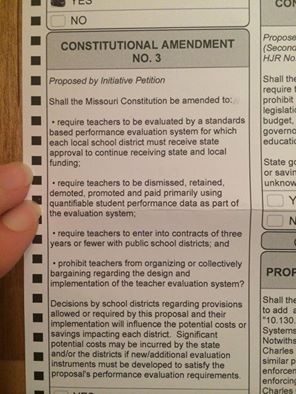
This is the worst constitutional amendment to appear on any state ballot in 2014.

missouriballotissue

It ties teacher evaluation to student test scores. It bans collective bargaining about teacher evaluation. It requires teachers to be dismissed, retained, promoted, demoted, and paid based primarily on the test scores of their students. It requires teachers to enter into contracts of three years or less, thus eliminating seniority and tenure.

This is VAM with a vengeance.

This ballot resolution is the work of the far-right Show-Me Institute, funded by the multi-millionaire Rex Sinquefeld.

He is a major contributor to politics in Missouri and to ALEC.

The Center for Media and Democracy writes about him:

“Sinquefield is doing to Missouri what the Koch Brothers are doing to the entire country. For the Koch Brothers and Sinquefield, a lot of the action these days is not at the national but at the state level.

“By examining what Sinquefield is up to in Missouri, you get a sobering glimpse of how the wealthiest conservatives are conducting a low-profile campaign to destroy civil society.

“Sinquefield told The Wall Street Journal in 2012 that his two main interests are “rolling back taxes” and “rescuing education from teachers’ unions.”

“His anti-tax, anti-labor, and anti-public education views are common fare on the right. But what sets Sinquefield apart is the systematic way he has used his millions to try to push his private agenda down the throats of the citizens of Missouri.”

Yesterday, I posted about the plan by Massachusetts to strip teachers of their licenses if their evaluations were poor.

As it happened, the Massachusetts Teachers Association had already issued a forceful response to this misguided proposal. President Barbara Madeloni posted this as a comment on the blog. It was released on October 27:

MTA to BESE: How can anyone in good conscience connect an employment evaluation to licensure?

In response to the Department of Elementary and Secondary Education’s proposed changes to initial licensure and relicensure, MTA President Barbara Madeloni and Vice President Janet Anderson sent the following letter to the Board of Elementary and Secondary Education and Commissioner of Education Mitchell Chester. More information and recommended actions are forthcoming.
October 27, 2014

To: Members of the Board of Elementary and Secondary Education
Mitchell Chester, Commissioner of Education

From: Barbara Madeloni, President, Massachusetts Teachers Association
Janet Anderson, Vice President, Massachusetts Teachers Association

Re: Changes Proposed by DESE to initial licensure and relicensure

On Monday, October 20, the Department of Elementary and Secondary Education released proposed changes to requirements for both initial licensure and relicensure. A day later, the DESE held its first “town hall” hearing about these proposals. These hearings were facilitated by the Keystone Center, but DESE staff were present.

While there are many questions to ask about these proposals that would allow us to gain some clarity of meaning (e.g., what does “grit” mean as a requirement for initial licensure?), the primary question is: How can anyone in good conscience connect an employment evaluation to licensure when these are entirely different areas of authority and oversight? We know of no other profession in which licensure is contingent on employment evaluation. More insidiously, the employment evaluations include student learning outcomes, thus connecting relicensure to student test scores.

“ How can anyone in good conscience connect an employment evaluation to licensure when these are entirely different areas of authority and oversight?”

We are asking the commissioner to rescind these recommendations in whole for the following reasons:

1. The DESE is advancing policy options that almost exclusively base license advancement and license renewal on the summative performance ratings in the educator evaluation framework and the student impact rating derived from MCAS growth scores and District-Determined Measures. This is a misuse of measures of student learning and is counter to the DESE’s own assertions about how student learning measures would be used.

2. As a professional organization representing approximately 80,000 licensed preK-12 practitioner-members, the MTA does not support either the design principles or the policy options outlined in this document. To connect licensure to evaluation is a serious breach of lines of authority and responsibility. The state’s determination of having met requirements to teach should not and cannot extend into performance on the job, which falls under the authority of school administrators. Further, linking performance evaluations to licensure puts all educators on notice: Be careful what you say and do or you risk not only your job, but also your ability to teach or administer in Massachusetts schools.

3. The MTA does not support short-track preparation programs that allow unqualified and underqualified individuals to enter classrooms as teachers of record without the requisite knowledge and skills to be “classroom ready” on day one. Too often, these underqualified individuals enter high-poverty, low-performing schools, thus contributing to existing achievement gaps and the inequitable distribution of highly effective practitioners.

4. The MTA decries the use of $550,000 in public funds to pay private vendors for this project. The process employed by these vendors shows little or no interest in engaging in meaningful dialogue about what is and is not effective in the current licensure and relicensure processes. Educators report that they have attended tightly controlled “town halls” in which the outcome seems predetermined and voices of dissent are not welcome. We need meaningful opportunities for input into the development of licensure regulations.

We urge the commissioner and the board in the strongest possible terms to heed the overwhelming opposition to these proposals from the people most directly affected and to act immediately to withdraw the policy options currently being considered.

Brian Ford, teacher and author, wrote this letter to the editor of TIME magazine, in response to the demeaning cover about teachers as “Rotten Apples” who cannot be fired. The cover said that “tech millionaires” had figured out how to deal with those teachers.


Ford writes:


To the Editors of Time Magazine:


“The media’s the most powerful entity on earth. They have the power to make the innocent guilty and to make the guilty innocent, and that’s power. Because they control the minds of the masses.” – Malcolm X


I hope Malcolm X was wrong about media controlling ‘the minds of the masses,’ but the Time cover on teacher tenure with the phrase ‘Rotten Apples’ emblazoned across it shows that his other points were spot on. Irresponsible media can accuse with impunity, they can treat as hereos tech millionaires who lambast teachers by not only encouraging the use of, but use the courts to compel the use of techniques such as ‘Value-added measurement.’


Having written extensively on VAMs, I am aware of what a troubled and inaccurate method it is. I am not going to enter into all the reasons –I have a book about that–, but the “flood of new academic research on teacher quality” is dubious at best, deliberately misleading at times, often relying on a single study of a single school in a single year and then generalizing that to all schools everywhere in all years. Furthermore, this research is often miscategorized and misrepresented by advocates for a quick fix. But there is no quick fix – the problems of our schools are rooted in social pathologies, not teacher quality.


It is concentrated poverty, not teacher quality that plagues our system – or, more accurately, those parts of the system which serve the poorest quarter of our population. Even Eric Hanushek of Stanford, who is known for saying we need to “replace the bottom five to eight percent of our teachers in terms of effectiveness,” stresses that “an average teacher is quite good in our schools” and would rate well against teachers anywhere in the world. And almost no one suggests what seems obvious – that tenure draws people into the teaching pool who might go elsewhere, thus very likely making the average teacher significantly better.


On the other side, the so-called fixes would make things worse, much worse. What none of the advocates admit is this: it narrows the curriculum. The ‘value’ measured is not that that of character or creativity, but is based on standardized tests and how students perform on them. It has nothing to do with their dreams or aspirations, on their unique gifts or their personal histories and, as one might expect, since the advent of high stakes tests in the early 1990s, young people have had documented declines in creativity. Administrators and teachers are pressured to teach students to do well on the short list of skills the tests measure, not on how to have a meaningful life.


Those tests are themselves narrow in many ways, but in one way they are not: they are sweeping in their ability to make money. Pearson education has a nearly half a billion dollar contract to provide testing services in Texas. As for venture capitalists, the money has gone up 30-fold, from $13 million in 2005 to $389 million in 2011. As former Massachusetts Governor William Weld said some years ago, the “fundamentals are all aligned for a great number of people to make a whole lot of money in this sector.”


Weld finished his statement, “and do well by doing good.” That is always the claim. Dismantle the public system to serve the students. This is done in the strangest way — teacher autonomy declines and long term professionals are pushed out not because they are ‘bad,’ but because they have higher salaries. The problem is that far too many advocates of this position are trying to make room in the budget for their own payments; ranging from Rupert Murdoch to purveyors of virtual education to TFA to Pearson to the Gates-funded, Michelle Rhee-founded organizations the New Teacher Project, have an interest, financial and professional, in labeling the system as failing.


Add to this those with political interests to do the same, from the Bushes to Chris Christie to Scott Walker to Kevin Johnson, and you have a potent force able to craft messages that are in their own interests, but not those of a democratic nation the most important foundation of which is its public education system.


Sincerely,
Brian Ford
brianford58@yahoo.com
646 713 8285


Sources:
First, my own book, Brian Ford, Respect For Teachers or The Rhetoric Gap and How Research on Schools is Laying the Ground for New Business Models in Education, Rowman and Littlefield, 2012. https://rowman.com/ISBN/9781475802078


Eric Hanushek speaking, “Class Size and Student Achievement,” Diane Rehm Show, 8 March 2011; accessed June 2011 at http://thedianerehmshow.org/shows/2011-03-08/class-size-and-student-achievement.


Luke Quinton & Kate Mcgee, “What’s in Texas’ $500 Million Testing Contract with Pearson?” KUT.ORG News, Austin, Texas, July 16, 2013; accessed October 2014 at http://kut.org/post/what-s-texas-500-million-testing-contract-pearson.


Stephanie Simon,”Private firms eyeing profits from U.S. public schools,” Reuters, New York, 2 August 2012; accessed October 2014 at http://www.reuters.com/article/2012/08/02/usa-education-investment-idUSL2E8J15FR20120802


Kyung Hee Kim, “The Creativity Crisis: The Decrease in Creative Thinking Scores on the Torrance
Tests of Creative Thinking,” Creativity Research Journal, 2011, Vol. 23:4, pp. 285-295.


Weld quote was from Walsh, Ed Week, 19 Jan 2000, p. 13

Peter Greene writes that there seems to be a contest among the states to see which one can be most hostile and punitive towards public school teachers. Is it North Carolina? Is it Tennessee? No, writes Greene, the state that is in the lead in this category is Massachusetts.


Massachusetts, which leads the nation by far on federal tests of mathematics and reading, intends to adopt regulations that will take away a teacher’s license if his or her students get low test scores.


Can you believe that? The teacher won’t  just be fired; she will lose her license to teach!


He writes:


There are three proposed versions (A, B & C) of the new system, and they all share one piece of twisted DNA– they link teacher evaluations to teacher licenses. Not pay level or continued employment in that particular school district– but licensure. A couple of below-average evaluations, and you will lose your MA license to teach.


There is no profession anywhere in the country that has such astonishing rules. Good lord– even if your manager at McDonalds decides you’re not up to snuff, he doesn’t blackball you from ever working in any fast food joint ever again! Yes, every profession has means of defrocking people who commit egregious and unpardonable offenses. But– and I’m going to repeat this because I’m afraid your This Can’t Be Real filter is keeping you from seeing the words that I’m typing– Massachusetts proposes to take your license to teach away if you have a couple of low evaluations.


It will not surprise you to learn that those evaluations would include all the usual groundless baloney. Student Impact Ratings– did your real student get better test scores than his imaginary counterpart being taught by an imaginary average teacher in a parallel universe? Did you successfully climb the paperwork mountain generated by a teacher improvement plan (duly filed with the state department that doesn’t have time to do the work it has now, so good luck with the new influx of improvement plan filings)? One version of the plan even allows for factoring in student evaluations of teachers; yes, teachers, your entire career can be hanging by a thread that dangles in front of an eight-year-old with scissors.


Which groups are advising the state in this draconian effort to drive teachers away? Some group called “the Keystone Center” and TNTP, the organization founded by Michelle Rhee.


Greene writes about these organizations:


“The Keystone Center was established to independently facilitate the resolution of national policy conflicts.” Those conflicts seem to most often have to do with oil and gas stuff, as well as Colorado higher education and monarch butterflies. How they ended up helping Massachusetts blow up teaching careers is not clear to me. But it’s easy to see how their “project partners” ended up here, because they’re teamed up with TNTP, a group that never met a set of teacher job protections that they didn’t want throw in a woodchipper and burn with fire.

If TNTP ever has a legitimate mission, it has long since been replaced with one single-minded focus– to make it easier to fire all teachers everywhere all the time.


The Massachusetts Teachers Association is fighting this irrational plan. They see that it is a looming disaster for teachers and public schools.


Greene writes:


I would point out to the people pushing this that it’s a great way to chase people away from teaching in Massachusetts ever. I would point out that young people interested in starting a teaching career might favor a state where that career can’t be snuffed out because of random fake data that’s beyond their control. I would point out that this is one more policy that will almost certainly make it even harder than it already is to recruit teachers for high-poverty low-achievement schools. I mean, most states are settling for evaluation systems that punish inner-city teachers with just losing that particular job; it takes big brass ones for Massachusetts to say, “Come teach in a poor struggling under-funded low-resource school. Take a chance on the job that could end your entire teaching career before you’re even thirty.” Who on God’s green earth thinks this is a way to put a great teacher in every classroom?

Well, the answer is nobody. I would say all those things to the people pushing this program if I thought they cared about any of that. But it seems increasingly obvious that creating a massive teacher shortage is not a bug, but a feature. It’s not an unintended consequence, but the chosen objective.


Good luck, MTA. The people of Massachusetts should celebrate the successes of their schools and send these interlopers who want to ruin teachers’ careers packing. How is it possible to improve education by ruining the lives of teachers? How is it possible to improve education by making test scores the measure of everything? Good business for Pearson, not so good for the children.


John Thompson reviews Anthony Cody’s néw book THE EDUCATOR AND THE OLIGARCH. The book recapitulates Cody’s five-part debate with the Gates Foundation. Thompson says Cody demolished their spokesmen.

Thompson writes that Cody won the debate, hands down:

“They probably didn’t expect a mere teacher to assemble and concisely present such an overwhelming case against their policies. But, who knows?, perhaps they were completely unaware of the vast body of social science that Cody drew upon, and they blamed the messenger for the education research he brought to the table. The Educator and the Oligarch explains how the failed Gates reforms could create an education dystopia.”

Best of all is Thompson’s summary of Cody’s proposal for how Gates ought to be evaluated.

Example:

“Since Bill Gates, more than any other person, is responsible for the absurd evaluations that are now being imposed on teachers, Cody wonders if Gates’ practice as a philanthropist should be evaluated. If so, what would it look like? Cody makes a strong case that in the tradition of the Danielson and Marzano teacher evaluation frameworks, an abbreviated version of his evaluation would look like the following:

Standard 1: Awareness of the Social Conditions Targeted by Philanthropy

Rating: Below Standard

… Actions and statements by him and his representatives indicate ignorance of the pervasive effects of poverty, and the overwhelming research that indicates the need to address these effects directly.

Recommendation for Professional Growth: We recommend Bill Gates take a year off from his work as a philanthropist, and work as a high school instructor in an urban setting. …

Governor Andrew Cuomo promised, in a meeting with the New York Daily News editorial board, to “bust” the public school monopoly.


Vowing to break “one of the only remaining public monopolies,” Gov. Cuomo on Monday said he’ll push for a new round of teacher evaluation standards if re-elected.

Cuomo, during a meeting with the Daily News Editorial Board, said better teachers and competition from charter schools are the best ways to revamp an underachieving and entrenched public education system.

“I believe these kinds of changes are probably the single best thing that I can do as governor that’s going to matter long-term,” he said, “to break what is in essence one of the only remaining public monopolies — and that’s what this is, it’s a public monopoly.”

He said the key is to put “real performance measures with some competition, which is why I like charter schools.”

Cuomo said he will push a plan that includes more incentives — and sanctions — that “make it a more rigorous evaluation system.”

Cuomo expects fierce opposition from the state’s teachers, who are already upset with him and have refused to endorse his re-election bid.

“The teachers don’t want to do the evaluations and they don’t want to do rigorous evaluations — I get it,” Cuomo said. “I feel exactly opposite.”


Cuomo sounds more and more like Scott Walker of Wisconsin every day. Bust the unions. Humble the teachers. Crush public schools and introduce free market competition.

This is a great story about the stupidity of the New York state teacher evaluation model (a value-added model), which is inaccurate and causes untold grief to teachers who are wrongly labeled. It arrived as a comment on the blog. This teacher is fighting back!


Sheri G. Lederman, Ed.D., a top performing fourth-grade teacher in Great Neck, today filed a lawsuit against the New York State Education Department, to invalidate a rating of “ineffective.” Judge Richard Platkin of the New York State Supreme Court, Albany County, directed the Education Department to show cause on January 16, 2015, why the rating of Dr. Lederman, whose student’s generally outperform state assessments by over 200%, should not be declared arbitrary and capricious and why the Education Department should not be enjoined from using its so-called growth model for evaluating teachers unless the model is modified to rationally evaluate teacher performance.


The lawsuit which was filed today in Albany explains that Dr. Lederman has been teaching 4th grade in Great Neck for 17 years. In those 17 years, students in her classes have consistently substantially outperformed state averages in English Language Arts exams and 4th grade math exams. For the past two years, when the percentage of students across the state of students meeting or exceeding standards is only about 31%, approximately 68% of Dr. Lederman’s students have historically met or exceeded state standards.


Dr. Lederman’s lawsuit challenges the rationality of the statistical model presently being implemented by the Education Department which purports to predict what scores theoretically similar students should achieve and then rates teachers on whether they can show that they have caused growth in their students compared to so-called similar students predicted by a computer model.


The lawsuit alleges that the New York State Growth Measures (or Student Growth Model or State Provided Growth Model or Value Added Model), as presently being implemented by Respondents, actually punishes excellence in education through a statistical black box which no rational educator or fact finder could see as fair, accurate or reliable.


For More information please contact Bruce H. Lederman, Esq, 516 551 0446

Those who long to see teachers fired based on student test scores must have been happy last week in Tennessee. Four teachers were fired based on the state’s evaluation system. Is it valid? Is it reliable? Were they fired for teaching in high poverty schools? Did the state or the district provide them with support?

Audrey Amrein Beardsley blogged about this termination process in Tennessee here. (The number fired went from five to four after she wrote about it.)

Beardsley wrote:

“It’s not to say these teachers were not were indeed the lowest performing; maybe they were. But I for one would love to talk to these teachers and take a look at their actual data, EVAAS and observational data included. Based on prior experiences working with such individuals, there may be more to this than what it seems. Hence, if anybody knows these folks, do let them know I’d like to better understand their stories.

“Otherwise, all of this effort to ultimately attempt to terminate five of a total 5,685 certified teachers in the district (0.09%) seems awfully inefficient, and costly, and quite frankly absurd given this is a “new and improved” system meant to be much better than a prior system that likely yielded a similar termination rate, not including, however, those who left voluntarily prior.”

A lawsuit seems inevitable.

Two board members were outspokenly critical:

“If the firings are approved then [after independent review], the group of teachers will become the first to lose their jobs under Metro’s new system that relies on state teacher evaluation to dismiss teachers deemed low-performing.

[Superintendent Jesse] Register, in pushing firings that state law authorizes, has said that all students deserve excellent teachers. But evaluations continue to be debated in Tennessee four years after their implementation

“If we have bad teachers in the classroom, I fully agree that we need to get them out of the classroom,” said board member Amy Frogge, who voted against certifying the teachers of each. “The problem is, I’m not sure we’re using a fair measure to do that.”

“Two of the teachers who face termination are at Neely’s Bend Middle School, another is at Madison Middle School and the fourth is at Bellshire Elementary School.

“Teacher evaluations in Tennessee, known as the Tennessee Education Acceleration model, have faced criticism particularly for their use of student gains on tests measured through value-added data. This compares student scores to projections and comprises 35 percent of an overall evaluation score. Qualitative in-class observations by principals account for an additional 50 percent. The remaining 15 percent is based on other student achievement metrics.

“The board’s Will Pinkston, a frequent critic of Register, objected to the board being asked to take up the votes after receiving details about the situations of each teacher only days before.

“I do not trust this process or the people behind it,” said Pinkston, who made four unsuccessful motions to defer voting on the charges.

“If mass teacher dismissals are going to be the new normal, then let’s do it right, not scramble to get information to meet some arbitrary deadline.”

The New York State School Boards Association is supposed to be the voice of the state’s local school boards, but some of those school boards believe that their association has become a voice for the New York State Education Department.


School boards in the Lower Hudson Valley are leading the charge, claiming that the NYSSBA is not representing them when it advocates for Common Core or for test-based evaluations of teachers and principals.


The NYSSBA is holding its annual conference right now in New York City, and a number of resolutions will be voted up or down.


Most people think of Long Island as the center of the resistance to Common Core because it has a large contingent of parent activists and a large number of students who opted out of state testing. But the “Lohud” (Lower Hudson Valley) school boards and parents are equally resistant to the state and federal mandates coming from Race to the Top. One even stopped paying dues to the state school boards association.


Gary Stern writes:


“Critics in the Lower Hudson Valley are calling out the School Boards Association for embracing the Common Core, the new teacher-evaluation system and other state-mandated reforms. Some say the group has become too cozy with the state Education Department at a time when many school board members and educators in Westchester, Rockland and Putnam counties are resistant to the state’s agenda.

 
“They don’t seem to be representing us or our region,” Pleasantville Board of Education President Shane McGaffey said. “It feels like they’ve become a mouthpiece for the state as opposed to their members.”

 
The Pleasantville school board took the unusual action this month of halting its dues payments to NYSSBA. Board members from other districts are watching to see how the School Boards Association responds.

 
NYSSBA is set to hold its 95th annual convention from Sunday to Tuesday at the Sheraton in Times Square. Delegates will vote on several resolutions that Timothy Kremer, NYSSBA’s executive director, said are “surprisingly controversial because, I think, the words ‘Common Core’ are in the resolutions.”
One resolution, in particular, that has galvanized critics supports the controversial teacher-evaluation system, including the use of student test scores to grade teachers. The Lower Hudson Council of School Superintendents has called for the system to be killed, saying it is irreparably flawed, but NYSSBA’s official “rationale” for the resolution chides opponets who have “fought relentlessly to roll back” the system.

 
A school board member from the New Paltz School District, Steve Greenfield, has written several tough criticisms of NYSSBA that have been widely shared through social media. He has tried to focus attention on NYSSBA’s acceptance of a $250,000 grant from the state Education Department to provide training to school board members on implementing the current reforms.

 
“NYSSBA is supposed to be our lobby before government bodies,” Greenfield said. “It’s an incredibly important organization. But they are accepting money and curriculum from the very agency they are supposed to be lobbying.”
The School Boards Association, based in Latham, outside Albany, represents 658 school boards or 93 percent of those in the state. It has a budget of about $9 million, 60 percent of which comes from school board dues, and a paid staff of 56 people.


Even critics say that it is a steep challenge for NYSSBA to represent urban, suburban and rural districts that often have different priorities. And it’s well known that criticism of the state’s reform agenda is more concentrated in the Lower Hudson Valley and Long Island than elsewhere in New York.
Kremer, the group’s executive director since 1998, acknowledged that the Westchester/Rockland area is “ground zero” for opposition to programs tied to the Common Core. He said he is in regular touch with local school board members and educators about their concerns. In fact, he plans to visit the Pleasantville school board on Nov. 18.

 
“We’re trying to say ‘Look guys, we want to hear from you and we want to be open,’ ” Kremer said. “To some extent, they want to work with us.”

 
Kremer emphasized that NYSSBA’s resolutions are not fixed positions but starting points based on surveys of members and months of reviews. He said he wouldn’t be surprised if the resolution on teacher evaluations gets rejected by delegates.

 
“If it gets voted down, our official position will be that we no longer support the use of student performance data in (evaluations),” he said. “People somehow think a resolution is our position. It is not.”

 
But some board members in the Lower Hudson Valley want NYSSBA to take a more critical initial stance.

 
“They’ve glossed over our fears and trepidations,” said Lawrence Boes, another Pleasantville board member. “There is a general feeling that we’re whining, that we’re these wealthy school districts that should acquiesce to the desires of the state Education Department.”

 
Frank Hariton, president of the Ardsley Board of Education, said he expects his board to review NYSSBA’s performance after the convention.


“We think the state is diluting the great stuff we did before,” he said. “I think that the state Education Department has become almost a subsidiary of Pearson (Inc.) and that NYSSBA is becoming an apologist for SED. I find it to be terrible.”
Members of other local school boards had similar concerns but said they would wait for the outcome of the convention before criticizing NYSSBA.

 
Of the general tenor in the region, Susan Elion Wollin, president of the Westchester Putnam School Boards Association, which is independent of NYSSBA, said: “It would be fair to say that Westchester Putnam members would enjoy the opportunity to have a deeper conversation with NYSSBA about issues we feel are important to us.”

 
Kremer said that the state’s school reforms are written into state law, and that NYSSBA’s role is to help school boards implement policies effectively.

 
“Whatever one thinks of the Common Core, as we sit here today, it is the law in New York state,” he said. “Our job is to make sure that school boards we represent have the information they need to make smart local decisions.”

 
One resolution on tap for the convention calls for more state funding for professional development tied to the Common Core. Another supports new teacher certification exams aligned with the Common Core.

 
Kremer said NYSSBA accepted a state grant to provide training because “Everyone has been trained in the reforms except for board members.” NYSSBA is using the grant to hold seven workshops around the state featuring speakers who support the Common Core.