Leonie Haimson points out that, despite much boasting, New York City and New York State have made no gains on NAEP from 2013-2017.
What she did not include is a graph showing that New York State’s NAEP scores have been flat from 2003-2017.
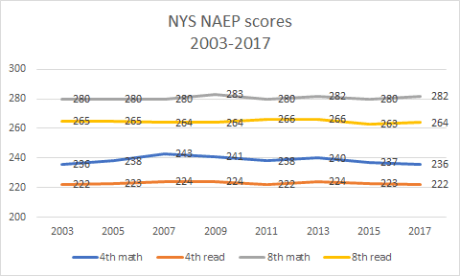
Leonie Haimson points out that, despite much boasting, New York City and New York State have made no gains on NAEP from 2013-2017.
What she did not include is a graph showing that New York State’s NAEP scores have been flat from 2003-2017.
Tom Loveless taught fifth grade in California, then earned a doctorate in educational policy, taught at Harvard, then landed at Brookings where he wrote reports on the condition of American education and analyzed international assessments. He recently retired from Brookings but continues to write.
He is one of the few original thinkers in the education think tank world. Neither the right nor left claims him. He is a straight shooter and brings a fresh perspective. He was one of the first to knock down the Great Shanghai Myth by pointing out that the student population of that city is not typical of China. Meanwhile the media and Arne Duncan ranted and raved about the superiority of Shanghai, as proven by its ranking on the international tests, which Loveless debunked.
I recently learned that Loveless had written a new paper evaluating the value of standards-based reform, the approach that is central to No Child Left Behind, Race to the Top, and the Every Student Succeeds Act.
He presented his findings at a conference sponsored by the American Enterprise Institute, a conservative D.C. think tank.
It is, as I expected, original and important.
Unless there is breaking news today, this will be the only post.
Please read the paper and feel free to comment.
Mercedes Schneider noted that John White, Louisiana’s Commissioner of Eduxation, got an advance copy of the NAEP scores, saw that his state was a disaster, and loudly complained about the switch to computer testing.
She observes that only a year earlier, a friend complained about computer testing to White, and he brushed off the complaint. Get used to it, he said. Hypocrite, she says.
Remember when Governor Bobby Jindal recruited a John White (TFA, Broadie) to bring true reform to the state of Louisiana?
If there was a New Orleans “miracle,” it did nothing to help the rest of the state. New Orleans should sign up for urban district NAEP, so we have a way of gauging what kind of miracle there was, if any.
Mercedes Schneider posts the Louisiana scores here, starting in 2000-2002.p, ending in 2017.
All that reform, so little change.
Mercedes says:
“So there we have it: John White’s 2017 NAEP problem.
“Let’s watch as he tries to spin it.”
Peter Greene has written about the harsh, punitive test-and-punish regime called “reform” for several years. Teacher evaluation by test scores of students. Charter schools promising to close achievement gaps. Vouchers. Turnarounds. Closing schools. Common Core, which was supposed to make everyone college-and-career-ready and provide equity and close gaps.
He says this about the NAEP release today.
It failed.
”Ed reform has failed.
“Everything else is just details and noise.”
Retired teacher Guy Brandenburg went to the National Press Club to observe the official release of the NAEP scores for 2017, released one year after the tests were offered in every state to samples of students.
His judgment: NAEP 2017 demonstrates the failure of what has been called “Reform” since the signing of NCLB in 2002 and the hiring of Michelle Rhee as autocratic chancellor of D.C.
”In the morning session, presenters acknowledged that for the nation as a whole, reading scores are flat – essentially unchanged — after 25 years of various types of ‘reforms’. Panelists tried to explain why, and seemed to me to give just about diametrically-opposed solutions to the problem. The introductory presenter (whom we saw on tape), essentially blamed us adults for not letting kids see us read often and deeply enough, and said that if we just wish harder, the results will come. (not quite a direct quote, but close)
“I did a quick appraisal of how Washington DC’s scores have improved (or not) before and after mayoral control, which was imposed shortly after students took the 2007 NAEP. You may recall that Michelle Rhee was imposed as DC’s first education Chancellor. She and her henchwoman, Kaya Henderson (who succeeded Rhee) predicted, in writing, all sorts of miraculous gains that would come if they were free to fire teachers en masse and subject them to rigorous numerical control via IMPACT and VAM.
“None of it came to pass.
“With today’s data it is even clearer than ever. I found 16 separate subcategories of students for which I could easily find data. Of them, improvements were better BEFORE mayoral control for 12 of them, and in only 4 was the improvement slightly better AFTER mayoral control.
“That’s a three-to-one vote against mayoral control and the whole educational Reformster movement.
“In other cities and jurisdictions, it’s more of the same. The imposition of Common Core curriculum, along with SBAC and PARCC testing and the like, has in fact made the gaps between high-achievers and low-achievers wider than ever.”
This is what failure looks like. Watch the excuses come pouring out.
James Harvey, executive director of the National Superintendents Roundtable, warns parents and the public not to be fooled by the “proficiency” standard of NAEP, the National Assessment of Educational Progress. The NAEP scores for 2017 will be released today, and you will hear loud lamenting about how many students are “not proficient.”
Under the leadership of Chester (Checker) E. Finn, Jr., the National Assessment Governing Board adopted “achievement levels” in 1992. The levels are: Advanced, Proficient, Basic, and Below Basic. They have been “provisional” since that time. They are determined by the subjective guesswork of adult panels who decide what students in fourth and eighth grade “should know and be able to do.” Sometimes these panels include teachers, but not always.
Before 1992, NAEP results were reported only as “scale scores” on a scale of 500 (they still are). One could see if the scores went up or down but not deplore their rise or fall because the scale scores tell you what is, not what ought to be. Checker has long been a critic of American schools, and he pushed for an easily understandable way to gauge the slow progress of the schools. Progress on a mass test is always incremental. When it is not, the measure is suspect.
Achievement levels provided a way to make simple (and simplistic) judgment calls. Most often, in this time of lamentations and chest-pounding about the younger generation, the achievement levels have turned into a cudgel with which to beat teachers, students, and public schools, usually by ignorant politicians who want to pass laws to ensure that “no child will be left behind” and that “every student succeeds.” Laws don’t teach children, nor do bluffs and fake threats.
My term on NAGB, the NAEP governing board, did not overlap Checker’s. I served later, from 1998-2004. I came to believe that the Advanced level represented A+ performance; Proficiency was a solid A, A-, even a B+; Basic was a B to C- level, where the plurality of students scored, and Below Basic was D and F. That was my judgment, not the policy of the board. When anyone asserts that all or almost all students should score in the Proficient range, I think of this as massive grade inflation. Reaching Proficient is a very high bar. It is entirely unrealistic to use NAEP Proficient as a passing standard, as the Common Core Tests do. Any school in which every student scores an A or A- or B+ must be a school for gifted students.
James Harvey writes:
NAEP TERM “PROFICIENT” IS MISLEADING
STATEMENT OF JAMES HARVEY
EXECUTIVE DIRECTOR
NATIONAL SUPERINTENDENTS ROUNDTABLE
FOR IMMEDIATE RELEASE
SEATTLE, April 9, 2018 – As the U.S Department of Education prepares to release the latest findings from the National Assessment of Educational Progress (NAEP), the American people should understand that the misleading term “proficient” sets a performance benchmark beyond the reach of most students in the world.
A detailed analysis released in January concluded that the vast majority of students in most countries could not demonstrate proficiency as NAEP defines the term.
The authors of the analysis, the National Superintendents Roundtable and the Horace Mann League, linked NAEP’s proficiency benchmark to the performance of students around the world on international assessments such as TIMSS (Trends in International Mathematics and Science Study).
The report on this work (How High the Bar?) concluded that:
In no nation do even 40 percent of students meet the NAEP Proficient benchmark in Grade 4 reading.
Only one nation has 50 percent or more of its students meeting the Proficient benchmark in Grade 8 science (Singapore).
Just three nations have 50 percent or more of their students meeting the Proficient benchmark in Grade 8 math (Singapore, Republic of Korea, and Japan).
Citing U.S. Department of Education documents, the report criticized the Department for misusing the term “Proficient.” The term, as the Department acknowledges, does not mean performing at grade level. Surprisingly, according to the Department’s statements, it does not even mean proficient, as most people understand the term.
Roundtable and Horace Mann League officials have insisted that the problem can be addressed without lowering standards by changing the term “proficient” to “high.” Without such a change, they maintain, the misuse of the term will continue to confuse both the public and educators, as in the past it has confused U.S. Secretaries of Education.
CONTACT: JAMES HARVEY: Office (206) 526-5336
Cell (206) 579-9272
******************************************
National Superintendents Roundtable
9425 35th Avenue, NE, Suite E
Seattle, WA 98115
*****************************************
National Superintendents Roundtable
9425 35th Avenue, NE
Suite E
Seattle, WA 98115
206-526-5336
Web: superintendentsforum.org
Facebook: http://www.facebook.com/ntsupsrt
Twitter: @natsupers
NAEP scores will be released April 18. They have already been released to state Superintendents so they can study their state’s scores and get their press release ready.
The 2015 scores were flat. Some states saw declines. This was widely viewed as a rebuke of the test-obsessed federal policies of the previous 15 years. Intensive test prep produced gains, but they had come to a halt.
Mercedes Schneider writes that Louisiana John White is already worried and has sent out a pre-emptive letter complaining that the scores may have been pushed down by NAEP’s switch to online testing. This is not a statement by a man who is looking forward to the score release. He is already making excuses.
White, a Broadie who got his start in TFA, has promised dramatic improvements. He has promoted charters and vouchers. He has hailed the New Orleans “miracle.”
We watch for the NAEP release.
James Harvey here explores “the problem with proficiency.”
Common Core tests arbitrarily decided that the NAEP proficiency level should be the “passing” mark for all. Test results are routinely reported as if those who did not meet this standard were “failing.”
I have routinely argued on this blog that NAEP proficiency is equivalent to earning an A, and that it was nuts to expect all students to earn an A. Only in one state (Massachusetts) have as many as 50% reached the standard.
Harvey demonstrates the reality.
He writes:
“In 1996, the International Education Assessment (IEA) released one of the earliest examinations of how well 4th grade students all over the world could read. IEA is a highly credible international institution that monitors comparative school performance; it also administers the Trends in Mathematics and Science Study (TIMSS), a global assessment of 4th and 8th grade mathematics and science achievement. Its 1996 assessment (The IEA Reading Literacy Study, a predecessor to the Progress in International Reading Literacy Study, or PIRLS) demonstrated that out of 27 participating nations, U.S. 4th graders ranked number two in reading (National Center for Education Statistics, 1996). Only Finland ranked higher. To the extent these rankings mean very much, this second-place finish for the United States was an impressive accomplishment.
”But around the same time, the National Assessment Governing Board of the National Assessment of Educational Progress (NAEP) reported that just one-third of American 4th graders were “proficient” in reading. To this day, the board of NAEP continues to release similarly bleak findings about American 4th graders’ reading performance (National Center for Education Statistics, 2011). And IEA continues to release global findings indicating that the performance of U.S. 4th graders in reading remains world class (Mullis et al., 2012).
“How could both these findings be accurate? Was it true, as NAEP results indicated, that U.S. 4th graders couldn’t walk and chew gum at the same time? Or was IEA’s conclusion—that the performance of American 4th graders in an international context was first class—more valid? A broader question arises here, one that has intrigued researchers for years: How would other nations perform if their students were held to the NAEP achievement-level benchmark for “proficient”? How might they perform on Common Core-aligned assess-ments with benchmarks that reflect those of NAEP?
”How Would Other Nations Score on NAEP?
“In 2015, statistician Emre Gönülates and I set out to explore these questions on behalf of the National Superintendents Roundtable (of which I am executive director) and the Horace Mann League (on whose board I serve). The results of our examination, recently released in a report titled How High the Bar? (Harvey & Gönülates, 2017), are eye-opening. In short, the vast majority of students in the vast majority of nations would not clear the NAEP bar for proficiency in reading, mathematics, or science. And the same is true of the “career and college-readiness” benchmarks in mathematics and English language arts that are used by the major Common Core-aligned assessments.
“This finding matters because in recent years, communities all over the United States have seen bleak headlines about the performance of their students and schools. Many of these headlines rely on reports about student achievement from NAEP or the Common Core assessments. One particular concern is that only a minority of students in the United States meet the NAEP Proficient benchmark. Frequently, arguments in favor of maintaining this particular benchmark as the desired goal for American students and education institutions are couched in terms of establishing demanding standards so the United States becomes more competitive internationally.
“But the reality is that communities around the world would face identical bleak headlines if their students sat down to take the NAEP assessments. So, when U.S. citizens read that “only one-third” or “less than half” of the students in their local schools are proficient in mathematics, science, or reading (or other subjects), they can rest assured that the same judgments could be applied to national education systems throughout the world if students in those nations participated in NAEP or Common Core-related assessments. (This is true despite the widespread perception that average student performance in some other nations exceeds average student performance in the United States. The metric applied in our study is not a rank ordering of mean scores by nation but the percentage of students in each nation likely to exceed the NAEP Proficient benchmark.)
“Our findings may not even be surprising when we consider questions that have arisen from previous research on NAEP.”
Harvey goes on to explain why it is absurd to use NAEP proficiency as a passing mark.
Thomas A. Cox practiced law in Georgia for many years and taught Education Policy and the Law at Emory University. Recently he moved to Virginia and discovered that the state’s leading newspaper, the Richmond Times Dispatch, was habitually hostile to the principle of public education and cheerleading for privatization. Cox submitted this opinion article to set the record straight, which the newspaper published.
I hope the editorial writers read his article.
He wrote about the falsity of the “failing schools narrative” and demonstrated that it is just plain wrong.
“Not often heard over the noise of this failure narrative is some compelling evidence that America’s public schools, far from being awash in failure, have overall been performing remarkably well, particularly in the face of new challenges and changing demographics. This counter-narrative is shared by a number of education researchers, historians, and educators, although they seldom receive the same fanfare (or financial impetus) as the nay-saying privatization advocates.”
Privatization is no answer to the challenges faced by our students today.
“A blind reliance on profit-driven markets to address and solve the challenges in educating America’s children would constitute a non-evidence-based leap of faith. Even worse, it would drive us toward abandoning our long-shared concept of education as a “common good” that we as a democratic polity have a collective responsibility to provide to all children. For almost two centuries, our country has served as a model to the world by striving to achieve that ideal through a shared societal commitment to publicly funded and locally operated schools.
“Although far from perfect and in need of constant re-evaluation and improvement, public schools and their legions of dedicated teachers continue to serve as critically important institutional forces in our nation’s ongoing struggle to provide equal opportunities for all citizens. In an age when so many economic and societal forces serve instead to increase inequality, now is no time for us to abandon that common commitment.”

 Diane Ravitch's blog