Archives for category: Media

This was one of Jennifer Rubin’s last columns for The Washington Post. She resigned on January 13 to start The Contrarian, to be free of the whims of billionaire Jeff Bezos. Bezos wants to be Trump’s ally. Rubin wants to be an independent journalist.

She writes here about the mainstream media’s newfound appreciation for Biden’s economic policies. The latest jobs report showed a healthy increase of 256,000 new jobs, which stunned economists. During the Biden administration, new jobs were created in every quarter for four years. This is an enviable record.

Currently, Trump and Vance are saying on social media that they are inheriting “a dumpster fire.” It won’t take long until they claim credit for the vibrant economy they are inheriting from Joe Biden.

She writes:

The New York Times wrote a few days ago, “President Biden is bequeathing his successor a nation that by many measures is in good shape, even if voters remain unconvinced.” Just how good are things? Here’s how the Times described the state of the economy:

For the first time since that transition 24 years ago, there will be no American troops at war overseas on Inauguration Day. New data reported in the past few days indicate that murders are way down, illegal immigration at the southern border has fallen even below where it was when Mr. Trump left office and roaring stock markets finished their best two years in a quarter-century.

The Financial Times reported last week on “why America’s economy is soaring ahead of its rivals.” Time published an essay in November that said, “President-elect [Donald] Trump is receiving the strongest economy in modern history which is the envy of the world.”

Gosh, you are not alone if you are wondering where such upbeat reporting has been for the past few years. After all, “The economy had a strong 2024: robust growth, low unemployment and inflation descending to 3%,” former car czar Steve Rattner told us. Moreover, he has said, “All told, Biden has added 693,000 factory jobs while Trump added just 425,000 before Covid hit.7 … The rate of grocery inflation — particularly troubling for everyday Americans ­— has subsided to less than 1.6%.” Real median incomes are higher than when Trump left office, border crossings are lower.

Overall, the Biden record is impressive, especially in light of the recession and pandemic he inherited. Researchers at the University of Chicago told us: “Under the Biden administration, real GDP rose 12.6 percent, rightly cheered … as ‘a historically robust expansion’ that repeatedly defied forecasts. Since the pandemic, economic growth in the US has far outpaced that of our peer nations. Business investment is up; unemployment is low.”

There are several explanations for why we did not have coverage commensurate with the success President Joe Biden enjoyed. The news media’s fixation on polls showing what voters thought about the state of the economy and its negative news bias (which I have written about) that refused to give proper weight to Biden’s successes failed to give voters an accurate picture of Biden’s achievements. And yet now, somehow, with the election over, the media widely acknowledges that Biden’s record is strong, something they downplayed during the election.

We should not discount the disproportionate impact of rising costs (again, echoed without sufficient context in political coverage) on the public perception of the economy (which in turn got amplified to the exclusion of “good news” by the media). “Inflation in the United States reached 9% in 2022, meaning that the average cost of goods and services went up by that amount,” Johns Hopkins University’s David Steinberg explained. “That is the highest rate of inflation that this country has experienced in over 40 years.” While inflation has now dropped close to the Federal Reserve’s 2 percent benchmark, “the price level today is more than 20% higher than it was four years ago. As a result, many Americans cannot afford to buy as many things as they otherwise would.”

There is something else at work as well. Utilizing 89 years’ worth of data, University of Chicago researchers found, very simply, “It is not enough to say that a strong economy favors the incumbent. … A strong economy favors Republicans, and a weak economy favors Democrats, regardless of the incumbent.” They postulate that “when the economy is weak, Americans become more risk averse, and that’s why they favor the party that promises redistribution and social insurance — Democrats. During booms, by contrast, voters are more willing to take risks and therefore more likely to elect Republicans, who favor lower taxes.”

Democrats, including Biden and former president Barack Obama, like to point out that Democrats routinely inherit recessions from Republicans, clean up the mess and yet get no credit for it. (“In finance, there’s a phenomenon known as the ‘presidential puzzle’ — stock returns have been higher under Democratic administrations than Republican ones,” the research showed. “Between 1927 and 2015, the period analyzed in our study, the average excess market return was nearly 11 percent per year higher under Democrats than Republicans.”)

And yet this does not explain why, after inheriting great economies, Republicans manage to mess things up, ushering in the conditions for Democrats to return. Let me suggest the most simple explanation: The sugar-high from the only consistent economic policy Republicans favor (supply-side economics) quickly wears off, leaving the country with higher debt, more economic inequality and underinvestment in critical areas (e.g., education, infrastructure). Coupled with reckless deregulation that often results in financial crisis (as in 2008), Republicans’ policies leave Americans reeling, ready to bring back the only party of responsible governance: the Democratic Party.

Democrats should extract several lessons from this pattern. First, the media cannot be relied on to tell the success story. Republicans have a reliable propaganda machine in right-wing media; Democrats enjoy no such luxury. (One need only look at the economic coverage during Biden’s term to see this is true.) Second, it follows that Democrats must do a much better job touting their own successes and communicating with low- and no-information voters. Biden joked he should have put his name on the stimulus checks; he was right.

And finally, before Democrats change their philosophy or dump capable leaders, they might simply run a 24/7 hard-hitting critique of the Trump economic agenda. That will set the stage for the midterms.

We already have hints what Trump will do: run up big deficits, cut taxes for the super rich, slash entitlements, enact inflationary tariffs that provoke trade wars, undertake mass deportations that prove economically disastrous and do corporation’s bidding in enacting reckless deregulation.

Voters may not have long memories (amnesia about Trump’s first term pervaded the campaign) but, fortunately for Democrats, Trump’s failures and scandals will be fresh in the minds of voters when they go to the polls in 2026

Jennifer Rubin explains why she gave up her column at The Washington Post, previously one of the most prestigious positions in American journalism. Billionaire Jeff Bezos, one of the richest men in the world, with assets exceeding $200 billion, has bent his knee to kiss the ring of Trump. To stay in Trump’s good graces, he has censored the editorial board, even an editorial cartoonist. The Post is hemorrhaging great journalists. Bezos bought one of the nation’s greatest newspapers and is destroying it.

She writes today:

Corporate and billionaire owners of major media outlets have betrayed their audiences’ loyalty and sabotaged journalism’s sacred mission — defending, protecting and advancing democracy.

The Washington Post’s billionaire owner and enlisted management are among the offenders. They have undercut the values central to The Post’s mission and that of all journalism: integrity, courage, and independence. I cannot justify remaining at The Post. Jeff Bezos and his fellow billionaires accommodate and enable the most acute threat to American democracy—Donald Trump—at a time when a vibrant free press is more essential than ever to our democracy’s survival and capacity to thrive.

I therefore have resigned from The Post, effective today. In doing so, I join a throng of veteran journalists so distressed over The Post’s management they felt compelled to resign.

The decay and compromised principles of corporate and billionaire-owned media underscore the urgent need for alternatives. Americans are eager for innovative and independent journalism that offers lively, unflinching coverage free from cant, conflicts of interest and moral equivocation.

Which is why I am so thrilled to simultaneously announce this new outlet, The Contrarian: Not Owned by Anybody. The Contrarian will offer daily columns, weekly features, podcasts and social media from me and fellow pro-democracy contrarians, many of whom have decamped from corporate media, others who were never a part of it. I am launching this endeavor with my cofounder, Norm Eisen. Founding contributors will include Joyce Vance, Andy Borowitz, Laurence Tribe, Katie Phang, George Conway, Olivia Julianna, Harry Litman (who recently resigned from the LA Times for reasons similar to mine for leaving the Post), and Asha Rangappa, among many other brilliant voices. We will provide fearless and distinctive reported opinion and cultural commentary without phony balance, euphemisms or gamified political punditry.

The need for upstart outlets has never been more acute. The contradiction between, on the one hand, the journalistic obligation to hold the powerful accountable and, on the other, the financial interests of billionaire moguls and corporate conglomerates could not be starker.

The Post’s own headline last month warned: “Trump signals plans to use all levers of power against the media; Press freedom advocates say they fear that the second Trump administration will ramp up pressure on journalists, in keeping with the president-elect’s combative rhetoric.” And yet The Post’s owner quashed a presidential endorsement for Trump’s opponent, forked over $1M for Trump’s inauguration through Amazon, and publicly lauded Trump’s agenda.

None of us could imagine Katharine Graham sending LBJ or Nixon a $1M check. It would have been, as it is now, a fundamental betrayal of a great American newspaper. Defense of the First Amendment is incompatible with funding or cheerleading for the very person who seeks to “drastically undermine the institutions tasked with reporting on his coming administration.”

The Post’s downfall is hardly unique. ABC, Mark Zuckerberg’s Meta and corporate-owned cable TV networks (which have scrambled to enlist Trump-friendly voices) are catering to powerful interests, and have profound corporate conflicts. Instead of guarding their independence, they join financial leaders, politicians and other public figures currying favor with Trump and his orbit.

Through classic anticipatory obedience—a dangerous but all too familiar pattern—they normalize the authoritarian menace. If Trump has taken “attacks on the press to an entirely new level, softening the ground for an erosion of robust press freedom,” as The Post reported, it is because he finds insufficient resistance. Instead, owners whose outlets he targets quite literally rewarded him.

In closing, I want to reiterate that I have been honored to work for over fourteen years alongside the finest writers and editors in journalism. Above all, I was blessed to work for The Post under the Graham Family ownership and Fred Hiatt’s leadership of the editorial section. My admiration for their collective integrity, dedication to craft, courage, patriotism, and decency is boundless. But when new leaders sully the reputation of institutions entrusted to them and the fate of democracy is in the balance, we all must reevaluate our careers and our obligations to the world’s most essential nation.

History calls us all.

I treasure the readers who have stuck with me over the years. I invite them and all those interested in defeating authoritarianism as well as writers and content creators to join this exciting new venture in defense of democracy. Forward!

More evidence that Jeff Bezos’ sycophantic actions are destroying The Washington Post.

Jennifer Rubin is one of my favorite columnists. She was hired by the Washington Post to offer a view from the right, after establishing a career as a conservative. Trump’s lies and policies turned Rubin into a liberal. She is both a journalist and a lawyer. She writes clearly and forcefully.

Media specialist Brian Stelter reports that Rubin is leaving the Post to start a new venture.

Today, veteran opinion columnist Jennifer Rubin is becoming the latest in a long list of Washington Post figures to leave the troubled institution.

Rubin tells me she is partnering with former White House ethics czar Norm Eisen and launching a startup publication called The Contrarian. Its tagline, “Not owned by anybody,” is a pointed reference to billionaire Washington Post owner Jeff Bezos and other moguls who, in Rubin’s view, have “bent the knee” to President-elect Donald Trump.

“Our goal is to combat, with every fiber of our being, the authoritarian threat that we face,” Rubin says.

Rather than anti-Trump, the founders describe their venture as pro-democracy. They said they have already enlisted about two dozen contributors, including Ruth Ben-Ghiat, Andy Borowitz, George Conway, John Dean, Bob Kagan, Barb McQuade, Katie Phang, Asha Rangappa, Stephen Richer, and Andrew Weissmann.

Eisen, who is departing his CNN legal analyst role, will be the publisher. Rubin will be the editor-in-chief. Rubin says she resigned from the Post because it, “along with most mainstream news outlets, has failed spectacularly at a moment that we most need a robust, aggressive free press.” She adds: “I fear that things are going from bad to worse at The Post.”

Dan Rather, the fearless reporter for “60 Mibutes,” now retired, writes about Jeff Bezos’ ham-handed interference with the editorial independence of The Washington Post. The moral of the story is that newspapers should not be owned by billionaires with other financial interests, especially those who need a good relationship with the President, like Bezos. Why should Bezos cut staff because the Post is losing money? His net worth is more than $200 billion. Why destroy one of the nation’s greatest newspapers to recoup $77 million in losses? That’s chump change for Bezos.

When a journalistic institution is the one making headlines, it’s rarely good news. Such is the case for a revered American newspaper, The Washington Post. A mothership of American journalism, whose reporters helped topple an American president and inspired generations of young reporters, is listing and taking on water.

As Donald Trump and his army of “alternate” truth-tellers get ready to take the reins of government again, the country desperately needs the best and brightest journalists watching and reporting on their every move. And yet we wake to news that the Post is expected to lay off dozens more staffers the very month Trump returns to power.

The 147-year-old newspaper is apparently bleeding money, a problem of its own making. When billionaire Post owner Jeff Bezos pulled the newspaper’s endorsement of Kamala Harris just days before the election, a reported 250,000 readers cancelled their subscriptions in protest. That accounts for 10% of the paper’s online audience.

“I just cancelled my Washington Post subscription. The web site asked why, and the closest option was ‘concern with the content.’ There was no option about surrendering to fascism, but that’s the real reason,” a former subscriber posted on X.

For Bezos, founder of Amazon, the Post’s financial losses are peanuts considering his $200 billion plus net worth. But his love of the paper and his passion for quality journalism seem to be shrinking.

Back in 2013, when Bezos bought the Post from the family of venerated publisher Katharine Graham, he said he wanted to transform it from a regional newspaper to a global one. He provided money — big money — to expand the newsroom and encouraged reporters to extend their reach by embracing the “gifts of the internet.”

Over the ensuing decade, his interest in the paper ebbed and flowed, but he mostly stayed out of the editorial decision-making. Then he pulled the Harris endorsement causing an exodus of top editors, opinion writers, and reporters.

But Bezos wasn’t done burnishing his rep with the former president. After the election, he pledged $1 million to help pay for Trump’s inauguration and agreed to stream it live on Amazon Prime (an additional $1 million in-kind contribution). Just before Christmas, he was seen at Mar-a-Lago, kissing the ring with fellow super-rich guy Elon Musk. And he has green-lit a documentary about Melania Trump to air on Prime. I’m guessing it will be what’s known in the trade as a “sweetheart profile.”

While it isn’t great that the owner of one of the most important papers in the country is cozying up to an incoming president who says he will be a dictator on “day one,” Bezos’s actions aren’t surprising. He didn’t become a billionaire by being selfless.

But on Friday, things took another turn at the Post. Pulitzer Prize-winning editorial cartoonist Ann Telnaes quit in protest after a cartoon of hers was killed.

In a piece she published on Substack, Telnaes explained that “there have been instances where sketches have been rejected or revisions requested, but never because of the point of view inherent in the cartoon’s commentary. That’s a game changer…and dangerous for a free press…”

Since 2005, a third of newspapers in the United States have folded, and two-thirds of newspaper reporters are gone. On an Axios podcast, Victor Pickard, a professor of media policy and political economy at the University of Pennsylvania, explained that “We no longer have a commercial market that can support the levels of journalism that democracy requires.”

Another model needs to be found, and fast. We’ve learned the hard way that benevolent billionaires aren’t going to rescue American journalism. Smarter people than I are working on ways to do just that … an important topic for another Steady down the road.

In the meantime, fingers crossed. As I have said over the years and repeat now for emphasis: A free and independent — fiercely independent when necessary — press is the red beating heart of democracy.

Another editorial cartoonist, Darrin Bell, weighed in to compare the difference between the fearless media of the 1970s and the careful media today. And just as important, he compares how social media has changed the expectations of readers.

Bell writes:

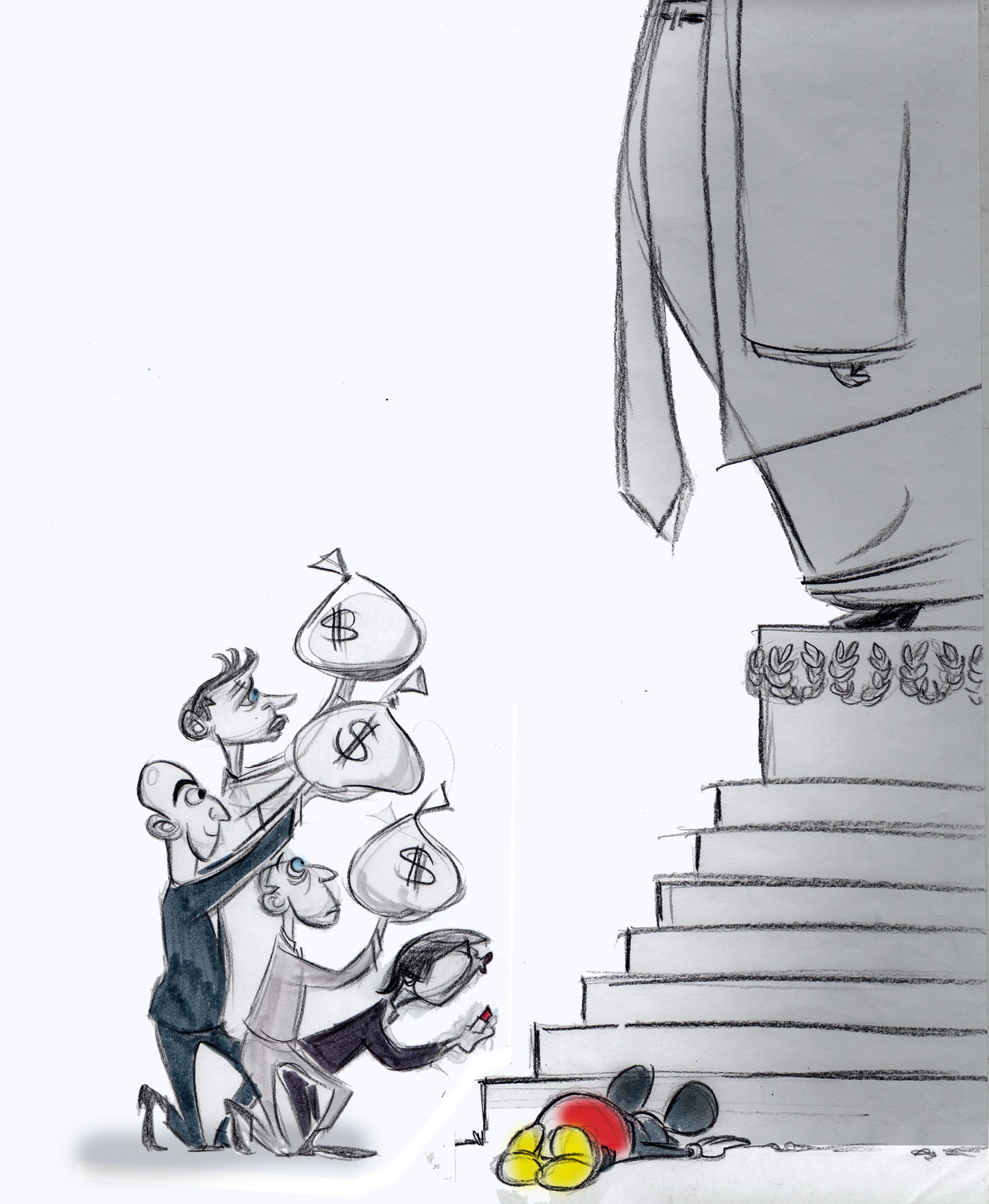
Ann Telnaes is a brilliant, Pulitzer Prize-winning editorial cartoonist for the Washington Post, and I’m proud to know her. Yesterday, she posted to her Substack that after The Post rejected this rough sketch, she resigned in protest:

I’ve spoken on a couple panels about editorial cartooning alongside Ann Telnaes. The first one was at a 2017 (or was it 2016?) convention in Columbus Ohio. The second was years later at the University of Virginia. 

In 2017, I told that audience how I broke into the industry through perseverance, by making myself stand out, and by proving myself to opinion page editors and to the newspaper syndicates. I felt such pride in recounting that story. But in 2023, it hit differently. As I opened my mouth to speak to students who don’t remember a time before social media, suddenly I felt that this generation was more likely to interpret my “inspirational” tale as one of how I groveled for years before gatekeepers. 

The obsolete origin story

Instead, I told the UVA students that my origin story was now obsolete. It’s not a road map they should follow anymore. I advised them to avoid newspapers altogether and reach readers directly through services such as Substack. I surprised myself. I wasn’t sure why I said that.

So I kept talking, and discovered why as I spoke. I’d been harboring frustration that, until then, I’d managed to suppress. 

Before I was born, the Washington Post’s reporters (and their cartoonist, Herblock) led the coverage that brought down Richard Nixon. That’s when the right wing began playing a long game, with the goal of neutering the Media. By 2023, they’d convinced most Americans that pretty much any media not owned by right wing ideologues were just cogs in a liberal conspiracy machine. 

The press is the only industry the Constitution specifically protects. But when I spoke to those UVA students, I could not tell them that newspapers were fulfilling the function the Founders had intended them to fulfill. The Founders had a lot of lousy ideas, but enshrining the press as the main line of defense against creeping authoritarianism wasn’t one of them.

I’d won a Pulitzer a few years earlier for work attacking police brutality, Trump’s malevolence, and systemic racism. But by 2023, those themes had become a tough sell – even to newspapers that had kept a running tally of Donald Trump’s lies throughout his wretched presidency. Papers seemed to want something less strident. Something less opinionated, on the Opinionpages.

I didn’t know whether to consider that a function of fear, or to chalk it up to editors simply being tired of all the existential dread, who just wanted to lighten things up. I’m not sure the distinction matters, to me. All the President’s Men was my first inkling of what journalism was supposed to be. Paul Conrad’s LA Times editorial cartoons were brutal and brilliant, especially to a kid like me in the 1980s. 

David Shipley’s response

David Shipley, the Post’s editorial pages editor, disagreed with Ann’s interpretation of events. He told the New York Times “Not every editorial judgment is a reflection of a malign force…” and “My decision was guided by the fact that we had just published a column on the same topic as the cartoon and had already scheduled another column — this one a satire — for publication. The only bias was against repetition.”

I’ve seen my work run alongside columns that dealt with the same issues before. It’s common. And a satirical column is not a replacement for an editorial cartoon. I don’t believe David Shipley considered something I’ve always found to be the case: different readers read different things.Some stick to earnest columns. Some dive straight into satirical columns. But others – especially young people like I was in the 1980s – only open the opinion page for the editorial cartoons. Editorial cartoons are an introduction to journalism, for young people and for those whose eyes gloss over when they see paragraph after paragraph of prose. Covering the same matter with three different types of journalism is not redundant, it’s reach-out.

Open the link to finish reading this provocative essay.

Ann Tolnaes is a brilliant cartoonist who resigned from The Washington Post when her latest cartoon was cancelled. It depicted the media and tech oligarchs bowing and scraping to Trump, including the owner of The Washington Post, Jeff Bezos.

The editor of the opinion section said he killed the cartoon because the paper had run a story on the same topic, and the cartoon was repetitious. I found that hard to believe because cartoons typically comment on stories in the news; they don’t break news.

He also said she had been invited to return. We will see what happens. The whole episode was widely publicized and is a stain on the newspaper’s reputation, especially since Jeff Bezos intervened and canceled the paper’s endorsement of Kamala Harris in the closing days of the campaign.

For another telling of this important story, read the article by Mike Peterson in The Daily Cartoonist about the controversy and about Ann Tolnaes’s importance. He reprints several of her cartoons, explains how to order a book of her cartoons (bypassing Amazon), and suggests we show our support by subscribing to her Substack blog. I just subscribed.

Thanks to reader John Ogozalek for directing me to this insightful commentary.

Ann Telnaes, editorial cartoonist for the Washington Post since 2008, quit her job after one of her cartoons was censored by higher-ups. The cartoon at issue depicted tech and media billionaires paying obeisance and money to Donald Trump. The cartoon included portrayals of Mark Zuckerberg (META), Sam Altman (AI), Patrick Soon-Shiong (Los Angeles Times), and Jeff Bezos, owner of the Washington Post. And, of course, Disney, which settled with Trump for $15 million rather than defend George Stephanopoulos in court. Each has given Trump $1 million or more to underwrite his inauguration. If Telnaes had waited a day, she would have added Tim Cook, CEO of Apple, to her list of suck-ups and sycophants.

The motto of the Washington Post is: “Democracy dies in darkness.” Conservative (but anti-Trump) lawyer George Conway wrote on BlueSky:

I guess the new slogan for the Washington Post ought to be:

“Newspapers die in cowardice.”

Ann Telnaes’ resignation is an act of courage that should inspire all of us to stand by our principles.

Telnaes wrote about her decision to resign on her Substack blog:

I’ve worked for the Washington Post since 2008 as an editorial cartoonist. I have had editorial feedback and productive conversations—and some differences—about cartoons I have submitted for publication, but in all that time I’ve never had a cartoon killed because of who or what I chose to aim my pen at. Until now.

The cartoon that was killed criticizes the billionaire tech and media chief executives who have been doing their best to curry favor with incoming President-elect Trump. There have been multiple articles recently about these men with lucrative government contracts and an interest in eliminating regulations making their way to Mar-a-lago. The group in the cartoon included Mark Zuckerberg/Facebook & Meta founder and CEO, Sam Altman/AI CEO, Patrick Soon-Shiong/LA Times publisher, the Walt Disney Company/ABC News, and Jeff Bezos/Washington Post owner. 

While it isn’t uncommon for editorial page editors to object to visual metaphors within a cartoon if it strikes that editor as unclear or isn’t correctly conveying the message intended by the cartoonist, such editorial criticism was not the case regarding this cartoon. To be clear, there have been instances where sketches have been rejected or revisions requested, but never because of the point of view inherent in the cartoon’s commentary. That’s a game changer…and dangerous for a free press.

(rough of cartoon killed)

Over the years I have watched my overseas colleagues risk their livelihoods and sometimes even their lives to expose injustices and hold their countries’ leaders accountable. As a member of the Advisory board for the Geneva based Freedom Cartoonists Foundation and a former board member of Cartoonists Rights, I believe that editorial cartoonists are vital for civic debate and have an essential role in journalism. 

There will be people who say, “Hey, you work for a company and that company has the right to expect employees to adhere to what’s good for the company”. That’s true except we’re talking about news organizations that have public obligations and who are obliged to nurture a free press in a democracy. Owners of such press organizations are responsible for safeguarding that free press— and trying to get in the good graces of an autocrat-in-waiting will only result in undermining that free press.

As an editorial cartoonist, my job is to hold powerful people and institutions accountable. For the first time, my editor prevented me from doing that critical job. So I have decided to leave the Post. I doubt my decision will cause much of a stir and that it will be dismissed because I’m just a cartoonist. But I will not stop holding truth to power through my cartooning, because as they say, “Democracy dies in darkness”.

Thank you for reading this.

Brian Stelter writes about the media for CNN. When CNN went through a reorganization a year or so ago, attempting to be “centrist” or appeal to the right, Brian was fired. He is actually very even-handed in his comments. After CNN’s shakeup failed, Brian was rehired and CNN again posts his “Reliable Sources” commentary in the media. Subscribe; it’s free.

He wrote this morning:

Within 24 hours of the Bourbon Street terror attack, reporters pieced together a relatively complete picture of the suspect. But a key early bit of misreporting confused the public – and possibly the president-elect. It’s a cautionary tale for everyone in the news industry as the new year begins.

Just after 10 a.m. Wednesday, Fox News reported that the suspect’s truck crossed the U.S. border in Eagle Pass, Texas “two days ago.” Some of Fox’s coverage explicitly said “the suspect” drove across the border, leading Fox viewers to believe that a foreigner might be responsible for the deadly carnage.

Evidently, Fox was misinformed by anonymous sources. The network walked it back within two hours and said the truck was in Eagle Pass nearly two months ago, not two days ago. And more importantly, the truck was being driven by someone else at the time, so the detail about the border was completely irrelevant and misleading. 

But the damage was already done. President-elect Donald Trump, seemingly misinformed by Fox, issued a statement about “criminals coming in” from other countries. “Biden’s parting gift to America — migrant terrorists,” Donald Trump Jr.wrote, sharing the Fox claim. “Shut the border down!!!” Rep. Marjorie Taylor Greene exclaimed.

The president-elect ironically used the New Orleans attack to say that he was right and the “Fake News Media” was wrong about the threat posed by illegal immigration. If he had waited a couple hours to react, he would have learned that the suspect was a U.S. citizen and Army veteran.

“Some Republicans continued to beat the border drum well after Fox News retracted its initial report,” The Daily Beast’s Josh Fiallo wrote last night. This morning I’m still seeing people on social media share the misinfo. 

A couple of takeaways: One, it’s incredibly difficult to claw back a bogus claim that people want to believe. And two, in a repeat of 2017-2020, it’s going to be crucial for reporters to scrutinize Trump’s sources of information, since his favorite sources have so often misled him in the past.

Stelter added, later in his post, a caution to the media:

I love what Kaitlan Collins told Semafor about 2024’s political surprises being “the ultimate reminder to never assume what the news is going to be.” As a reporter, “you should always operate with an open mind,” she said. “It’s easy, but risky, to think you know where a story is going.”

Ashton Pittman is the news editor of the Mississippi Free Press and a fine writer. I get my news about Mississippi by reading MFT, reported by people who live there. Pittman describes in this article why he debated whether to leave Twitter. When Musk bought Twitter, he knew it was going to be bad. He had spent years building up a following there and didn’t want to give it up. He investigated other social media platforms, but they weren’t right.

Then came the 2024 election, and Twitter turned into a political platform that favored Trump, where nasty trolls and bots created a toxic atmosphere.

Ashton joined BlueSky and very quickly gained a large number of followers close to what he (and the Mississippi Free Press) had had on Twitter.

He writes:

For a long time, it seemed like nothing was going to replace Twitter, even as it further devolved into a hellscape that seemed as if it were overrun by the trolls of 4chan, the neo-Nazis of Stormfront and the dullest AI bots Chat GPT ever powered. Twitter transformed into X, a place where racism, misogyny, homophobia and especially transphobia run rampant under the guise of “free speech,” but where using the word “cisgender” can get your account restrictedbecause Musk (who has described his very-much-alive transgender daughter as “dead”) considers it a slur.

I had really wanted one of the Twitter alternatives to take off, but one of the biggest impediments was the lack of buy-in from major journalists, publications, celebrities and other figures who could draw audiences away. A familiar pattern developed: People would leave X in hopes of joining another platform, then come back. 

Then came the election. Twitter turned into a Trump propaganda site. And Ashton was done.

But you know what I really enjoy about BlueSky? It doesn’t pigeonhole me. On other platforms, particularly X, you choose one facet of yourself and that’s the following you get, and the algorithm recommends you based on that. On BlueSky, I get to be a Mississippi journalist whose news stories draw engagement from people who care about news, but I also get to be a film photographer whose posts about my black-and-white film adventures spark conversations, too. None of us is just one thing, no matter what some lousy algorithm thinks, and it’s affirming to be able to build communities around shared interests beyond just news and politics. Social media should be social, not anti-social….

My experience as a journalist on BlueSky has reminded me that my job is to provide good information to those who want it, not to argue with trolls and validate attention-seeking behavior from the worst people on the internet. My desire to reach a diverse audience does not have to entail subjecting myself to constant abuse. I am not obligated to stay on a platform where Nazi trolls with 1488 in their usernames and cartoon frogs as their profile images regularly hurl the word “fagg-t” at me and issue veiled threats. I do not have to entertain the endless stream of incels who think “soy boy” is some sort of profound insult. I do not have to accept being under the thumb of an algorithm that prioritizes crypto scams, AI bots and conspiracy theorists over my voice.

And you know what? You don’t either.

Some of the smarter people among us have said that BlueSky is an echo chamber. Well, right now, it’s a place where I hear the echoes of artists, writers, cinephiles, scientists and neighbors caring about their neighbors. And that’s a hell of a lot better than being trapped in a chamber that’s increasingly filled with the echoes of Adolf Hitler.

So farewell, Twitter. I’m off to bluer skies.

Maurice Cunningham, a retired professor of political science, reviewed the Boston Globe’s bad habit of treating billionaire-funded groups as authoritative on education issues.

He wrote recently, as posted on the blog of the Network for Public Education:

Maurice Cunningham finds that looking at the Boston Globe tells us too much about the folks who think education is just to prepare children to become useful tools for business. Reposted with permission. 

When I was a kid in the Sixties we’d occasionally hear stories about some poor Japanese soldier, abandoned on a Pacific island after WWII, finally being rescued while believing he was still fighting the war. That’s sort of where the Boston Globe’s post-MCAS coverage is. But as a lesson in the biased media approach to interest group coverage, it is a real education.

The latest is by reporter Mandy McLaren, With no more MCAS requirement, graduation standards vary widely among state’s largest districts. What interests me is the sources used in the story, which include a heavy presence of billionaire funded and tax deductible “non-profits” aka interest groups. That’s because non-profit, while it sounds eleemosynary ( I just wanted to use that word in a sentence) actually represents the policy preferences of the moneyed few; or as the media like to say the Massachusetts business community; or as I like to say: capital.

Let’s meet the Globe’s eleemosynary sources starting with “The risk moving forward, said Andrea Wolfe, president and CEO of MassInsight, a Boston-based education nonprofit.” Mass Insight’s donors include the Bill and Melinda Gates Foundation and the Boston Foundation (you will remember them from The Globe Puffs Up Another Dubious “Science of Reading” Program) and Fidelity Investments Charitable Gift Fund (also from Puffs Up).

Then there is “Erin Cooley, Massachusetts managing director for Democrats for Education Reform, a group that advocated against Question 2.” Don’t make me go through the Oligarch Party funding of Democrats for Education Reform again, but you can catch the gist at Democrats for Education Reform: Let’s Meet the Funders and How to Understand Democrats for Education Reform Using Two Quotes from Democrats for Education Reform.

Finally,

Erika Giampietro, executive director for the Massachusetts Alliance for Early College, said she hopes whatever path the state takes next focuses on the ‘competencies’ students graduate with, especially those that truly matter in the real world.”

“[Employers] are not saying, ‘I wish kids had taken two years of foreign language, four years of English and four years of math.’ They’re saying, ‘Yeah, kids aren’t coming with strong enough executive functioning and clear enough communication skills and showing up to work every day and realizing how important that is to be on time,‘” Giampietro said.

Funders include Gates, Boston Foundation, Fidelity Charitable Gift (also in Puffs Up).

Employers=business=capital. Ms. Giampietro offers the interest group frame: employers would like taxpayer paid employee training (while not increasing taxes). The focus is employers and not children. If you read enough of these stories, that comes through. Not that kids should be introduced to foreign cultures, discover a love of literature or art, or heaven forbid, question the prevailing structures of society. Such concerns are not the “the real world” issues of business.

The article did quote Max Page, president of Massachusetts Teachers Association. But when you also quote two superintendents who miss MCAS and three eleemosynary business group interests, well . . . does three from capital equal one from labor?

Money never sleeps. Follow the money.

“Imagine movie critics who either did not know, or did not care to know, that movies have producers, script writers, directors, financiers, or casting directors, and so based their reviews on the premise that it was the actors alone who created the storyline, dialogue and mise en scene, and that the most successful actors were those who best understood the audience. That is essentially how all politics is covered in 21st century America.”—Michael Podhorzer.

Network for Public Education

P.O. Box 227
New York, New York 10156
(646) 678-4477