Archives for category: Media

I don’t know about you but I was disappointed by the CNN interview of Kamala Harris and Tim Walz. Interviewer Dana Bash wanted her colleagues to say she was tough, so she asked several gotcha questions. In particular, I was annoyed by the “what will you do in your first day in office?” question. It seems to be a standard question, but the answers it elicits are either banal or unrealistic. I recall that Trump told Sean Hannity that he would “drill, baby, drill” and “build the wall” on his first day. Oh, and he would be a dictator on day one. Harris just offered some platitudes about starting “the opportunity culture.” The realistic answer might be “I’m going to meet with my new staff; I’m going to find out where the bathroom is; I’m going to check out the desk drawers and arrange my family pictures; I’m going to plan our legislative agenda.” If Harris were coming in after Trump, she would have many executive orders to sign, reversing his bad ideas. But she follows Biden, and it is unlikely she will reverse anything.

Thom Hartmann was disappointed by the CNN interview. He explains here:

CNN shows everything that’s wrong with 2024’s repeat of 2016’s election coverage. In an interview with Vice President Harris and Governor Walz Thursday night, CNN’s Dana Bash chose to repeat pathetic rightwing attacks on the candidates instead of engaging in issues of importance to a majority of Americans. Only four of the questions she asked during the entire interview were not rightwing talking points. She could have asked about their pledge to protect Social Security and Medicare after Trump proposed cuts to both programs every year for his 4 years in office, or the 90% of Americans who want weapons of war off our streets, or their efforts to revive labor unions in the face of GOP opposition, or how they feel about Republicans on the Supreme Court thwarting Biden’s efforts to cut student loan debt, or what they’d do about the severe ethics problem with bribed Supreme Court justices Alito, Roberts, and Thomas, or their support for the queer community in the face of unrelenting attacks by JD Vance and other rightwingers, but, no. Instead, she had to ask about a one-word misspeak by Walz five years ago, whether Harris identified as Black or Indian or what, and why Walz implicitly lied when he said he and his wife had undergone “IVF” treatment for infertility when, in fact, they’d undergone the similar “IUI” treatment. As if anybody, anywhere, gives a damn. Probably the best analysis of the interview is here on Substack by Jeff Teidrich. Meanwhile, CNN’s management is ebullient about having pulled in a “whopping 6 million viewers.” Like I said, money over country…

Margaret Sullivan was the ombudsman (public editor) for the New York Times. She writes a blog called American Crisis. There are so many amazing blogs these days that it’s hard to keep track. This one appeared in my email today, and it speaks to a debate among readers on this blog about whether the media, and most especially The New York Times, normalizes Trump’s behavior and ideas in an effort to be “fair.” I’m subscribing.

She writes:

I once asked Jill Abramson, the former top editor of the New York Times, to name the best reporters she had ever encountered.
I recall she mentioned her friend and co-author Jane Mayer — definitely on my list, too — and a few others. Mayer’s book, “Dark Money,” about the Koch Brothers, is a classic of investigative reporting.

Another one was James Risen, the renowned investigative reporter formerly of the New York Times, and later at the Intercept. I agreed again, particularly because of an investigation that Risen did during the George W. Bush administration about the government surveillance of American citizens through warrantless wiretapping. (There’s quite a backstory there, but suffice it to say that Times editors held back the investigation for many months after the administration claimed that publishing would threaten national security; Risen eventually forced the hand of his editors, resulting in the publication of the blockbuster co-authored with Eric Lichtblau — and it won a Pulitzer Prize.)

I heard from Risen a few days ago, as I do from time to time; I got to know him while I was the Times public editor or ombudswoman. He wrote to express his outrage at his former employer for a recent story. I pay particular attention to him as a former Timesman himself and a journalist of integrity.

“At first, I thought this was a parody,” Risen told me. Unfortunately, it wasn’t. Even more unfortunately, the lack of judgment it displays is all too common in the Times and throughout Big Journalism as mainstream media covers Donald Trump’s campaign for president.

“Harris and Trump Have Housing Ideas. Economists Have Doubts,” is the headline of the story he was angered by. If you pay attention to epidemic of “false equivalence” in the media — equalizing the unequal for the sake of looking fair — you might have had a sense of what was coming.

The story takes seriously Trump’s plan for the mass deportation of immigrants as part of his supposed “affordable housing” agenda.
Here’s some both-sidesing for you, as the paper of record describes Harris’s tax cuts to spur construction and grants to first-time home buyers, and Trump’s deportation scheme.
“Their two visions of how to solve America’s affordable housing shortage have little in common …But they do share one quality: Both have drawn skepticism from outside economists.” The story notes that experts are particularly skeptical about Trump’s idea, but the story’s framing and its headline certainly equate the two.

There’s only one reason I disagree with Risen’s reaction. He wrote: “This story is unbelievable.”

I wish.

Stories like this run rampant in the Times, and far beyond. It matters more in the Times because — even in this supposed “post-media era” — the country’s biggest newspaper still sets the tone and wields tremendous influence. And, of course, the Times has tremendous resources, a huge newsroom and the ability to hire the best in the business. Undeniably, it does a lot of excellent work.

But its politics coverage often seems broken and clueless — or even blatantly pro-Trump. There’s so much of this false-balance nonsense in the Times that there’s a Twitter (X) account devoted to mocking it, called New York Times Pitchbot. 

Sometimes, sadly, it’s hard to tell the difference between the satire and the reality. Hence, Risen’s parody line.

At the same time, when Trump does something even more outrageous than usual, the mainstream press can’t seem to give it the right emphasis. Last week, NPR broke the news that Trump and his campaign staff apparently violated federal law — and every norm of decency — by trying to film a campaign video at Arlington National Cemetery and getting into a scuffle with a dutiful cemetery employee.

Of course, the story got picked up elsewhere and got significant attention. But did it get the huge and sustained treatment that — let’s just say — Hillary Clinton’s email practices did in 2016? Definitely not, as a former Marine, Ben Kesling, wrote in Columbia Journalism Review:

“Lumped together, the reporting this week left readers and listeners, especially with no knowledge of the military, at a loss to understand what actually happened — and crucially, why it mattered so much. The Trump campaign had successfully muddied the waters by alleging that the photographer had been invited to the event by family members of soldiers buried there.”

It came off, he wrote, “like a bureaucratic mix-up or some tedious violation of protocol,” not a deeply disrespectful moral failure, which it surely was. “The sacred had been profaned.”

The political cartoonist Darrin Bell, however, certainly got the point across in a time-lapse video cartoon. Check it out here. (Open the link to see this).

Why does this keep happening, not just in the Times but far beyond? 

Nearly 10 years after Trump declared his candidacy in 2015, the media has not figured out how to cover him. (My last major piece in the Washington Post laid out how coverage should change if Trump decided to run again, and I’ve also written recommendations here from the Media and Democracy Project.)

And what’s more — what’s worse — they don’t seem to want to change. Editors and reporters, with a few exceptions, really don’t see the problem as they normalize Trump. Nor do they appear to listen to valid criticism. They may not even be aware of it, or may think, “well, when both sides are mad at us, we must be doing it right.” Maybe they simply fear being labeled liberal.


American Crisis is a community-supported project where I explore how journalism can help save democracy. Please consider joining us! Subscribe


All of this matters immensely as the extraordinarily important campaign for president heads into its last couple of months. I’ll be continuing to monitor coverage here, and trying to find ways to improve it.

Twitter (X) has few rules but one of them bars fake images.

X belongs to Elon Musk, the richest man in the world. He can do whatever he wants on X. Rules are for others. So he did.

Tech billionaire Elon Musk, a supporter of former President Donald Trump, on Monday posted a fake image of what appears to be Vice President Kamala Harris dressed in a red communist uniform.

“Kamala vows to be a communist dictator on day one. Can you believe she wears that outfit!?” Musk posted on X, the social media platform he owns, in response to the vice president’s post warning about Trump being a “dictator on day one.”

According to X’s policy, users “may not share synthetic, manipulated, or out-of-context media that may deceive or confuse people and lead to harm. … In addition, we may label posts containing misleading media to help people understand their authenticity and to provide additional context.”

Musk’s post does not have any such label on it.

Last month, Trump posted a fake, AI-generated image depicting Harris speaking in front of a communist symbol at the Democratic National Convention. 

The least trustworthy tweets are those posted by Musk.

Robert Hubbell was outraged by the editorial in The Washington Post attacking Kamala Harris’s economic plan. The editorial said, basically, that her plans to help the middle class made no sense. Consider the source, he says. In one post, he listed and praised Harris’s economic priorities, then went into detail, explaining how they would benefit the average American.

This is the heart of her economic plan:

  • Increase the child tax credit.
  • Increase the earned income tax credit for wage earners without children.
  • Prohibit price gouging in food supplies.
  • Subsidize down payments for first-time [home] buyers.
  • Decrease the cost of prescription drugs.

Then he followed up by attacking the Washington Post editorial belittling her plan.

He writes:

Apologies for taking a second-bite at the apple, but Jeff Bezos just gave Kamala Harris a gift that cannot be ignored. The Bezos-owned Washington Post just issued an Editorial by the Editorial Board that was titled, “Opinion The times demand serious economic ideas. Harris supplies gimmicks.”

Oh, thank you, Jeff Bezos, owner of Amazon Fresh, Whole Foods, and one of the largest home delivery grocery services on the planet, thank you!

Here is what Kamala Harris should do at the convention: Put up that headline on big screen, and give a speech that contains these elements:

The Washington Post Editorial Board, which works for billionaire Jeff Bezos, thinks it’s a “gimmick” to give families with newborns a tax credit in the first year of the newborn’s life.

Billionaire Jeff Bezos thinks it’s a “gimmick” to expand the child-tax credit, the single most effective measure for lifting children out of poverty in three generations.

Billionaire Bezos, who has a super-yacht to ferry passengers to his mega-yacht, thinks it’s a “gimmick” to give low-income working Americans a $1,500 tax credit.

Billionaire Bezos, whose company, Amazon, is trying to take over the pharmacy business in America, thinks it’s a gimmick to limit out of cost prescription drug prices to $2,000 for ALL Americans, not just seniors.

Billionaire Bezos, who just bought his THIRD mansion on an island in Florida, thinks it’s a gimmick to give first time home buyers a $25,000 subsidy for a starter home.

Billionaire Bezos says that we shouldn’t prohibit “price gouging” because grocery stores are aggressively reducing prices. Let me hear from you: Is your grocery bill going down now that inflation is under control?

Billionaire Bezos is free to have his personal newspaper criticize my plan all he wants. This is America and billionaires are entitled to free speech, even if they get to buy an Editorial Board to promote their opinions.

But fair is fair. Donald Trump held a press conference last week to reiterate his plan for the economy, which has only two elements: Extending tax cuts that favor billionaires and imposing an economy killing 10% tariff on all imports.

Here is what Jeff Bezos’s editorial board had to say about Donald Trump’s insane plan that just happens to be good for billionaires like Jeff Bezos: Nothing. Nada. Zip. Zero. 

That’s right, in the face of an economic plan that favors Jeff Bezos but would destroy the economy for hundreds of millions of Americans, the Washington Post Editorial Board was silent–but roused itself to say that my plan aimed at helping the working poor and middle class is–according to Bezos–a bunch of gimmicks.

Now, Jeff Bezos and his employees on the Editorial Board will tell you that Bezos doesn’t weigh in the editorial stance of the Washington Post. If you believe that the panicked voice of Jeff Bezos wasn’t in the ear of every editor who did his bidding by writing that editorial–while ignoring Trump’s plan–I’ve got a bridge in Brooklyn I would like to sell you.

I have promised a new way forward for all Americans, one that does not involve a handful of billionaires telling us what is good for the working poor and middle class in America. I suggest that Jeff Bezos leave his private island in Florida, sell his super-yacht AND mega yacht, and spend some time with people like you–the people who built America before Amazon arrived on the scene and who will sustain it long after Amazon is gone. You are America. You are the new way forward. Don’t let anyone tell you otherwise.

Umair Haque is an economist. In this post, he takes aim at journalists who have taken potshots at Kamala Harris’s economic proposals. He explains why they are, as he puts it, “brilliant.”

He writes:

It took nanoseconds. Kamala announced her economic policies. Wham! The press pounced. All in unison. Without taking even a second to think. Bad! Terrible! Awful! The Washington Post went so far as to legitimize Trump calling her a communist.

Welcome to the crackpot level of American media, and nowhere is it worse than its commentary on economics.

My friends, I’m here to tell you something. Kamala’s economic policies are brilliant. Absolutely stellar. They are the economic state of the art, reflecting not just the latest thinking, but also aimed directly at solving America’s biggest problems. Price gouging. Housing. Having a family. This is stuff that should be celebrated. America is becoming a leader again through such policies.

I know that for a fact. I’ve been the chief economist of one of the world’s largest corporations. I keep up with the literature. I’ve written peer-reviewed books about the economy. This is why so many of you follow me. I know precisely what I’m talking about.

They don’t. Journalism’s criticism of Kamala’s econ policies isn’t criticism at all. It’s a disgrace. They are just making it all up. I’m going to explain that to you, as well, because I feel that our econ journalists are an embarrassment. They lash out at Kamala—and yet they appear not to know the current state of the field at all. They’re regurgitating tired, obsolete far-right talking points from decades ago. Which have all been discredited in the real world. I’m going to explain that to you, in this dense essay, and it’s dense because I want to do justice to Kamala’s policies, and rebut some of the sheer nonsense coming from these crackpots by teaching you a thing or two about econ.

If you feel like something’s off here, it is. They’re trying to get Kamala. Just like they got Biden. This sort of thing is the equivalent of character assassination, and our media should be doing better. What do I mean?


How to Raise a Society’s (Falling) Standard of Living

The Washington Post minced no words. Instantaneously, their editorial board called Kamala’s trio of policies “gimmicks,” while their columnists savaged them, too. Fair? Spectacularly foolish.

Kamala’s first policy is to offer families a $6K tax break for having a first child. A gimmick? Give me a break. America’s median family income is about $70K. Before taxes. That’s about 10% of median income. Would you like a 10% raise? That’s what you’ll get. I think at this juncture, most Americans would be grateful for 10% more income. Half of families—that’s what “median” means—make less than that, of course. So up to half of American families could get a lift more than 10% of their incomes. 

In this day and age? We’re savaged by a “cost of living crisis.” I put that in quotes to emphasize that I don’t make it up: even the world’s most pre-eminent, and most conservative, financial institutions, like the IMF, call it that. During an historic cost of living crisis, giving people more than a 10% lift in incomes? That’s a Very Big Deal

Sound like a “gimmick” to you? The media didn’t even bother doing this basic math. It takes five secondsBut they appear not to even know these fundamental facts about the economy—median incomes, cost of living crisis, etcetera. Like I said: this isn’t criticism. They’re just making stuff up. The IMF itself—one of the world’s, again, most conservative institutions—has recommended governments find ways to help people address the cost of living crisis. Ways just like this.

It’s shocking to me that the editorial board of the Washington Post and their columnists wouldn’t know this. But maybe it shouldn’t be. They seem more focused on gotcha journalism these days than facts. And facts are what I’m trying to teach you. Facts enlighten us, and now you know whyKamala’s first policy is brilliant.

Many readers pointed out to me that the Post is now run by a former Murdoch editor? Does that play a role here? 

Let’s come to the second policy, which is building three million new homes. Targeted directly at the middle and working class, not to be sold to investors, aka private equity funds. Is that a…gimmick?

Three million homes. They will house three million families. That’s twelve million people. Twelve million people is 4% of America’s populationIn other words, Kamala’s proposing enough housing for a sizable share of the population. If you’re one of those twelve million, is that a gimmick? Having a new, affordable home to live in? A “gimmick,” if we’re fair, is something that doesn’t really count—maybe it affects .001% of the population. But 4%? That’s very real. Far from a gimmick—that’s a policy with real, and tremendous impact. If it’s repeated in a second term, we’re talking housing for 10% of a society’s population, roughly. A gimmick? You must be kidding.

Let’s think harder about it. To build each of those homes, perhaps 10 people will be employed. Probably more, but let’s stick with ten. That’s 30 million jobs. What do 30 million new jobs do? They raise demand in the economy. What are we currently struggling with? A situation of slow demand, which the IMF—let me say it yet again, the world’s most authoritative financial institution—has called weak and sluggish and a threat to financial stability. Creating 30 million jobs right about now is an incredibly smart move, because it restores health, demand, and growth, the good kind, to the economy, when things are risky and uncertain and difficult.

Again, how hard is this to understand? I’ve explained it to you simply, and yet, media didn’t want to think any of this through for even the few seconds it took me to explain it to you. That’s disgraceful. If a media can’t do that, what purpose does it serve?

Let’s keep going. What do those 30 million jobs do, in turn? They create growth, because now, of course, more demand is flowing through the economy, more money is in people’s pockets, and they can go out and spend and invest it. As they do that, new businesses can roar, and more than that, the magical thing called certainty and confidence return. That in turn sparks a virtuous cycle of investment, which is the key to raising living standards.

And that’s really what all this is about. Raising living standards. That’s the point of an economy, after all. And yet our media, pundits, journalists, editorial boards—they seem deliberately unwilling to engage with that point and fact, instead, just regurgitating discredited talking points. All the above is “communism!” My God. Can you even imagine? If any time we talk about raising living standards, it’s “communism,” then of course, we’re not having a sane conversation anymore. We’re just trying to reason with crackpots, which is what America’s media has become, sadly.


Why American Living Standards Have Fallen

I’ll come back to that. First, let’s tackle the third proposal from Kamala, which is the one that really set the media’s hair on fire.

Price gouging. They went nuts. Price gouging?! Where? Where’s the evidence? The Post’s economics columnist went so far as to equate taking on price gouging to “price controls,” and say that was communist. So there’s the Post, calling Kamala a communist.

Let’s pause there. The Post’s columnist literally made this up. Kamala’s proposal pointedly doesn’t mention price controls. And in fact, there are already price controls in the economy. Here’s one Big One. The…minimum wage. Does it make America a “communist” society because it has a minimum wage? You see how ridiculous this is. And you also see how illiterate economics commentators are not to understand this elementary level of stuff.

Why do we want to stop price gouging, anyways? Far from being “communism,”, because that’s how we restore capitalism to good health. Price gouging is already illegal in most states, and every other developed country besides America. Why? Because it’s usually evidence of, and propelled by, “anti-competitive behaviour.” Anti-competitive behaviour means basically building monopolies. America’s economy is the most highly concentrated on earth—just a handful of gigantic companies control nearly every industry. What we want, if we’re interested in the health of capitalism, is competition.

Competition between market players, which ends up in price competition. Why do we want price competition? Because prices are “signals” in economics. The integrity of the “price signal” is paramount in economics, because it allows economies to allocate resources efficiently. But if prices are out of whack, if they’re bad signals, then an economy can’t do that. And that is why we want no price gouging—not for moral reasons, or because we’re “communists,” but because we want capitalism to be healthy, and for prices to be reliable, meaningful signals.

Again, it’s utterly shocking to me that media wouldn’t know this, or worse, not be able to tell you this. The Washington Post literally legitimized Trump calling Kamala a communist, and people went into an uproar, rightly so. But on an even deeper level, it’s worse than it seems, because, no, it’s not “communism,” we’re actually trying to defend capitalism, by making prices work the way they should.

Whew, it makes my head sort of explode, but let me return to the issue.

How do we know if there’s price gouging or not? The wrong way to do it is the way pundits tried to—revealing, again, that they don’t know what they’re doing. They looked at “longitudinal” data, aka, prices over time, in a narrow way. The correct way to do it is to look at comparative data.

Let me explain, and here’s a brief tutorial in social science, by the way.

Think about any major category of expenditure in America. Let’s take for example healthcare. Healthcare costs in America have exploded by thousands of percent over the last few decades. So has, for example, sending a kid to college. That’s also true for food, and of course housing. 

Now. In most of these categories, the same hasn’t been true in many other countries. In France, my favorite example is that the Sorbonne is free, while sending a kid to Harvard will cost $100K a year or whatnot. Healthcare’s affordable, even if it’s private, in most of the rest of the rich world. Why is that? And what does it tell us?

It tells us that something went badly wrong in America. Americans pay astronomical prices for most basic categories of goods and services compared to most if not many of their peer countries. And that’s clear evidence of price gouging.

And Americans know that by now. We all know that when you get some kind of bill, for example, from an HMO, it’s literally mostly made up. And if you call up and make a fuss, you can get them to drop some of the “charges,” because they’re fictional to begin with. 

One thing that strikes most Americans who’ve lived overseas is how much cheaper food is. It comes as a shock. Fruit, dairy, meat, even snacks—half the price or less. That, too, isn’t just evidence of price problems in America, it’s because Europe’s laws on food have been carefully designed to keep it relatively affordable for people.

Is there price gouging in America? Media and pundits have gone hysterical asking this question, and then tried to answer it in naive and unsophisticated ways. They end up missing the forest for the trees. There’s a much simpler, and yet more sophisticated way, to think about the question. If there’s not price gouging in America, how come life in peer countries is so much more affordable? 

This is all why America’s standard of living has been falling. According to the most authoritative index on the subject.

That’s a fact. Another one that those writing about economics should know. If there’s not price gouging happening, then why are living standards falling? America’s hardly out of money, housing, or jobs, after all. The reason must be that people are having a harder and harder affording the standard of living their parents and grandparents once enjoyed.


How (Not) to Think About Economics

You see my point, perhaps. Let me make it really, really clear though. There’s a lot of crackpot “research” that comes from “think tanks” in America, which is just right wing propaganda, basically. But the last really good paper on all this? By an eminent and internationally respected economist? Here’s what it found:

I review the causes and consequences of rising concentration of market shares that is occurring in most U.S. industries. While concentration is not necessarily harmful to the economy, my assessment of the available evidence leads me to conclude that Increased barriers to entry have resulted in lower investment, higher prices, and lower productivity growth. I estimate that the associated decline in competition has likely decreased aggregate labor income in the United States by more than $1 trillion between 2000 and 2019.

Now connect that to the evidence on falling living standards.

And there are literally tons of papers like that, because this is what the field has found. Its a consensus now in mainstream economics that, yes, this is a problem, monopolies, raising prices, leading to lower investment and growth. But—again—the editorial boards and journalists we’re dealing with don’t appear to actually read, know, or grasp modern economics at all, and so they don’t know this. But then what business do they have teaching you rank disinformation?

All of that’s abysmal and shocking to me. Let me sum up where we are.

Kamala’s policies aren’t gimmicks. They’re brilliant. Because they hold to transform the American economy, by raising living standards again. 

Kamala’s policies aren’t “communism.” They’re designed to keep capitalism healthy. Those are polar opposites, and that journalists and editorial boards have fallen for the former tell us what level their thinking is at—nonfunctional.

Kamala’s policies aren’t some kind of radical leftism. In fact, they are precisely the directions that the cutting edge of the field of economics, the best economists, already suggest. But because journalists and editorial boards don’t read that stuff, they don’t know that, and that’s actually disgraceful, because they’re just making stuff up, and miseducating you. The truth is that 99% of the world’s better economists would nod their heads at Kamala’s plans, and approve whole-heartedly. (And if crackpots from American thinktanks disagree, so much the better.)

We should celebrate policies this smart, innovative, and ferocious. To reflect the cutting edge of economics, to transform living standards, to lay a foundation for growth—these are brave and wise and good things. For media and journalists to paint them as the opposite is, like I’ve said, disgraceful. It betrays that they literally appear to have no idea about the very issues they’re pretending to be authorities opining on, that they hope you listen to. You shouldn’t. Their ignorance is one thing, but when ignorance joins hands with itself, it’s called folly, and nobody should make that mistake.


America Deserves Better

America deserves better than the charade media is playing out with policy. If you don’t understand the first thing about economics, as I’ve proven here, then…keep your mouth shut and go read and learn instead. It’s shocking and alarming that a major American paper, as we discussed above, would call keeping capitalism healthy “communism,” and play right into Trump’s hands, repeating his smear. Just crazy—but irresponsible, too, and egregiously outside the boundaries of good journalism. This is some of the lowest quality writing and thinking I believe I’ve ever seen—I’d flunk it out of a college class—and America deserves better.

Tomorrow, I’ll write some more about this—this is too long already. Take some time with it. This was dense, and I packed a lot of lessons and example into this essay. Let me end on this note.

I’m here to tell it to you like it is. If Kamala’s policies sucked, I’d tell you. If they were pie-in-the-sky, I’d say it. If they were fantastical or brain-dead, you’d hear it from me. The fact is that they are brilliant. Remarkable. Smart. I don’t say that lightly. Don’t let those who don’t know the first thing about economics, don’t read papers or books, and still think the wealth is going to trickle down, or right-wing thinktanks are credible—don’t let them convince you otherwise. Don’t join them in their folly. This moment is too crucial for that.

❤️ Don’t forget…

📣  Share The Issue on your TwitterFacebook, or LinkedIn.

💵 If you like our newsletter, drop some love in our tip jar.

📫  Forward this to a friend and tell them all all about it.
Josh Marshall of Talking Points Memo cites several critical headlines in major newspapers about Kamala Harris’s campaign. One says her campaign is light on details. Another says she is running a substance-free campaign. Yet another demands to know when she will meet the press. He remembers how the Washington press corps treated her as a lightweight, as a problem, as a dead weight at the top of the ticket. There was an unspoken assumption that the public was not ready for a Black woman for president, especially not this one.

He writes:

I’ve come at this debate in my head from a bunch of different directions over the last few days…. I actually got in a minor spat today with a reporter who I’d dinged for an article description which presented Harris as a sort of mystery candidate verging on a Manchurian Candidate, with unknown views and barely detailed ambitions. Are we kidding with all of this?

On the one hand, journalists press for information, details, answers. That’s what they do. It’s their job. It’s part of their job to be annoying. They press for things that people aren’t going to volunteer. But there is something uncanny and vaguely absurd hearing this mix of complaints, demands and warnings of electoral disaster leveled at a campaign which is finishing up what has to be at least among, and quite possibly the, best single month of any presidential campaign in at least half a century. Campaign success isn’t what journalists are or should be concerned about. But it defies belief that Harris and her campaign would shift gears when what they’ve been doing is working this well.

I’ve made my points on this in the earlier piece. I don’t want to rehash them here. But there is one additional point: modern political campaign journalism is almost totally indifferent to public policy. Normally, Democrats cannot get reporters to pay attention to it. So these demands for a “vision” for this and a vision for that and detailed policy papers on all the rest are just a bit weird. Where does this newfound interest come from?

The whole thing will take care of itself. Harris will do some interviews — not because reporters are demanding it but because it will make sense for her campaign. And they’ll flesh out some policies — again, ones that make sense for her campaign.

The deeper story is that most campaign reporters simply don’t know what to make of Harris’ campaign and can’t figure out how it has managed, at least for the moment, to be so successful. That’s not a criticism: I think many of Harris’ supporters are equally mystified. But they’re just happy with the results. They don’t need an explanation. But for reporters the inexplicableness requires a storyline. And this is that storyline: the substanceless campaign, the lack of interviews, yada yada yada. As Kate noted in today’s pod: Biden started doing a bunch of interviews when his campaign started to tank. Trump’s been doing a spree of them because he’s floundering and he’s trying to regain attention. Candidate do these when they need to, not when reporters demand it.

The final part of the story is rooted in official Washington’s view of Harris. To put it baldly, most elite DC journalists treated Harris with a kind of breezy disdain that could scarcely rise to the level of contempt. For the first year of her vice presidency there was an ongoing series of critical reports about issues in the Office of the Vice President, staff drama, mean bossism, general turmoil. I don’t know how much reality there was to those reports. But they set a dismal tone. You’ll remember that when Ezra Klein and others got together the calls for a Thunderdome convention, Klein referred delicately and painedly to “the Kamala Harris problem,” a problem so obvious that it scarcely required explanation: how to usher her out of the way for others from the vaunted Democratic bench.

I’m not trying to pick on Klein here. I’ve done enough of that. I note this simply because it was such a deep conventional wisdom that it hardly required explanation. Everyone in that world knew what he meant. That certainly figures into this, and in both directions. It is not only that there is this great appetite to find out just what it is Harris must be doing wrong. That backstory must have left Harris just utterly uninterested in what these folks have to say. They treated her as something between a punchline and a nonentity and now she’s the odds-on favorite, if only by a small margin, to be the next President. Why should she care?

Dan Rather warns about the danger of one-man control of a major social media company. He had Elon Musk in mind. Musk is supporting Trump, and he is using Twitter, his personal megaphone, to help Trump and smear Harris.

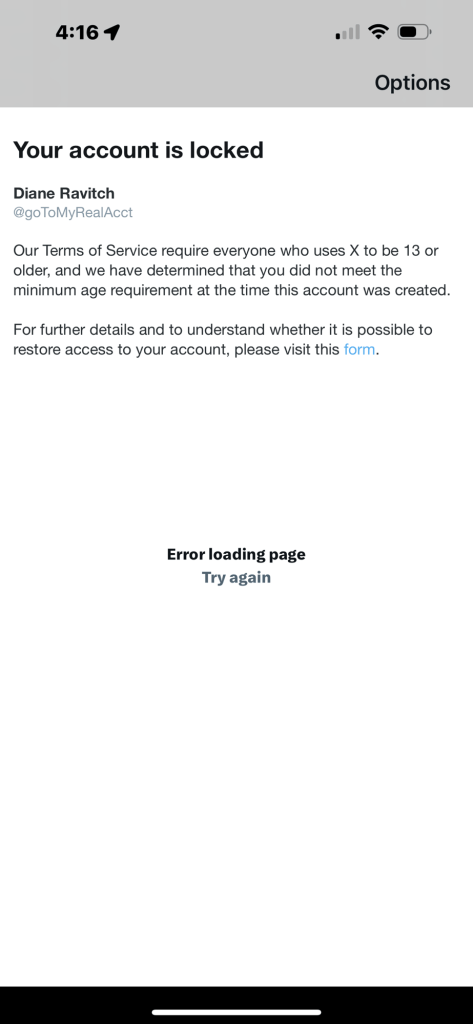
I have been locked out of Twitter since mid-July, because Twitter says I am underage. Really! So I am no longer influenced by Musk propaganda. But millions of other people are.

Rather writes on his blog “Steady”:

Imagine having the ability to instantly lob information, true or not, to millions of people across the globe. Elon Musk, the owner of X (formerly known as Twitter), has that ability. One would hope that with that power would come responsibility. In a perfect world, the owners of social media companies would be fair-minded and objective. Alas.

For all the talk of social media reform after 2016 and the Facebook fiasco when misinformation ran rampant across that platform, it now appears that Musk has decided not only to support the Republican candidate for president but to personally help spread misinformation about voting and the election.

Plus, in 2024, Musk has more powerful tools than Facebook ever imagined eight years ago. Artificial intelligence is coming into its own, and the dangers it presents to our democracy are profound.

Musk has recently released an AI chatbot, which, if you don’t know, is basically a computer that can simulate a human conversation. Musk named his Grok, and within hours of President Biden bowing out of the race, it created a post that read: “The ballot deadline has passed for several states for the 2024 election,” naming nine states: Alabama, Indiana, Michigan, Minnesota, New Mexico, Ohio, Pennsylvania, Texas, and Washington. The message suggested that Kamala Harris had missed the filing deadline to get on the ballot in those states.

This is 100% false and was shared with millions of users on X.

Secretaries of state in five of the nine states have written a letter to Musk urging him to “immediately implement changes” to Grok. I’m not holding my breath.

When Grok was launched late last year, Musk called it the anti-“woke” chatbot — his characterization. He said he wanted the AI search assistant to “answer spicy questions that are rejected by most other AI systems.” Those other AI systems, powered by OpenAI, Google, and Microsoft, are specifically designed to avoid controversial topics.

But it’s not just Grok that is pushing out lies. Musk himself reposted a manipulated version of Harris’s first campaign video. It featured an altered voice track that sounds just like Harris. In it “she” says she didn’t “know the first thing about running the country” and that she is the “ultimate diversity hire.” Musk tagged the video as “amazing” and didn’t include a disclaimer. His post has garnered 135 million views, so far. It has not been taken down.

Talk about strange bedfellows. Over the years, there has been no love lost between Musk and Donald Trump. As recently as May, Trump was a vociferous and vocal proponent of the oil and gas industry. Remember the Mar-a-Lago get-together where he promised to end Biden’s green energy initiatives, including his electric vehicle policies, in exchange for $1 billion in campaign contributions?

Apparently Musk and Trump have mended some pretty tall fences. For his part, Musk has promised lots of cash to the pro-Trump America PAC. Maybe Trump didn’t get what he asked for from his oil and gas friends.

The Musk-backed America PAC is already helping Trump in swing states. The PAC’s website is tricking people into sharing personal data. The site promises to help people register to vote, but when a user enters a zip code in a battleground state, after also giving their name and phone number, they are directed to a page that says “thank you.” They are then asked to “complete the form below.” But there is no form. And there is no redirection to a voter registration site.

In exchange, Trump now thinks electric vehicles are “incredible.” What a shocker. At a rally in Georgia on Sunday, Trump told his supporters, “I’m for electric cars. I have to be because, you know, Elon endorsed me very strongly. So, I have no choice.”

The Michigan secretary of state is investigating Musk and the PAC. “Every citizen should know exactly how their personal information is being used by PACs, especially if an entity is claiming it will help people register to vote in Michigan or any other state,” a spokeswoman for the secretary of state’s office said.

In 2022, President Barack Obama gave a speech at Stanford University about the dangers of artificial intelligence, foreseeing that “regulation has to be part of the answer” to combating online disinformation. His closing thought is a reminder that AI can be a help as well as a hindrance — but that it can’t exist in a vacuum.

“The internet is a tool. Social media is a tool. At the end of the day, tools don’t control us. We control them. And we can remake them. It’s up to each of us to decide what we value and then use the tools we’ve been given to advance those values,” Obama said.

For all intents and purposes, social media has become our town square — but unlike most communities, it has no sheriff, and it very much needs one. In his or her absence it is up to us, social media’s users, to be wary consumers.

Lawrence O’Donnell appears nightly on MSNBC at 10 pm EST. I love his show because he is so smart.

This episode is a must-watch.

As a bonus, here is Robert Reich wondering why the media doesn’t report honestly about Trump’s dementia.

For three weeks, I was locked out of Twitter because of a snafu that’s not worth recounting. Every time I tried to log on, I received a notice saying I was underage and not allowed to engage on Twitter. I have been on Twitter since 2009. So, even though I have been an active participant on Twitter for 15 years, Twitter concluded I had not yet passed my 13th birthday!

I have been active on Twitter for 15 years, but the great X decided I was not yet 13. Should I feel complimented or insulted?

Anyway, I didn’t watch or listen when Elon Musk held a conversation with Trump last night. I did notice, however, that the topic “slurring” was trending, and I discovered hundreds of comments about Trump slurring his language in the conversation, which led to comments about weird things Trump said: congratulating Musk for firing workers who dared to strike; brushing off climate change and rising seas, instead saying that he would get “more oceanfront property” and that our real worry should be “nuclear warming.” Many more non sequiturs.

Rex Huppke of USA Today wrote about the Musk-Trump show and summed it up well: it was a disaster. Worse, it was boring.

It started 40-45 minutes late, due to technical problems.

It was downhill from there.

For a fascism-curious billionaire who loves cuddling up to right-wing loons, Elon Musk sure is good at making right-wing politicians look stupid.

Former President Donald Trump had loudly trumpeted a planned Monday night interview with Musk that would stream on X. But much like the disastrous X-platformed launch of Florida Gov. Ron DeSantis’ presidential campaign, the Musk/Trump interview failed to launch, leaving social media users laughing at the collective incompetence.

Since Vice President Kamala Harris rose to the top of the Democratic presidential ticket last month, Trump’s reelection campaign has been flailing. His childish attacks against her aren’t working. His racist comments about her mixed-race heritage have repelled all but his most loyal supporters. His vice presidential pick, JD Vance, becomes less likable every time he speaks.

So his answer, weirdly, was to sit down with Musk and talk to what would undoubtedly be a very online audience that doesn’t represent the broader electorate. Had the conversation gone off without a hitch, it still would have been odd and largely useless for Trump’s effort to halt Harris’ momentum….

Forget the glitches, Trump’s X interview got worse when he started talking

Of course, things didn’t get better for Trump once the interview was able to proceed. …

He was rambling, babbling on about crowd sizes and immigration and President Joe Biden and whatever else seemed to pass through his mind. He was also badly slurring his words, raising questions about his health, and doing nothing to knock down rising concerns about his age and well-being.

He sounded like a disoriented, racist Daffy Duck…

I’m not going to quote anything Trump said in the interview because it was either too stupid to merit transcription or a mere repetition of the nonsense he spouts at every rally he holds.

A big part of Trump’s problem right now is he has become almost unbearably boring. Build a wall. Drill, baby, drill. Marxist, socialist something-something. Harris only recently became Black. Blah, blah, blah.

So for Trump, sitting down with a rich weirdo few people like and slurring his way through an interview that failed to launch was, in the words of one Donald J. Trump, “a DISASTER!”

Musk, with his social-media ineptness and unmerited sense of self-importance, made DeSantis look like a fool. And now he’s done the same to Trump.

Blogger Robert Hubbell was an enthusiastic supporter of Joe Biden and now he is enthusiastic supporter of Kamala Harris. Like me, he wants to stop Trump and his anarchist pals from retaking the White House and wreaking havoc on our society.

He knows that the media is currently amazed by the enthusiasm that Harris’s campaign unleashed. But he warns about what will happen next as journalists get bored and seek to burst the bubble of excitement she has generated:

We must shape the media narrative

By its nature, the political media is contrarian. It has been impossible for the media to ignore the outpouring of enthusiasm for Kamala Harris. Still, we should expect the media to turn on Kamala Harris and Democrats. It is just a question of when. Media outlets will begin featuring stories with random voters—likely young, diverse, female—who support Trump or are doubtful about Kamala. Such random interviews are worse than meaningless. They are efforts to distort reality and mislead readers about the true nature of the race.

When such stories begin to appear, recognize them for what they are: lazy reporting by journalists who can’t be bothered with the hard work of reporting the truth. Instead, they will default to the “Just asking questions” brand of false reporting. (“Is Kamala in trouble?” “Can she sustain the enthusiasm?”) I saw an article today from someone who wanted Biden to withdraw, asking, “Was Kamala the right choice?” Thankfully, he was being overwhelmed by negative comments from readers.

One way to fight the contrarian news cycle is to spread the good news of Kamala’s candidacy and the incredible energy of the Democratic base. For now, we have the upper hand; we are controlling the narrative and should be “flooding the zone” with positive messaging for Kamala Harris.

But this cannot be said enough: The election will be won on the ground in fifty states by ensuring a historic turnout of voters. That effort will take hundreds of thousands of volunteers. Be one of those volunteers. If you haven’t joined a grassroots group already, do so ASAP. If you already belong, recruit new volunteers and mentor new members. We have less than 100 days left to get this done, but we have every reason to be hopeful—and no reason to be complacent.