Archives for category: Justice

Liz Cheney is a conservative. She supported Trump during his term in office. She is opposed to abortion. But, unlike other conservatives, she was outraged by what Trump did on January 6, 2021. She was outraged that he refused to accept his loss and the peaceful transfer of power. She was so outraged that she agreed to co-chair the January 6 Commission.

And now she has announced that she will vote for Kamala Harris. Trump has threatened to prosecute her for treason if he regains office. She is not afraid of Trump. She is, she said in this interview with ABC News, afraid for her country.

She sacrificed her career and stood on principle. Her principle is the dominance of the Constitution and the rule of law.

She is a profile in courage.

Jason Linkins of The New Republic writes that it doesn’t really matter what Kamala Harris’s policies are because the Supreme Court is poised to strike them down. its recent decision, overruling what is known as the Chevron doctrine, hamstrings any Democratic initiative.

If Trump should win, he will be able to appoint replacements for the two oldest justices, guaranteeing a rightwing majority for decades.

Linkins writes that “a dark shadow” blights every policy that a Harris administration might want to initiate. That dark shadow is the conservative majority’s decision in a case called Loper Bright Enterprises v. Raimondo. 

Linkins writes:

That ruling, which overturned a doctrine called “Chevron deference,” puts the future of any policy that Harris favors in grave doubt. If you want the Harris campaign to get more detailed on policy, I’m sorry to say that any conversation starts and ends with how they plan to confront a Supreme Court that has torched the separation of powers in the mad game of Calvinball they kicked off during the Trump era. 

The gutting of Chevron deference is not something that the smooth-brained masses of the political media adequately understood when it came down. Chevron deference is essentially the doctrine that allows government agencies to respond nimbly to their congressional mandates; hitherto, the judiciary stayed out of the way, allowing executive branch personnel to use their expertise to interpret ambiguous regulations. Imagine, for example, the technological advancements that have occurred since landmark environmental legislation was passed decades ago. The EPA, given free rein to adapt to this changing landscape, can move more fleetly to remediate pollution thanks to Chevron. The Roberts court, instead, imagines a world where they have to return to Congress each time there is an emergency, to get specific guidance.

The best way of describing what the conservative majority did is to say it gave six unelected right-wing politicians who all enjoy a lifetime appointment a line-item veto over anything a Democratic Congress—and by extension Harris—wants to do, unless they can muster the votes to confront each problem they want to solve with an inhuman amount of hyper-specificity. As Vox’s Ian Millhiser has explained, if the executive branch “can’t regulate without getting permission from a Republican judiciary … then conservatives no longer need to worry about Democratic presidents doing much of anything that doesn’t meet the GOP’s approval…” 

The Supreme Court really is the most critical policy issue in this election. The Trump-installed majority is central to what the right plans for a second Trump term. Beyond the fact that the Roberts court’s ruling in Trump v. United States imbues the chief executive with monarchic levels of unaccountability—a dangerous privilege for, frankly, any president to possess—Project 2025, which is best understood as a massive rollback of individual rights, is something that Republicans simply could never contemplate without their super-legislature in black robes. 

Here, vaporizing Chevron has an asymmetric impact on the ambitions of the two parties. The GOP, having retreated from any part of the policy realm besides Project 2025’s infernal schemes, the furnishing of tax cuts to plutocrats, and deregulating everything under the sun (also a form of wealth transfer to plutocrats), need not worry about Chevron being in effect anymore.
But what makes Chevron crucial to this campaign is that the sledding for Democrats remains rough even if they prevail in November.

Indeed, even if they blow the GOP out of the water electorally, the end of Chevron deference is a fail-safe against Democratic policy, constantly running in the background as long as five of the six conservatives on the Roberts court agree. In this way, Harris and her fellow Democrats are locked out of liberal governance. Since liberal governance will form the cornerstone of anything Harris and Democrats want to do during her time in office, a confrontation with a Supreme Court that’s holding the policymaking apparatus hostage is not a fight they can duck. 

All Democrats need to join in this fight, and constantly raise the salience of the Supreme Court and its attendant corruption. It would be a good idea for any policy discussion to note that the Roberts court is the primary antagonist to making things better, easier, safer, and fairer for ordinary Americans; they are despoilers of the land and pilferers of our wealth. Harris should continually remind voters that turning things around will require a Democratic president to be on hand to appoint any replacements that may be needed, and prevent the oldest conservative justices from escaping into retirement, which would allow Trump to replace them with young members of the right’s lunatic lower-court farm system.

Is it time to revisit court-packing? I think the institutionalist case against it completely collapsed by the end of the court’s last term, but I doubt Harris has the stomach to revive the idea over the next several weeks. Nevertheless, the Supreme Court will remain the rock in the road that Democrats must find a way around if they want to improve our lives. Anything you might want an ascendant Democratic administration to do faces the judicial veto of right-wingers who can’t be voted out of office. It’s true that Harris is probably not going to deliver, or even champion, the most ambitious policies that progressives favor. But whether you’re a progressive fan of Medicare for All, or a centrist dedicated to means-tested, watered-down bullshit, you’re all in the same boat, so grab an oar.

Elie Honig is a former federal prosecutor who writes at a site called Cafe, where he and other legal experts follow and explain Trump’s legal entanglements. In this post, he speculates on how Jack Smith’s effort to hold Trump accountable for his efforts to overturn the 2020 election might fare in the months ahead.. Note that he points out that the investigation was hampered by the very late start of the U.S. Justice Department.

He writes:

Dear Reader,

I remember vividly the first time I lost a key piece of evidence. The NYPD had caught our defendant in Washington Heights with a fake police badge around his neck and a loaded gun in his waistband, and we charged him with federal firearms and armed robbery conspiracy crimes. Better yet (for us on the prosecution side), we flipped a cooperating witness who would testify that he and the defendant had committed two prior armed robberies together by posing as cops and ripping off drug dealers.

A week or so before trial began, the judge held a conference to handle routine pre-trial housekeeping. I confidently laid out the cooperator’s expected testimony. “That’s out,” the judge ruled, nonchalantly. “Too prejudicial.” For those who think that every judicial decision is rendered in scholarly prose, replete with probing analysis and citations to applicable precedent: welcome to the real world.

It was a kick in the gut. “That’s such bullshit. He can’t do that,” I whined afterwards. “Sure he can,” my supervisor responded. “He’s the judge.”

My experience is a tiny-potatoes version of what the U.S. Supreme Court has done to Special Counsel Jack Smith and his 2020 election subversion case against Donald Trump. The Court declared, for the first time in our history, that a president is entitled to criminal immunity for official acts. That part was no surprise; the law has long recognized civil immunity, and the justices during oral argument seemed in no mood to affirm the lower courts’ outright rejection of Trump’s claim.

But the breadth of the Supreme Court’s decision was astonishing. The majority held, for example, that “in dividing official from unofficial conduct, courts may not inquire into the President’s motives.” (It remains unclear exactly how a judge is supposed to draw that vital distinction.) And the Court ruled that if conduct is immune, prosecutors can’t base a criminal charge on it – nor can they mention it at all during trial, even as necessary context or background.

Now the case has landed back in trial court, before Judge Tanya Chutkan. She originally wanted the parties back before her today, but Smith asked for a few more weeks to gather his thoughts; he clearly has accepted that there won’t be a pre-election trial, despite his prior dogged efforts. Trump’s counsel, ever intent on slowing things down, happily consented to the prosecution’s request for delay. When Court reconvenes on September 5, it’ll be up to the Judge to pick through the wreckage and figure out what can be salvaged.

On that question, the Supreme Court has offered pointed guidance, and it bodes poorly for the core of Smith’s indictment. Trump’s effort to coerce the Justice Department to gin up proof of non-existent election fraud? Almost certainly an “official act,” and therefore immune and out of the case altogether. Trump’s pressure campaign aimed at his vice president, Mike Pence? Probably out. And Trump’s public statements, including his tweets and January 6 Ellipse speech? Likely toast, too.

The Supreme Court conspicuously reminded Judge Chutkan that it’s unimpressed with her work so far and will be watching her closely. The justices in the majority blasted the lower courts for “the expedition of this case, the lack of factual analysis… and the absence of pertinent briefing by the parties.” Indeed, as we’ve noted here before, Smith, Chutkan, and the intermediate appeals court judges tried to shortcut ordinary process to get Trump tried before the election; the Supreme Court noticed and disapproved. Most importantly on the vital timing issue, the Court has specified that Trump can appeal Judge Chutkan’s decisions about what conduct is (and is not) immune, before trial starts. That means, as a practical matter, there’s a zero-point-zero percent chance this trial happens before the November 2024 election.

If you’ve been hoping that Trump faces accountability for trying to steal the 2020 election before voters head to the polls for the next one, don’t despair – not fully, anyway. (For the record, I’m with you. The real problem is that DOJ took over two-and-a-half years to charge the case.) Judge Chutkan still can – and I believe will – order an evidentiary hearing to enable Smith to air some of his most explosive evidence, before voters head to the polls.

The Judge now must sift through the prosecution’s evidence and determine how much of Trump’s alleged conduct was an official act (and therefore immune), and which conduct can remain in the case. She has some leeway here. The Judge could opt to take “proffers” from both sides – detailed statements by the lawyers about what they expect their evidence to show. That’s a little flat, but it’s also perfectly permissible and efficient. And then there’s the more sensational alternative: the Judge can permit Smith to call live witnesses to expound from the stand on what their trial testimony would be.

I expect Smith to push for door number two, and Judge Chutkan to agree. If that happens, brace for a series of dramatic in-court encounters. We could see Trump’s former chief of staff, Mark Meadows, take the stand to give his first-ever public accounting of what his boss did (and didn’t do) before and on January 6. And Mike Pence could testify about how Trump begged and eventually threatened him in an effort to get him to throw the election – and how, on January 6, he had to run for his life to avoid the frothing mob.

No, an evidentiary hearing won’t hit nearly as hard as a jury trial and verdict. And we won’t actually see or hear any of it, because federal courts don’t permit cameras or live audio streaming. (Fair enough, given that it’s apparently the year 1892 right now.) We likely already know the most damaging information, as revealed in 2022 during the unforgettable January 6 Select Committee hearings in Congress, and the ensuing 800-plus page report. But, really, imagine: Trump’s own former chief of staff and VP taking the stand in, say, September of an election year, to describe firsthand how their former boss trampled on the Constitution to try to steal an election. Even if we all mostly know the story by now, that simply can’t be good for Trump at the polls, just weeks before voters cast their ballots.

It’s unclear how much of Smith’s case will ultimately survive the Supreme Court’s strafing. He might eventually go to trial on a tattered indictment focused on Trump’s effort to pressure state and local officials, without any of the damning evidence relating to DOJ and the VP and incitement of the rally crowd. Or the wounds inflicted by the Supreme Court might ultimately prove fatal.

But if Smith’s goal is to expose Trump’s conduct to the American public before the election – and let’s face it, that’s plainly been a driving force for the special counsel all along, despite his refusal to acknowledge it – he’ll still have a backdoor path to partial success.

Stay Informed,

Elie

Elie Honig served as an Assistant U.S. Attorney in the Southern District of New York for 8.5 years and as the Director of the Division of Criminal Justice at the Office of Attorney General for the State of New Jersey for 5.5 years. He is currently a legal Analyst for CNN and Executive Director at Rutgers Institute for Secure Communities

Trump has the same reaction to every adverse circumstance in his life: Sue. Sue. Sue. He has been involved in literally thousands of law suits in his life. That’s his style. Sometimes the threat of a lawsuit is enough to frighten away an adversary. Sometimes a lawsuit forces a settlement, which works to his advantage.

Now he is suing the Justice Department for searching Mar-a-Lago for top-secret documents which he falsely claimed were his personal property. He no doubt expects the lawsuit to go before a friendly pro-Trump judge or the U.S. Supreme Court, which usually rules in his favor. If he is lucky, it will land in Judge Aileen Cannon’s court.

The New York Daily News reported:

Former President Trump is reportedly planning to sue the federal government for $115 million over the 2022 search of his Mar-a-Lago estate, accusing the Department of Justice of unconstitutional “political persecution.”

Even though the search turned up hundreds of classified documents and led to his indictment on federal charges, Trump says prosecutors improperly targeted him in hopes of damaging his campaign to win back the White House.

“What President Trump is doing here is not just standing up for himself — he is standing up for all Americans who believe in the rule of law,” Daniel Epstein, a lawyer for Trump, told Fox Business News.

Trump is demanding $15 million in compensation for his legal costs, plus $100 million in punitive damages.

Trump accuses Attorney General Merrick Garland and FBI Director Christopher Wray of failing to implement normal procedures for getting back the documents in order to carry out the search and humiliate the Republican ex-president….

The filing sets the clock ticking on a 180-day period during which Trump and the government can seek to work out a settlement. If no deal is reached, a federal judge will hear the case in south Florida.

This image contained in a court filing by the Department of Justice on Aug. 30, 2022, and partially redacted by the source, shows a photo of documents seized during the Aug. 8 FBI search of former President Donald Trump's Mar-a-Lago estate.
APThis image contained in a court filing by the Department of Justice on Aug. 30, 2022, and partially redacted by the source, shows a photo of documents seized during the Aug. 8 FBI search of former President Donald Trump’s Mar-a-Lago estate. (AP)

Trump admits taking the documents with him to his Florida estate after leaving the White House in January 2021, but claims he had the legal right to do so.

He returned some of the documents when hit with a subpoena to give them back.

Suspecting Trump was hiding more documents, the feds asked a judge to approve a search warrant for Mar-a-Lago, which was carried out on Aug. 22, 2022.

Garland appointed Special Counsel Jack Smith to investigate the case after Trump announced he would run for president again in 2024.

Trump was indicted on a string of charges accusing him of improperly retaining the documents and obstructing justice. Two Mar-a-Lago workers were also charged with moving boxes of sensitive documents to hide them from investigators and even Trump’s own defense attorney.

Judge Aileen Cannon recently dismissed the case on the grounds that Smith’s appointment was unconstitutional. The prosecution is appealing that decision to a higher court but it will likely wind up being decided by the Supreme Court.

In an opinion piece in The Washington Post, President Joe Biden proposed important reforms to the U.S. Supreme Court. He recommended a term limit of 18 years and an ethics code for Justices of the Supreme Court. Public opinion of the Court is at its lowest since polling began in 1987. This may be in response to ethical and partisan scandals associated with the Court, as well as politically-motivated decisions.

During Trump’s single term, he was able to add three justices to the Court, stacking it with a 6-3 hard-right majority (thanks to the Federalist Society, its leader Leonard Leo, President Trump, and the canny Republican Senate Majority Leader Mitch McConnell).

The Court first showed its radicalism by overturning Roe v. Wade, then followed with several other extremist decisions, giving the President “absolute immunity” for any crimes he commits while in office (Trump v. U.S.), sharply reducing the powers of regulatory agencies (the “Chevron Doctrine”), eroding the line between church and state (Carson v. Makin)), and more. You might reasonably wonder why President Biden didn’t push these goals sooner. As an institutionalist, he was loath to breach the separation of powers, and he knew he did not have the votes in Congress to win. Nonetheless, he is laying out important aims for the future.

President Biden wrote:

This nation was founded on a simple yet profound principle: No one is above the law. Not the president of the United States. Not a justice on the Supreme Court of the United States. No one.

But the Supreme Court’s 6-3 decision on July 1 to grant presidents broad immunity from prosecution for crimes they commit in office means there are virtually no limits on what a president can do. The only limits will be those that are self-imposed by the person occupying the Oval Office.

If a future president incites a violent mob to storm the Capitol and stop the peaceful transfer of power — like we saw on Jan. 6, 2021 — there may be no legal consequences.
And that’s only the beginning.

On top of dangerous and extreme decisions that overturn settled legal precedents — including Roe v. Wade — the court is mired in a crisis of ethics. Scandals involving several justices have caused the public to question the court’s fairness and independence, which are essential to faithfully carrying out its mission of equal justice under the law. For example, undisclosed gifts to justices from individuals with interests in cases before the court, as well as conflicts of interest connected with Jan. 6 insurrectionists, raise legitimate questions about the court’s impartiality.

I served as a U.S. senator for 36 years, including as chairman and ranking member of the Judiciary Committee. I have overseen more Supreme Court nominations as senator, vice president and president than anyone living today. I have great respect for our institutions and the separation of powers.

What is happening now is not normal, and it undermines the public’s confidence in the court’s decisions, including those impacting personal freedoms. We now stand in a breach.

That’s why — in the face of increasing threats to America’s democratic institutions — I am calling for three bold reforms to restore trust and accountability to the court and our democracy.
First, I am calling for a constitutional amendment called the No One Is Above the Law Amendment. It would make clear that there is no immunity for crimes a former president committed while in office. I share our Founders’ belief that the president’s power is limited, not absolute. We are a nation of laws — not of kings or dictators.

Second, we have had term limits for presidents for nearly 75 years. We should have the same for Supreme Court justices. The United States is the only major constitutional democracy that gives lifetime seats to its high court. Term limits would help ensure that the court’s membership changes with some regularity. That would make timing for court nominations more predictable and less arbitrary. It would reduce the chance that any single presidency radically alters the makeup of the court for generations to come. I support a system in which the president would appoint a justice every two years to spend 18 years in active service on the Supreme Court.

Third, I’m calling for a binding code of conduct for the Supreme Court. This is common sense. The court’s current voluntary ethics code is weak and self-enforced. Justices should be required to disclose gifts, refrain from public political activity and recuse themselves from cases in which they or their spouses have financial or other conflicts of interest. Every other federal judge is bound by an enforceable code of conduct, and there is no reason for the Supreme Court to be exempt.

All three of these reforms are supported by a majority of Americans — as well as conservative and liberal constitutional scholars. And I want to thank the bipartisan Presidential Commission on the Supreme Court of the United States for its insightful analysis, which informed some of these proposals.

We can and must prevent the abuse of presidential power. We can and must restore the public’s faith in the Supreme Court. We can and must strengthen the guardrails of democracy.
In America, no one is above the law. In America, the people rule.

Jennifer Rubin was originally hired by The Washington Post to write the conservative point of view on its opinion pages. A journalist and a lawyer, Rubin found Trump to be intolerable, and she no longer writes from the right.

In this column, she commends the effort to investigate Justice Clarence Thomas and explains why:

Fed up with the justice’s stonewalling, egregious violation of judicial ethics, inaccurate legal filings and gross money grubbing from right-wing billionaires with business before the Supreme Court, Sens. Sheldon Whitehouse (D-R.I.) and Ron Wyden (D-Ore.) sent a letter to Attorney General Merrick Garland this week demanding a special counsel be appointed “to investigate possible violations of federal ethics and tax laws by Associate Justice of the Supreme Court Clarence Thomas.” Well, it’s about time someone took Thomas’s inexcusable conduct seriously. (Democratic Rep. Alexandria Ocasio-Cortez’s introduction of articles of impeachment in a Republican-controlled House, meanwhile, which followed on Wednesday, is a showy gesture but a nonstarter.)


The letter details “repeated and willful omissions of gifts and income from Justice Thomas’s financial disclosure reports required by the Ethics in Government Act.” And as the senators point out, investigations have been raised against other government officials for far less serious allegations.


This is not a complaint about failure to recuse, as reprehensible as it might be for Thomas to sit on cases concerning the insurrection in which his wife played a limited role, or about bribery; thanks to this court, such prosecutions are practically impossible. Instead, the letter concerns bread-and-butter allegations of false statements signed under oath and tax violations.


The list of issues is gobsmacking. For example: forgiveness of the principal on a $267,000 loan that was never reported as income. (“Documents obtained by the Senate Finance Committee indicate that no principal was ever repaid on the loan and that Justice Thomas only made interest payments on the loan prior to all payments ceasing on the loan. Forgiven or discharged debt is taxable income, and the Ethics in Government Act requires justices to disclose any ‘income from discharge of indebtedness.’”) This was never included on Thomas’s financial disclosure reports. Thomas has refused to say whether he accounted for the loan forgiveness on his income taxes.

Then there are the gifts — lots of gifts. The senators cite “undisclosed gifts from other wealthy donors … including private jet travel from Paul Anthony Novelly; private jet travel and country club membership from the late Wayne Huizenga; and private jet travel, luxury sports tickets, and lodging at a ranch from David Sokol.” The senator include an appendix detailing these lavish gratuities. The senators write, “Justice Thomas has claimed that some omissions were ‘inadvertent,’ and he has

amended some past reports accordingly. However, Justice Thomas has not disclosed all of the gifts that have been uncovered, and there may well be more.” Therefore, they charge: “His long history of omissions indicates a pattern of willfulness meriting investigation under the Ethics in Government Act.”


Then there are the gifts specifically from Leonard Leo — the right-wing legal impresario and former vice president of the Federalist Society who has helped pick Supreme Court justices and contrived to bring cases before the court to advance his dark money groups agenda, according to Whitehouse. The senators explain:
Last year, the Washington Post reported that Leo directed payments of at least $25,000 to a consulting firm run by Justice Thomas’s spouse, with Leo specifying that the documents related to the payments should make “[n]o mention” of Mrs. Thomas. The furtive nature of the payments raises further questions about how many such payments were orchestrated, whether legitimate services were actually rendered, and whether such payments required additional reporting by Justice Thomas. We have not yet adequately been able to investigate the extent to which any or all these undisclosed gifts were part of a coordinated gifts program to reward recipient justices.


In sum, the senators raise allegations of willfully false statements on government disclosure forms and income tax and gift tax violations. At this stage, these are allegations only. But surely there is a basis for further inquiry, the senators argue. After detailing other investigations into less egregious conduct, the senators argue that only a special counsel can properly investigate. (“Since no litigant appears before the Supreme Court more frequently than the United States government, represented by the Department of Justice, the Department may understandably hesitate to offend a member of that Court.”)

The senators are not the only ones to have advanced these arguments. In April 2023, the anti-corruption group Citizens for Responsibility and Ethics in Washington (CREW) sent a letter to Chief Justice John G. Roberts Jr. and Garland after Pro Publica broke news of lavish gifts Thomas received from another billionaire, Harlan Crow.


In that letter, CREW and several ethics experts wrote: “If true, Justice Thomas’ acceptance and failure to report these gifts and sales transactions on his annual mandatory financial disclosure statements not only undermines trust in his ability to impartially and fairly administer his duties as a member of the Court, but also threatens to corrode public confidence in the Supreme Court as an institution.” CREW’s president, Noah Bookbinder, tells me CREW never received a response.


One of the ethics experts who signed that letter, Richard Painter, tells me, “The attorney general may or may not decide to appoint a special counsel. I believe it is justified in this case.” If Garland does not appoint a special counsel or undertake any investigation, the Supreme Court justices, like the president in the new scheme of government concocted by this court, will conclude they operate in a world of criminal immunity, secure in the knowledge a partisan Senate will never remove them from the bench.
“Justice Thomas’s serious and frequent misconduct, including consistent failure to report lavish gifts from a wealthy benefactor with strong interests in the Supreme Court’s work and repeated failure to recuse from cases in which he had a clear conflict of interest, requires thorough investigation and genuine accountability,” Bookbinder tells me.

The Thomas scandal is what comes from refusing to adopt a mandatory ethics code for the Supreme Court and investing its justices with lifetime security. That leaves the rule of law dependent on the justices’ own good graces to remain ethical. That has obviously proven insufficient.


And so Whitehouse and Wyden, with no alternative, ask for the Justice Department to do its job. “The request is foundational to the rule of law,” constitutional scholar Dennis Aftergut tells me. “While many won’t expect Garland to pick it up before the election, if democracy survives November, the senators have written the bottom line for what must happen if we are to get corruption out of the court.”


Unfortunately, if felon and former president Donald Trump is elected, one can be sure no investigation will be undertaken. It therefore behooves Garland to move quickly, lest — again — justice delayed becomes justice denied.

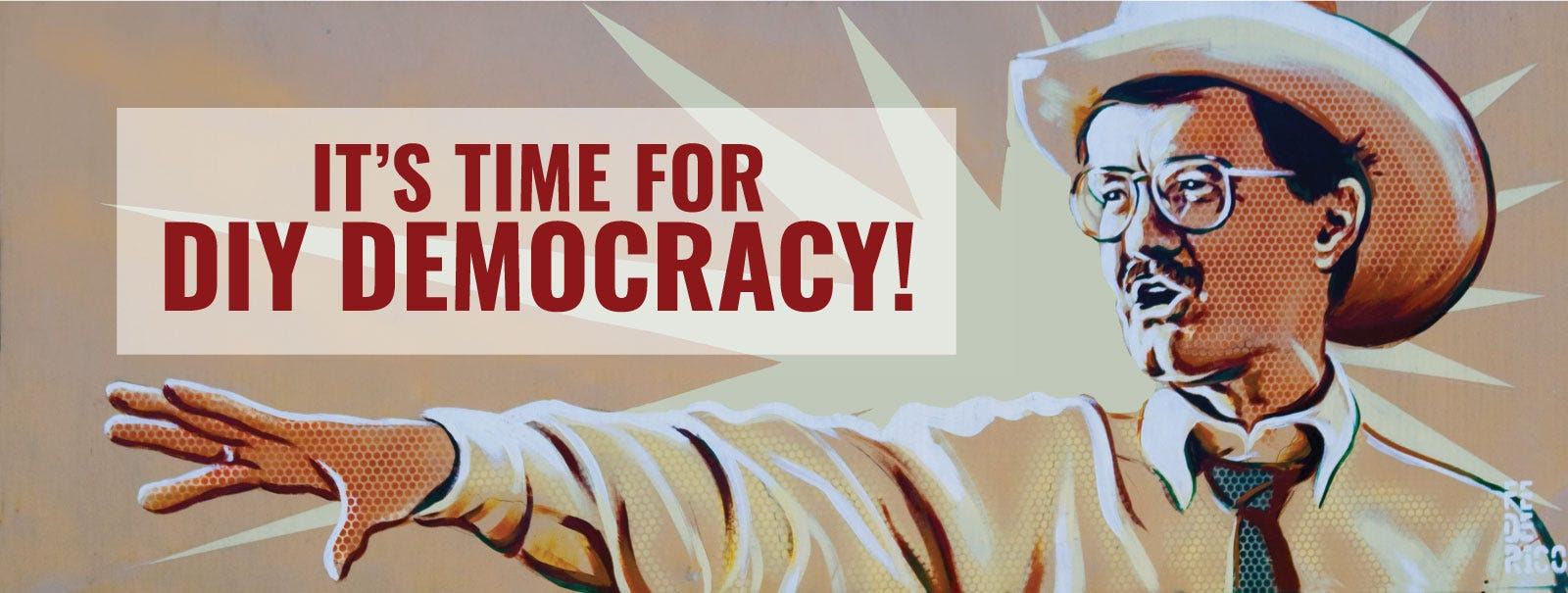
Jim Hightower, activist Democrat and former elected official in Texas, says it’s time for “Do-It-Yourself Democracy.” We can’t sit back and let Trump’s Supreme Court whittle away our rights and laws.

He writes:

It’s July 4th week!

Sure, do a few 12-ounce elbow bends and set off some sparklers in celebration of our people’s democratic values. But wait – why are we celebrating the Spirit of ‘76, but meekly accepting the recent tsunami of autocratic, plutocratic dictates from a sextet of extremist, right-wing, partisan lawyers? 

These six unelected Republicans, put on the Supreme Court by a tiny group of billionaire-funded political operatives, are routinely imposing their anti-woman, racist, xenophobic, homophobic, anti-worker, anti-environment, theocratic agendas on the vast majority of us who want none of the above.

Start with the fact that they are liars. Each one duped senators into giving lifetime appointments to them by loudly promising that they would never even consider rewriting the fundamental laws and legal precedents that form the egalitarian fabric of American society. Nor, each insisted, would they ever dream of being a part of a cabal working to turn the judicial branch into a repressive force routinely eliminating democratic power in order to erect a government of-by-and-for right-wing elites.

Then they proceeded, case-by-case, to do exactly what they swore on their honor they would not do. And now, with yesterday’s Trump v. United States edict, the six have haughtily attempted to rewrite the Constitution and 248 years of our People’s history by proclaiming, on their own whim, that America has an imperial presidency with executive authority to act with impunity.

We the People do not have to put up with their imperious crap. 

They’ve turned the Supreme Court into a political operation – so it’s the duty of us grassroots democracy champions to fight their usurpation, not only in the presidential race, but carrying the fight into every political forum. Don’t wait on national “leaders” – they lack the guts for standing up to runaway power. 

And while no individual can fix our democracy, a movement can. I think of a small hardware store here in Austin that had a can-do attitude, offering to help customers handle even the biggest tasks. The store’s slogan was “Together, we can do it yourself.” 

We’re collecting actions that grassroots people can take, and are collaborating with longtime friends and allies to light a fire under the butts of Democratic Party leaders. We’ll keep you updated on those efforts, but to start, here are two groups to join up with.

Share

Demand Justice has been advocating for the Judiciary Act, which would expand the court by four seats. They’re asking people to call their representatives, and to join their rapid response team

We’ve long been a fan of Lisa Graves (you can watch our 2022 Chat ‘n’ Chew episode with her here), and she’s teamed up with the folks at Court Accountability for a new round of intense actions called Justice Can’t Wait. They’ve shared with us a list of things you can do:

  • Share the Justice Can’t Wait updatedwebsite.
  • Raise awareness of the seeds being planted by Trump and his allies to deny the results of the 2024 election if it doesn’t go their way. Trump has refused to commit to accepting legitimate election results if he does not win, and his allies are laying the groundwork for election denial through lawsuits and false claims about election fraud.
  • Urge Congress to pass reforms clarifying the Insurrection Act, which Trump plans to invoke to deploy the military against the American people, on his first day in office.
  • Share Stand Up America’s Supreme Court Voter website, which aims to educate and mobilize voters on the impact the next president will have on the future of the U.S. Supreme Court.
  • Educate Americans on the economicthreats that the extremist Project 2025 poses. Economic concerns “consistently rank as top issues among likely voters,” and people need to understand the likely consequences and chaos for our economy and American families if Project 2025 affiliates are able to carry out their dangerous agenda.
  • Join United for Democracy in calling on Congress to rein in the out-of-control Supreme Court.
  • Drive home that this is Trump’s Supreme Court. Trump installed the corporatist majority that has taken away women’s fundamental freedoms and stripped away protections for Americans’ health and safety. Even after Trump led an insurrection, the Court that Trump built is now tipping the scales to help him win again in November and protect him from accountability for his actions.  
  • From the Hightower staff: And let’s not forget how the Supremes view actual bribery: as nothing more than a tip or a token of thanks for a job well done. They’re basically creating loopholes to legalize their own corruption!

The New Republic published a hypothetical speech by Sidney Blumenthal that Joe Biden might give if were as ruthless as Trump. However, he won’t because he is an institutionalist. He believes in the law and the Constitution. He believes, despite the Roberts Court, that no one is above the law, not even the President.

Here is the hypothetical Biden speech:

Good evening, my fellow Americans. With the close of the current session of the Supreme Court, I want to report to you on my compliance with their decisions, especially in the case involving presidential immunity, United States v. Trump.

When I took the oath of office, I swore that I would “preserve, protect and defend the Constitution of the United States.” The Supreme Court has now reinterpreted that document. The court, for all intents and purposes, has also reinterpreted the Declaration of Independence, which proclaimed, “Governments are instituted among Men, deriving their just powers from the consent of the governed” to replace the “absolute tyranny” of a king. 

I have read the court’s majority opinion that an official act of the president is “presumptively” immune from all prosecution during and after his term, and that the president’s motive cannot be questioned. I have read, according to the majority, that a president who orders the Department of Justice and his vice president to commit election fraud is immune. I have read that a president who incites a mob to attempt to assassinate the vice president for failing to follow those instructions is immune. As Justice Sonia Sotomayor wrote in her dissent, “Orders the Navy’s Seal Team 6 to assassinate a political rival? Immune. Organizes a military coup to hold onto power? Immune. Takes a bribe in exchange for a pardon? Immune. Immune, immune, immune.”

Fellow Americans, I have taken the court’s opinion to heart. I am not one to defy the court. I am, as many have remarked, an institutionalist. I believe with all my soul in our institutions. And now, following the letter and the spirit of the court’s ruling, I have acted swiftly, decisively, and enthusiastically to enforce it. I will not, I cannot, shirk my constitutional duty. As Justice Sotomayor states, “In every use of official power, the president is now a king above the law.” 

To begin with, certain “gratuities,” as we shall call them, have been paid to the court majority as a token of appreciation. In their ruling in the case of Snyder v. United States, the majority decided that James Snyder, the former mayor of Portage, Indiana, who cajoled $13,000 from a trucking company after he granted it a city contract, was not liable for bribery. The court stated that it was a “gratuity.” “Gratuities are typically payments made to a public official after an official act as a reward or token of appreciation,” wrote Justice Brett Kavanaugh in the majority opinion.

Payment of “gratuities” to the justices who ruled in the majority in y follows the court’s decision in Snyder. It cannot be considered a bribe because it was not promised beforehand. But I do hope, as Justice Kavanaugh wrote, that there is “appreciation.” 

Now, following my strict construction of the court’s ruling on immunity, I can report to the nation that the threat to national security posed by my former political opponent, my late predecessor, has been eliminated. It was an official act. It was, to quote the court, “presumptive.”

The reasons for his removal do not need to be explained. Under the court’s decision, as an official act, it is more than privileged. I hope you understand that I need not disclose the reasons. I must respect the Supreme Court. I can assure the American people that there will be a thorough report that is currently being written by the intelligence community. It is classified. The substance cannot be disclosed—and never can be.

But I do want to tell you that he did have sex with a porn star. She didn’t like it. And he lied about his golf handicap.

Why am I doing this? That’s not admissible. The state of mind of the president, according to the court, is not admissible. My state of mind falls under an official act, so it’s nobody’s business but my own. I am proud of my official acts. I must respect the precedent of keeping secret all my reasons. Otherwise, I would be damaging the presidency for others who might follow in this office.

I regret to inform you that Speaker of the House Mike Johnson has been arrested. A number of other members of the House Republican Conference have been taken into custody. Jim Jordan, unfortunately, attempted to resist arrest. After wrestling with an FBI agent, he met a tragic fate. In the sudden absence of those members, there is a new majority in the House. I look forward to a long and cooperative relationship. I can say proudly, gridlock is at last broken. And we can all give thanks to the Supreme Court.

I further regret to inform you that 10 members of the Republican Senate caucus have been arrested. Again, unfortunately, Josh Hawley attempted to run away and was wounded in the leg. The incident was entirely his fault: if only he had submitted to the authorities. Lindsey Graham was arrested in his office. He has renounced all of his former allegiances, and I have issued him a pardon—a conditional pardon. There will be no more obstruction from filibusters. Again, we can thank the court. 

Now, about the court itself, with the present available members of the Congress, I have proposed that the Supreme Court be expanded by 26 justices. I can report that those new justices have already been nominated and approved. Advise and consent is on the fast track. All 26 will be here tomorrow. A longer bench is already under construction.

Tragically, Chief Justice John Roberts has been arrested for his treasonous comment that the president is doing something illegal, based on his very own opinion. I will name a new chief justice after the new 26 members take their posts.

More reform is on the way. The Twenty-Second Amendment prohibiting the president from holding more than two terms will be replaced by the Twenty-Eighth Amendment, which rescinds it. The new amendment has been proposed in the states. I have no doubt that three-quarters of the states, through their legislatures, will be cooperative. In fact, I can promise you that I expect 100 percent cooperation from each and every state legislature on a bipartisan basis. I have alerted FBI offices in every state to assist in our plan to extend democracy. 

To that end, I am creating a new Cabinet department, the Department of Official Acts, to coordinate, simplify, and centralize the far-flung activities of the Department of Homeland Security, the Internal Revenue Service, the Department of Defense, and other departments and agencies. I am committed to eliminating waste and abuse in official acts.

Moreover, the vice president will head a new office here at the White House, the Office of Reimagining Official Acts, to spur innovation, creativity, and efficiency, and above all the execution of justice. That office will review all of the acts that I take so that they qualify as official.

The Office of Reimagining Official Acts has already held a Zoom conference this morning with all of the Fortune 500 CEOs. Each and every executive without exception has released a statement in support of my official acts and promised full cooperation, with gusto. By the way, the chairman of the Democratic National Committee will hold a press conference to announce the details of the amazing news that our campaign has just received new contributions of $43 billion and counting. 

I can also report that Rupert Murdoch has been arrested for seditious conspiracy, along with his accomplices at Fox News, who have previously been liable for defamation. They have been spewing libels every hour of every day since. That’s as much as I can say. I cannot give another reason without breaking the strictures laid down by the court.

The Supreme Court’s immunity decision has also had a big impact on international relations. I have had a conversation with Vladimir Putin, who told me that he misunderstood me all along, and that after the day’s events here at home, he has decided to withdraw Russian troops from Ukraine. He told me he has the greatest admiration for our form of government now. He said, we can do business, strongman to strongman. 

As for the rest of the campaign, when the Republican National Committee decides on its candidate, I would consider a debate with the ground rules that candidates adhere to national security guidelines, which will be presented as needed—before, during, and after such an event, consistent as official acts.

If any reader of this column can show where anything described here would be illegal under the Supreme Court immunity ruling, please turn yourself in to the nearest FBI bureau to avoid yet another tragic result. Thought is mother to the deed. Thought must be included among the potential threats to be countered by presidential official acts. “Presumptive,” as the court stated, must mean presumptive. And the reason? The president does not need to explain. 

As we celebrate this Fourth of July, in a fervent prayer that the court’s ruling will work out for the best of all possible worlds, I want to say in conclusion, what goes around comes around.

Heather Cox Richardson brilliantly dissected the U.S. Supreme Court’s shocking decision about Presidential immunity. The Court abandoned the foundational principle of our country that “no one is above the law.” As she points out, even the justices reiterated that principle at their hearings. To read the sources, open the link or subscribe.

She wrote:

Today the United States Supreme Court overthrew the central premise of American democracy: that no one is above the law. 

It decided that the president of the United States, possibly the most powerful person on earth, has “absolute immunity” from criminal prosecution for crimes committed as part of the official acts at the core of presidential powers. The court also said it should be presumed that the president also has immunity for other official acts as well, unless that prosecution would not intrude on the authority of the executive branch.

This is a profound change to our fundamental law—an amendment to the Constitution, as historian David Blight noted. Writing for the majority, Chief Justice John Roberts said that a president needs such immunity to make sure the president is willing to take “bold and unhesitating action” and make unpopular decisions, although no previous president has ever asserted that he is above the law or that he needed such immunity to fulfill his role. Roberts’s decision didn’t focus at all on the interest of the American people in guaranteeing that presidents carry out their duties within the guardrails of the law. 

But this extraordinary power grab does not mean President Joe Biden can do as he wishes. As legal commentator Asha Rangappa pointed out, the court gave itself the power to determine which actions can be prosecuted and which cannot by making itself the final arbiter of what is “official” and what is not. Thus any action a president takes is subject to review by the Supreme Court, and it is reasonable to assume that this particular court would not give a Democrat the same leeway it would give Trump. 

There is no historical or legal precedent for this decision. The Declaration of Independence was a litany of complaints against King George III designed to explain why the colonists were declaring themselves free of kings; the Constitution did not provide immunity for the president, although it did for members of Congress in certain conditions, and it provided for the removal of the president for “high crimes and misdemeanors”—what would those be if a president is immune from prosecution for his official acts? The framers worried about politicians’ overreach and carefully provided for oversight of leaders; the Supreme Court today smashed through that key guardrail. 

Presidential immunity is a brand new doctrine. In February 2021, explaining away his vote to acquit Trump for inciting an insurrection, Senate minority leader Mitch McConnell (R-KY), who had also protected Trump in his first impeachment trial in 2019, said: “Trump is still liable for everything he did while he was in office…. We have a criminal justice system in this country. We have civil litigation, and former presidents are not immune from being held accountable by either one.”

But it was not just McConnell who thought that way. At his confirmation hearing in 2005, now–Chief Justice John Roberts said: “I believe that no one is above the law under our system and that includes the president. The president is fully bound by the law, the Constitution, and statutes.” 

In his 2006 confirmation hearings, Samuel Alito said: “There is nothing that is more important for our republic than the rule of law. No person in this country, no matter how high or powerful, is above the law.” 

And in 2018, Brett Kavanaugh told the Senate: “No one’s above the law in the United States, that’s a foundational principle…. We’re all equal before the law…. The foundation of our Constitution was that…the presidency would not be a monarchy…. [T]he president is not above the law, no one is above the law.”

Now they have changed that foundational principle for a man who, according to White House officials during his term, called for the execution of people who upset him and who has vowed to exact vengeance on those he now thinks have wronged him. Over the past weekend, Trump shared an image on social media saying that former Representative Liz Cheney (R-WY), who sat on the House Select Committee to Investigate the January 6th Attack on the U.S. Capitol, was guilty of treason and calling for “televised military tribunals” to try her. 

Today, observers illustrated what Trump’s newly declared immunity could mean. Political scientist Norm Ornstein pointed out that Trump could “order his handpicked FBI Director to arrest and jail his political opponents. He can order the IRS to put liens on the property of media companies who criticize him and jail reporters and editors.” Legal analyst Joyce White Vance noted that a president with such broad immunity could order the assassination of Supreme Court justices, and retired military leader Mark Hertling wrote that he was “trying to figure out how a commander can refuse an illegal order from someone who is issuing it as an official act.” 

Asha Rangappa wrote: “According to the Court, a President could literally provide the leader of a hostile adversary with intelligence needed to win a conflict in which we are involved, or even attack or invade the U.S., and not be prosecuted for treason, because negotiating with heads of state is an exclusive Art. II function. In case you were wondering.” Trump is currently under indictment for retaining classified documents. “The Court has handed Trump, if he wins this November, carte blanche to be a ‘dictator on day one,’ and the ability to use every lever of official power at his disposal for his personal ends without any recourse,” Rangappa wrote. “This election is now a clear-cut decision between democracy and autocracy. Vote accordingly.”

Trump’s lawyers are already challenging Trump’s conviction in the election interference case in which a jury found him guilty on 34 counts. Over Trump’s name on social media, a post said the decision was “BRILLIANTLY WRITTEN AND WISE, AND CLEARS THE STENCH FROM THE BIDEN TRIALS AND HOAXES, ALL OF THEM, THAT HAVE BEEN USED AS AN UNFAIR ATTACK ON CROOKED JOE BIDEN’S POLITICAL OPPONENT, ME. MANY OF THESE FAKE CASES WILL NOW DISAPPEAR, OR WITHER INTO OBSCURITY. GOD BLESS AMERICA!”

In a concurring opinion, Justice Clarence Thomas, whose wife was deeply involved in the effort to overturn the 2020 presidential election, also took a shot at the appointment of special counsels to investigate such events. Thomas was not the only Justice whose participation in this decision was likely covered by a requirement that he recuse himself: Alito has publicly expressed support for the attempt to keep Trump in office against the will of voters. Trump appointed three of the other justices granting him immunity—Neil Gorsuch, Brett Kavanaugh, and Amy Coney Barrett—to the court.

In a dissent in which Justices Elena Kagan and Ketanji Brown Jackson concurred, Justice Sonia Sotomayor wrote that because of the majority’s decision, “[t]he relationship between the President and the people he serves has shifted irrevocably. In every use of official power, the President is now a king above the law.”

“Never in the history of our Republic has a President had reason to believe that he would be immune from criminal prosecution if he used the trappings of his office to violate the criminal law. Moving forward, however, all former Presidents will be cloaked in such immunity. If the occupant of that office misuses official power for personal gain, the criminal law that the rest of us must abide will not provide a backstop. With fear for our democracy,” she wrote, “I dissent.” 

Today’s decision destroyed the principle on which this nation was founded, that all people in the United States of America should be equal before the law.

The name of the case is “Donald J. Trump v. United States.” 

The Supreme Court ruled 6-3 that the President of the United States has absolute immunity for criminal acts committed in his official capacity. He may order the Department of Justice to prosecute his political opponents. He can organize a coup against the government. He may order the military to assassinate his enemies. He may, as Trump did, send a mob to storm the U.S. Capitol and seek to stop the certification of the man who won the election and to murder elected officials. He may take a bribe for appointments or pardons.

The Court laid the groundwork for authoritarianism. For fascism. It eroded a basic understanding of our democracy. The six reactionary justices obliterated the bedrock principle of our government that “no person is above the law.” Under this ruling, the President is above the law. He is a King. The Founders would be appalled by this decision. Under this ruling, Richard Nixon need not have resigned.

This court is a threat to democracy. The majority is not conservative. It overrules precedent without hesitation, as it did in Dobbs (the abortion decision) and as it does in this decision.

Read the decision and the dissents yourself.