Archives for category: For-Profit

The New York Times recently wrote an article claiming that many black and Hispanic families were disappointed that Democratic presidential candidates were abandoning the charter school crusade beloved by the leaders of No Child Left Behind and Race to the Top, and currently by Betsy DeVos.

Steven Singer disagrees. He responds bluntly that charter schools exploit children of color. 

He writes:

Go to most impoverished black neighborhoods and you’re bound to find three things in abundance.

Liquor stores, payday lenders and charter schools.

It is no accident.

In the inner city, the underemployed compete for a shortage of minimum wage jobs, healthcare is minimal, public transportation inadequate and the schools are underfunded and short staffed.

But that doesn’t mean money isn’t being made.

In capitalist America, we make sure to turn a profit off of everything – including our peculiar institutions of racial inequality.

Businesses are on every corner, but they aren’t set up for the convenience of those living there.

Ethnic isolation – whether caused by poverty, legal coercion, safety in numbers or white flight – often puts the segregated at a disadvantage. It creates a quarantined economy set up for profiteers and carpetbaggers to get rich off the misery of the poor.

The system is set up to wring as much blood as it can from people forced to live as stones.

Families struggle to survive in a community where they are exploited by grasping landlords and greedy grocers. And the system is kept in check by law enforcement officers who are either disposed to turn the other way or so overzealous as to shoot first and ask questions later.

As W.E.B. DuBois described it nearly a century ago, “Murder sat on our doorstep, police were our government, and philanthropy dropped in with periodic advice.”

The economy is glutted with enterprises offering cheap promises of relief but which actually reinforce the status quo.

Predominantly black, low-income neighborhoods are eight times more likely to have carry-out liquor stores than white or racially integrated neighborhoods, according to researchers at the Johns Hopkins School of Public Health.

Yet in higher income black neighborhoods in the same cities, you don’t find these same liquor stores.

They are established in the poorest neighborhoods to offer cheap, temporary respite from the trauma of living in poverty. Yet they increase the likelihood of alcoholism, addiction and violence.

The same goes for payday lenders.

These are basically legal loan sharks who offer ready cash at exorbitant interest rates.  Typically these payday loans are meant to last the length between paychecks – approximately two weeks. However, they come with extremely high interest rates. For instance, the average $375 loan ends up costing $520 (139%) in interest.

These businesses aren’t located in the suburbs or wealthy parts of town. You find them typically in the inner cities and poor black neighborhoods. They promise temporary help with one-time purchases and unexpected expenses, but in truth most are used to pay for necessities like rent or food.

They end up trapping users in a debt spiral where they have to take out payday loans to pay off previous payday loans. This is mostly because these loans are made based on the lender’s ability to collect, not the borrower’s ability to repay while meeting other financial obligations.

And these are just two of the most common features of this predatory economy – capitalist enterprises designed to enrich businesses for exploiting consumers beyond their ability to cope.

Others include high priced but limited stock grocery markets, fast food restaurants, gun stores, inner city rental properties and charter schools.

That last one may seem out of place.

Most descriptions of urban neighborhoods neglect to mention charter schools, but in the last few decades they have become an increasingly common part of the landscape. And this is no wonder. They fit the same pattern of exploitation as the other establishments mentioned above.

Think about it: (1) charter schools disproportionately locate in poor black communities, (2) offer the promise of relief from inequality but end up recreating or worsening the same unjust circumstances and (3) they are often owned by rich white folks from outside the neighborhood who profit off the venture.


Sue Legg of the Florida League of Women Voters wrote here about concerns about teachers’ pensions and whether the 2020 legislature is planning to undermine them.

She writes:

There are rumblings that the 2020 Florida Legislature may revise funding for the Florida Pension Plan.   There is no question that the retirement system revenue has declined; it has not been 100% funded since the 2008 recession. The current rate is about 84% of the cost if all people retired at one time. Of course that is an unlikely scenario, but there are now more people vested in the system than are contributing to it. One million public employees participate in the system, about half are teachers and the others are local and state government employees. As retirees increase and new participants decrease, covering costs becomes more problematic…

Pensions are not the problem..The real question as always is whether funding pensions is mostly a political, not a financial issue.  The National Association of State Retirement Administrators cited a report stating that an 80% funding level is the federal benchmark for financial stability of state pension systems.  Florida’s level exceeds that benchmark. Nevertheless, there is a political divide over providing pensions, and it is closely tied to those supporting school privatization.  Florida charters and private schools typically do not contribute to retirement systems, and the resulting high teacher turnover keeps salaries lower.   Thus, there is more money available for management companies in the private sector.   This is not a recipe for a high quality educational system.


Prominent groups that support public schools–not charter schools or religious schools–are meeting on Saturday in Pittsburgh to discuss the future of public education with Democratic presidential candidates.

The billionaire-funded charter industry is angry that they can’t control the event and they have released their plans to disrupt the event.

Contrary to the claims of the charter industry, charter schools are not public schools. They are private contractors that receive public money and are typically unregulated and fail to meet basic standards of accountability and transparency.

Unfortunately, their leaders insist on minimal or non-regulation, assuring that grifters and entrepreneurs will be able to receive public dollars without any accountability.

The industry resolutely refuses to acknowledge, let alone curb, the waste, fraud, and abuse that has created a backlash against charter schools.

The Center for Education Reform, led by former Heritage Foundation education analyst Jeanne Allen, sent out this email:


 Charter Schools in Pittsburgh & Leaders

 throughout Pennsylvania Unite


Issue strong message to special interest sponsors of “Public Education Forum 2020” and the Democratic candidates ignoring parental demands


WASHINGTON – Charter school leaders in Pittsburgh, joined by others throughout Pennsylvania, and by key state democratic officials issued strong statements today challenging the Democratic candidates for president who will be in Pittsburgh, Pennsylvania, this Saturday, December 14, 2019, at the David L. Lawrence Convention Center for the “Public Education Forum 2020: Equity and Justice for All.” Sponsored by unions and other interest groups, the Forum has sparked strong responses from the Pennsylvania charter school community, with its unfounded attacks upon the substantive work being carried out throughout the state and right in the city where the forum will be held.


“We call on the candidates to remember those who won’t be there: the thousands of parents from underserved communities tragically forced to watch their children suffer academically because of a failed system that refuses any real reform,” said representatives of 5 of the city’s charter schools in a statement, speaking on behalf of the state’s 143,000 charter school students and their parents.


“The Democratic Presidential candidates have been summoned to demonstrate their allegiance to the unions and special interests who they believe hold the key to their nomination,” said CER Founder & CEO Jeanne Allen. “Not invited were any charter or reform minded voices to participate in this nationally televised forum where Pennsylvania Governor Tom Wolf is expected to attend and criticize the very charter schools he has tried to keep from operating.”


Many charter educators will be on the ground in Pittsburgh to make their voices heard, including Dara Ware Allen, PhD, CEO and Principal, City Charter High School; Dr. Tina Chekan, CEO/Superintendent, Propel Schools; Jon McCann, CEO, Environmental Charter School; Vasilios Scoumis, CEO, Manchester Academic Charter School; Brian Smith, Founder & CEO, Catalyst Academy Charter School; William C. Wade, Ed.S., CEO, Urban Pathways K5 College Charter School; and David Zeiler, CEO, Provident Charter School. They have issued the following statement in response to the Public Education Forum this Saturday.


“As eight potential future presidents gather here in Pittsburgh this Saturday and are hosted by some of the nation’s most powerful special interests, we call on the candidates to remember those who won’t be there: the thousands of parents from underserved communities tragically forced to watch their children suffer academically because of a failed system that refuses any real reform. It is a cruel irony that the tagline of this weekend’s forum is ‘equity and justice for all’ when all the candidates being celebrated each oppose the very policies that help our schools give such words real meaning. Thanks to school choice, our public charter schools prevail at giving life-altering opportunity to children for whom educational success – and the more hopeful and secure future that comes with it – would likely be denied.


Thomas Ultican wrote a post about the billionaire-driven world of educational technology, which has nothing to do with education or learning, but everything to do with scoring profits.

The edtech industry is driven by greed.

He begins:

Anthony Kim founded Education Elements in 2010. He sold Provost Systems – which built virtual schools – to Edison Schools in 2008 and was ready for a new project. His new company sells personalized learning systems and consulting services to several school districts. Education Elements is one of more than a hundred ed tech companies being supported by venture capital organizations hoping for one big score. It is representative of the education technology startup business.

With education businesses there is opportunity for magnificent profits because of the large scale of education spending. The United States alone spends $650 billion dollar a year on public education. If businesses can convince people that learning at a digital screen is equivalent to or even better than a teacher led classroom, education technology would become America’s next great profit center minting many new billionaires. This allure of lavish profits is driving education technology.

The Venture Capital Firms

Crunchbase, which analyzes venture capital and startups, lists five venture capital companies investing in Education Elements.

Harmony is the only one of the five venture funds that does not focus specifically on education technology. They simply say, “Over the past 20 years, we have invested over $750 million in 80 companies.” They list their current investments which includes Education Elements.

NewSchools Venture Fund is the most strident in its commitment to disrupting public education. NewSchools is a non-profit that claims they are a “venture philanthropy working to reimagine public education investing in education entrepreneurs.” Their venture portfolio contains more than 150 companies.

Every year NewSchools hosts a “Summit” in Oakland, California which they state brings together more than 1,200 educators, entrepreneurs, community leaders, funders, and policy makers to share ideas on how to “reimagine learning.” The “Platinum” sponsors for the 2020 gathering are the Chan Zuckerberg Initiative and The Walton Family Foundation who are also well-known leaders in the movement to monetize and privatize public education.

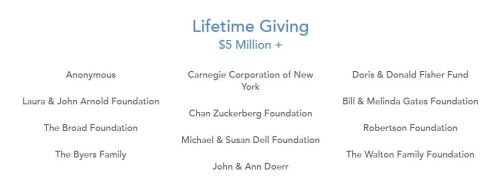
New Schools Venture Fund Donors

Twelve Organizations Contributing $5 Million Plus to NewSchools Venture Fund

Eleven of the twelve organizations listed above are known for promoting market based education reform. The twelfth, Anonymous, most likely has the same ideology.

Rethink Education is the third venture fund. It claims to focus on “Crucial Life Skills, Personalized Learning, Vocational Preparation, Curation of Workforce Learning Resources, College Dropout Prevention.” Jenny Abramson is the founder and Managing Partner of Rethink. She is a former Teach For America (TFA) corps member and a board member of the Washington DC charter school, DC Prep.

Imagine K12 is the forth fund investing in Education Elements. It was founded in 2011 as a startup accelerator for education technology companies. In 2016 Imagine merged with Y Combinator. The joint companies have invested in over 100 education technology focused companies.

Tugboat Ventures is the fifth fund invested in Education Elements which is one of its 35 listed properties.

The thread that ties together these ventures is the pursuit of profits. That is a mighty thread indeed.

He lists the members of the Board of Directors, all from the financial world.

No actual teachers in sight.

He adds:

Due to lobbying by billionaires like Bill Gates and Reed Hastings, the latest update to the national education law turned the US Department of Education (USED) into an education technology sales hub. Critically for companies like Education Elements, the federal technology pitch includes Competency Based Education (CBE). In order to have an inexpensive cyber based education system, there must be small skills that can be drilled and then tested. The USED says,

“Competency-based strategies provide flexibility in the way that credit can be earned or awarded, and provide students with personalized learning opportunities. These strategies include online and blended learning, dual enrollment and early college high schools, project-based and community-based learning, and credit recovery, among others.”

Unfortunately CBE is just an update of previous failed teaching strategies. In the 1970’s it was called Mastery Learning and in the 1990’s it was called Outcome Based Education. CBE is simply putting Mastery Leaning on a computer instead of using worksheets and paper assessments. It is still bad pedagogy. Computer based credit recovery is the fraud engendering the recent soaring graduation rates.

What is called “education reform” is a giant scam. It is not about “education” and it is not about “reform.” It is about money.

Last spring, the Network for Public Education published a report on waste, fraud, and abuse in the federal Charter Schools Program. The report, called Asleep At the Wheel, documented the Department of Education’s failure to monitor the veracity or feasibility of applications for the program or to follow up on what happened to the money spent to launch new charter schools. It found that nearly $1 billion of federal dollars had been wasted on charters that either never opened or closed soon after opening.

Today, NPE released a new report that delves into what happened with federal money from the Charter Schools Program in the states. The findings were even more concerning than last spring’s report.
The new report is called Still Asleep At the Wheel.

An excerpt:

This report, Still Asleep at the Wheel: How the Federal Charter Schools Program Results in a Pileup of Fraud and Waste, takes up where our first report left off. In it, we provide detailed information, state by state, on how federal dollars were doled out to schools that no longer exist or never existed at all.

In 2015, the U.S. Department of Education (the Department) published a list of charter schools that received grants between the years of 2006 and 2014. Using that database of 4,829 schools, we meticulously determined which charters that received grants were still open, which had closed and which had never opened, resulting in state by state records of enormous waste. We examine the detailed spending records of some of Michigan’s ghost charter schools that received grants exceeding $100,000. We explain how money moves into the hands of for-profit management organizations and tell the stories of subgrantees that engaged in fraud—sometimes amounting to hundreds of millions of dollars—all beginning with funding from the federal Charter Schools Program.

Major findings of our research include the following:

Documented charter school closures and the waste of federal funds exceeds our first report’s estimations.
We believed that about 1,000 recipient charters were defunct. However, using the 2015 database (active grantees from 2006-2014), we identified 1,779 grantee schools that either never opened or had shut down. The number of non-operational recipients, across 25 years of the program is inevitably in the thousands.
In the first report, we estimated the fail- ure rate for recipient schools to be 30 percent. For schools listed in the database, however, our latest review found a failure rate of 37 percent.

It is impossible to document total waste for the entire 25 year program because the Department never required the states to report the names of funded schools until 2006. However, we have now documented $504,517,391 (28 percent of the total database amount) that was awarded to schools between 2006-2014 that never opened or that have closed. Applying that percentage to the total expenditures ($4.1 billion) of the CSP programs designed to create new schools, approximately $1.17 billion in federal funding has likely been spent on charters that either never opened, or that opened and have since shut down.

The disbursement of over one billion dollars during the program’s first decade was never monitored for its impact or results. There is no record of which schools received the funds.

From 1995 to 2005, enormous funds were pushed out to the states to distribute to schools via subgrants. Yet the Department has no complete record of which schools re- ceived funding during the program’s early years, because it never required the states to report the names of subgrantee schools or their status. The Department’s over- sight ended when the funds left Washington.

During the first decade of the program when states did not have to report where the money went, Florida, a state where nearly half of all charter schools are run by for-profit organizations, received four grants totaling $158,353,525. Michigan, where about 80 percent of all charters are run by for-profit management companies, received four grants totaling $64,608,912. California also received four grants, totaling $190,857,243.
Although the overall rate of failed charter projects was 37 percent, in some states the rate of failure was much higher.

Iowa and Kansas have the largest propor- tions of failed subgrantee charter schools. Eleven charter schools in Iowa received grants. Ten failed, wasting over $3.66 million. As of 2014, the database indicates that Kansas doled out $8.51 million to 29 schools. Twenty-two (76 percent) of those schools either never opened or are closed today–$6,389,964 of the $8.9 million was wasted.

States with a subgrantee failure rate exceeding 50 percent include: Delaware, Georgia, Hawaii, Iowa, Kansas, Maryland, Mississippi, Virginia and Washington (state). Mississippi had only one grantee and that school failed. Georgia had 75 failures, resulting in over 23 million federal dollars wasted.

The percentage of defunct charter school grantees in Florida was 37 percent ($34.2 million); the Michigan failure rate was over 44 percent ($21 million) and Lou- Asian’s failure rate was 46 percent ($25.5 million).
The most astounding loss, however, was California’s: nearly $103 million was awarded to charters that never opened or have shut down—37% failed.

Five hundred thirty-seven (537) schools list- ed in the database never opened at all. Many received over $100,000 in federal funds.

Since 2001, charter school entrepreneurs have been eligible to receive CSP grants before they have even identified an authorizer or submitted a detailed application to open a school. In total, we identified 28 states that had at least one charter school (537 schools in total) that never enrolled even one student for one day and yet had received federal funds. According to the CSP database, those schools received, or were due to receive when the database collection ended, a total of $45,546,552 million.

Topping the list was the state of Michigan where 72 never-opened schools received grants, most exceeding $100,000. Over $7.7 million was wasted. In California, we identified 61—with waste of $8.36 million.
Other states with large numbers of never- opened schools receiving CSP funds in- clude Arkansas (18), Florida (46) Illinois (20), Maryland (38), Massachusetts (17), New Jersey (23), Ohio (20), Oregon (40), Pennsylvania (41), South Carolina (34), Tennessee (43) and Wisconsin (15).

This report provides details on how several of these never-opened charters in Mi- chigan spent those federal funds.

Although Congress forbids for-profit opera- tors from directly receiving CSP grants, they still benefit by having their schools apply.

Although we could not identify every charter in the CSP database that was run by a for-profit management company, we were able to identify those run by the large for-profit chains including Academica, K12, National Heritage Academies, White Hat and Charter Schools USA. In total, we found 357 schools in the database run by major for-profit chains. These schools had received a total of $124,929,017 in federal CSP start-up funds. Unsurprisingly, most of this money flowed to for-profit run schools in Florida ($46,936,979) and Michigan ($26,452,927). Eighty-three (83) schools run by the Flor- ida-based, for-profit chain Academica received CSP grants, totaling $23,426,383.


Still Asleep at the Wheel also describes why so many charter schools fail, along with the stories of grantee schools that abruptly closed, sometimes with little or no notice to their students and families. Far too often those schools shut down due to corruption and fraud. Our report provides disturbing accounts of grifters and profiteers who took CSP and other taxpayer funds only to enrich themselves at the expense of the students they had promised to serve.

The staggering amount spent on schools that have closed or never opened, as well as those that have engaged in fraud, is nothing short of a national scandal. As public dollars are diverted from public schools, the students who attend their neighborhood schools have fewer resources. It is time to put on the brakes and chart a new course.

We were heartened that after the publication of our first report in March of 2019, the U.S. House of Representatives reduced funding for the CSP program for 2020. However, a small reduction is not sufficient to address the program’s structural flaws.

We therefore strongly recommend that Congress end appropriations for new charter school grants in the upcoming budget and continue funding only for obligated amounts to legitimate projects. Once those grants have been closed, we recommend that the CSP be ended and that charter schools continue to receive federal support only through other federal funding streams such as Title I and IDEA. Students, not charter school en- trepreneurs, should benefit from federal funds.

We also recommend thorough audits by Congress of previous grant awards, the establishment of regulations to ensure grant awards still under term are being responsibly carried out and that misspent money is returned to the federal coffers.



Will Bunch, regular opinion writer for the Philadelphia Inquirer, excoriates McKinsey in this column. 

He writes:

In the last few years, McKinsey & Co.’s image as a go-to high-paying job option for the Ivy League’s best and brightest has morphed into something uniquely dark and sinister, as outstanding journalism from the New York Times and others has shed a light on arguably the world’s most secretive company, which never reveals its client list.

Nonetheless, the various scandals swirling around McKinsey have largely registered under the radar screen before last week, when journalists from ProPublica, publishing in the Times, exposed McKinsey’s work on behalf of U.S. Immigration and Customs Enforcement, or ICE. Two important things to note: a) it was the administration of Barack Obama that hired McKinsey for this task in 2015 and b) ICE officials under the Trump administration, justifiably pilloried for their cruel treatment of migrants, actually thought some of McKinsey’s ideas were inhumane.


When I worked in the first Bush Administration In 1991-92, McKinsey consultants were everywhere. Gaggles of very young, well-dressed people marched in and out of the White House with briefcases and plans. McKinsey has advised school districts, given them business plans to fix their problems. Does anyone ever check up on how their proposals turned out? Do they ever admit failure? I never figured out what they were doing or why they were there. Like Pearson, McKinsey is always there, although there is no evidence that they are education experts. What seems to mark the McKinsey brand is a sense of certainty that they know everything and know how to fix everything. To learn more about the corporate consultants who advise on how to do everything, I recommend this book, The Lords of Strategy. Education has been warped for the past 30 years by the inappropriate application of corporate strategy to schools and classrooms and children.

Their biggest disaster was their role in South Africa, where they received a huge payment to fix the state-owned power company. They didn’t but collected a huge fee for their failure.

In late 2015, over objections from at least three influential McKinsey partners, the firm decided the risk was worth taking and signed on to what would become its biggest contract ever in Africa, with a potential value of $700 million.

And a bitter irony: While McKinsey’s pay was supposed to be based entirely on its results, it is far from clear that the flailing power company is much better off than it was before.

The Eskom affair is now part of an expansive investigation by South African authorities into how the Guptas used their friendships with Jacob Zuma, then the country’s president, and his son to manipulate and control state-owned enterprises for personal gain. International corruption watchdogs call it a case of “state capture.” Lawmakers here call it a silent coup. It has already led to Mr. Zuma’s ouster and a moment of reckoning for post-apartheid South Africa.

Yet despite extensive coverage of the scandal by the local news media, one question has remained largely unanswered: How did McKinsey, with its vast influence, impeccable research credentials and record of advising companies and governments on best practices, become entangled in such an untoward affair?

McKinsey admits errors in judgment while denying any illegality. Two senior partners, the firm says, bear most of the blame for what went wrong. But an investigation by The New York Times, including interviews with 16 current and former partners, found that the roots of the problem go deeper — to a changing corporate culture that opened the way for an aggressive push into more government consulting, as well as new methods of compensation. While the changes helped McKinsey nearly double in size over the last decade, they introduced more reputational risk.

It was also the biggest mistake in McKinsey’s nine-decade history.

The contract turned out to be illegal, a violation of South African contracting law, with some of the payments channeled to an associate of an Indian-born family, the Guptas, at the center of a swirling corruption scandal. Then there was the lavish size of that payout. It did not take a Harvard Business School graduate to explain why South Africans might get angry seeing a wealthy American firm cart away so much public money in a country with the worst income inequality in the world and a youth unemployment rate over 50 percent.

Why did they do it? Greed? Arrogance?

Is Chester-Upland School District the frog in the boiling pot of water that is a warning to every other school district in the state of Pennsylvania?

The Chester Community Charter School is a subject of endless fascination. It has absorbed 70% of the elementary school students in the impoverished district of Chester-Upland in Pennsylvania. Its scores are low, lower even than the district schools. It is owned by an extremely wealthy suburban lawyer, who is a major campaign contributor to Republicans in the state. He receives a healthy profit every year from the charter school in Chester-Upland, despite the fact that the school is low-performing. Meanwhile, the school district has been in receivership since 2012, while the charter school is thriving. The district has been bankrupted by payments to the charter school and to cyber charters. That is the way the state law was written by charter-friendly Republicans in the Legislature.

The Chester-Upland School District is a majority-minority district: It is 18% white; 67% African American; 11% Hispanic; the remainder, other groups.

Peter Greene writes here about this district.

The school district is Chester Uplands, and they’ve been in the charter-related news before. Specifically, they were the poster child for how a careful gaming of the charter system in Pennsylvania could result in huge charter profits. As I wrote at the time:

The key is that while all CUSD students with special needs come with a hefty $40K for a charter school, they are not all created equal. Students on the autism spectrum are expensive to teach; they make up 8.4% of CUSD special ed student population, but only 2.1% at Chester Community Charter School, and a whopping 0% at Widener and Chester Community School of the Arts. Emotionally disturbed students are also costly; they make up 13.6 % of special ed at CUSD, 5.3% at Chester Community, and zero at the other two. Intellectual disabilities make up 11.6% for CUSD, 2.8% for CCCS, and zero for the others. 

Speech and language impaired, however, are pretty inexpensive to educate. CUSD carries 2.4% of the special ed population in this category, but the three charters carry 27.4%, 20.3% and 29.8%.

Back in 2015, this helped put CUSD in the astonishing position of giving more money to charter schools than it received from the state.

In 2015, the district made a deal to cut its payments to cyber charters (which are among the lowest performing schools in the state).

Greene writes:

In 2015 the district made a deal for charters to accept less money for students with special needs, but the cyber charters went to court to be exempted– and the court eventually agreed, giving CUSD a huge retroactive bill to pay cyber charters.

The district has long been attractive to worst of charter vultures. Not just the cybers, but for-profit management companies like CSMI, founded by the infamous Vahan Gureghian, charter school multimillionaire and generous GOP donor.

Currently, charters enroll about half of the 7,000 student district population. CSMI would like to have a larger piece of the pie and run all of the elementary education in Chester Uplands, and it has asked the court to hand them over (because the district itself has no say in this). CSMI runs some charters elsewhere, including a school in New Jersey that is the subject of a whistleblower lawsuit. The suit was filed by a former principal who says she was fired for making a fuss over CSMI’s policy of cutting corners to make a buck. Cutting corners didn’t just mean cutting services; it also meant falsifying records and misappropriating funds. Great company.

Open the post to see beautiful pictures of the charter owner’s gorgeous estate in Pennsylvania and his recently sold mansion in Palm Beach.

The lesson, says Greene, is that there is no real difference between for-profit and nonprofit charters. The Chester Community Charter School is “nonprofit.”

It is unclear how much money CSMI would make on the Chester Uplands deal because, as a private business, it doesn’t have to account for its financial activities– even though they are funded by trhe taxpayers. Do you see why, when someone like Cory Booker or Pete Buttigieg starts talking about how only for-profit charters are bad, they are just selling thinly sliced baloney. Chester Community Charter School is a non-profit school–that generates profits for the CSMI management company that runs it, and runs it like a business and not like a school.

The Inquirer quoted the CUSD school board president–his primary concern isn’t the charter takeover of the elementary schools as much as it is the inadequate funding from the state. “Ask them what they have done for 25 years in Chester Upland.” He has sort of a point, but the fact is that this non-weathy non-white district is in danger of losing all local control and voice.

This is what chartering as a tool of privatization looks like. Gut the public schools. Chase the students into profitable charters. Strip every last asset from the public school and strip all the power from the voters and taxpayers. Operate charters like businesses; every dollar you spend on students is a dollar you don’t get to keep. Make some guy a multimillionaire while stripping public education and democratic voice from the members of a poor community.

This chart comparing the charter school to the district’s four elementary and middle-schools was prepared by the Keystone State Education Coalition.

This chart summarizes the PA Dept. of Education’s Future Ready Index reports for the Chester Community Charter School (CCCS) and the four Chester Upland School District elementary/middle schools.


Indicator Name CCCS Main Street Stetser Sch of Arts Toby Farms
Percent Proficient or Advanced on ELA/Literature (All Student) 16.3 31 52.3 18.2 12.5
Percent Proficient or Advanced on Mathematics/Algebra 1 (All Student) 6.4 7.6 13.8 10.2 2.3
Percent Proficient or Advanced on Science/Biology (All Student) 22.8 36.7 59.5 59.6 13.7
Meeting Annual Academic Growth Expectations (PVAAS) ELA/Literature (All Student) 63 78 94 76 50
Meeting Annual Academic Growth Expectations (PVAAS) Mathematics/Algebra 1 (All Student) 78 100 77 81 54
Meeting Annual Academic Growth Expectations (PVAAS) Science/Biology (All Student) 50 69 70 97 50
Percent Advanced on ELA/Literature (All Student) 1.2 1.9 15.6 1.2 0.6
Percent Advanced on Mathematics/Algebra 1 (All Student) 1 0 1.8 3 0.6
Percent Advanced on Science/Biology (All Student) 2.8 8.3 16.2 7.7 0.9
Percent  English Language Growth and Attainment (All Student) 22.9 IS IS IS IS
Percent of Students with Regular Attendance (All Student) 48.7 59.2 59.8 53.4 42.1
Percent Grade 3 Reading (All Student) 14.5 24.4 37 20.7  DNA
Percent Grade 7 Mathematics (All Student) 6  DNA  DNA  DNA 1.7
Percent Grade 5, Grade 8, and/or Grade 11 Career Standards Benchmark (All Student) 98 98 98 98 98

Lawrence A. Feinberg of the Keystone State Education Coalition writes:

Flooding from Katrina precipitated the charterization of NOLA schools. Will a historical flood of campaign contributions do the same for Chester Upland SD? PA Department of Education Future Ready Index reports show that 3 of the 4 Chester Upland school district’s elementary/middle schools are outperforming the Chester Community Charter School. Why would the charter school operator want to charterize all the elementary schools in the district? There is no Right-to-Know requirement for private charter management companies like Vahan Gureghian’s CSMI, but the 990 for Chester Community Charter School for last year alone lists $18 million in management fees.


Politico reports that Betsy DeVos thanked her ideological bedfellow, ALEC, for its help in framing proposals to defund public schools (aka vouchers, opportunity scholarships, tax credits, education savings accounts, a rose by any other name, etc.).

ALEC is the far-right extremist libertarian organization that hates public schools, gun control, unions, environmental regulations, and anything else that infringes on the right of corporations to pursue profits without regard to consequences. ALEC is also a strong supporter of charter schools.


DEVOS IS SCHEDULED TO THANK ALEC FOR EDUCATION FREEDOM SCHOLARSHIP SUPPORT in a speech to the council’s conference in Arizona today, the Education Department said. The proposal, which has found little traction in Congress, would create a new $5 billion federal tax credit for donations to scholarship-granting organizations to pay for students to attend private schools or expand their public education options.

DeVos is a longtime friend to ALEC’s group of conservative state legislators. The secretary’s addressed the group’s conferences before, and drawn protests with a push for local control of education issues.

Arizona unionists have planned extended protests at ALEC’s conference, and have been aware that DeVos would be visiting.

This article about charter real estate dealings was written by Professors Preston Green III, Bruce Baker, and Derek W. Black.

They argue that lax state laws allow charter operators to reap profits while maintaining an ostensibly “nonprofit” status.

While critics charge that charter schools are siphoning money away from public schools, a more fundamental issue frequently flies under the radar: the questionable business practices that allow people who own and run charter schools to make large profits.

Charter school supporters are reluctant to acknowledge, much less stop, these practices.

Given that charter schools are growing rapidly – from 1 million students in 2006 to more than 3.1 million students attending approximately 7,000 charter schoolsnow – shining a light on these practices can’t come too soon. The first challenge, however, is simply understanding the complex space in which charters operate – somewhere between public and private.

Unregulated competition

Charters were founded on the theory that market forces and competition would benefit public education. But policy reports and local government studiesincreasingly reveal that the charter school industry is engaging in the type of business practices that have led to the downfall of other huge industries and companies.

Charter schools regularly sign contracts with little oversight, shuffle money between subsidiaries and cut corners that would never fly in the real world of business or traditional public schools – at least not if the business wanted to stay out of bankruptcy and school officials out of jail. The problem has gotten so bad that a nationwide assessment by the U.S. Department of Education warned in a 2016 audit report that the charter school operations pose a serious “risk of waste, fraud and abuse” and lack “accountability.”

Self-dealing

The biggest problem in charter school operations involves facility leases and land purchases. Like any other business, charters need to pay for space. But unlike other businesses, charters too often pay unreasonably high rates – rates that no one else in the community would pay.

One of the latest examples can be found in a January 2019 report from the Ohio auditor-general, which revealed that in 2016 a Cincinnati charter school paid $867,000 to lease its facilities. This was far more than the going rate for comparable facilities in the area. The year before, a Cleveland charter was paying half a million above market rate, according to the same report.

Why would a charter school do this? Most states require charter schools to be nonprofit. To make money, some of them have simply entered into contracts with separate for-profit companies that they also own. These companies do make money off students.

In other words, some “nonprofit” charter schools take public money and pay their owners with it. When this happens, it creates an enormous incentive to overpay for facilities and supplies and underpay for things like teachers and student services.

Many millions of dollars of public funds that were intended to educate children are squandered, they say.

It is called “legal graft.”