Archives for category: Education Industry

Jeff Bryant reports here on the waste of millions of federal dollars poured into charter schools in Louisiana. 

Usually, when the media writes about New Orleans, they tell you about success stories, but they don’t mention the many failures.

Between 2006 and 2014, on the watch of both Margaret Spellings and Arne Duncan, millions of dollars were awarded to open or expand charter schools in New Orleans.

Nearly half of those charters closed their doors or never opened. Nearly $24 million was wasted.

The large numbers are bad enough. The individual stories are even worse.

While the numbers alone are startling and a cause for concern, individual examples of charters in Louisiana that received CSP money and then closed throw into further doubt the prudence of using federal seed money to spread schools that open and close, repeatedly, and fund charter organizations that churn through districts and neighborhoods without any obvious regard for what parents and local officials want.

One of the examples I singled out from Burris’ research is Benjamin Mays Prep School in New Orleans, which received a $600,000 CSP grant. Mays Prep had long-standing academic issues and persistent budget shortfalls. The school had to move to a different building in 2012 and then lost that location in 2014 when its charter wasn’t renewed and a different charter moving into the space refused to enroll the Mays students. The school closed officially in 2014.

Another New Orleans charter, Miller McCoy, received a $600,000 CSP grant but eventually closed in 2014 after “a long downward spiral,” according to a local news source. The charter school’s two founders left in 2012 under alleged ethics allegations, and the school had a series of unsuccessful leaders after that. An “F” academic rating from the state seemed to have been the final straw.

The school had promised to be equivalent to a prestigious all-male private prep school in New Orleans, only free. Its closure left the teachers and remaining students and families with “a sense of loss, sadness, a grieving for what could have been,” reported a different local news outlet.

Another New Orleans charter, Gentilly Terrace, received a $600,000 CSP grant. The school was operated by a charter management group, New Beginnings Schools Foundation, that was cited for being out of compliance with several federal laws, including misdirection of federal funds for Title I schools—­money earmarked for high-poverty students. New Beginnings also had chronic problems with employee turnoverin its schools and non-transparent practice by its board of directors.

Gentilly Terrace closed in 2014 with a “D” rating from the state’s academics report card. Recently, the CEO of New Beginnings resigned amid allegations of falsifying public records and allowing one of its three remaining schools to engage in grade-fixing.

Really, you have to wonder whether anyone at the U.S. Department of Education ever read the applications, ever followed up to see how the money was used. Or do they just hand out millions and forget about it?

This year, Betsy DeVos has $440 million to toss to her favorites. KIPP got $89 million, and no one could ever say that KIPP was needy. The IDEA corporate charter chain won $116 from their friend Secretary DeVos, adding to the many millions she give them in previous years.

The federal Charter School Fund is truly a slush fund for the corporate charter industry.
 

Whenever anyone mention an education “miracle,” scoff. We had the “Texas miracle,”  the “New York City Miracle” (that lasted only as long as MIchael Bloomberg was Mayor), and countless others.

Now that Cory Booker is running for President, we will hear about the “Newark miracle.” Don’t believe it.

To understand the statistical legerdemain, read Jersey Jazzman’s explanation here about Newark.

JJ is a teacher who became so frustrated with false claims that he went to Rutgers and earned a doctorate so he could master statistics and put paid to lies.

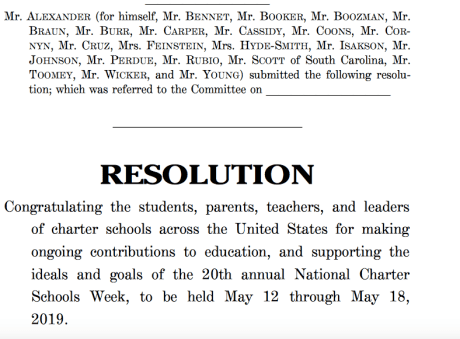
These are the Senators sponsoring a resolution to celebrate National Charter Schools Week. You will notice that the Democrats who signed on as sponsors include Cory Booker (NJ), Michael Bennett (CO), Dianne Feinstein (CA), and the two Senators from Delaware (Coons and Carper). Let’s hope that the Democrats who did not sponsor this resolution had a finger in the air and realized that the winds are blowing strongly against all forms of privatization, including charters and vouchers. Perhaps it occurred to the non-sponsors that only 6% of American students are enrolled in privately managed charters. Nearly 90% attend public schools. Perhaps they did not want to be associated with the Trump-DeVos agenda.

Screen Shot 2019-05-15 at 2.56.57 PM


Koby Levin, reporter for Chalkbeat, tried to attend meetings of the board of 10 charter schools in Detroit. It was challenging, to say the least.

When parents have an issue with their child’s school, there’s at least one place where they’re guaranteed a hearing on anything from school finance to student discipline: a school board meeting.

Yet in Detroit, a city with an infamously troubled school landscape, dozens of charter school board meetings are hard to find or poorly attended — if they happen at all.

Even finding the meeting times can be difficult. When a Chalkbeat reporter called to inquire about the board meeting at Covenant House Academy, the person on the other end of the line said “I don’t have that information,” and quickly ended the call.

David Ellis Academy did post its meeting schedule online, but the April meeting was set for Easter Sunday. It was canceled without notice.

These schools had not broken the law. But critics view such incidents as proof that charter schools in Detroit, which bring in more than $350 million from taxpayers for the 36,000 students they serve each year, aren’t doing enough to engage the community

A reporter tried to attend 10 charter board meetings, proceeding roughly in alphabetical order. Four were canceled. When meetings took place, the reporter was the only person in the room who didn’t work for or oversee the school, except for one meeting where an advocate spoke on behalf of a student she believed had been wrongly expelled.

This is a pattern of disrespect.

As a side note, I will add that this story exemplifies why I admire Chalkbeat. Even though it is funded by billionaires including Gates, Walton, and Broad, it’s journalism is not tilted to favor the funders’ clear preference for charters. That’s why I make a small annual donation to Chalkbeat. It is informative and honest.


The SPLC wrote to Governor Ron DeSantis to protest the latest Florida voucher plan, which takes money intended for public schools, without the fig leaf of tax credits.

By signing S.B. 7070 into law yesterday, Florida Gov. Ron DeSantis set his state on the path to further decimate its public schools through an unprecedented expansion of private school vouchers.

Florida already diverts nearly $1 billion of scarce public funds to unaccountable, under-regulated private schools each year through several different voucher programs. This massive diversion of public funds has led the state to fall from 24th among states in per-pupil funding to the bottom 10.

And even as Florida has spent more than any other state on private school vouchers, these programs have not proven to be successful, either in Florida or elsewhere. Research, in fact, shows a negative impact on academic achievement across the country. What’s more, private schools participating in Florida’s voucher programs are not held to the same standards, educational or otherwise, as public schools. 

We do have evidence about what works to ensure all students have opportunities to learn, grow, and thrive: investing in schools that value collaboration between educators, families, and communities, and focusing on wraparound supports like health care, counseling, after-school programs, and other neighborhood services.

Yet DeSantis and the Florida Legislature have chosen to set up dueling, non-uniform systems, where communities and their schools compete with private school vouchers for resources – and  lose.

Florida’s 3 million schoolchildren deserve better. Every child in Florida deserves a thriving public school – and a government that will work toward this goal.

Read more about the bill in this letter we sent urging DeSantis to veto the legislation.


Governor Gavin Newsom acted to tighten enrollment rules for charter schools, which have been credibly accused of excluding or pushing out students with disabilities and students who get low scores.

Three years ago, the ACLU of Southern California and the public interest law firm Public Advocates identified charter schools that advertised their exclusionary policies on their websites, but have since changed their websites. Their report found that more than one in five charters acknowledged keeping out certain classes of students.

EdSource summarized:

These practices, the report alleges, “violate the California Education Code, the California and U.S. Constitution, and state and federal civil rights laws.”

The report, titled, “Unequal Access: How Some California Charter Schools Illegally Restrict Enrollment,” says that according to the California Charter Schools Act of 1992, charter schools are required to “admit all pupils who wish to attend,” except for space limitations.

Newsom proposed a statute to ban such practices:

Newsom’s proposed statute would specify that charter schools cannot request or require parents to submit student records before enrolling. And it would require that charter schools post parental rights on their websites and make parents aware of them during enrollment and when students are expelled or leave during the year….The proposed statute implies there should be no allowances “for any reason” that might discourage any pupil from enrolling in a charter school.

A charter school advocate complained that district magnet schools for the arts or science or other specialties are not required to accept every applicant.

Many of those impose “selective (sometimes elite), complex and burdensome admissions requirements” that charter schools would not be allowed to adopt, said Eric Premack, executive director and founder of the Sacramento-based Charter Schools Development Center, which advises founders of charter schools. “It would be very interesting to see how districts would respond if the governor had proposed to subject districts to the same restrictions.”

The powerhouse California Charter School Association, the lobbying group, was noncommittal, not wanting to alienate the governor:

The California Charter Schools Association, which represents most of the state’s charter schools, has not commented on the specifics of Newsom’s proposal. In a statement last week on his education budget, it said, “We applaud Governor Newsom’s commitment to increasing funding for special education, and we share his vision in ensuring that all of California’s kids – especially our most vulnerable students – have access to public schools that meet their individual needs.”

UPDATE.

Fred Smith, testing expert, warns parents that New York begins using their children as guinea pigs starting tomorrow when field tests start in 869 schools in NYC and 2,490 schools across the state. More than a quarter million children will be forced to take a useless test.

The tests are meant to field-test future test questions. They don’t count. They waste students’ time for the benefit of the test publisher.

The kids could be learning something, reading something, doing something. Instead, they are working without pay for the test publisher.

This is a good time for all parents to tell their children to refuse the test.


Senator Bernie Sanders has produced an excellent plan for education .

Thus far, he is the only candidate to address K-12.

His first principle is crucial:

Every human being has the fundamental right to a good education.

Read the plan.

Sanders’ commitment to funding education is breathtaking. He intends to triple the funding of Title 1 for the neediest children. He proposes a national floor for per-pupil spending. He wants to reduce class sizes. He promises that the federal government will pay 50% of the cost of special education.

He promises to:

Significantly increase teacher pay by working with states to set a starting salary for teachers at no less than $60,000 tied to cost of living, years of service, and other qualifications; and allowing states to go beyond that floor based on geographic cost of living.

He also pledges to protect and expand collective bargaining rights and tenure.

He does not shy away from the charter industry.

He recommends a flat ban on for-profit charters. He endorses the NAACP resolution that calls for a new moratorium on new charters. He recognizes that charters are funded by billionaires and not in need of federal aid.

He says:

That means halting the use of public funds to underwrite new charter schools.

We do not need two schools systems; we need to invest in our public schools system.

This is a powerful program that addresses the three critical issues of our time.

First, the need for adequate and equitable funding.

Second, the need to restore teacher professionalization.

Third, the need to reject privatization.

What will

the other candidates do? Senator Sanders has challenged them to match his boldness. Will they?


CNN says that Senator Bernie Sanders will deliver a major address on education on Saturday. 

He will call for a flat ban on for-profit charters.

He supports the NAACP’s call for a moratorium on new charters.

Most important is this:

The Vermont independent also will call for a moratorium on the funding of all public charter school expansion until a national audit on the schools has been completed. Additionally, Sanders will promise to halt the use of public funds to underwrite all new charter schools if he is elected president.

That would mean elimination of the federal charter slush fund, which has wasted nearly $1 billion on schools that never opened or that closed soon after opening. This program, called the Charter Schools Program, was initiated in 1994 to spur innovation. It is currently funded at $440 million a year. Secretary DeVos used the CSP  to give $89 million to KIPP, which is already amply funded by the Waltons, Gates, and other billionaires and is not a needy recipient. She also has given $225 million to IDEA, part of which will be applied to opening 20 charters in El Paso.

If Senator Sanders means to eliminate CSP, that’s a very good step forward.

Every other Democratic candidate should be asked what they will do about the federal charter slush fund.


Howard Blume writes in the Los Angeles Times about the new political landscape in education after Jackie Goldberg’s landslide election to the LAUSD school board.

Jackie met with Superintendent Austin Beutner, and both pledged to work for the passage of Measure EE, a tax proposal that would raise $500 million in new revenues for the public schools.

More than anything else, Goldberg is stressing the need for better funding — a point of agreement among many combatants in the education wars, including charter supporters.

We’ve been starving schools,” Goldberg said during an appearance Wednesday at Micheltorena Street Elementary in Silver Lake. “It is a crime that we are not investing in children the way they did when I was a kid….”

Goldberg’s win turned around a losing streak for the teachers union. Until Tuesday’s election, charter school supporters, fueled by wealthy donors, were outspending the unions in L.A. school board contests. And in July 2017, candidates they backed claimed a board majority.

Charters are privately operated, mostly nonunion and compete with district schools for students and the funding that follows them. They enroll close to 1 in 5 district students. It will not be easy to find the way forward on charters, because most rules governing their expansion and oversight are made at the state level.

While the L.A. teachers union has remained a political force, its influence in local board elections was being eclipsed by charters.

With its success Tuesday, the teachers union might be riding something of a national wave, said Julie Marsh, professor at USC’s Rossier School of Education.

“We’re seeing some shifts in the narrative around charter schools,” Marsh said. Charter backers long have pointed to the bipartisan appeal of these schools, but their embrace by President Trump and his polarizing Education secretary, Betsy DeVos, “make it difficult for Democrats to associate with these reforms….”

Goldberg insisted Wednesday — as she has before — that she has no agenda to push Beutner out.

Her presence, however, could circumscribe Beutner’s long-awaited district reorganization. In campaign appearances, Goldberg said she suspected Beutner of secretly crafting a plan that would favor charter school expansion. As evidence, she and others cited the work that consultants for Beutner had done in other districts. She vowed to oppose any such effort.

In recent appearances, Beutner has emphasized that he envisions helping district-run schools operate more efficiently and effectively.

As a candidate, Goldberg had much in common with board member George McKenna, who also had a strong base even without the teachers union. He too allied with the union to win office against a well-funded opponent.

McKenna’s win, in 2014, contributed to the departure of then-Supt. John Deasy because he defeated an opponent who’d strongly supported Deasy.

Goldberg, like McKenna, is no union vassal, although her preferred policies align closely with those of United Teachers Los Angeles. In reality, all seven board members are more nuanced in their beliefs than the stark contrasts represented by their supporters.