Archives for the month of: June, 2021

The charter industry has set a target on Texas as a new frontier for expansion. With a rightwing Governor and state commissioner who support privatization of public money meant for public schools, the outlook was bright. The state leadership doesn’t care that public schools outperform charter schools and close down with alarming frequency. The big-money fellas don’t care about violating local control or the corporatization of an essential public service. This is a state where a charter chain wanted to lease a private jet for $2 million a year, spent $400,000 on box seats for San Antonio Spurs basketball games, and the CEO left office with a $1 million golden parachute.

As our friends the Pastors for Texas Children reports, the charter lobby fell short this year.


PASTORS FOR TEXAS CHILDREN PRAISES
STATE BOARD OF EDUCATION FOR BLOCKING CHARTER SCHOOLS


The Texas State Board of Education took the unusual step of denying four of the seven new charter school applications today.


California-based Rocketship Charter Schools barely passed on an 8-7 vote, only after an unprecedented push from moneyed Fort Worth interests and last-minute lobbying from Governor Greg Abbott.


This vote comes on the heels of the 87th Legislative session that saw a record 39 charter bills filed. Only one significant charter bill passed, after a procedural slight of hand when many anti-charter members were off the floor and could not vote.


All in all, the charter juggernaut has ground to a halt in Texas.


“We have taken a huge step forward in exposing the corruption of charters—and equating them with the waste
& violation of vouchers,” PTC executive director Rev. Charles Foster Johnson said.


“We still have a long way to go. It is contrary to everything Texans stand for to turn our children’s education over to the control of out-of-state interests—especially those located in California!”


There is no evidence that charter schools outperform traditional neighborhood and community public schools. Many charters fail and fold after several years due to poor educational quality and control. The mediocre oversight of charters has produced a pattern of waste and corruption that is unacceptable.


PTC joins a growing chorus of public education advocates in calling for an extensive study and review of our state’s charter school policy, which has morphed into something far afield from the original intent of charters. Good financial stewardship demands that charter expansion in Texas cease until this inventory can occur.


We thank Dr. Keven Ellis and the State Board of Education for their careful listening to many voices on both sides of the charter issue this week, as well as their careful deliberation.


And we call on all public education stakeholders to unify around the moral and constitutional duty before God to “make suitable provision for public free schools.”
+++


Pastors for Texas Children mobilizes the faith community for public school assistance and advocacy.
PO Box 471155 – Fort Worth, Texas 76147 http://www.pastorsfortexaschildren.com

Lelac Almagor teaches fourth grade in a charter school in Washington, D.C. The following article appeared in the New York Times.

She writes:


Our prepandemic public school system was imperfect, surely, clumsy and test-crazed and plagued with inequities. But it was also a little miraculous: a place where children from different backgrounds could stow their backpacks in adjacent cubbies, sit in a circle and learn in community.

At the diverse Washington, D.C., public charter school where I teach, and which my 6-year-old attends, the whole point was that our families chose to do it together — knowing that it meant we would be grappling with our differences and biases well before our children could tie their own shoes.

Then Covid hit, and overnight these school communities fragmented and segregated. The wealthiest parents snapped up teachers for “microschools,” reviving the Victorian custom of hiring a governess and a music master. Others left for private school without a backward glance.

Some middle-class parents who could work remotely toughed it out at home, checking in on school between their own virtual meetings. Those with younger kids or in-person jobs scraped together education and child care — an outdoor play pod or a camp counselor to supervise hours of Zoom classes. With schools closed, the health risks and child care hours didn’t disappear. They simply shifted from well-educated, unionized, tax-funded professional teachers to hourly-wage, no-benefit workers serving only those who could afford to pay.

The families with the fewest resources were left with nothing. No child care, only the pallid virtual editions of essential services like occupational or speech therapy.

If they could work out the logistics, their kids got a couple of hours a day of Zoom school. If they couldn’t, they got attendance warnings. In my fourth-grade class, I had students calling in from the car while their mom delivered groceries, or from the toddler room of their mom’s busy day care center.

Home alone with younger siblings or cousins, kids struggled to focus while bouncing a fussy toddler or getting whacked repeatedly on the head with a foam sword. Others lay in bed and played video games or watched TV. Many times each day, I carefully repeated the instructions for floundering students, only to have them reply, helplessly, “I’m sorry, I can’t hear you,” their audio squealing and video freezing as they spoke.

Even under optimal conditions, virtual school meant flattening the collaborative magic of the classroom into little more than an instructional video. Stripped of classroom discussion, human connection, art materials, classroom libraries and time and space to play, virtual school was not school; it was busywork obscuring the “rubber-rooming” of the entire school system.

Some educators sneered that the parents who complained just wanted free babysitting. But I’m not ashamed to say that child care is at the heart of the work I do. I teach children reading and writing, yes, but I also watch over them, remind them to be kind and stay safe, plan games and activities to help them grow. Children deserve attentive care. That’s the core of our commitment to them.

I am still bewildered and horrified that our society walked away from this responsibility, that we called school inessential and left each family to fend for itself. Meanwhile nurses, bus drivers and grocery workers all went to work in person — most of my students’ parents went to work in person — not because it was safe but because their work is essential. Spare me your “the kids are all right” Facebook memes. Some children may have learned to do laundry or enjoy nature during the pandemic. Many others suffered trauma and disconnection that will take years to repair.

I don’t know the first thing about public health. I won’t venture an opinion on what impact the school closures had on controlling the spread of Covid. What I do know is that the private schools in our city quickly got to work upgrading HVAC systems, putting up tents, cutting class sizes and rearranging schedules so that they could reopen in relative safety. Public schools in other states and countries did the same.

More of our public school systems should have likewise moved mountains — repurposed buildings, reassigned staff, redesigned programming, reallocated funding — to offer consistent public schooling, as safely as possible, to all children.

Instead we opened restaurants and gyms and bars while kids stayed home, or got complicated hybrid schedules that many parents turned down because they offered even less stability than virtual school. Even now, with vaccinations rising and case rates dropping, some families remain reluctant to send their kids back to us in the fall. I can’t help thinking that’s because we broke their trust.

Does virtual learning work for some kids, in some circumstances? Sure. So does home-schooling, or not attending school at all. But I am profoundly relieved that most districts, including my own, plan to shut down or restrict the online option.

I hope this means that we are renewing our collective commitment to true public education. Just as before, we will have to fight to make our schools safer, more equitable and more flexible. Just as before, coming together will be messy and complicated. Children, families and teachers will all need time to rebuild relationships with our institutions.

But we’ll be back together, in the same building, eating the same food. We’ll find that the friend who helps us in the morning might need our help in the afternoon. We’ll have soccer arguments at recess and patch them up in closing circle. We’ll sing songs, tell stories, plant seeds and watch them grow. That’s schooling in real life. That’s what public school is for.

Lelac Almagor (@MsAlmagor) is in her 18th year of classroom teaching.

Gary Rubinstein teaches mathematics at Stuyvesant High School. It is one of the best high schools in the nation. It has a competitive admissions process. Students who hope to attend take a standardized test of read and math on one day, no repeats. New students are accepted based on their score on that one test. The school, like other elite public high schools in New York City has often been criticized for the very small percent of black and Hispanic students who win admission. Its student body is primarily Asian-American.\

In this post, Gary discusses the merits and demerits of selective schools like the one he teaches in. He clearly approves, he admits, or he would not be teaching there.

He invites his readers to respond to his thoughts.

Billy Townsend tells the story in this post of Hillsborough County in Florida, where parents and community activists are actively resisting the State Legislature’s demand for privatization of public schools.

It is a fascinating post that shows that regular people can beat big money and political power when they get angry enough about scams and shady real estate deals and schools that exclude limited-English-proficient children and children with disabilities.

Here is a small part of the story:

The anti-privatization, anti-fraud, pro-human being approach to public education in Florida — of which I’m proud to have been an early advocate — was politically ascendant in this state at the community level when COVID struck and temporarily overshadowed it. 

Now it’s back, thanks to Hillsborough; and it’s much more consequential than the performative battles over 2024 presidential election talking points currently making the most news. 

This movement elected me in 2016 in Polk County. It got rid of former Senate President Joe Negron’s wife a couple years ago. It purged a number of voucher-loving Democrats in recent primaries. It helped Karen Castor Dentel in Orange County win 72 percent of the vote in August after the charter industry labeled her “Public Enemy Number 1.” (They also labeled me “Public Enemy Number 1,” which is the name of this newsletter now. Yes, they had two number 1s.)

The movement helped Tom Edwards beat an incumbent in Sarasota County who outspent him $220,000 to $24,000.

Open the link and be inspired.

John Thompson is a historian and a retired teacher in Oklahoma. He has written on this blog frequently.

He writes:

The Perfect Storm of Education Reform: High Stakes Testing and Teacher Evaluation, by Sheryl Croft, M. Roberts, and Vera Stenhouse provided an essential service to public education by explaining that the corporate school reform disaster wasn’t due to its “discrete singular efforts.”  Instead, it was “a confluence of systematic and orchestrated education reform efforts that are akin to storm fronts.” Just as important, Croft, Roberts, and Stenhouse provide insights into why post-Covid schools are likely to face comparable challenges.

As their metaphor explains, rain and wind don’t necessarily wreak havoc, and no single policy mandate, no matter how ill-conceived, was to blame for the corporate reforms’ “colossal failure;” the catastrophe was caused by the combination of an unprecedented amount of high-stakes standardized testing, data-driven teacher evaluations, and attempts to hold individual students and teachers accountable for Common Core test results; the “testing industrial complex (TIC),” where consultants promoted test-driven policies and teaching methods; charter schools and a culture of competition driven by test scores; the “false narratives” about public education, especially  incessant attacks on failing teachers; similar mandates for teacher preparation policies; and the replacing of recess and play with nonstop test prep which often drove the joy of learning out of school. Moreover, reformers didn’t understand what should have been obvious – that these mandates would most damage the educations of poor children of color, who were most likely to receive the biggest deluge of “drill and kill” test prep.

As Croft, Roberts, and Stenhouse explained, the perfect storm of corporate school reform “arrived in full in 2015.” In doing so, they preview the dilemmas which many post-Covid schools will likely continue to face. Corporate reform was “a perfect storm” that eroded “the bedrock of public education in the United States.” It was like “a mesoscale storm [which] is comprised of individual storms that combine to form a larger persistent/perfect storm.” Even as educators need to stop and think anew about post-Covid schooling, the components of these edu-political storm fronts continue to move across the landscape.

No Child Left Behind was like a high-pressure “warm front (precipitation and fog) followed by a cold front (narrow) bands of thunderstorms and severe weather.” It propelled the testing industrial complex to produce “a warm front” which “rained down neoliberal education polices under the guise of improving education while obscuring the free-market ideology of corporatization.” Despite its failure, Secretary of Education Arne Duncan doubled down on both the false accountability-driven narratives, and the testing industrial complex. The TIC front also forced local school systems to “lay off teachers, close neighborhood schools, eliminate art and music programs, and dedicate more and more revenue to supporting standardized testing.”

I saw the same dynamic in Oklahoma City which Croft, Roberts, and Stenhouse analyzed in Georgia. Duncan briefly visited our KIPP Charter School and made the obviously false statement that it became an “A” school by “raising expectations” while teaching the “same students, in the same building,” Of course the low-income, high-attrition KIPP had nothing in common with schools like my mid-high serving everyone in a segregated neighborhood with an extreme concentration of generational poverty, a lack of social capital, and enormous numbers of children who survived multiple traumas. That Big Lie was a major reason why disadvantaged black, brown, and poor people were “most grievously injured” by corporate reform.

By now, it should be clear that complex, interrelated social, economic, and educational problems need complicated interconnected solutions – not wave after wave of interconnected assaults on public schools and “disruptive innovation.” But, there is no sign that market-driven reformers have abandoned their faith in “transformative” change. So, educators still have reason to fear another TIC storm front.

I’m especially concerned about last part of the confluence of corporate reforms described by Croft, Roberts, and Stenhouse that turned my troubled school into the state’s lowest-performing mid-high school. The final storm front dumped millions of dollars of Stimulus and School Improvement Grant money, funding policies that made our school much, much worse, replacing classroom instruction with nonstop remediation. We can’t ignore the lessons of the failed post-Great Recession investments without inviting another TIC-funding storm.

My experience of 2009 was like that of the educators who Croft, Roberts, and Stenhouse listened to. Our top administrators understood why NCLB had failed, and why it made no sense to double down on test and punish. Even though they could only say so in private, the top OKCPS administrators knew the social science which explained why better instruction, driven by better professional development and curriculum, could not improve outcomes in most of our district’s schools until a socio-emotional foundation was laid. That would require a team effort, drawing on community partners, and patience. But, they were intimidated by state legislative leadership and federal guidelines into a rushed instruction-driven, curriculum-driven gamble.

Today’s education leaders shouldn’t allow themselves to be intimidated by demands that standardized testing must continue, and prioritizing the “remediation” of last year’s learning loss, using the “best practices” sold by the TIC’s consultants, so that neighborhood schools don’t lose in the competition with charters. The Oklahoman reports that the OKCPS (for instance) will receive $255.4 million in stimulus money (more than three times the federal assistance it received after the Great Recession), but there has been no public discussion about spending priorities. Instead, it reported that many Oklahoma districts hope that the 2021-22 school year “will closely resemble pre-pandemic life.” 

Chris Brewster, the superintendent of the charter system which has creamed off the most students from the Oklahoma City School System, exemplifies the hope that “growing teachers, training teachers and equipping teachers” is the best way to spend the new money.  If Brewster really believes that, then he clearly doesn’t understand how his charters operate in a completely different world from the OKCPS schools serving entire neighborhoods with extreme concentrations of generational poverty, with so many students who have survived multiple Adverse Childhood Experiences (ACEs).

Urban district leaders can choose to listen to community partners and State Superintendent Joy Hofmeister, and prioritize the student supports which could provide the foundation for holistic teaching and learning. Or they could be intimidated by the Republican leadership which changed the excellent state funding formula in order to punish urban schools, who invested $10 million of federal Covid relief money in private schools, and increased spending for charters, as they cut corporate taxes and implicitly banned discussions on Critical Race Theory.   If that happens, they – like compliant educators in 2009 – could feel obligated to focus on the learning deficits produced by last year’s crisis, and squander opportunities to bring together waves of constructive student-centered policies.

Educators should shake off their fears and start with the wisdom of Teresa Thayer Synder about the need to “Resist the pressure from whatever ‘powers that be’ who are in a hurry to “fix” kids and make up for the “lost” time.”  She stresses the humanity of students:

In our determination to “catch them up,” I fear that we will lose who they are and what they have learned during this unprecedented era. What on earth are we trying to catch them up on? The models no longer apply, the benchmarks are no longer valid, the trend analyses have been interrupted. … We can make those invalid measures as obsolete as a crank up telephone!

She then tackles the reality that should be our priority:

When the children return to school, they will have returned with a new history that we will need to help them identify and make sense of. When the children return to school, we will need to listen to them. Let their stories be told. …

I sincerely plead with my colleagues, to surrender the artificial constructs that measure achievement and greet the children where they are, not where we think they “should be.” Greet them with art supplies and writing materials, and music and dance and so many other avenues to help them express what has happened to them in their lives during this horrific year. Greet them with stories and books that will help them make sense of an upside-down world. They missed you. They did not miss the test prep. They did not miss the worksheets. … They missed you.

If that sounds too touchy-feely for under-the-gun educators, they should draw upon the recent New York Times’ reporting by Eduardo Porter on the West Virginia initiative which “mushroomed into a partnership branded Reconnecting McDowell, encompassing over 100 organizations and offering assistance like social and health services for families and apartments for teachers and other professionals.” The program grew out of a conversation between American Federation of Teachers president Randi Weingarten, and Gayle Manchin, the State Board of Education vice president (and the wife of Sen. Joe Manchin.)Since Oklahoma and West Virginia are basically tied with the highest percentage of young people who have survived multiple ACES, our education leaders should listen to Porter who writes:

Reconnecting McDowell has done well by many students and their families. It sent health clinics, mental health clinics and even dentists into the schools. It runs a mobile farmers’ market out of a truck, offering produce to poor families that can be many miles from the nearest supermarket. It championed a juvenile drug court to offer intensive drug treatment programs that help nonviolent young offenders return quickly to school, rather than go to jail. The program helps with college tuition and funds a mentoring program that takes groups of high school seniors to Charleston, the state capital, and Washington.

I understand the fears of education administrators who worry that building such a mesoscale solution is too daunting of a challenge. If we can’t subdue our fears, however, who knows how many waves of mesoscale storm-like corporate reforms will rob our kids – especially those who have suffered the most – of what it takes to really offer our students the learning required in these calamitous times?

T
When Gina Raimondo, now Secretary of Commerce, was governor of Rhode Island, she was an enthusiastic supporter of privately-run charter schools. Her successor as governor was director of a charter school (Blackstone Valley Prep) before he ran for office.

Now, the Rhode Island House of Representatives has proposed a bill that would “automaticallly enter all public school students into charter school lotteries.”

The story reads:

The bill has the support of the Rhode Island Mayoral Academies, which includes the state’s two largest charter networks, Achievement First and the Blackstone Valley Prep Mayoral Academy, located in northern Rhode Island. After some initial misgivings, the Rhode Island Department of Education also backs the measure.  

Currently, families must apply or “opt into” a charter public school. This bill, which now goes to the Senate, would automatically enroll students into eligible charters and allow them to decline an invitation to enroll if their child is accepted. Most charter schools draw children from specific districts. 

But the executive director of the Rhode Island League of Charter Schools, which represents the mom-and-pop charters, said the new approach, while laudable, has serious unintended consequences.  

“Highlander is a K-12 statewide charter school,” said league executive director Keith Oliveira. “There are about 140,000 public school children in Rhode Island. Everyone in the state would be part of their lottery. 

“This is a nightmare for the school districts, which have to collect the data, places an additional burden on the Department of Education and on the charter schools, which will run the lotteries.” he said.  “The bill is intended to solve a problem that doesn’t exist.” 


Governor Ron DeSantis and the Florida legislature are worried that the state’s colleges and universities are hotbeds of socialism, so they passed a bill to survey students and faculty about their beliefs. They worry that there is a lack of “intellectual diversity” on the state’s campuses.

What next? Loyalty oaths?

In his continued push against the “indoctrination” of students, Gov. Ron DeSantis on Tuesday signed legislation that will require public universities and colleges to survey students, faculty and staff about their beliefs and viewpoints to support “intellectual diversity.”

The survey will discern “the extent to which competing ideas and perspectives are presented” in public universities and colleges, and seeks to find whether students, faculty and staff “feel free to express beliefs and viewpoints on campus and in the classroom,” according to the bill.

The measure, which goes into effect July 1, does not specify what will be done with the survey results. But DeSantis and Sen. Ray Rodrigues, the sponsor of the bill, suggested on Tuesday that budget cuts could be looming if universities and colleges are found to be “indoctrinating” students.

Governor DeSantis has a peculiar notion of “intellectual diversity.” Only two weeks ago, at his urging, the state board of education placed limits on what may be taught about racism in the schools, specifically banning “critical race theory” and The 1619 Project.

Brian Franklin, a historian at Southern Methodist University, wonders how the politicians in Texas can reconcile their support for teaching about Juneteenth while banning honest teaching about slavery and racism. Franklin previously wrote a brilliant article about Governor Abbott’s “1836 Project” to teach Texas history based on the founding documents. He pointed out that the state’s founding documents were shot through with racism.

In this new article, he writes:

On June 16, Texas history made the news twice. Both developments, in strikingly different ways, present an opportunity for history teachers to engage with their students anew about history, with all its intriguing complications, and its promise for teaching us today.

The bill’s supporters bar teachers from teaching their students even the concept that slavery was part of the founding ideals of the United States.

In a strangely bipartisan scene, the U.S. Senate unanimously passed a resolution to establish Juneteenth (June 19) as a national holiday, to commemorate the end of slavery in the United States. Massachusetts Sen. Ed Markey, a Democrat, joined Texas Sen. John Cornyn, a Republican, and Texas Rep. Sheila Jackson Lee, a Democrat, in leading the effort.

Later that afternoon, Texas Gov. Greg Abbott unceremoniously signed HB 3979 into law, a bill that joins a host of others across the country known by some as “anti-1619” bills. In this act to alter the social studies curriculum standards for Texas public schools, the bill’s supporters bar teachers from teaching their students even the concept that slavery was part of the founding ideals of the United States.

Spirit of Sam Houston, we have a problem.

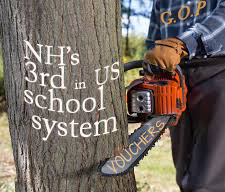
Jeanne Dietsch writes regularly about politics and social welfare in New Hampshire. She is a former legislator. The Republican legislature recently voted to cut public school funding, to launch vouchers for private schools and homeschooling, and to cut property taxes.

She wrote:

A decade ago, I read a story in The Atlantic about a boy stranded at sea, in a boat that had been carefully crafted and tended by his grandfather, but neglected by his parents. The motor died and the dinghy was beginning to leak, amid tall waves, while he was still far from shore.


I see New Hampshire’s children in that boat. One in every nine children in NH lives in poverty – less than $22k per year for a family of three – compared with one in fifteen adults. Between 2008 and 2018, the proportion of children on free and reduced lunch rose almost 40%. NH has among the highest rates of college debt, highest tuition, highest growth in teen suicide. Educational achievement has been demonstrated over 50 years to vary with poverty and parental education more than race. Mental health problems can be caused or exacerbated by the stress of poverty and depression.

Are NH leaders ferreting out the causes of child poverty, the causes of mental illness, to root them out? No, because they would have to admit that defunding government and giving the private sector free rein is not working. They would have to stop steering tax cuts to the wealthy and powerful and start investing in children and the future.

Instead, the G.O.P. is defunding 22 positions at DCYF, the people tasked with protecting children, at a time when reports of abuse have increased. Is it because the state is short on funds? No, revenues exceed plan. It is because the pay scale for those positions is so low that DCYF has been unable to fill 41 vacancies. Last time NH let case loads rise to 70 per employee, two children died. The problem is not lack of funds, it is lack of interest from the G.O.P.

The G.O.P is also cutting the education stability grants that the Senate allocated to property-poor districts last term. This burdens those towns local property taxpayers. This increases poverty in those towns. Public schools hand out take-home meal bags to children who cannot rely on being fed over the weekend. Public schools must try to educate children of parents struggling with addiction, children who have no one at home to care for them.

Rather than address poverty and its impact on educational achievement, G.O.P. leaders merely bandage the wounds of a sick society.[1] They inserted “Education Freedom Account” vouchers into the budget. The EFAs give $4600 per year to people already paying their children’s private tuition. For a family living in poverty, whose parents work extended hours to get by, a partial tuition subsidy is useless. And at least one for-profit company is already raising millions in startup money at the prospect of raking in NH taxpayer dollars for providing cut-rate instructional services. The goal of the company is to replace schools and certified teachers with aides who educate children in their homes. This, according to EFA supporters, will cut local taxes because: Professional teachers will be laid off. Schools will close. And taxpayers will no longer need to maintain the stranded assets of the school districts.These new “micro-schools” cater to people of similar economic, cultural, and educational background. Any sociologist can explain that the way to increase upward mobility is to create networks across boundaries. This approach traps children in bubbles of like-minded people, just as social media does.

Similarly, for mental health, the NH G.O.P majority is funding band aids, increasing budgets for treatment resources. For people already suffering from mental illness, treatment is crucial, of course. However, to ignore poverty’s role in depression and mental illness is like foregoing COVID vaccination and only treating patients after they are sick. It is foolish, expensive, and cruel.

New Hampshire has the second lowest birth rate in a country with less-than-replacement rate nationwide. Each child is that much more precious, as a result. Yet the G.O.P. refuses to invest in them. Is it not obvious that this is a recipe for future decline?

Are NH G.O.P. members so determined to prove that government can do no good that they refuse to use it to help children? Are they so self-indulgent that they only care about their own? Or are they just drinking the kool-aid of the cult?

Whatever reason drives each individual official, they act as a block. We must replace them. And we must not send to Washington any who place profit, power or party over our nation’s future well-being. The seas are rough and the G.O.P. seem willing to let the boat sink, as long as their kids have life vests.

The Economic Policy Institute unabashedly advocates for workers and unions and publishes accurate data about inequality. It recently revealed that CEO pay rose by 16% between 2019 and 2020, while the average worker saw a pay increase of only 1.8%.

In 1950, the average CEO was paid twenty times the wages of the average worker.

By 2019, the average CEO was paid 320 times as much as the average worker.

In some companies, the CEO is paid 1,000 times more than the average worker in that company.

Bloomberg.com reported on the CEO-worker pay gap, in an article titled “Is a CEO Worth 1,000 Times the Median Worker?”

Chipotle recently became the latest company to voluntarily raise worker pay, announcing that many of its 76,000 hourly employees would get a bump to $15 an hour. This occurred shortly after the company disclosed that CEO Brian Niccol had made nearly 3,000 times the median employee salary in 2020, up from 1,136 times in 2019 and among the top ten highest pay ratios among companies in the Russell 3000 stock index, according to research firm Equilar.

Coincidence? Or is the pay bump for the rank and file a sign that the most highly compensated senior executives are starting to feel a tinge of shame? 

For the past four years, the Securities and Exchange Commission has required publicly traded companies to disclose something called the CEO pay ratio — the amount the CEO receives in relation to the annual salary of the median employee. At many companies, especially large companies with thousands of low paid workers (think retailers, restaurants and tourism), it’s not uncommon to see a number like Niccol’s, with the CEO making more than a thousand times the salary of the median employee. According to Equilar, there are 57 such companies in the Russell 3000. Auto-parts company Aptiv PLC topped the list: CEO Kevin P. Clark’s total 2020 compensation of $31 million was more than 5,000 times that of its median employee, who made less than $6,000, according to Aptiv’s proxy.

The mere disclosure of the pay ratio is something of an achievement in itself, given how red-hot an issue compensation remains. The SEC took five years to write and nearly eight years to implement the rule, which was part of the Dodd-Frank legislation that then-President Barack Obama signed into law in July 2010. It has yet to complete rules on four other compensation-related topics, which were clearly not a priority under former SEC Chairman Jay Clayton. When the pay-ratio rule was first proposed in 2013, it attracted nearly 200,000 comments. It should come as no surprise that the overwhelming majority of companies were opposed, citing complicated business operations and unreasonable costs, while shareholder advocates and investors were eager to see the ratio disclosed.

Open the article to see the list of companies where the CEO: worker pay was largest.