Archives for the month of: June, 2018

The Washington Post published a long story about Laurene Powell Jobs. She is of course the widow of Steve Jobs and has a net worth of $20 billion or so. The article is probably behind a paywall, though I’m not sure.

To say it is an admiring portrait would be an understatement. It is the story of St. Laurene. She went to public school in New Jersey. School saved her life. Her children went to public school. Yet one of her first hires for her Emerson Collective was Arne Duncan. She was probably impressed because he was Secretary of Education but those of us who have followed his career wonder what she saw in him other than a title. His Race to the Top was one of the worst federal programs ever to be imposed on the nation’s schools. It was a massive failure, a waste of billions of federal and state dollars. It was NCLB 2.0, and its major legacy is privatization, standardization, teacher shortages, underinvestment in teachers and schools, and demoralization.

Here are a few quotes from this hagiography.

Laurene Powell Jobs — like the inventors and disrupters who were all around her — was thinking big. It was 2004, and she was an East Coast transplant — sprung from a cage in West Milford, N.J., as her musical idol Bruce Springsteen might put it — acclimating to the audacious sense of possibility suffusing the laboratories, garages and office parks of Silicon Valley. She could often be found at a desk in a rented office in Palo Alto, Calif., working a phone and an Apple computer. There, her own creation was beginning to take shape. It would involve philanthropy … technology … social change — she was charting the destination as she made the journey.
She eventually named the project Emerson Collective after Ralph Waldo Emerson, one of her favorite writers. In time it would become perhaps the most influential product of Silicon Valley that you’ve never heard of.

Yet at first, growth was slow. The work took a back seat to raising her three children and managing the care of her husband, Steve Jobs, as he battled the cancer that killed him in 2011 at age 56, followed by a period of working through family grief.
She inherited his fortune, now worth something like $20 billion, and became the sixth-richest woman on the planet. By 2014, Emerson Collective was up to 10 employees. “For the first few years I worked here, there would be people who would say, ‘Who?’ ” says the eighth hire, Anne Marie Burgoyne, director of grants. “ ‘Is there someone in the Valley who’s famous whose last name is Emerson?’ That seemed like a fair question. The Valley is a place of reputation, so it’s logical to ask whose last name is Emerson. Nobody knew who we were.”


Powell Jobs, now 54, wanted it that way, and she wished she could stay out of the spotlight. She wrote a short essay on the sublimity of anonymous giving that she handed out to employees. One of her staff recently gave it to me to read but not to quote: Her policy on anonymity is anonymous. She was frequently seen but not heard — seated with Michelle Obama during the State of the Union address in 2012, vacationing with former D.C. mayor Adrian Fenty, whom she dated a few years ago after he moved to California. When she did speak, she seemed most comfortable having wonkishly impersonal conversations at forums with, say, a Stanford entre­pre­neur­ship professor on the subject of “Injecting Innovation Into Intractable Systems,” or with musician Will.I.Am on “Art, Activism and Impact.”


All the while, she tended to Emerson Collective, quietly assembling a kind of Justice League of practical progressives: Arne Duncan, education secretary in the Obama administration, came on board to tackle gun violence in Chicago. Russlynn Ali, assistant education secretary for civil rights in the Obama administration, co-founded Emerson’s affiliate for education reform, the XQ Institute, where none other than storied urban fashion entrepreneur Marc Ecko has landed as chief creative and strategy officer. (“I feel like everything I’ve done up until this moment was for this reason,” the former T-shirt designer for Spike Lee and Chuck D told me.) Andy Karsner, assistant energy secretary for renewable energy in the George W. Bush administration, runs environmental programs. Jennifer Palmieri, communications director for Hillary Clinton’s 2016 presidential campaign, consults on communications strategy. Dan Tangherlini, head of the General Services Administration under Obama (and D.C. city administrator under Fenty) is the chief financial officer. Peter Lattman, former deputy business editor of the New York Times, oversees media investments and grants. Marshall Fitz, former vice president of immigration policy at the Center for American Progress, runs immigration reform efforts.


Then, last year, Powell Jobs unleashed a series of dramatic moves across a three-dimensional chessboard of American culture. In July, Emerson Collective purchased a majority stake in the Atlantic, a 161-year-old pillar of the journalistic establishment. In September, an arm of the collective and Hollywood’s Entertainment Industry Foundation co-opted the four major networks in prime time to simultaneously present an hour of live television, featuring dozens of celebrities inviting the nation to reconceive high school. Over the following weeks, the collective partnered with the French artist JR to create two monumental pieces of guerrilla art on either side of the U.S.-Mexico border that went viral on social media as satirical critiques of the border wall. In October, she bought the second-largest stake — about 20 percent — in the estimated $2.5 billion holding company that owns the NBA’s Wizards, the NHL’s Capitals, Capital One Arena and several other sports ventures.


The pace continued this year. In February, Golden State Warriors star Kevin Durant announced he was committing $10 million to help create a Washington-area branch of a program that Powell Jobs had co-founded, which supports students to and through college in nine cities. In March, Emerson Collective helped bring director Alejandro Iñárritu’s shattering virtual-reality installation “Carne y Arena” — an immersive experience that simulates what it’s like for an immigrant to cross the border — to an abandoned church in Northeast Washington.
She had our attention now — but what was she doing? Emerson Collective did not appear to conform to traditional models of philanthropy. Its worldview seemed more or less clear — center-left politics with a dash of techie libertarianism — but its grand plan was unstated while its methods of spurring social change implied that simply funding good works is no longer enough. The engine Powell Jobs had designed was equal parts think tank, foundation, venture capital fund, media baron, arts patron and activist hive. Certainly, it was an original creation — and potentially a powerful one. “I’d like us to be a place where great leaders want to come and try to do difficult things,” Powell Jobs told me recently. “I think we bring a lot more to the table than money. … If you want to just be a check writer, you’d run out of money and not solve anything.”

Of course, she plans to reinvent the high school, possibly the entire American school system that gave her a life.

“Her father was a Marine Corps pilot who was killed in an airborne collision when she was 3. Her mother was left with four children under the age of 6 and not much money. She scrambled for ways to make ends meet, setting an example of “work ethic and commitment to focusing on what you need to do to be successful or, in her case, to survive,” Laurene’s older brother Brad told me. Laurene and her three brothers — two older, one younger — always had jobs. The local paper route was passed down from one sibling to the next. There was no money for the family to travel, so Laurene collected stamps of countries she would like to visit someday. (Their mother later married a school guidance counselor, and Powell Jobs has a younger sister and three stepsiblings from that marriage.)
“

“School was the thing that really worked for me,” she says. “I did well in school, and so it was a nice, positive, rewarding cycle for me to want to spend as much time there and to excel.” Fewer than half the students at her high school went on to college, according to Powell Jobs, but she and her brothers were determined. With student loans, multiple jobs, work-study and a small family commitment, she paid for enrollment in the University of Pennsylvania, where she studied economics, political science and French. “I know it in my core that, without that, I never would have had the opportunities that I have in my life,” she says. Education would become Emerson Collective’s seminal issue. “For the students who I work with, I understand that school is their way out,” she says. “It’s really their portal to anything larger than what they see around them. That was true for me.”

She went to the University of Pennsylvania, then worked at Goldman Sachs, then on to Stanford Graduate School to learn to be an entrepreneur. But there she had the good fortune to meet Steve Jobs, who was giving a lecture, and the rest is history. After his death, she set up the Emerson Collective, named for Ralph Waldo Emerson.

“She set up the collective as a limited liability company rather than a foundation, not unlike the three-year-old Chan Zuckerberg Initiative established by Priscilla Chan and Mark Zuckerberg. This gives flexibility to do more than just make grants to nonprofit groups. “When philanthropists are engaged in the type of system change that Laurene is,” Laura Arrillaga-Andreessen, a venture philanthropy expert at Stanford and a friend of Powell Jobs’s, told me later, “you have to be as nimble as possible because ecosystems are constantly shifting, stakeholders are developing new positions on particular issues, political contexts change, economic forces evolve.”

Emerson invests in private companies, Powell Jobs said, not because the goal is to make money but because Silicon Valley has shown her that “amazing entrepreneurs who … are 100 percent aligned with our mission” can find solutions that might not occur to a nonprofit. Emerson is also able to back advocacy groups, launch its own activist campaigns and contribute to political organizations. It has given $2.6 million at the federal level since 2013, primarily to Emerge America, dedicated to recruiting Democratic women candidates, and to Priorities USA, a Democratic super PAC. Powell Jobs herself is a registered independent and has made about $4 million in federal campaign contributions since 1997, mainly to Democratic candidates and organizations in line with issues of concern to Emerson.


“The LLC structure also means Emerson need not disclose details of its assets and spending. “The majority of her philanthropy, no one knows about,” Arrillaga-Andreessen said. However, a tax filing Powell Jobs signed last fall offers a clue to the scale, showing that a related entity called the Emerson Collective Foundation began 2017 with $1.2 billion available, largely from Disney stocks and bonds, a fruit of Steve Jobs’s sale of Pixar to Disney in 2006.

“
For the crew Powell Jobs has assembled, being tapped to join the collective was like being called to a mission. In early 2016, shortly after he had left the Obama administration, Arne Duncan mentioned to Powell Jobs his idea for a novel experiment to confront the gun carnage in his home town of Chicago. “I said that I can’t guarantee you that I’ll be successful — I may fail,” Duncan recalled to me. “She said basically, ‘I want to take on some of society’s most in­trac­table problems for the next 25 years and then pass the torch to someone else. So why don’t I support you in that work?’ … I think she was actually attracted to the level of difficulty.””

Another passion is immigration reform. Who did she hire to make a documentary? Davis Guggenheim. Unmentioned in the article is his turkey, “Waiting for Superman.”

“In 2013 Powell Jobs commissioned documentarian Davis Guggenheim (“An Inconvenient Truth,” “He Named Me Malala”) to make a film called “The Dream Is Now” about dreamers hoping to build lives in this country. She wanted it done in a matter of months to have a timely influence on the political debate. It was typical of Emerson Collective’s approach to issues. Alongside the usual tools of polling and policy advocacy, it will create, say, an “immigration innovation incubator” to foster tech solutions, and it will enlist artists and storytellers to appeal to the public on alternative channels.


“She was very involved in helping us pick who we should follow, how we should frame the issue,” Guggenheim told me. “We talk a lot about changing hearts and minds, about engaging people and telling stories that break through. … She is very focused on how do we tell stories that can change hearts and minds.”

Immigration is perhaps the most partisan fight into which she is pushing a stack of her billions of chips, on behalf of those who see the issue the way she does. On the other side is a countervailing apparatus of funders, thinkers and advocates pushing for tighter borders, fewer legal immigrants and more deportations. Since she entered the fray in 2001, her opponents have won nearly every battle in Washington, so she is turning her tactics away from the capital. “We’re looking for ways to activate people around the country, so that they can understand what’s at stake,” she says. “So that they can start building a chorus that Congress can’t ignore.

”
Her strategy on education policy has been similarly novel. The long list of storytellers in acting and song who participated in last fall’s prime-time education reform special — from Tom Hanks and Viola Davis to Lin-Manuel Miranda and Andra Day — did a good job of selling Emerson’s approach to reimagining high school. The XQ Institute, Emerson’s independent education arm, has pledged $115 million to 18 schools across the country pursuing their own innovative approaches, including Washington Leadership Academy, a tech-focused public charter in the District. Without prescribing exact models, the group wants schools to focus on the competence a student achieves in a given subject more than the number of hours she sits in that class. There’s an emphasis on knowledge relevant to employers of the future.“

Immigration reform is a terrific issue for LPJ. She should definitely put her eggs in that basket, but someone should explain that you can’t fix our insane policy at the grassroots, but only in Washington.

The article says the first check she ever wrote to a charity was to the Southern Poverty Law Center for $20, when she was in high school. I hope she writes lots more checks to the Southern Poverty Law Center. Their work is important. They help people. They don’t toy with their lives and institutions.

Here is Jan Resseger’s take on Laurene’s plans:

Laurene Powell Jobs’ Glitzy Projects versus School Reform that Is Basic and Essential
Last night, the San Francisco Board of Education voted unanimously to reject an “Innovate” charter school. The Walton Family Foundation has poured many millions into the Innovate chain in a sustained effort to disrupt public schools and replace them with non-union, privately managed charters.

Innovate will appeal the rejection to the County board. If they lose there, they will appeal to the state board.

The great change in last night’s hearing is that the board was not fooled. They know that the charter is there to take money away from the schools that are open to all students.

The NAACP was very effective in saying so.

http://www.sfexaminer.com/sf-school-board-shoots-charter-school-application-backed-silicon-valley-education-reform-group/

Tom Ultican, recently retired teacher of physics, has embarked on a mission to cover the Destroy Public Education movement. His posts have taken him to several cities, where the school choice movement has destroyed public education without putting anything better in its place. In fact, the “new” schools are usually worse than the public schools.

In his latest foray, he studies the destruction wrought by the Destroy Public Education movement on the public schools of Philadelphia.

The trouble started when Republican Governor Tom Ridge hired the Edison Project to conduct a study of the Philadelphia public schools and come up with solutions (such as, taking charge of the entire district themselves, nothing like conflict of interest to stir the commercial juices.)

Ultican relies heavily on Samuel Abrams’ excellent book Education and the Commercial Mindset, which began life as a study of Chris Whittle’s Edison Project.

Things went downhill from there. The whole point of “reform” was not to make the schools better, but to save money.

“Edison’s report was not impartial. Both the Philadelphia Inquirer and the Philadelphia Daily News called it a charade. (Abrams 116) The report was overly critical of the school district and recommended that the Edison Project be put in charge of running it. Edison also called for reforming “failing” schools by turning them into charter schools.

“Helen Gym (now on the Philadelphia city council) speaking for Asian Americans United, asked, “If this [privatization] is so innovative why aren’t they doing it in Lower Merion.” (Abrams 114) This turns out to have been a perceptive question. Lower Merion is 85% white and rich. Still today, there appear to be no charter schools in Lower Merion Township. Charter schools mostly exist in poor communities without the political capital to protect their schools.”

Broadies, Broadies everywhere! Closing public schools. Starving them. Opening charters. Destroying the district. The great Charade of “Reform.”

Peter Greene here makes a case for “vagueness” and against national and state standards.

“I am opposed to national or state standards. I recognize that in this I am a bit out there, and I recognize that reasonable people can believe that state and federal standards would be a good idea. I just don’t agree.

“However, I am not an advocate of completely unstructured wandering classrooms. You should know why you’re teaching what you’re teaching; you should have goals and objectives in teaching that material. So, no– I’m not lobbying for the Classroom of Do As You Please.

“Also, feel free to insert “in my opinion” in front of all the following.

“That said…

“The kind of laser-sharp focus advocated by some educational folks gives me the creeps.

“Sitting a department down to say, “We’re going to figure out how we can all teach exactly the same things for exactly the same purposes aimed at exactly the same outcomes,” diminishes the professionalism of the people in the room and does not serve the education of their students.

“Laser-sharp focus on a single objective is a bad idea, a stultifying limiting idea. I say this not just as an education viewpoint, but a life viewpoint. People who focus on one single objective are the people who throw away gold because they were focused, laser-like, on digging up diamonds. Yes, some of them find diamond mines, but mostly they barrel through a lot of other human beings and riches of another kind because of their laser-like focus.

“Laser-like focus also encourages you to view every deviation from the path as a crisis, a sign of impending disaster, instead of an opportunity. Laser-like focus fosters high-strung panic instead of sparkling improvisation.”

I posted this morning about a very poorly designed “evaluation” of North Carolina’s voucher program, whose purpose seems to have been to satisfy the wealthy school choice advocacy groups.

This additional review confirms that impression and shows how poorly constructed the evaluation was and how misleading its PR. This kind of research mars the professional reputation of those associated with it, though it may land them grants from the Walton Foundation.

“The report’s primary flaw is that it has no external validity. That is, the students tested as part of this study are different from the average Opportunity Scholarship student. As a result, there’s no reason to think that the untested Opportunity Scholarship students would similarly outperform their public school counterparts. As the Charlotte Observer‘s Ann Doss-Helms noted, just over half of the voucher schools that participated in the study were Catholic, while only 10 percent of all schools receiving Opportunity Scholarship vouchers are Catholic. Additionally, the report only looked at students who were recruited and volunteered to take a test. These students are different from the average voucher student.

“Because of these differences, you can’t use the report to make claims about the average voucher student or the impact of the voucher program overall. The effects highlighted by the researchers only apply to the 89 Opportunity Scholarship students (in the researcher’s preferred comparison) who volunteered to be tested, representing just 1.6 percent of the 5,624 Opportunity Scholarship students in the 16-17 school year. The report tells us nothing about the other 98.4 percent of Opportunity Scholarship students.”

One of the researchers told the local newspaper “the study she and her colleagues conducted provides valuable insights but doesn’t mean the average scholarship recipient is outperforming peers who stayed in public schools.”

What? Useless! What a sham!

And voucher boosters are singing its praises.

“Regardless, the report’s biggest weakness remains that the results – even if accurately measured – tell us nothing about the program as a whole. Because the report only examines the test results of a small, non-representative sample of students who volunteered to participate, these results don’t tell us whether the average scholarship recipient is outperforming peers who stayed in public schools. The report (though not the press release) makes this flaw clear. To the extent the report tells us anything about student performance of voucher students, it only tells us about the 1.6 percent of voucher students recruited to take part in the study.

“In short, this report is not an evaluation in the common understanding of the word. Despite the report’s publicity, it does nothing to tell us whether the Opportunity Scholarship is helping or hurting its students. And the roll-out, coordinated with right-wing advocacy groups, has done more to misinform, rather than inform, the public.”

The researchers might give some thought to their professional standards and ethics. They have embarrassed their profession.

The prestigious American Medical Association took a strong stand against gun violence, calling for a complete ban on assault weapons and opposing the arming of teachers.

At its annual policymaking meeting, the nation’s largest physicians group bowed to unprecedented demands from doctor-members to take a stronger stand on gun violence — a problem the organizations says is as menacing as a lethal infectious disease.

The action comes against a backdrop of recurrent school shootings, everyday street violence in the nation’s inner cities, and rising U.S. suicide rates.

“We as physicians are the witnesses to the human toll of this disease,” Dr. Megan Ranney, an emergency-medicine specialist at Brown University, said at the meeting.

AMA delegates voted to adopt several of nearly a dozen gun-related proposals presented by doctor groups that are part of the AMA’s membership. They agreed to:

— Support any bans on the purchase or possession of guns and ammunition by people under 21.

— Back laws that would require licensing and safety courses for gun owners and registration of all firearms.

— Press for legislation that would allow relatives of suicidal people or those who have threatened imminent violence to seek court-ordered removal of guns from the home.

— Encourage better training for physicians in how to recognize patients at risk for suicide.

— Push to eliminate loopholes in laws preventing the purchase or possession of guns by people found guilty of domestic violence, including expanding such measures to cover convicted stalkers.

Many AMA members are gun owners or supporters, including a doctor from Montana who told delegates of learning to shoot at a firing range in the basement of her middle school as part of gym class. But support for banning assault weapons was overwhelming, with the measure adopted in a 446-99 vote.


Whom do you trust? Physicians or the NRA?

The rabid rightwing General Assembly passed a law to allow expansion of charters, that would predictably encourage more segregation. The NAACP has threatened a lawsuit to block the charter law, as well as a voter ID requirement, which they believe is intended to suppress the black vote.

The NAACP is warning companies like Apple and Amazon not to locate in NC.

Read Jeff Bryant on the charter law. Racism. Segregation. The Old South is back.

John Merrow announced on his blog that he planned to ride his bike 77 Miles to celebrate his 77th birthday.

Not only did he reach his goal, he exceeded it!

And he raised $85,000 for three worthy charities.

Thank you, John!

Mission Accomplished:77+ miles=$85,000+

The New York Times reports that Jared Kushner and his wife Ivanka continued to engage in business deals while they were both federal employees, increasing their net worth by more than $100 million. This could be investors buying access to the Trump administration. Or not.

Whatever it is, it is unethical and possibly illegal.

When I worked in the federal government in the Bush 1 administration, ethics laws were rigidly and swiftly enforced.

I couldn’t have lunch with anyone without paying my own check.

Meanwhile, Trump never divested from his business, and he is being sued for owning a hotel a few blocks from the White House where foreign dignitaries often stay. He is violating the emoluments clause of the Constitution, the suit claims, which forbids the president from taking any income from foreigners.

How low can we go?

William Mathis is managing director of the National Education Policy Center and Vice-President of the Vermont State Board of Education. He sent this report to the blog exclusively. Hanushek is a strong believer in testing, accountability, and school choice, as well as annually firing the bottom 5% of teachers, as identified by their students’ test scores.

Dr. Hanushek Again Imagines Saving Trillions of Dollars

William J. Mathis

In a recent brief published by the American Enterprise Institute, economist Eric Hanushek announces that $76 trillion (that’s a “T”) dollars will be generated or saved by adopting unspecified educational reforms.[i] That’s almost a four-fold increase! The closest explanation of these mysterious school improvements is that they are “incentives” for “teachers and leaders.” In a longer technical version of the brief, the authors dismiss the need for more specifics stating “the precise source of the given improvements is not important.”[ii](p.466)


Hanushek is the Paul and Jean Hanna Senior Fellow at the conservative Hoover Institution of Stanford University, best known for his frequent testimony on behalf of defendants in school-funding litigation. But his work also includes analyses of teacher effectiveness, among other topics.


The argument made in the new AEI brief is one he and his colleagues have made repeatedly over the years. It goes like this: If we imagine that standardized test scores go up a certain amount, this will add trillions to the GDP. Alas, this argument is little more than a numerological exercise in assumptions, multiplication and extrapolation.  The astonishing increased dollar amounts are the result of “new estimates of … human capital stock” and assumptions about growth, which are then extrapolated to the nation. It assumes that NAEP test scores are a valid measure of workforce quality which will, in turn, drive the economic gains. As noted, this improved workforce is developed through unspecified “significant changes in school policies.”

The AEI brief does not present the actual methods or results, but some of these are found in the original technical paper, which itself circles back to the authors’ other work. In the end, the analyses fail in predictable ways:

  • They oversimplify the complex relationship between education and national wealth,
  • They are based on correlations which are interpreted as causal,
  • The statistical approach exaggerates the results, and
  • Workforce projections do not support this static scenario.


Oversimplifying – Education and wealth are certainly connected. But assuming education has this pervasive power over the economy ignores the complex set of interactive factors affecting the economy. This includes infrastructure, transportation, investments, political instability, climate, poverty, social changes and macroeconomic supports.[iii] In fact, two-thirds of the variance in test scores is attributable to outside of school influences.[iv]


Correlations are interpreted as causation – “Gains from school activities” certainly sounds causal. More specifically, the long paper flatly states the “… gains in annual GDP [are] due to educational reforms.” (p.470). But then, they back away and state causality is “challenging.” (p.479)

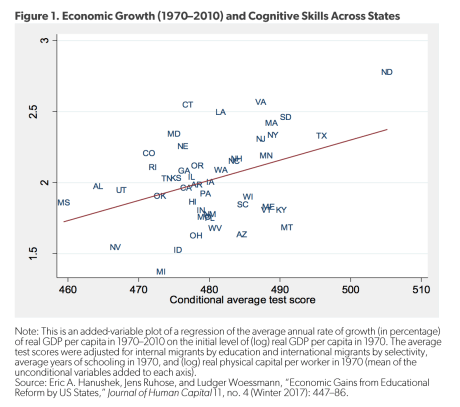
The core assumption of the piece is illustrated in a scatterplot of test scores and state economic growth (Figure 1, reproduced below). This includes an “estimated impact” of education on a state’s wealth. Little or no consideration is given to more important variables that might be the causes of the limited correlation.


Screen Shot 2018-06-04 at 9.04.13 PM


Statistical Exaggerations – Although a best fit line (regression) is super-imposed on the scatterplot, the pattern is more suggestive of a shot-gun blast than an illustration of a strong relationship. Going back to the original study, we find that test scores explain a mere 23% of the variance in economic growth – and this may be largely due to the aforementioned “third variables.” This weak relationship is far from being as strong as touted. Furthermore, achievement test scores are collapsed into “state aggregate scores.” When scores are collapsed in this manner, the effect is to exaggerate a correlation.


Mystery Methods – Beyond one short note below the study’s Figure 1, the AEI paper does not share how these numbers were derived. How these were calculated for each state goes unexplained. Improving teaching and teacher leaders is put forth as the leading reform, but this also is not defended or explained. Neither socio-economic factors nor adequate funding are addressed, although a vast and relevant literature points to their importance. Yet, improvements are claimed to be “enormous” and states should be “willing to make substantial changes.” But how these strong but unknown recommendations are derived is not explained. However, the long paper does present a rich trove of irrelevant statistical exotica.


Workforce Extrapolations – The brief misses the mark with its implicit assumption that the work force and economic needs will remain static and can be easily extrapolated. In an age of emerging artificial intelligence and with virtually every job being transformed in the next half-century, it seems a long reach to assume that the form, function and role of education (and the economic drivers) will remain unchanged.

[1]  Hanushek, Eric A. (May 2018). Every State’s Economic Future Lies with School Reform. Washington, DC: American Enterprise Institute. Retrieved May 29, 2018 from https://www.aei.org/wp-content/uploads/2018/05/Every-States-Economic-Future-Lies-with-School-Reform.pdf? FRPc013V1FcL1JnZHg4V0Vsd253Z0kzUWsxVjc3dGhUSGVzRURhWUZORyttNDlQdWR2aVgifQ%3D%3D

[1] Eric A. Hanushek, Ruhose, J. & Woessmann, L. (Winter 2017) “Economic Gains from Educational Reform by US States,” Journal of Human Capital 11, no. 4 (447-86). Retrieved June 1, 2018 from http://hanushek.stanford.edu/sites/default/files/publications/Hanushek%2BRuhose%2BWoessmann%202017%20JHC%2011%284%29_0.pdf

[1] Sala-I-Marten, X., et al. (2014). The Global Competitiveness Index. Retrieved May 29, 2018 from http://www3.weforum.org/docs/GCR2014-15/GCR_Chapter1.1_2014-15.pdf

[1] Rothstein, R. (2016). In Mathis and Trujillo, Learning from the Federal Market Based Reforms. Charlotte, N.C. : Information Age Publishing. p. 432.

[1] Hanushek, E (Summer 2011), “Valuing Teachers; How much is a good teacher worth?” Education Next, 11(3). Retrieved May 29, 2018 from http://hanushek.stanford.edu/publications/valuing-teachers-how-much-good-teacher-worth