Leonie Haimson points out that, despite much boasting, New York City and New York State have made no gains on NAEP from 2013-2017.
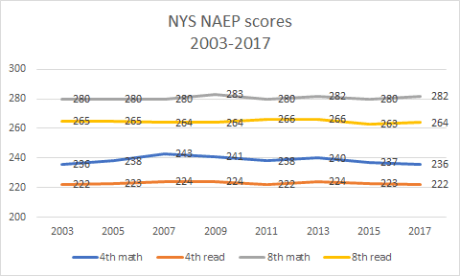
What she did not include is a graph showing that New York State’s NAEP scores have been flat from 2003-2017.
Leonie Haimson points out that, despite much boasting, New York City and New York State have made no gains on NAEP from 2013-2017.
What she did not include is a graph showing that New York State’s NAEP scores have been flat from 2003-2017.


 Diane Ravitch's blog
NY funds public schools better than Ohio does so maybe this doesn’t apply to NY, but I was surprised scores in Ohio didn’t drop.
Public schools in my state have a government that is utterly captured by ed reform lobbyists, they have gutted funding, and our schools have suffered thru two consecutive anti-public school Presidents at the federal level- Obama and then Trump.
They adopted Common Core and then they pretended to drop Common Core- what they never did was invest anything in Common Core. The MOMENT the more difficult tests when in they dropped all mention of Common Core. The promised “support”? Never materialized.
It’s been utter chaos for public schools. They are jerked around by every crackpot idea and fad that comes out of the ed reform lobby. I think we’re on the 4th testing scheme in as many years. They’re revamped graduation requirements twice in the last 4 years. If you’re an Ohio high school freshman my advice is to not make any plans- all they need are two ed reform lobbyists in the statehouse and they will happily upend requirements again.
I’m amazed they held the line on scores, with this entire elite army working against them. Bravo. Good job, public school teachers. Despite the hostile environment and chaos you still somehow managed to get your work done.
Imagine what they could accomplish if anyone in power actually worked to help them and support them.
LikeLike
Chiara–I’m assuming this is because is not as ‘content literal’ as some so you she the long term stability of learning over time, rather than so called teaching to the tests…it’s been a long time since I looked at the questions so I could be wrong…but another insight is that this is across the population sampling which tend to smooth out individual school/classroom variations. So NGSS, Common Core, etc. can get smoothed out.
LikeLike
Common Core is just another small bump on the road. The curricula in World History and Math did not change much in two decades. The reform math of 1990s has won, and the kids are “taught” (yes, in quotes) project-based nonsense with little algebra left. The decline of secondary education is at least four decades in the making.
LikeLike
Gruff,
Since you don’t identify yourself, your sweeping conclusions about the curriculum in every American school—without any source or evidence—can be marked “nonsense.”
LikeLike
Diane, there are other guests of your blog who use pen names. Seeing what Facebook scandal has turned into, you can see a reason to withhold as much personal info as possible.
Information about curricula and textbooks used is easy to find, one does not need to work at school district office. Regarding math, you can google up “Math Wars” and proceed from there. In my case, we use a math program that was designed in accordance to NCTM ideas of the late 1980s early 1990s. These ideas were fought against, and California even implemented a decent math standards in 1997 only to succumb to Common Core diluted program. So, the 1990s math program was re-dressed as “aligned with Common Core” and dumped onto unsuspecting students. The districts accepted this program because it is branded as Common Core-compatible, and they needed Common Core-compatible programs according to the State Board. This is how the industry wins step by step, if not by a direct assault, but by attacking from a flank.
LikeLike
Gruff,
In case you hadnt noticed, this blog supports public schools because they serve the Common good. If you want to make sweeping denunciations of all public schools and all teachers, bring your evidence. Without evidence, your negativism and hostility are unwelcome.
LikeLike
Ohio ed reformers could have “achieved” the same result they got with the hugely expensive and disruptive Common Core if they had simply taken the old state tests and bumped “proficient” up 20 points.
All they had to was re-label the score bands, because in fact that is ALL they changed.
All that hoopla over putting in a more difficult test. All those earnest teachers taking them seriously and diligently learning the Common Core, and at the end of the day ed reform political leaders simply put in the more difficult test and walked away. Common Core in reality is a test- it’s nothing more than that.
On to the next fad! Which is blended learning. Which they;re also over-selling and which will also mean needless expense and waste and chaos for the public school students who are the experimental population for the ed tech industry.
Ed reform should take two years off and see if the scores go up. Just kick back for 2 years and look at the test scores. In my state I suspect scores would go up, simply because there would be some consistency and predictability at the school level.
LikeLike
Why would anyone give any credence to the falsehoods and complete invalidities that are NAEP test scores?
LikeLike
Duane…..pretty tough being the voice of sanity these days, isn’t it. Thanks for your post.
LikeLike
Thanks for the kind words, Joe.
There are many who consider me the voice of insanity, and that’s okay, I’ll take em on anytime. But what I find is that not one of those who disagree with my analysis (or Wilson’s) ever challenge that analysis. Not a single one, ever. So who is the insane one, eh??
LikeLike
Duane
Mathturbation is one of those things people do because it makes them feel good.
It serves no useful purpose and there is therefore no “sane” reason for it.
LikeLiked by 1 person
The funny thing about NAEP results is that the scores for high school seniors have been “flat” since day one.
So whatever the schools have done since the 70’s, it has had no effect — at least according to that test.
LikeLike
Those scores are flat because that is exactly how the test results are designed-to follow a “normal” curve statistically speaking. For to do otherwise would be to admit that the foundations on which those tests are built are weaker than sand castles on the beach at low tide.
LikeLike
Well, even a normal curve could shift over time so that it was centered on either a higher or lower mean score, but the fact that it has not (the mean score has remained the same) means that whatever the test has been “testing for” has remained essentially fixed for 4 decades.
It’s strange that people rarely mention the mean scores for 17 year olds. Or maybe not strange at all. Flat scores over 40 years are not a particularly ringing endorsement of anything.
LikeLike
“Flat scores over 40 years are not a particularly ringing endorsement of anything.” Yep, but what is really happening is what Wilson calls “psychometric fudging” is what is going on. He should know as he was in the belly of the testing beast in Australia as the head administrator of testing for one of the states, New South Wales, I believe.
So, no, it doesn’t necessarily mean that what the test is testing has remained fixed, it means that those determining how it is scored have been consistent in keeping the scores as similar/same as possible through various psychometric “fudges”.
As per usual I recommend that all read Wilson’s work to understand those “fudgings” (which the testing industry does its best to hide): “Educational Standards and the Problem of Error” found at: http://epaa.asu.edu/ojs/article/view/577/700
LikeLike
“Those scores are flat because that is exactly how the test results are designed-to follow a “normal” curve statistically speaking.” — “Grading on the curve” is normalizing the scores and then slicing it into A, B, C, D, and F ranges. The raw scores themselves are absolute, the grades are “curved”. I believe that NAEP uses raw scores.
LikeLike
Since you don’t know how NAEP scores are derived, don’t speculate.
LikeLike
Not sure, Gruff, what point you are trying to make. Can you please clarify?
The raw scores are absolute only in a mathematical sense, certainly not absolute in any other onto-epistemological sense.
LikeLike
Test scores make reformsters sad. Maybe if there were much less testing, reformsters could be happy again. Cheer up, reformsters, OptOut parents will rescue you!
LikeLike
Wow! I call this a success, and why a fuller appreciation for NAEP is needed. It should be flat, must be, because this is the point of this version of a content standard. Of course I would like education standards to be more like building codes, setting minimum and allowing for greater creativity. And if you look at the band of students who meet basic, you are getting close to 100%…but in truth the cut score idea is bogus. But is shows something we need to highlight…in most schools students are successful unless you look at ideas like relevance, engagement, persistence, then you see a serious gap. One of largely unmeasured issues, kids bifurcate between what they see as the values of schooling vs the social cultural learning they value. It should be the goal for teachers to engagement, enrichment, make learning, and the life long learning we need to solve problems, is the outcome. We can measure this…in HE level you have the NESE. Oh well, let’s keep making the test companies richer, hope you bought stock!
LikeLike
“. . . why a fuller appreciation for NAEP is needed.”
Please RCollay, in light of the total and complete invalidity of the usage of the results of the NAEP test (as shown by Wilson and myself) please explain WHY a “fuller appreciation” is needed. Thanks in advance!
“Of course I would like education standards to be more like building codes, setting minimum and allowing for greater creativity.”
Unfortunately, education standards are bogus from start to finish. To understand why read and understand Wilson’s “Educational Standards and the Problem of Error” found at:
http://epaa.asu.edu/ojs/article/view/577/700 and/or Ch. 6 “Of Standards and Measurement” of my book “Infidelity to Truth: Education Malpractice in American Public Education”.
“One of largely unmeasured issues. . .[and] We can measure this. . .”
Hmmm, no we can’t “measure this”. We can assess, evaluate and judge these things but we can’t measure them. Not all human characteristics, feelings, activities can be measured, as a matter of fact, those “measurements” are an impossibility. I’ve posted this before, please, RCollay respond, rebut or refute what I have to say:
The most misleading concept/term in education is “measuring student achievement” or “measuring student learning”. The concept has been misleading educators into deluding themselves that the teaching and learning process can be analyzed/assessed using “scientific” methods which are actually pseudo-scientific at best and at worst a complete bastardization of rationo-logical thinking and language usage.
There never has been and never will be any “measuring” of the teaching and learning process and what each individual student learns in their schooling. There is and always has been assessing, evaluating, judging of what students learn but never a true “measuring” of it.
But, but, but, you’re trying to tell me that the supposedly august and venerable APA, AERA and/or the NCME have been wrong for more than the last 50 years, disseminating falsehoods and chimeras??
Who are you to question the authorities in testing???
Yes, they have been wrong and I (and many others, Wilson, Hoffman etc. . . ) question those authorities and challenge them (or any of you other advocates of the malpractices that are standards and testing) to answer to the following onto-epistemological analysis:
The TESTS MEASURE NOTHING, quite literally when you realize what is actually happening with them. Richard Phelps, a staunch standardized test proponent (he has written at least two books defending the standardized testing malpractices) in the introduction to “Correcting Fallacies About Educational and Psychological Testing” unwittingly lets the cat out of the bag with this statement:
“Physical tests, such as those conducted by engineers, can be standardized, of course [why of course of course], but in this volume , we focus on the measurement of latent (i.e., nonobservable) mental, and not physical, traits.” [my addition]
Notice how he is trying to assert by proximity that educational standardized testing and the testing done by engineers are basically the same, in other words a “truly scientific endeavor”. The same by proximity is not a good rhetorical/debating technique.
Since there is no agreement on a standard unit of learning, there is no exemplar of that standard unit and there is no measuring device calibrated against said non-existent standard unit, how is it possible to “measure the nonobservable”?
THE TESTS MEASURE NOTHING for how is it possible to “measure” the nonobservable with a non-existing measuring device that is not calibrated against a non-existing standard unit of learning?????
PURE LOGICAL INSANITY!
The basic fallacy of this is the confusing and conflating metrological (metrology is the scientific study of measurement) measuring and measuring that connotes assessing, evaluating and judging. The two meanings are not the same and confusing and conflating them is a very easy way to make it appear that standards and standardized testing are “scientific endeavors”-objective and not subjective like assessing, evaluating and judging.
That supposedly objective results are used to justify discrimination against many students for their life circumstances and inherent intellectual traits.
LikeLike
I can’t help but ask if this judgement isn’t a bit hopeful considering the loss of educational content. I wonder how much less our students know about humanities i.e. Social studies, geography, philosophy, ethics, languages, art and music along with aesthetics, logic and basic science including: biology, botany, chemistry, and physics. Bending to the test and punish mode has cost our elementary students the introduction needed for success in these upper level subjects. Some secondary schools have limited the availability of some of these subjects. Apparently teaching coding passes for science and logic these days.
LikeLike
Ding!
https://www.theatlantic.com/education/archive/2018/04/-american-students-reading/557915/
LikeLike
Nice to note that I am not crazy. Thanks for that.
LikeLike
Interesting article, but still in the “NAEP is a valid education practice” mode”. The end of the article:
“Louisiana has not only created its own curriculum but has also asked the federal government for permission to give tests based on that curriculum rather than passages on a variety of randomly selected topics. If that movement spreads, the National Assessment of Educational Progress may finally live up to its name and the American education system may at last be able to unlock the untold potential of millions of students.”
Tests based on curriculum? Heaven forbid, eh!
But nothing at all is said in the article about the discrepancies in resources available for poor vs rich districts. Yes, it speaks of the home influence differences that different SES status families experience. But without adequate resources especially for those children that need it the most, our public schools will continue to not properly serve those most in need.
LikeLike
Don’t worry Firstgrademonkey, you’ve got a long way to go to displace me as the resident crazy (at least in the mind of quite a few here). 🙂
LikeLike
Key question: “is our children learning”?
LikeLike
Exactly. The retrograde, puerile CCSS in ELA are a sloppily prepared list of abstract skills, almost entirely content free.
LikeLike
With poverty and inequality on the rise it is painfully naive to expect educational gains.
LikeLike
Exactly
LikeLike
A Letter to the Editor I submitted into the Washington Post, published this morning (Sunday) on Common Core math and NAEP scores in the District of Columbia Public Schools:
To the Editor:
The April 10 Metro article “NAEP scores hold steady” reported “the District’s black and low-income children showed greater gains in their test scores than their white and wealthier peers.” Let’s check.
Because of gentrification and changes in school-lunch policies, the best measure of achievement gaps in D.C. Public Schools is parental education. Between 2009 and 2017 in eighth-grade math, DCPS students with one or more college-educated parents saw scores rise 20 points. If the most-educated parent held a high school diploma but no college, scores rose 1 point. D.C.’s “Common Core” math standards skimp on fundamentals, favoring children whose parental resources can fill in gaps. In public schools, should parental education be destiny?
— Rick Nelson, Falls Church
One problem of many in the Common Core math standards — that in DC and most states determine the math curriculum — is that the standards never ask students to commit to memory their subtraction and division facts. Cognitive science says that due to limits in the “working memory” (where the brain solves problems) when handling non-memorized information, students are unable to calculate simple arithmetic if ALL fundamentals have not been committed to memory.
The result of standards that in the brains of children do not work? Growing achievement gaps. Wider inequality. And it wasn’t teachers who designed or adopted these untested standards that cognitive scientists say cannot work.
It’s time to ask teachers and cognitive experts for their views on the Common Core standards.
LikeLike
As a retired public school teacher, I say see my comments above for my views. I’ve explained more in my book “Infidelity to Truth: Education Malpractice in American Public Education”.
LikeLike