John Kuhn was the superintendent of the small Perrin-Whitt school district in Texas and was recently named superintendent of schools in Mineral Wells, Texas. He is also one of the best informed, most eloquent critics of corporate reform in the nation. He was a lead speaker at the 2011 Save Our Schools March on Washington, where he electrified the crowd. He has recently published two books: Fear and Learning in America and Test and Punish: How the Texas Education Model Gave America Accountability Without Equity. Kuhn says that the Texas A-F school grading system sets up schools that enroll poor kids to fail; A stands for “Affluent.”
Kuhn writes:
Texas Education Agency Releases A-F Grades for School Districts the Same Day It Dismisses Its Own A-F Grade on the National “Quality Counts” Report Card
On January 5, the Austin American-Statesman published the Texas Education Agency’s A-F grades for Texas school districts and campuses. The law establishing this system called for official A-F grades to come out in 2018, so these are “what if” grades, intended to provide to legislators a preview of what the “real” grading system will look like when grades come out officially. In a statement, TEA commissioner Mike Morath cautioned that no “inferences about official district or campus performance in the 2015– 16 school year should be drawn from these ratings.” That didn’t keep public school critics from immediately proclaiming that the A-F grades “transparently and comprehensively represent the performance of districts and campuses statewide.” No surprise there; A-F is seen by many as a tool designed specifically to give anti-public education forces ammunition to aim at the public school system.
In releasing the “work-in-progress” A-F grades to the public (as they were obligated to do), TEA officials ensured that these unofficial scores will become the de facto rating system for Texas schools for the remainder of the year, even though an actual rating system is already in place. This is despite commissioner Morath stating clearly and repeatedly that the grade report “is very much a work-in progress,” that the bases and assumptions behind the grades may change, and that the TEA didn’t take into account local community ratings of districts (statute requires that this local stakeholder input be included as 10% of schools’ final A-F grades). We now have a confusing situation in which the TEA homepage notes in a headline article that 94% of Texas school districts “Met Standard” while public school critics giddily point to another article on the same homepage announcing the release of A-F grades that often label formerly successful schools as sudden failures. In fact, several high-performing schools around the state received D’s and F’s. The Dallas Morning News listed 11 local school districts that received F’s but that were only recently considered as having “Met Standard.” “That’s amazing
when you consider that they all met the standard two weeks ago and the scores, the data, haven’t changed,” Mesquite Superintendent David Vroonland said.
School district officials have called the new A-F system “a big mistake,” “NOT an accurate reflection of quality education,” and “an unfair game,” and have noted that a similar A-F system was rescinded in Virginia after failing spectacularly, and that, since an A-F rollout in Oklahoma, student performance has declined significantly–despite the fact that A-F systems are sold to legislators as a means to improve student performance by holding districts accountable. It is difficult not to conclude that this system is for the most part arbitrary and capricious. In one respect it is very reliable, as it actually very consistently punishes those Texas schools that serve the most economically- and socially-challenged families and students. District A-F grades appear to align exceptionally closely with the percentage of economically-disadvantaged students on school district rosters, a factor that is obviously outside the ability of schools to affect.
As a means of assessing the impact of non-school factors on districts’ A-F grades, I sorted every school district in the state by the percentage of their student bodies made up of economically disadvantaged students, and then I listed their A-F grades out to the side. I took the ten districts with the lowest percentage of economically disadvantaged students that received grades in all four categories and compared them to the ten districts with the highest percentage of economically disadvantaged students. Here are the results:
The 10 Schools Serving the Lowest Proportions of Poor Kids in Texas
A – 20
B – 7
C – 9
D – 2
F – 2
Overall average – B
On the other hand:
The 10 Schools Serving the Greatest Proportions of Poor Kids in Texas:
A – 6
B – 8
C – 11
D – 6
F – 9
Overall average – D+
As you can see, there is a strong and verifiable correlation between districts’ A-F grades and the prevalence of poverty among their students. Meanwhile, there is no verifiable correlation between districts’ A-F grades and the quality of their teachers, which is supposed to be the purpose behind A-F grades even existing. They are supposed communicate to the public which schools are better, not which schools are poorer. We don’t need a measure that communicates which schools have the greatest concentrations of poor kids—we already have that measure (the economically disadvantaged numbers). The A-F system exists to differentiate good schools from bad, not poor schools from rich, and it can’t do it! Major fail.
That latter assertion—that A-F can tell us which schools are better and which schools are worse—was never really anything more than a blind assumption built on ideology and political posturing, rather than on science. This A-F system, despite what the anti-public education lobby will say, is not in the least transparent, not in the least fair, not in the least accurate, and does not serve the need of Texas parents and taxpayers to be informed about the quality of teachers and schools. In fact, if anything, it misinforms them. It amounts to fake news. These are fake grades, non-representative of what they purport to reflect. If your passing school in Texas is suddenly failing today, it’s probably because it educates the wrong kinds of kids: poor ones. The A-F system is carefully-crafted disinformation likely to adversely effect on public support for public education.
If I had time, I would do a similar bit of sorting of districts by residential home values, ratios of students served in special education, ratios of students with limited English, ratios of at-risk students, average teacher salary levels, and school finance revenue levels (because, in case you don’t know, Texas schools are funded at wildly different levels). I predict that each of those exercises would result in a strong correlation with these A-F grades (that, again, purportedly reflect teaching quality and supposedly do NOT merely reflect non-school factors outside the control of the educators being smeared by these grades). I challenge any statisticians worth their salt to examine this system in an independent review and let Texas education stakeholders know what these grades really show.
Commissioner Morath had to release these grades by law, so I don’t blame him for releasing it. However, he badly let down local teachers and administrators by over-promising transparency in the lead-up to A-F and under-delivering with its rollout. In a meeting of school leaders from the Dallas-Fort Worth area in December, Mr. Morath confidently assured school leaders that, out of a sense of fairness, since schools in Texas are funded so inequitably, he would ensure that anywhere the TEA published A-F ratings for schools, the Agency would also publish information related to each school’s relative funding level—so that users of the information would have the full picture, as it is unfair to expect schools with fewer resources to outperform schools that are funded more generously. Having promised that, however, Mr. Morath somehow failed to ensure that the information published by the Austin newspaper included the funding-levels context. As of this writing, I haven’t seen the promised relative funding levels information published anywhere by TEA. As many of us feared, the assurance that appropriate context would be included alongside the published results of the A-F accountability system appears to have been little more than a bait-and-switch. As with every school accountability system in the history of the state of Texas, this system purports to communicate to Texas parents that it represents a fair ranking of schools that are competing on an even playing field. In reality once again, by funding some schools at double and triple the level of others and keeping hush-hush about which schools are flush and which are kept on a shoestring budget, Texas is picking winners and losers and concealing the fact in school accountability system after school accountability system. This A-F system, like all the others, occludes more than it reveals.
In the end, A-F appears to exist primarily as a political tool, designed not to inform but to misinform parents and taxpayers across Texas. The A-F rating system has not been independently assessed for validity. No third party has done an in-depth analysis to establish whether A-F grades for schools tend to significantly correlate with factors outside of schools’ control, such as poverty levels of students, discrepant funding levels, and the like. Until it is established that the system accurately reflects educational quality more than it reflects social realities that schools operate within and cannot control, the system should be considered incapable of serving its stated purpose. No educational quality conclusions should be drawn absent this independent validation.
One last sidebar:
Ironically, on the same day that the TEA released grades for local campuses, it received its own A-F grade from Education Week’s “Quality Counts” report on the education systems in all 50 states and the District of Columbia. The Texas Education Agency received an overall grade of C- on the national report and wasn’t happy. TEA immediately dismissed the validity of the report, stating that it is “difficult to effectively evaluate the state’s performance from a national report where no state made the highest grade, no state made the lowest grade, and the majority of states were all lumped into the same grade category.”
On the chart below (from www.edweek.org/media/qualitycounts2016_release.pdf), you will see that on the “Quality Counts” ranking, Texas ranked 45th in the nation in school finance. In other words, Texas schools are low-funded compared to other states. However, on the achievement of students, Texas was ranked 24th. To this educator, that means Texas teachers are picking up the slack that lawmakers are leaving. Additionally, on a third measure called “Chance of Success”—which includes circumstances faced by students including family income, parent education, parent employment, steady employment, etc.—Texas ranked 42nd. So, despite long odds and little meaningful help from policymakers, Texas teachers are doing an outstanding job overcoming obstacles placed in front of them and helping our students to learn.
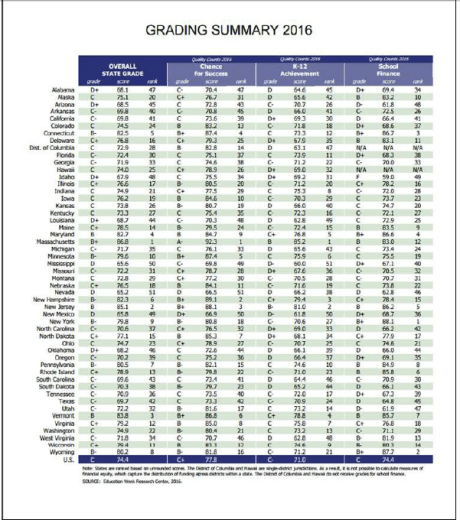
Despite the systemic obstacles like inadequate school funding and insufficient outside-of-school supports available to Texas children, the TEA nonetheless released this grading report labeling 30% or so of Texas schools—as demanded by the bell curve they built the system on—as “D” and “F” schools. Perhaps most incredible of all is the fact that these grades are based almost exclusively on STAAR standardized test results, an exam fraught with problems, about which the Texas Lieutenant Governor Dan Patrick once said “we don’t trust this test.”
Despite misgivings about the quality and ability of the test to reflect student learning, and despite the TEA’s own tepid reaction to its A-F grade from Education Week, and despite the prior existence of a school accountability system proclaiming 94% of Texas schools to be satisfactory performers, and despite the fact that the A-F system reflects poverty better than it reflects teaching quality, ultimately, when it comes to A-F grades, the Texas Education Agency apparently believes it is better to give than to receive.
Note: Spreadsheets with the Texas data can be found here and here.

 Diane Ravitch's blog
Reblogged this on David R. Taylor-Thoughts on Education and commented:
I also took a look at the data and reached similar conclusions.
https://davidrtayloreducation.wordpress.com/2017/01/11/a-closer-look-at-the-new-a-f-grades-for-texas-schools/
LikeLike
Numbers. Letters. Grades. Stack ranking. How to judge, how to judge…
Compare this thoughtful and incisive look at rheephorm in Texas with the president-elect’s press conference yesterday.
Which of the two is more qualified to lead any organization of any size?
“It is not the answer that enlightens, but the question.” [Ionesco]
😎
LikeLike
Maybe we shouldn’t grade them at all. For thousands of years, the standard by which people were judged by was:
Can they be a productive member of society?
We seem to have lost track of that some along the line.
LikeLiked by 1 person
YES. Maybe we shouldn’t grade them at all: giving schools a letter grade is, to mind, a blatantly elitist act.
LikeLike
Letter grades for schools was Jeb’s ideas.
Speeds up privatization.
LikeLiked by 1 person
Gotta disagree with your statement, drext727.
The concept of “judging people” against a “standard” is a fairly recent invention. The meme of being a “productive member of society” is at best a Calvinistic interpretation of what it means to be human.
May I suggest (if you haven’t already read it) reading M. Foucault’s brilliant historical analysis of how the concept of normality and the flip side, abnormality has been viewed, at least from a Western European point of view/focus “Madness and Civilization”.
My challenge to you is to cite evidence that in the last few thousand years that people were judged in the fashion you describe.
LikeLike
Duane,
it is true that productive member of society is a very simplistic standard. It is also an expression of my frustration with the excessive judging of everything education. Superintendents, Principals, and teachers are always being judged and characterized as the problem with all public schools.
Everyone is working as hard and smart as they are capable and yet every time a governmental body goes into session there are more mandates cast upon them. Their hands are tied behind their backs a little tighter and more movement is restricted.
As an example: In 2006 in Texas, they began a data monitoring process referred to as Performance-Based Monitoring Analysis System began. The state made up and arbitrary number that said only 8.5% of students in a district could be classified as Special Education. Districts then went to great lengths to stay under that “made-up” number so that they did not have to write corrective action plans.
As part of the PBMAS report is on discipline. If the district has too many students out of placement in In-School-Suspension, suspended from school or sent to a Discipline Alternative Education Program then once again the district will have to write a corrective action plan. This has created a philosophy in which most campuses are afraid to do anything with discipline. My wife is currently at an intermediate campus in which they do not have any discipline. If she calls a parent 20 times, writes a discipline referral, and sends them to the office then they are back in her class in 20 minutes with “counseling” as the consequence. All because no one wants to write a corrective action plan for the state.
One more example. during the 2013 Texas Legislative Session, a law was passed that prohibited Law Enforcement Officers from writing citations for certain offenses during school.
“Offenses like using profanity and fighting have led some Texas public school students to the courtroom. Under a new law, school police officers will not be allowed to charge students for such offenses.”
https://www.texastribune.org/2013/08/29/class-disruption-cases-head-principals-office-not-/
LikeLike
drext727: but if we “didn’t grade them at all” how could we pick the few winners and the BIGLY YUUUUUGE number of losers?
Hmmmm….
W. Edwards Deming (renowned stats & numbers guy) had something to say about this.
[startexcerpt]
Let’s talk about education for a minute. There is deep concern in the United States today about education. No notable improvement will come until our schools abolish grades (A, B, C, D) in schools from toddlers, on up through the university. Grades are often a forced ranking. Only 20 percent permitted to get As, thirty percent may get Bs, 30 percent may get Cs, 20 percent may get Ds. Forced ranking. You mean there’s a shortage of good pupils? I don’t think so. Why should there be a shortage? I don’t believe there is a shortage. Only 20? That’s nonsense. Maybe there aren’t any; maybe everybody should get As. Forced ranking is wrong, I believe.
Abolish merit ratings for teachers. Who knows what a great teacher is? Not till years have gone by. Abolish comparison of schools on the basis of scores. The aim is to get a high score, not to learn but to cram your head full of information. Abolish gold stars for athletics. Indeed, we’re worse off than we thought we were.
[endexcerpt]
THE ESSENTIAL DEMING: LEADERSHIP PRINCIPLES FROM THE FATHER OF QUALITY, Joyce Orsini, ed., 2013, p 199.
And on page 200, same piece:
[startexcerpt]
A grade is only somebody’s assessment of a pupil’s achievement on some arbitrary scale. Does the scale make any sense? Will high achievement on this scale predict future performance of the pupil in business, government, education, or as a teacher? Some other scale might be a better predictor. Some other pupil, low on the prescribed scale today, might perform better than the one that made a high grade on it today.
A grade given to a student is nevertheless used as prediction that he will in the future do well, or do badly. A grade is a permanent label. It opens doors, it closes doors. How may a teacher know how someone will do in the future? If a student seems to lag behind other members of the class, it may be the fault of the teaching. Or maybe the pupil is acquiring knowledge and not information. Does not show up so well compared with the others. Grading in school is an attempt to achieve quality by inspection. Very interesting. Quality by inspection is not the way to get quality.
[endexcerpt]
A golden oldie—this bit is from 1992!
😎
LikeLike
Considering the level of financial support Texas provides for public schools, the schools are performing better than expected. Overall, the system is another example of accountability without equity. The same can be said about the Great Schools website whose rankings favor charters and affluent school districts. There are many other factors not mentioned that make a school effective, not only scores on standardized tests, and these type of rating and ranking systems can be misleading.
LikeLike
While Kuhn’s analysis is spot on it is just a symptom of the mental masturbation that is attempting to “grade” schools, and more importantly, “grading” students. When starting with a false onto-epistemological premise-that one can “grade” with a simple letter the very complex institution of public education (school/district grade cards) or of the very complex nature of the teaching and learning process (grading students) then one can only end up with false, error filled results and conclusions.
So much of this post set off my bullshit alarm that it is hard to respond to all of the nonsense stated in it.
First, why would the authorities leave out the “local component” of evaluation? Could it be because most see their local community public school in a very positive light and that fact would cause the “grades” to go upward? But again, that is still just part of the mental masturbation that these malpractices entail.
or
“The Dallas Morning News listed 11 local school districts that received F’s but that were only recently considered as having “Met Standard.” “That’s amazing when you consider that they all met the standard two weeks ago and the scores, the data, haven’t changed,” Mesquite Superintendent David Vroonland said.””
Very fine adminimal speak of defending, more likely than not his own ass and district. But then again I don’t expect adminimals to challenge anything even when they admit that the processes they implement are actually malpractices and harmful to students. Now, the bullshit analysis is getting too close to the adminimal’s ass and an adminimal only knows how to politely cover it instead of ferociously attacking the insanities. Adminimal speak at its finest in Vroonland’s statement. Effin sick is what it is.
Error, falsehoods and pure bullshit dominate the educational landscape these days, more so than ever. And the proponents, the teachers and adminimals refuse to stand up and defy the insanity.
I pity the students!
LikeLike
“Teachers are certified, and, in my opinion at least, state officials are just certifiable.”
A great one-liner, certainly applies to Ohio, and also to the ratings published as “Quality Counts” in EdWeek.
LikeLike
All about the vouchers, tge push to take money from the already underfunded public schools.
LikeLike
It’s important to note that the TEA implements legislation passed by those elected to guide the direction our state takes.
The responsibility for this rating system rests with Texas voters.
If you do not like Texas’s laws, get involved appropriately in the political process.
I encourage those against the legislation resulting in the A-F rating system to unite and promote their wishes in ways that make a real difference.
LikeLike
I have a hard time believing that this is what parents and taxpayers are asking for. Why do you suppose politicians make the claim that the public is begging for A-F? Like the communists, the plan is to dismantle public education without firing a bullet.
LikeLike
Insightful article. An A-F rating tells nothing helpful in rating schools. Oversimplification on a very complicated topic! As a retired teacher who now subs in my old district, I have never seen so many teachers discouraged,downhearted,and questioning the wisdom of having chosen education as a profession. Our profession used to be respected,but now is being demonized on a regular basis. How can that be good for anyone?
LikeLike