Archives for category: Common Core

Lyndsey Layton of the Washington Post interviewed Bill Gates in 2014 and told the full story of the origin of the Common Core “State” Standards.

In case the Washington Post is behind a paywall, the full text of the Layton article is here.

Secretary of Education Arne Duncan and other friends of the CCSS insisted that the standards were developed by governors, state superintendents, education experts, and teachers. No, they were developed by David Coleman, formerly of McKinsey, now CEO of the College Board, and a committee whose members included no working teachers but a full complement of testing experts from ACT and SAT. Google David Coleman and “architect” and you will see that he is widely credited with shepherding the CCSS to completion.

It would not have happened without the enthusiastic support and funding of Bill Gates.

Layton writes:

On a summer day in 2008, Gene Wilhoit, director of a national group of state school chiefs, and David Coleman, an emerging evangelist for the standards movement, spent hours in Bill Gates’s sleek headquarters near Seattle, trying to persuade him and his wife, Melinda, to turn their idea into reality.

Coleman and Wilhoit told the Gateses that academic standards varied so wildly between states that high school diplomas had lost all meaning, that as many as 40 percent of college freshmen needed remedial classes and that U.S. students were falling behind their foreign competitors.

The pair also argued that a fragmented education system stifled innovation because textbook publishers and software developers were catering to a large number of small markets instead of exploring breakthrough products. That seemed to resonate with the man who led the creation of the world’s dominant computer operating system.

“Can you do this?” Wilhoit recalled being asked. “Is there any proof that states are serious about this, because they haven’t been in the past?”

Wilhoit responded that he and Coleman could make no guarantees but that “we were going to give it the best shot we could.”

After the meeting, weeks passed with no word. Then Wilhoit got a call: Gates was in.

What followed was one of the swiftest and most remarkable shifts in education policy in U.S. history.

The Bill and Melinda Gates Foundation didn’t just bankroll the development of what became known as the Common Core State Standards. With more than $200 million, the foundation also built political support across the country, persuading state governments to make systemic and costly changes.

Bill Gates was de facto organizer, providing the money and structure for states to work together on common standards in a way that avoided the usual collision between states’ rights and national interests that had undercut every previous effort, dating from the Eisenhower administration.

The Gates Foundation spread money across the political spectrum, to entities including the big teachers unions, the American Federation of Teachers and the National Education Association, and business organizations such as the U.S. Chamber of Commerce — groups that have clashed in the past but became vocal backers of the standards.

Money flowed to policy groups on the right and left, funding research by scholars of varying political persuasions who promoted the idea of common standards. Liberals at the Center for American Progress and conservatives affiliated with the American Legislative Exchange Council who routinely disagree on nearly every issue accepted Gates money and found common ground on the Common Core.

One 2009 study, conducted by the conservative Thomas B. Fordham Institute with a $959,116 Gates grant, described the proposed standards as being “very, very strong” and “clearly superior” to many existing state standards.

Gates money went to state and local groups, as well, to help influence policymakers and civic leaders. And the idea found a major booster in President Obama, whose new administration was populated by former Gates Foundation staffers and associates. The administration designed a special contest using economic stimulus funds to reward states that accepted the standards.

The result was astounding: Within just two years of the 2008 Seattle meeting, 45 states and the District of Columbia had fully adopted the Common Core State Standards.

Even Massachusetts, the state with the highest academic performance in the nation, replaced its excellent standards with CCSS and won a federal grant for doing so.

Some states adopted Common Core before it was publicly released. The state chief in Texas, Robert Scott, refused to adopt the CCSS sight unseen, but he was a rarity.

Without Gates’ money, there would be no Common Core.

Opposition came from Tea Party groups, then from independent teacher groups like the BadAss Teachers Association.

The promise of the Common Core was that it would lift student test scores across the board and at the same time, would close achievement gaps.

The Common Core was rolled out in 2010 and adopted widely in 2011 and 2012.

Districts and states spent billions of dollars on new textbooks, new tests, new software and hardware, new professional development, all aligned to the CCSS.

This was money that the districts and states did not spend to reduce class sizes or to raise teachers’ salaries.

Test scores on NAEP and on international tests have been stagnant since the rollout of the Common Core.

Teacher morale down. New entries into teaching down. Test scores flat. Achievement gaps larger.

Edu-entrepreneurs enriched. Testing industry happy. Tech industry satisfied.

Disruption achieved.

If you want to read more about the origins of the Common Core, read Mercedes Schneider’s Common Core Dilemma: Who Owns Our Schools? and Nicholas Tampio’s https://www.amazon.com/Common-Core-Nicholas-Tampio-ebook/dp/B079S2627M/ref=sr_1_fkmr0_1?keywords=nicholas+campion+common+core&qid=1575909356&s=books&sr=1-1-fkmr0Common Core: National Education Standards and the Threat to Our Democracy.

Bottom line: What the Gates’ billions spent on Common Core proved was that the basic problem in American education is not the lack of common standards and common tests, but the growing numbers of children who live in poverty,  who come to school (or miss school) ill-nourished and lacking regular medical care and a decent standard of living.

He spent more than $4 billion on failed experiments in education over the past 20 years. Wouldn’t it be great if he invested in children, families, and communities and improved their standard of living?


Jan Resseger is upset that the New York Times posted an article seeking to revive the moribund Common Core standards.

Some states dropped the CC standards; some kept them but gave them a new name. Most dropped the CC-aligned tests.

In her view, the CCSS died because it was hated by significant numbers of teachers and parents. It launched the Opt Out movement in New York State, which annually enlists the non-cooperation of nearly 20 percent of the state’s test-eligible students.

They were hated because it was not “developed by governors, educational experts, state superintendents, and teachers,” as the founding myth claims, but by a small number of people who wrote them with minimal consultation of classroom teachers.

They were hated because they were funded by one man–Bill Gates–and never validated by any field trial in real classrooms.

They were pushed on the states not by consent but by the lure of $5 billion in Race to the Top funding. The only state officials who had to agree were the governor and the state superintendent, and most of those have since moved on. The states that did not agree to accept the CCSS were not eligible to compete for RTTT billions

They fell into disfavor because activists on the right saw them as federal overreach and activists among teachers and parents in the center and on the left disliked the standards and hated the tests.

They lost support when the testing consortia that Arne Duncan funded with $360 million arbitrarily decided to align the CCSS test standards with those of the NAEP, which was totally inappropriate. The NAEP standard for “proficiency” is not grade-level, nor is it pass-fail. It represents a high level of achievement, like a B+ or an A-. Massachusetts is the only state in the nation where as much as 50% of students score NAEP proficient, yet the Common Core testing groups expected that most American students would reach that high mark. They did not, and the CCSS tests wrongly generated headlines that inaccurately labeled students, schools, and districts as “failing” when they did not reach an impossible benchmark.


Every blogger who has written about MSNBC’s Public Education Forum expressed gratitude that a big cable network paid attention to our most important democratic institution.

Nancy Bailey is angry about the issues that were ignored, the ones that threaten the future of students, teachers, and public education.

She is also streamed that the program was not on live TV. Public education not important enough for live TV? 50 million children are in public schools. They have parents. Quite an audience to overlook.

Good work, Nancy!

She writes (in part, read it all):

Candidates talked about making the wealthy pay their fair share of taxes to help schools, but no one mentioned Bill Gates, the Waltons, Eli Broad, Mark Zuckerberg or any of the corporate reformers who are taking control of public schools.

They didn’t mention Common Core or the failure of the initiatives funded by the Gates Foundation and taxpayers. Nor did they speak about portfolio schools, the latest corporate endeavor to push choice and charters.

No one mentioned using Social Impact Bonds or Pay for Success to profit off of public schools. See: “Wall Street’s new way of making money from public education — and why it’s a problem” by Valerie Strauss.

CEO Tom Steyer mentioned corporate influence towards the end, but it was brief, and no moderator attempted to explore what he said.

Ed-Tech

No one mentioned what might be the biggest threat to public education, the replacement of teachers and brick-and-mortar schools with technology.

Disruption was initially described by Clayton Christensen and Michael Horn in their book Disrupting Class: How Disruptive Innovation Will Change the Way the World Learns. This is seen as the revolution by those in business and the tech industry and is being played out in online charter schools like Summit and Rocketship. Summit also has an online virtual school.

Many students across the country get school vouchers to be used for substandard online instruction like K12 and Connections Academy.Preschoolers are subjected to unproven Waterford UPSTART.

The candidates might want to review Tultican’s “Ed Tech About Profits NOT Education.”

Wrench in the Gears is another blog good at describing the threat of technology.

Teach for America

Teach for America corps members with little training have taken over classrooms, and they run state departments of education!

Do Democratic candidates have Teach for America corps members as consultants on their campaigns? It’s troubling if they do. They should not be wooing teachers with professional degrees and experience while relying on TFA behind the scenes.

Other insidious reform groups are also about replacing education professionals. Relay Graduate School, The New Teacher Project, New Leaders are a few.

This needs to be addressed, sooner, not later.

Betsy DeVos et al.

I don’t know anyone who doesn’t enjoy hearing Democratic candidates say they’re going to boot Education Secretary Betsy DeVos out.

But President Obama had individuals from the Bill & Melinda Gates Foundation, and other corporate reform groups, working in the U.S. Department of Education. Arne Duncan was no friend to teachers or public schools.

So, while applause against DeVos are justifiable, now’s the time to address the role Democrats have played (and continue to play) in corporate school reform.

The fact is, many groups and individuals are working to end public education, who wear Democratic name tags. It’s imperative that Democratic candidates address this.


IT WON’T BE OFFICIALLY PUBLISHED UNTIL JANUARY 21, BUT YOU CAN PRE-ORDER YOUR COPY FROM YOUR BOOKSELLER OR AN ONLINE BOOK DEALER (PLEASE PATRONIZE INDEPENDENT BOOKSTORES, IF YOU STILL HAVE ONE NEAR YOU!).

I PROMISE YOU WON’T BE DISAPPOINTED!

IF YOU COME TO THE ANNUAL MEETING OF THE NETWORK FOR PUBLIC EDUCATION IN PHILADELPHIA MARCH 28-29, I WILL PERSONALLY INSCRIBE YOUR COPY OF THE BOOK!


EDUCATION

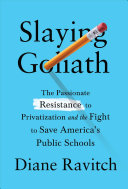
Slaying Goliath: The Passionate Resistance to Privatization and the Fight To Save America’s Public Schools

Knopf. Jan. 2020. 352p. ISBN 9780525655374. $27.95. ED
COPY ISBN

In this incisive, meticulously researched book, Ravitch (education, New York Univ.; The Death and Life of the Great American School) argues persuasively that the U.S. school privatization movement has resulted in poor test scores, the closure of public schools, and attacks on the teaching profession. Ravitch blames the so-called school reformers, whom she renames the disruptors, such as Bill Gates, Alice Walton, Michelle Rhee, Mark Zuckerberg, and Eli Broad, who spend millions to replace public schools with charter schools and private institutions that are run like businesses. Though disruptors view themselves as opposing the status quo, Ravitch contends that they are doing everything they can to maintain it. She devotes most of her book to the resisters, or the teachers, parents, and union leaders who have taken on the disruptors and are working to keep their local public schools open. Through this lens, Ravitch discusses the Common Core teaching standards, standardized testing, the Obama administration’s Race to the Top grant program, and Teach for America.

VERDICT This extensive analysis is required reading for anyone concerned about American education. [See Prepub Alert, 7/8/19.]

Nancy Bailey writes here about the idea–promoted by NCLB, Race to the Top, and Common Core– that kindergarten children should know how to read. She says this is wrong.

Young children should be encouraged to speak and listen, she writes, which is something they do while playing and interacting with other children.

She writes:

With No Child Left Behind, Race to the Top, and Common Core State Standards, some adults have been led to believe that four- and five-year-old children should read by the end of kindergarten. Preschoolers are pushed to be ready for formal reading instruction by the time they enter kindergarten.

This is a dangerous idea rooted in corporate school reform. Children who struggle to read might inaccurately believe they have a problem, or reading could become a chore they hate.

Pushing children to focus on reading means they miss listening and speaking skills, precursors to reading. These skills are developed through play, which leads to interest in words and a reason to want to read.

Some children might learn to read in kindergarten, and others might show up to kindergarten already reading, but many children are not ready to read when they are four or five years old. And just because a child knows how to read in kindergarten, doesn’t mean they won’t have other difficulties with speech and listening.

When children come to schools from poor home environments, much of what they’ve missed involves a variety of language skills like speech and learning how to listen. When children have disabilities, speaking and listening skills are critical.

Forcing children to focus on reading early denies children opportunities to work on those other missing skills.

Also, there’s no research, no evidence that a child’s brain has evolved to indicate children can and should read earlier. Our culture has changed, but children have not. Even if new reading methods are developed that assist children to be better readers, there’s no reason to push children to read before they are ready.

In the drive for higher test scores, play has been minimized or eliminated. This is a crime against children.

This is a good time to recommend some reading: Pasi Sahlberg and William Doyle, Let the Children Play: How More Play Will Save Our Schools and Help Children Thrive. 


John Merrow writes here about the stagnant scores reported on NAEP, PISA, and every other measure. They are an indictment of the test-centric policies of Bush, Obama, and Trump, he says.

He writes:

Given the PISA results and the harsh truth that NAEP scores have been disappointing for many years, it’s time to rename NAEP. Let’s call it the National Assessment of Educational Paralysis, because paralysis accurately describes what has been going on for more than two decades of “School Reform” under the test-centric policies of George W. Bush and Barack Obama.

Unless and until we renounce these misguided “School Reform” policies developed under No Child Left Behind and Race to the Top, educational paralysis will continue, and millions of children will continue to be mis-educated and under-educated.

Right now, too many school districts over-test, which means their teachers under-teach. Too often their leaders impose curricula that restrict teachers’ ability to innovate.  At the same time, these narrow curricula have curtailed or eliminated art, music, physical education, recess, drama, and even science.  Today many districts judge teachers largely by student test scores, leading teachers to devote more and more class time to test-prep, not teaching and exploration of idea.  This is what I and others label the ‘test-and-punish’ approach to education, instead of a far more desirable ‘assess to improve’ philosophy.

Alan Singer calls out Common Core for the poor showing of US students on PISA. 

Remember all the promises about how Common Core would raise all test scores and close gaps? Nada.

Of course, the deeper issue is that decades of test-and-punish reforms failed, not just Common Core.

it those who pushed these failed policies will not abandon them. They will say—they are saying—that we must double down on failure.

The consensus among governors and policy elites that followed “A Nation at Risk” in 1983 was that common standards, tests, and accountability would lead to high levels of performance (ie, test scores).

They didn’t. They haven’t. They won’t.

Almost four decades later, we can safely say that this theory of reform has failed. Billions of dollars wasted!

Politico Morning Education reports:


U.S. SCORES IN READING, MATHEMATICS AND SCIENCE LITERACY REMAINED ESSENTIALLY FLAT FROM 2015 in the latest Program for International Student Assessment results, but U.S. rankings improved because other education systems worsened.

— The 2018 PISA results showed U.S. average scores in reading and science literacy were higher than the average of about three dozen mostly industrialized countries making up the Organization for Economic Cooperation and Development, which develops and coordinates the assessment. But U.S. average math scores were lower than the OECD average.

— PISA, an international assessment administered every three years, measures 15-year-old students’ literacy in the three disciplines and is designed to provide a global view of U.S. students’ performance compared to their peers in nearly 80 education systems.

— “If I communicated nothing, I hope I communicated that we are struggling in math in comparison to our competitors around the world,” Peggy G. Carr, the associate commissioner of assessments for the National Center for Education Statistics, told reporters in a call before the results were released. Nicole Gaudiano has more.


The PISA results were released, and they put the test-and-punish reforms of the past two decades in a harsh light. Billions have been spent on testing and spurious teacher evaluations.

Dana Goldstein writes in the New York Times:

The performance of American teenagers in reading and math has been stagnant since 2000, according to the latest results of a rigorous international exam, despite a decades-long effort to raise standards and help students compete with peers across the globe.

And the achievement gap in reading between high and low performers is widening. Although the top quarter of American students have improved their performance on the exam since 2012, the bottom 10th percentile lost ground, according to an analysis by the National Center for Education Statistics, a federal agency.

If you recall, the Disrupters claimed that their method would both “Race to the Top” and “close achievement gaps.”

Their strategies did neither. Time for a change.

The National Superintendents Roundtable has a message for the public: be fair when judging our public schools. Schools today are far better than they were 40 or 50 years ago, by all conventional measures. what they might have added was that schools made steady progress until about 2007 or so, when No Child Left Behind took hold, then things were made worse by Race to the Top and Common Core. The proliferation of choice has flattened the progress made from 1970 to 2007.