Every year, Science magazine highlights the most innovative development of the year. While the United States retreats from efforts to protect the environment, China surges ahead with the use of American technology.
Here is its selection for 2025:
BREAKTHROUGH OF THE YEAR
The rise of renewables
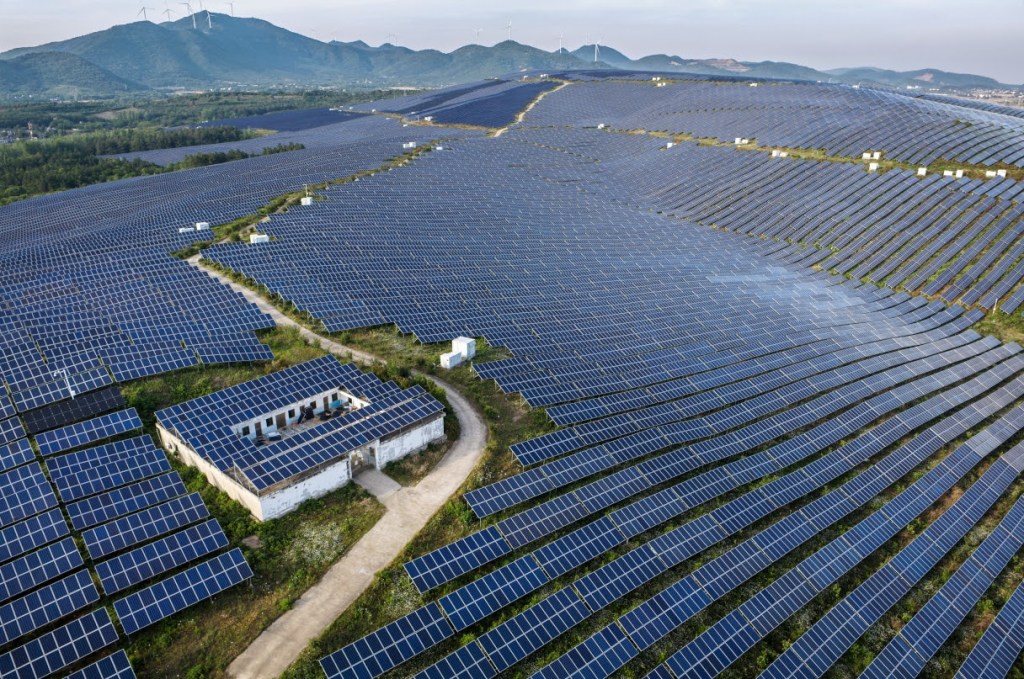
Solar panels armor a hillside in China’s Anhui province, parting only for an access road. Distant ridges host wind turbines, another fast-growing component of an energy revolution that has helped ease air pollution and slow the growth of China’s carbon emissions. GEORGE STEINMETZ
This year—for the first time—the world produced more energy via renewable sources than with coal. The meteoric rise of these greener energy technologies, particularly in China, has brought us tantalizingly close to the turning point where annual global carbon emissions plateau and even decline. “To many, the continued growth of renewables now seems unstoppable,” wrote Science News Editor Tim Appenzeller—“a prospect that has led Science to name the renewable energy surge its 2025 Breakthrough of the Year.”
While renewable technologies were pioneered in the U.S., it was China’s industrious production of them that changed the game. The country now makes 80% of the world’s solar cells, 70% of its wind turbines, and 70% of its lithium batteries. Increased production led to lower prices and increased demand, which in turn fueled even more production and even lower prices. As a result, “wind and solar became the cheapest energy in much of the world,” Appenzeller noted. Instead of investing in renewables because they are environmentally friendly, countries—and individuals—started buying them up because they were more affordable. “That change in motivation may be the most important breakthrough of all, ensuring that this year’s inflection points are just the beginning,” he concluded.
But there is one notable exception: the United States. “The U.S. is now squandering an opportunity to reap the benefits of its own technology, ceding the income and the geopolitical power to a nation that repeatedly puts technological prowess above politics,” wrote Science Editor-in-Chief Holden Thorp in an accompanying editorial. While much of the world continues to increase its renewable energy capacity, “the U.S. marches boldly backward toward the past,” Thorp wrote.

 Diane Ravitch's blog
Great! Unfortunately our President is encouraging a return to coal, nuclear, etc. Let’s hope we can keep from having a war with China over this, and proceed under new administrations to reduce our own emissions. While we’re at it, maybe we can do more to put solar on more rooftops so as to use us less land. The photo from China is beautiful in one way, but not so in another. Here in Chillicothe Ohio we too have many acres covered with solar panels. It’s good for the environment, but not so much for tourism. There are worse things to look at then a field of shining panels–but the flowers and greenery was more attractive. While we’re at it, let’s work to break the chain that requires home owners with panels to send their electricity through the corporate grid. Time was when lots of the homes in Southern Ohio and elsewhere had windmills providing water. Today we could use roof panels and windmills to create each home’s energies. I know I’m dreaming, but as a teacher, retired, I naturally do that. Happy Holidays to Diane and everyone!
LikeLike
Just like Russia!
LikeLike