For five days, the public was obsessed with the search for the man who murdered the CEO of United Healthcare. For a while, he seemed to be a mastermind, evading the surveillance state that so closely monitored his movements. But then he was caught while eating breakfast at a McDonald’s in Altoona, PA.
There is no excuse for murder. None, unless you are acting in self-defense, which Luigi Mangione was not. He has ended the life of Brian Thompson, the CEO of UHC, and simultaneously destroyed his own life. He is likely to spend the rest of his life in prison. Couldn’t he have thrown a bucket of red paint in protest? Or a cream pie?
The health insurance industry in this country is a mess. Most insurance companies operate for profit, and their actions seem to based on the prospect of profit, not the well-being of their customers. The industry makes obscene profits, based on its frequent denials of reimbursement.
This post was written by Qasid Rashid. When he learned that his child had a deadly disease, he sought help from his insurance company but was repeatedly denied any help. Read the story. It shows how repellent privatized for-profit insurance is. The insurance company was willing to let the child die rather than pay the cost of her desperately needed treatment.
He and his wife wrote:
This article is a deeply personal and vulnerable piece about our daughter Hannah Noor. It is primarily written by my wife Ayesha Noor. We are sharing this not because our daughter’s story is special, but sadly, because her story is all too common. Every year thousands of children and adults suffer incomprehensible pain, suffering, and even death. They suffer not because we lack the means to treat them, but because exploitative insurance companies, incompetent bureaucrats, and apathetic politicians deny them access to the life saving care they need. In light of recent events [See: America’s Violent Health System], we are sharing this story to bear witness to the preventable suffering of so many, the deadly violence imposed upon them, and to give hope that even in the darkest of times things can get better if we demand it. Let’s Address This.
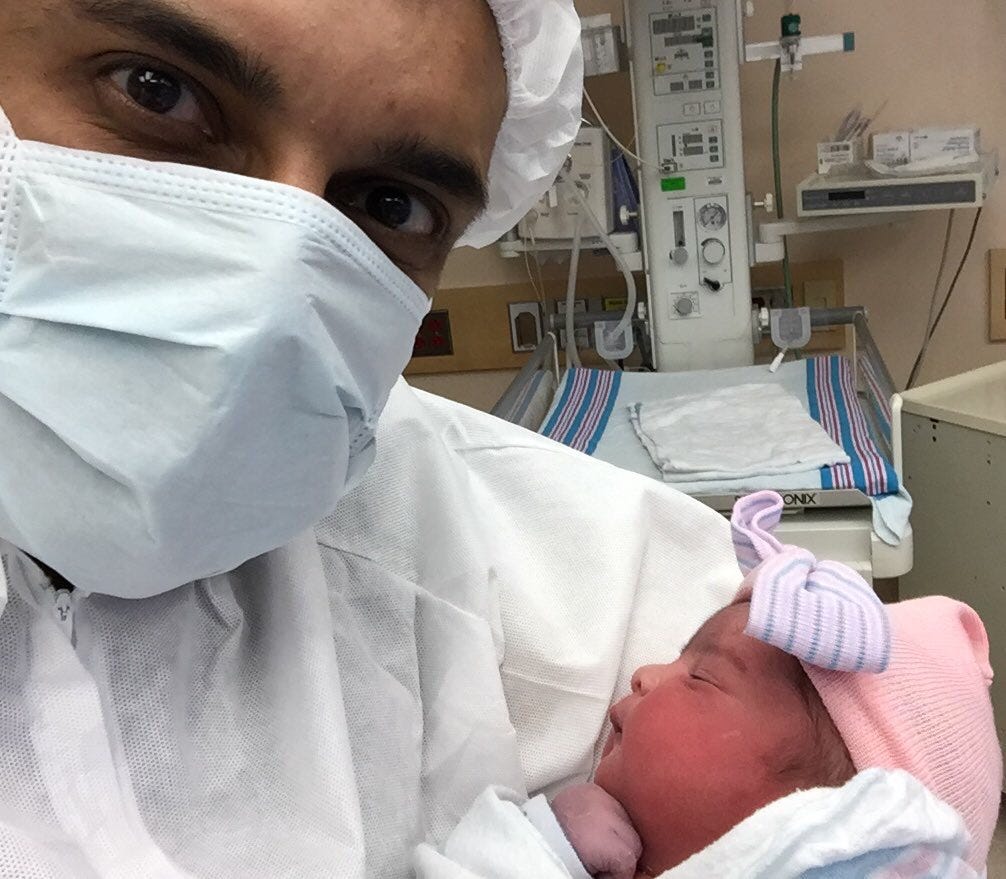
A Scream in the Dark
It was just after her sixth birthday in 2021 when our daughter screamed from her bed in the middle of the night. We rushed to her room to find she had thrown up all over her bed. We cleaned her up, changed her sheets, and blamed the incident on the Oreos she’d eaten after dinner. The next day she complained of a stomach ache and rushed to the bathroom, experiencing diarrhea. Like most parents, we dismissed it as a passing bug—kids get diarrhea now and then. But something felt different this time, even though it was her first experience.
When it happened again just a short time later, the stomach pain was more severe. She screamed, cried, and rushed to the bathroom, but this time there was blood—so much blood. It terrified us. Before we could even make it to urgent care, she had another episode with even more bleeding. We hurried her in, only to be told by the nurse practitioner to “keep her hydrated” and that it was probably a stomach virus. But again, something in our gut told us otherwise.
This was just before Thanksgiving 2021, and I convinced myself she’d recover over the break and be able to return to school. She loved school, as most kindergarteners do. But the bleeding continued. The pain worsened. More urgent care and pediatrician visits followed, but answers did not. By now, our once energetic and chatty daughter was pale, frightened, and visibly losing weight.
Navigating Through the Dark
We reached out to a close friend who happened to be a pediatric gastroenterologist. His questions and careful listening indicated it was not a simple virus, but he didn’t say much directly. He urged us to connect with the GI team at Children’s National Hospital in Washington D.C. Unfortunately, we were met with insurance hurdles and skepticism from her pediatrician. Weeks passed, and her condition deteriorated until, thanks to our friend’s intervention, we finally secured an appointment with a pediatric GI doctor in December.
Hannah Noor, now frail and scared, was put on iron supplements, and an colonoscopy was scheduled for January. She now weighed just 30 pounds—skin and bones, and we feared the worst. Her fear of eating, going to the bathroom, or even moving too much consumed her days. Our winter break became a period of sleepless nights, endless tears, and prayers. We felt like prisoners trying to navigate through treacherous terrain while blindfolded and shackled.
The preparation for the scope was grueling—a 24-hour liquid diet. To make matters worse, a severe snowstorm in early January 2022 left us without power for three days. Despite the chaos, we made it to the hospital. As I held her tiny hand, she bravely went under anesthesia. Hours later, the doctors confirmed what we feared: Hannah had ulcers all over her colon.
Inflammatory Bowel Disease (IBD) was the diagnosis—a chronic, lifelong condition that would require extensive management. Even as the doctor explained, I couldn’t fully grasp the gravity of it. I naively asked, “How long will she need the medication?” The doctor replied—“Do you understand what it means to have IBD? This is for life.”
It shattered me. My world crumbled.
Steroids, with their array of side effects, initially helped stabilize her condition, and she was subsequently started on mesalamine. However, managing IBD is never straightforward. Moving homes and finding a new doctor compatible with our insurance became an uphill battle. Procuring mesalamine was a nightmare, as our insurance kept on requiring prior-authorization—a term we’d never even heard before. Evidently, even though our doctor had prescribed a specific medication to save our daughter’s life, the insurance company required their non-medically trained admins to agree that our board certified physician knew what she was doing in prescribing the medication she prescribed. Spoiler: They disagreed and repeatedly denied the critical medication our daughter needed.
Making matters worse, moving meant we were in between doctors. Desperate to try anything to improve Hannah’s quality of life, we spent hours consulting with a nutritionist to see if dietary changes could make a difference. We invested extensive time and resources into a gluten-free diet, but it did not help at all; in fact, it made her averse to eating. We also tried the FODMAP diet, which was recommended during a flare, but it added to the confusion of what she should or shouldn’t eat. Every day became a battle over something as simple as food—one filled with uncertainty and frustration. Despite our efforts, Hannah’s condition remained unpredictable, with debilitating flares continuing to disrupt her life. By late 2023, we had pursued every imaginable route to find a way to protect our daughter’s health and life, and yet felt exhausted and at a dead end.
It was clear that only one option remained—she needed a quickly advancing form of therapy known as biological treatment. This would be a direct IV infusion of medication to stabilize the IBD, every six to eight weeks, forever.
A Dark Dead End
We were at the end of the road. If we couldn’t access biologic treatment, there was nowhere left to go. But what we hoped would finally bring us closure and healing, resulted in yet another emotional roller coaster and painful circus—our insurance corporation blocked us. Turns out, insurance corporations block more than 51% of patients whose doctors prescribe them biologic treatment to save their lives.
The recommended biologic promised not a cure, but a chance at living a healthy life. Our insurance rejected us outright reasoning that we hadn’t tried other medications first—a policy called “step therapy.” Despite our daughter’s life threatening condition, they wanted us to try every other variation of every other possible medication—knowing full well they would likely fail just as much and make our daughter suffer, vomit, bleed, and lose weight. But that did not matter to them, because that was the preferable path to ensure they “maximized shareholder value.”
Our doctor stepped in and conducted a peer-to-peer direct meeting with the insurance company to show all the data, blood tests, and medical reports to prove that our daughter needed biologics to live. To show without a shadow of a doubt that the yet untried medications they demanded we try were not substantively different than the plethora of medications we had tried and had not worked. Yet, that meeting also went in vain. The insurance company still refused to approve our claim. And Hannah Noor’s condition worsened. She was pale, swollen from steroids, in pain, losing weight, and back to missing school.
We finally contemplated paying for the biologic treatment out of pocket. We knew it would only require six doses a year. How much could one dose be, after all? We checked and our hearts sank once more. Each dosage cost and administration would run into the tens of thousands of dollars. A year’s supply to keep our daughter alive would run into the hundreds of thousands. We certainly did not have that kind of money. We were cornered and desperate.
We contemplated what any parents might. Do we sell the house and cars and move into a small apartment? Do we set up a GoFundMe? Do we borrow money from family and friends? Do we take out a second mortgage?
Do we file for medical bankruptcy, as 500,000 Americans do annually?
But we soon learned another sinister result of hyper-privatization of health insurance—even if we had the excessive means to pay the hundreds of thousands of dollars out of pocket, the hospital would not accept the funds. Why? The industry is such that not only do insurance companies deny 51% of claims, they have enacted policies forbidding people from paying for the critical medication they need out of pocket, lest the insurance company lose control and revenue. “Either you pay us, or you pay no one,” is a line you’d expect out of a mafia handbook—not out of a health provider. This is not health insurance, this is health exploitation.
A Spark of Light in the Darkness
In that moment of confusion we happened to run into to a fellow parent who, now is a great friend, and learned her children shared a similar medical struggle. She suggested calling the biologic manufacturers directly and applying for their patient assistance program. An idea that seems so obvious now, but something we did not even know was a possibility then.
The application process was tedious, and even then, it was initially rejected. But after weeks of back-and-forth, countless phone calls, and sleepless nights, a miracle happened—we finally secured approval. We let out a cathartic sigh of relief after more than two years of suffocation. And to be sure, the approval was not through our insurance company, who never even bothered to offer such an option, likely because it would cost them money. Rather, the approval was from the drug manufacturer directly. To this day our health insurance company has refused to budge on their cruel and calloused “maximizing shareholder value” decision to deny our daughter the medicine she needs to live.
On March 6, 2024—more than two months after the doctor first prescribed it, a period in which our daughter suffered horrific and unimaginable pain, bleeding, and vomiting—Hannah Noor received her first infusion at Comer Children’s Hospital in Chicago. And since then, everything has changed. Her spark of light returned. Our daughter was back.
The Light We Create
A process that should have only taken 30-60 days from the night we heard that scream in the dark, took us on a 28 month torturous journey to finally see light again. Hannah Noor’s journey since starting biologic treatment has been a blessing. She’s eating, playing, drawing, and even learning karate (currently a Yellow Belt). The last three years of her life had been a torture for her, but now she is finally thriving as any 9-year-old girl should. Though the fear of flares always looms, we refuse to let it dictate our lives. Herbal and homeopathic treatments complement her medical regimen, and her strength inspires us daily.
As for our insurance company? Those corporate leeches also denied covering the hospital costs as well. Fortunately, despite that high price tag still running into the thousands, we tightened our belts and found a way to pay for that out of pocket, and continue to pay for that out of pocket. (We were shocked there wasn’t some additional insurance rule preventing us from paying our hospital directly). Despite us paying our insurance premiums every single month without exception, our insurance company has not covered a single penny of our daughter’s critical healthcare needs. The care she needs to live. But at least they’re maximizing shareholder value.
This story isn’t just about one child’s struggle with IBD; it’s about the systemic barriers hundreds of millions of families face every single day. From insurance denials to inaccessible care, to step therapy nonsense, to prior authorization red tape, the system fails the most vulnerable. What if we didn’t speak English? What if we couldn’t afford out-of-pocket costs for tests and treatments? What if one of our close friends didn’t just happen to be a national expert on this particular rare disease, and couldn’t leverage his relationships to get us access to a world leading expert? What if we didn’t have a network of supportive friends to recommend new ways to acquire this life saving medicine?
A Brighter Future Is Possible
We named our daughter Hannah Noor because Hannah was the mother of Mary Mother of Jesus, and Noor means light. We couldn’t think of a more beautiful name for our only daughter, and she has lived up to it every day of her life.
In these darkest of times, she is the Light of our eyes.

Hannah Noor’s story highlights a flawed and cruel system that places profits over people. Yet it also underscores the power of advocacy, persistence, and community. To every parent navigating the complexities of chronic illness: stay strong, fight relentlessly for your child, and lean on the resources available, like the Crohn’s and Colitis Foundation, and do not underestimate support groups on Facebook. If I can be of any support, do not hesitate to reach out at ayesha [dot] noor @ gmail.com.
Hannah Noor is living proof that even in the darkest moments, there is hope. She teaches us daily to believe in miracles—and to fight for them when necessary. It is also a reminder that our for profit exploitative health insurance system will always only serve the wealthy elites, the stock market, and whatever private investor who decides to buy and sell these corporations. They will not serve the people. Not our beautiful baby girl, nor the nearly 70,000 Americans who die annually due to lack of care, nor the 500,000 Americans who are forced to file for medical bankruptcy every single year. It is by the sheer grace of the Almighty that we still have our wonderful Light with us today. But for so many parents and families, the end result is not so fortunate.
Perhaps the most frustrating part about all of this is that the medication to save our child’s life existed all along. But because some calloused business person decided her life wasn’t profitable enough and worth saving, it was an acceptable cost to reject her claim and let her die.
It is our responsibility to demand better, not just for our daughter, but for all the daughters, sons, and children out there. We do not suffer from a lack of resources, but from an excess of greed. We can ensure high quality, accessible, and affordable healthcare for all people in this country—but we cannot ensure the satiation of greed for the billionaire corporations, corrupt politicians, and elitists who care more about shareholder value than the survival of innocent children. We have to choose one side. And we choose the children of this great country—we hope you do too.

 Diane Ravitch's blog
Brian Thompson himself was a murderer. A mass murderer, in fact, who killed far more than Mangione could dream of (assuming he is, in fact, the shooter). Just because Thompson did it by algorithm rather than gun doesn’t change that.
LikeLike
An excellent perspective on the health care corporate CEO murder and what’s really at stake in the U.S.
Family members of ours moved to Switzerland for work about 8 years ago. They were just home visiting. Interestingly, they told us that the Swiss have a health care system that is similar to Obamacare, a public/private hybrid.
A key difference is a cap on the out-of-pocket amount of money that any individual or family will have to spend in the event of dire circumstances, like those described in this post. I think the cap is 15% of a family’s income.
But you get the idea….there is a humane limit to human suffering, both physical and financial, in Switzerland.
And because there is a thoughtful, equitable, health care system, the number of lawsuits involving people’s health care providers and insurance companies etc… suing each other to recover costs is much less than here in the United States.
Of course, trump and his ilk have weaponized the civil justice system in new and dangerous ways, using the courts to attack the free press.
Crazy how for so long the G.O.P. paid lip serviced touting so-called “tort reform”, you know?
Thanks, Diane, for your thoughts.
LikeLike
Just like the insurance industry protects its own interests, our politicians from both parties do the same. As long as unlimited amounts of money can be poured into elections, nothing is likely to change. Politicians will continue to block any attempts to create a single payer public option for healthcare, and hyper-privatization will continue to be unchecked. It will expand at great risk to the healthcare of our older people and disabled. It is already happening with ACO Reach, a little known corporate parasitic plan, that has been inserted into Medicare through the ACA. A corporate manager will be able to deny services under this plan. All the big insurance companies, most hospital chains, private equity and many health adjacent companies are signed up in this program so they can throttle access to seniors’ care and pocket 40% of the Medicare benefit. When you are a good capitalist, everything is a market. If it isn’t a market, you buy political will to make it one, even when there is no real benefit to the public. Consider what is going on in public schools, the USPS and, of course, healthcare. All these privatization schemes benefit the wealthy, not the people.https://www.commondreams.org/opinion/medicare-privatization
LikeLike
Insurance is only one paty of the broken system. What was the real cost of the biologic treatment. Americans spend 650 billion on drugs. 450 billion more on drugs than their value in a free market without patent monopolies. 50 billion is spent by the government 100 billion by pharmaceutical companies on research.
If the government were to assume the research and relegate production to generics half the tale above would disappear. At a savings of over 400 billion, to the people and Government programs
Then there is the broken Medical education system that steers Physicians to specialize at tremendous costs to the system with not much benefit. American Physicians are paid multiple times what equally qualified foreign physicians are paid. How much could be saved by providing that education for free to qualified physician candidates. Taking away their excuse of education costs they justify their wages with.
LikeLike
The providers are definitely a huge cause of the cost problem. Americans’ out of pocket spending is a lower percentage of total healthcare costs than people do in almost every other western nation. But that’s largely because the costs are so insanely high in America.
LikeLike
This was illiterate but you get the idea. I’m at my ophthalmologist.
LikeLike
“The insurance company was willing to let the child die rather than pay the cost of her desperately needed treatment.”
When a health insurance company denies health care that’s needed to keep someone alive, killing the individuals who are respnisble for that decision should be considered justifiable homecide, “the killing of a person in circumstances which allow the act to be regarded in law as without criminal guilt.”
Also, denying health care to someone who dies from that deicison should be concidered premeditated murder.
“Premeditated murder is the intentional killing of a person after careful planning and consideration.”
Health care insurance in the US operates like death panels deciding who will live and die, not much different than Hitler’s Final Solution, where Nazis decided who would go to their death camps and who would die once they arrived.
“The Nuremberg defense, also known as the “just following orders” defense or superior orders, is a legal plea that claims a person should not be held responsible for crimes ordered by a superior. This defense was a central theme in the Nuremberg trials after World War II.
“The Nuremberg trials established two core principles: the importance of fair trials and the need for accountability for serious crimes. The principles of the Nuremberg trials have influenced the International Criminal Court (ICC), which also holds individuals accountable for the most serious international crimes.
“The Nuremberg trials also led to the Nuremberg Code, a ten-point statement that defines the limits of permissible medical experimentation on human subjects. The Nuremberg Code establishes basic legal and ethical rules for research with human subjects.”
LikeLike
By this standard, every American president was a first-degree murderer and their assassination should be considered justifiable homicide. I don’t mean to be offensive but this is really stupid.
And no, the murder of Brian Thompson was not justifiable.
And I’m not saying the American system is great, or even good, but are people under the impression that medical treatments are never denied in systems like in the UK or Canada? That cost is never considered because money is no object in such systems? If a potentially life-extending treatment is denied in such systems, should the director of the NHS be murdered?
LikeLike
In tears, once again, after reading one of your carefully selected stories. Knowing the insurance industry is corrupt and callous is one thing – reading a story like this is hard. It’s hard to believe we live in a world where so many people can be so cold in the name of amassing millions and exploiting the people they are supposed to serve.
What a beautiful girl.
Diane, thank you for bringing stories to us that add layers of insight and understanding.
LikeLike
Sometimes one story tells more than data.
LikeLike
Very much so.
And on another note – Word Press assigned me the odd name of “Meticulousdevotedly4….. ” – my old account must have expired. I’m trying to fix.
LikeLike
You seem to have fixed your name. It’s now beacht
LikeLike
Yes – thank you 🙂
LikeLike
It seems like the equally important question is why the medication costs many hundreds of thousands of dollars – and who benefits.
Why are drug manufacturers offering a “patients’ assistance program” instead of making their drugs affordable? Was the name of the drug company that charged hundreds of thousands of dollars for doses of their life-saving drug even mentioned?
Martin Shkreli made drug costs unaffordable in order to profit and was rightly criticized. I wonder if the drug manufacturer increasing shareholder value by charging insurance companies so much for their drug had hedge fund capital behind it.
LikeLike
The drug was an expensive biologic that is usually administered by infusion and reserved for complex conditions including autoimmune disorders. Biologics are very expensive everywhere in the world, but they are far more expensive in the US than most of the countries.https://my.clevelandclinic.org/health/treatments/biologics-biologic-medicine
LikeLike
But this specific post – the story of the girl who needed the infusion – was solved by the DRUG company giving up its’ enormous profit that it would normally force the insurance company to pay for.
The expensive hospital costs to administer the infusion weren’t covered by the drug company – they were presumably covered by the insurance company.
Infusion costs occur with chemo and other medications (including the first beneficial covid treatments when Trump benefited from getting infusions).
But this all was apparently solved by the drug company waiving the charge for their drugs.
It’s just more complicated than “bad insurance company” (and I’m not absolving them of being bad). But in this case, the insurance apparently covered all the infusion costs, but it was the outrageous cost of the medication that was the real problem.
It’s not even clear if the “other medications” the insurance company was requiring the daughter to take first would have also been via infusion.
Not at all defending insurance companies, but I think that this is about much more than that.
LikeLike
The hospital costs are being born by the family itself. It was in the article.
LikeLike
T,
Thank you – I missed that sentence near the beginning of the article.
But that sentence supports my point.
The DRUG COST was 90% of the cost!
Isn’t that quite warped?
The family – once it didn’t have to pay for the drug – could tighten its belt and pay the hospital costs. The cost of all those doctors and nurses and infusion machines and the unnoticed background staff that keeps a hospital sanitary and safe (as well as the overhead costs of maintaining the physical building) had a price tag “still running into the thousands”.
But with the medicine, the price tag “would run into the HUNDREDS OF THOUSANDS.”
The cost of the drug was 100x the cost of all the medical personnel and equipment!
And there is something very wrong with that.
LikeLike
Yes – drug companies are also taking advantage. There is something amiss with the whole system and plenty of blame to go around when billions are funneled to share holders.
To say once the drug is paid for the family could “tighten their belts” and pay for the cost – is a puzzling comment. I don’t know, Isn’t that what insurance is for – so we don’t have to pay for insurance and also “tighten our belts” meaning have to sell our cars and eat ramen to pay tens of thousands of dollars when care is needed.
Most middle class employees are already tightening their belts when they pay $20,000 a year for a family – contributing to their yearly health insurance costs.
NYC, I think you should go back and reread the story and see what the key takeaway is.
LikeLike
*a family policy
LikeLike
I was quoting from the article itself:
“Fortunately, despite that high price tag still running into the thousands, we tightened our belts and found a way to pay for that out of pocket, and continue to pay for that out of pocket.”
VERSUS:
“A year’s supply to keep our daughter alive would run into the hundreds of thousands. We certainly did not have that kind of money. We were cornered and desperate.”
Running into the thousands versus running into the hundreds of thousands when the actual cost of the drug itself is included.
I agree with you that insurance should mean that families don’t pay out of pocket at all, but reading this almost makes the drug company seem like heroes (after all, they provided their drugs for free) instead of a very, very big part of the problem.
In the rush to blame insurance companies, it seems as if we forget the Martin Shkrelis aren’t good guys just because they allow some people free compassionate use while charging everyone else hundreds of thousands of dollars.
LikeLike