Archives for category: For-Profit

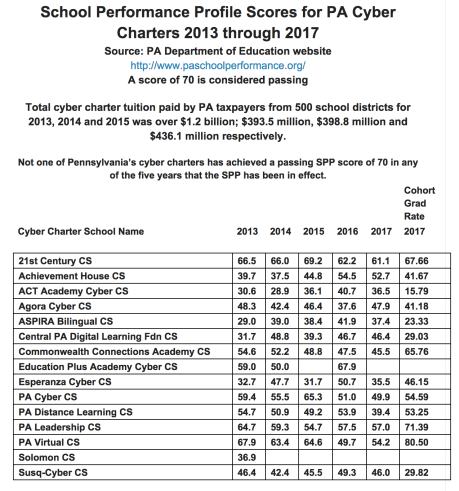
For the fifth year in a row, not one cybercharter in Pennsylvania achieved a passing school performance score of 70. When will these scams be held accountable for their poor performance? When will the State close down these failing schools? These “schools” drain hundreds of millions of dollars away from real schools and get poor results, year after year. Two different cybercharter operators were indicted for stealing millions from state taxpayers. One was convicted, the other was tried but the trial ended in a hung jury.

Screen Shot 2017-11-02 at 9.44.37 PM

A few days ago, the New York Times ran a first-page story about the big push by tech companies to get their software and hardware adopted by public schools. The market is huge, and the vendors are pulling out all the stops to woo District officials by inviting them to conferences, giving them awards, and showering them with attention. The district that was featured by the Times was Baltimore County, which had committed to spend $300 million on high tech, while basic physical needs of the schools were ignored. The BC Superintendent Dallas Dance had recently resigned, and he was replaced on an interim basis by his deputy Verletta White, who shared his passion for going high tech.

The big story was that the district bought equipment that was soon discontinued and that ranked third of four choices in an independent evaluation. No, the big story was how cleverly and insidiously the tech industry sold their stuff to school officials.

But now we learn that Dallas Dance and Verletta White both were paid fees by the tech industry and didn’t report the payments on their income disclosure. In relation to the size of the contracts, the payments were relatively small. Which does not excuse the payments but demonstrates how easy it is to buy influence.

http://www.baltimoresun.com/news/maryland/education/k-12/bs-md-verletta-white-dallas-dance-ethics-20171106-story.html

John Merrow here recounts the sad story of how Baltimore County got snookered by the tech industry, sinking hundreds of millions into a soon-to-be obsolete tech tablet while ignoring the basic needs of the sistrict’s schools.

He writes:

“It’s a breathtaking story of greed, but what’s only hinted at around the edges in the Times story is the harsh truth that this would never happen if educators, politicians and policy makers were not worshipping at the altar of standardized test scores. Tech is selling–and educators are willing buyers–a fantasy: “Buy our fancy software and hardware packages, and your test scores will soar.”

“The reporters use Baltimore County (MD) public schools as their poster child, and surely (now former) Superintendent Darryl Dance has a lot of ‘splaining to do, given the coziness of his relationship with HP and other providers. Under Dance’s leadership, his system signed a $200 MILLION contract with HP in 2014 and was also on the hook for many millions more in related contracts. In the district’s own evaluations, the HP device scored third out of the four devices tested, with only 27 points out of a possible 46, but the County signed with HP anyway.

“(The device, the Elitebook Revolve, has been plagued with problems and has been discontinued by HP, and Superintendent Dance abruptly resigned in April, no reason cited.)

“While the reporters for The Times do not come right out and call the public school people in Baltimore County and elsewhere ‘crooks’ or ‘prostitutes,’ they come pretty close…

“Sadly, this isn’t a new story. Apple sold an expensive bill of goods to Los Angeles County Public Schools years ago, and Joel Klein’s Amplify signed some lucrative contracts, deals that went south when some of the machines burst into flames. I write about those deals and other stupidities in my new book, “Addicted to Reform: A 12-Step Program to Rescue Public Education.” (The New Press, 2017)”

Dallas Dance has moved on. Baltimore County is out nearly $300 Million in total for Dance’s tech deals. The County has obsolete hardware.

Where is the accountability.

The North Carolina State Board of Education unanimously approved the opening of a for-profit charter school that will enroll more than 2,000 students in Cary. The school will be operated by Charter Schools, USA, a Florida corporation owned by Jonathan Hage, a friend of Jeb Bush. Not an educator, Hage has built a very large business by owning for-profit charters.

The State Board of Education unanimously approved Cardinal Charter Academy West Campus, which plans to educate up to 2,180 students in kindergarten through 12th grade. The new school, modeled after the existing Cardinal Charter Academy in Cary, represents the latest effort by charter school operators to target the fast-growing western Wake County area…

Critics say charter schools are targeting the more-affluent families who live in western Wake, where test scores are higher and the percentage of low-income students is lower than the Wake County school district average. Charters are taxpayer-funded public schools that are exempt from some of the regulations that traditional public schools must follow.

But supporters say they’re meeting the need for school choice, citing the long waiting lists for Cardinal Charter and packed parent information sessions.

Cardinal Charter West would be managed by Charter Schools USA, a Florida-based for-profit company that could receive more than $2 million a year from the new school.

Read more here: http://www.newsobserver.com/news/local/education/article182268141.html#storylink=cpy

At the same meeting of the state board, a charter school in rural Bertie County was closed because of its low enrollment and poor academic standing.

Business Insider reports that the latest new thing, AltSchool, is not making it.

Backed by Mark Zuckerberg and tech entrepreneur-Trump acolyte Peter Thiel, started by a former Google executive, AltSchool was lauded lavishly when it opened. It was supposed to revolutionize education.

AltSchool, an educational software developer and network of “micro-schools” with four locations in California and New York, is shuttering another outpost.

The startup’s schoolhouse in Manhattan’s East Village will close its doors at the end of the academic year, according to an email obtained by Business Insider from vice president of schools at AltSchool, Sam Franklin, to parents of AltSchool students on Thursday night.

It’s the second closure that AltSchool has announced in two days, after the buzzy ed-tech startup revealed it’s closing its location in Silicon Valley. AltSchool appears to be refocusing its energy on licensing its educational software to existing schools, rather than creating new ones.

In an email to parents, Franklin apologized to parents who may have learned about the school closures “in the news rather than hearing it from us.”

AltSchool counted the Oxycontin billionaire family, the Sacklers, among its investors. Also Laurene Powell Jobs. All the really smart and very rich folks.

Sad. Very sad. Just a tax write-off.

The charter industry in Michigan might be the worst in the nation, although it has stiff competition from the charter industry in Nevada, Ohio, and California. About 80% of charters in Michigan operate for-profit, and their academic results are unimpressive. The few high-performing charters use the usual tricks of excluding the kids they don’t want. A few years ago, the Detroit Free Press conducted a year-long investigation into the state’s charter sector and described it as a $1 Billion (Billion with a B) a year industry that is unaccountable and produces results no better than, and often worse than, public schools.

In early December, the failing but profitable charter industry is holding its annual conference. Will it discuss its problems? Will it honestly assess its failings?

Of course not! It will celebrate its role as “Innovators.” If anyone knows of any innovation that the Michigan charter industry has produced, please write in here and let us know. Its biggest innovation seems to be stuffing its pockets with taxpayers’ money that was supposed to support public schools, not enriching greedy entrepreneurs.

Lily Eskelsen Garcia forced herself to sit down and listen to Betsy DeVos’ speech at Harvard, where she thought she would be in a choice-friendly environment, surrounded by allies at the Program on Educational Policy and Governance, led by choice advocate Paul Peterson. As we now know, students in the audience rejected her message and unfurled banners expressing their opposition to her policies.

Lily has refused to meet with DeVos because of her well-known contempt for public schools and the teaching profession.

This is her reaction to DeVos’ remarks.

“At times, I felt like I was getting a root canal without novocaine from the dentist in “The Little Shop of Horrors.” When the pain subsided, I was more convinced than ever that DeVos knows little about public schools and even less about their mission.

“Here’s a summary:

“1. DeVos talked about her Rethink School tour, applauding the schools she visited for openly stating: “’We’re not for everybody and we don’t expect everybody to want to come here.’ I think all schools should have that attitude.”

“She doesn’t understand the concept of “public” schools—schools that are open to all students, no matter what language is spoken at home, what the family income is, what their religion or race is, what abilities or disabilities they have, whether they are gay, straight, or transgender. The mission of public schools is to provide opportunities for each and every student who walks through the door, not to roll up the welcome mat, bar the door, and declare: “Sorry, but we’re not for everybody.”

“I think we already went through that time in history. There was even a name for it: Segregation.

“2. When she mentioned the places she visited during her tour, there was one noticeable omission: Michigan, her home state. Who can blame her? She funded efforts in Michigan to siphon funds from students in public schools, allowing for-profit companies to operate schools with taxpayer money and no accountability. The result? Schools with shoddy academic records continued operating for years; no state standards focus on who operates or oversees charters; and schools routinely close without giving families or educators adequate notice.

“This, apparently, is her goal from coast to coast.”

Read on to understand Lily’s reaction.

The rightwing-funded Black Alliance for Educational Options is closing its doors. It was launched by Howard Fuller, who was superintendent of Milwaukee public schools in 2000. Fuller was radicalized by his inability to change the system and formed an alliance with the far-right Bradley Foundation, which funded vouchers and wanted to privatize public education. Over the years, BAEO has been funded by white conservative foundations including the Walton Foundation.

BAEO Sought to persuade African Americans that school choice, charters, and vouchers, and privatization were in their interest.

Southern legislatures, controlled by conservative white men, liked BAEO’s ideas.

Education Week credits BAEO with getting Alabama and Mississippi to pass charter laws, and Louisiana and D.C. to pass voucher legislation.

White segregationists embrace school choice readily, as they have wanted it since 1954. Fuller pushed on an open door. Now southern states can fund segregated schools and do it with a clear conscience. Sort of.

Fuller no doubt was following his conscience, but it would be better if he had done it without all that rightwing money.

In the era of Trump and DeVos, it is difficult to play the role of a progressive when their agenda and yours are the same. Especially when the NAACP is speaking out against charters and privatization.

In a related story, the former chairman of the BAEO board Kevin Chavous has been named president of K12 Inc.s Academics, Policy, and Schools. K12 Inc. was founded by junk bond king Michael Milken and his brother Lowell and is the nation’s largest virtual online charter corporation. It is listed on the New York Stock Exchange. Its schools have been notable for high attrition rates, low test scores, and low graduation rates. The NCAA withdrew accreditation from two dozen K12 schools a few years ago because of their poor quality. This is a choice strongly supported by DeVos. K12 Inc. is also known for paying lavish compensation, desite its poor academic results.

This column by Gail Collins is a Must Read.

The bad news from the U.S. Department of Education comes so frequently that it is hard to keep track of it.

DeVos is clear in her goals: roll back the federal role in protecting students and taxpayers’ money.

One egregious example: she is diluting, diminishing, removing federal efforts to rein in for-profit Colleges. In fact, she has hired former executives and lobbyists from the industry to write the regulations. Some of her many investments were in the industry, which she obviously sees as part of the future. And surely she has not forgotten Trump University, the fraud associated with the man who appointed her.

Collins writes:

“DeVos is the superrich Republican donor who once led a crusade to reform troubled Michigan public schools by turning them into truly terrible private ones. Now she’s in the Trump cabinet, and she seems to be dedicating a lot of her time to, um, lowering higher education.

“When no one was watching she hired a lot of people that come from the for-profit colleges,” complained Senator Patty Murray of Washington, who feels the additions are far more interested in protecting their old associates than in overseeing them. Murray is the top Democrat on the Health, Education, Labor and Pensions Committee, otherwise known as HELP. These days it’s hard to tell whether that’s a promise of assistance or a cry of distress.

“To oversee the critical issue of fraud in higher education, DeVos picked Julian Schmoke Jr., whose former job was a dean of — yes! — a for-profit university. Specifically a school named DeVry. Last year, under fire from state prosecutors and the Federal Trade Commission, DeVry agreed to pay $100 million to students who complained that they had been misled by its recruitment pitch.

“That sort of thing is getting to be common in the darkest corners of the for-profit world. For instance, there’s a now-defunct “university” that promised to show students how to get rich quick in real estate and wound up paying $25 million to settle the case. …

“Back to the Department of Education. One of DeVos’s top advisers, Robert Eitel, is on a leave of absence from a company that operates for-profits and once paid more than $30 million to settle charges of deceiving students about the loans they were getting.

“Which is, again, even more than that real estate school, where some students claimed they were encouraged by instructors to increase the limits on their credit cards. …

“There are well over 3,000 for-profit colleges and universities in the country, everything from tiny schools that promise to set you off on a career in cosmetology to conglomerates with campuses all over the world. Some of them have names that might seem intended to be confused with somebody else’s. (Not necessarily thinking of you, Brown College, Berkeley College, Columbia Southern University or Northwestern College.)

“Experts say some for-profits are fine. However, there have been a ton of horror shows in which low-income men and women are promised a path to life-changing jobs but wind up with nothing to show except huge loan bills.”

Susan Ochshorn founded ECE PolicyWorks to advocate for high-quality education for young children.

In this post, she analyzes the pernicious influence of financiers and hedge fund managers on decisions about the fate of young children, as they figure out how to make a profit with “Social impact bonds.”

Everyone loves the idea of early childhoood education. But unfortunately the financiers have figured out how to make it pay—for them.

Ochshorn shows how Goldman Sachs and other investors saw a path to profit and how public officials fell in love with metrics. The children? Not so much.

She gives the background of the social impact bond.

And she concludes that commodifying children is a very bad idea:

“By last summer, the U.S. Department of Education had gotten on board. Under the aegis of John King, former education commissioner of New York, they launched a Pay for Success grant competition, $2.8 million available for state, local, and tribal governments interested in exploring the investment vehicle’s feasibility. Early this year, as Betsy DeVos replaced King in the top job, the department distributed funding ranging from $300 to $400 million to 8 recipients. Rigorous evaluation, as the Urban Institute’s “Pay for Success Early Childhood Education Toolkit,” makes clear, is the sine qua non of the transaction, precise metrics and data collection essential for determining the venture’s outcome.

“To quantify is to have the illusion of mastery over all that defies our control, yet the metrics fall short, the ends perverted: they cannot capture children’s unique capacities, or the uneven trajectory of their development—as messy and challenging as it gets.

“Three- and four-year-olds are not commodities. They have had the grave misfortune of entering the academic arena in a period of measurement gone berserk. What young children need most is time, and sustained support for experiences that nourish their bodies, minds, and spirits—their due, according to the Convention on the Rights of the Child, which the U.S has not yet ratified more than 25 years after the resolution was adopted by the U.N. General Assembly.

“The benchmarks and assessments of the Common Core violate this right—especially for our youngest students. So do social impact bonds. If the payback is contingent upon a particular timetable, and the desired outcomes are not forthcoming, where does that leave the kids?

“Those who have made their millions and billions in private equity, investment banking, and hedge funds see themselves as the saviors of our most vulnerable children. Yet their fancy models are putting our youngest learners at greater risk—along with democracy and the public good.”