Archives for category: Corporate Reformers

Ed Johnson, a close observer and frequent critic of the Atlanta public schools, writes here about the superintendent’s plans to adopt models developed by Eli Broad and the Waltons to transform the public schools into a business.

Johnson is a believer in the collaborative philosophy of W. Edwards Deming.


December 2019

Journey of Transformation: Atlanta schools to “buy” teachers by “price tag”

  • “Thinking about human beings as interchangeable commodities for sale, or abstract units of labor power, would lead merchants and planters to see human capital in much the same way that they saw animals.  And, by the time a young apprentice became a partner, he would feel ‘no more remorse in fitting out a ship for the purpose of trading in human flesh, than he would have done in sending her to catch whales or seals.’”
  • —Caitlin Rosenthal. Accounting for Slavery: Masters and Management. Kindle Edition, location 1153.
Last month, Atlanta superintendent Meria Carstarphen, Ed.D., gave a presentation to the Atlanta Board of Education Budget Commission on FY 2021 budgeting for what she calls “Student Success Funding,” or SSF.  The Budget Commission is a standing committee of the Board that meets monthly.

At one point during the presentation, Dr. Carstarphen invited the Chief Financial Officer (CFO) of the Atlanta Public Schools system (APS) to more adequately explain a matter that see, Dr. Carstarphen, suggested to enquiring commission members she had already explained well enough (my insertions):

  • (50:30-51:00) “… the way the schools purchase back their positions … we allocate the dollars and they buy their teachers back.  The price tag we put on those teachers is an average salary … and all schools buy back [teachers] at that rate.  What we know, what we’ve seen is that the schools that have the highest needs … have teachers that have either less experience or they don’t have the high degrees and, for whatever reason, they are ‘cheaper.’  … So what we would like to propose is … allowing those schools to buy their positions back at the actual average [value of the price tags we put on teachers] for their school.”
Despite the Board’s decision to non-renew her employment contract beyond the current school year, Carstarphen, by her presentation, makes clear she continues to advance her Journey of Transformation of APS.

When finished—and it can be finished, we must now understand—the journey will have brought APS to a permanent state of being “run like a business” and, in that state,  destroyed as the democratically governed public good is it supposed to be.

Thus the word “finish” must now be understood as signifying something real and consequential.  To continue thinking the word means something rhetorical or non-specific poses a grave risk to ever reclaiming and restoring APS as the public good it is supposed to be.

Entangled actors

In their joint report, The Strategic CFO: A Guide for School Districts, billionaire Eli Broad’s The Broad Center and Education Resource Strategies (ERS) lay out the essence of the matter as related to SSF.

So, too, does the partnership of ERS and APS, in the joint presentation, Student Success Funding: [APS] A District in Transformation.

Moreover, the APS CFO talks about student-based budgeting in the ERS Q&A, Student-Based Budgeting Takes Root in Atlanta.

ERS is a consultancy that says it helps clients to maximize—operative word, “maximize”—usage of capital resources, including “human capital.”  But as the Taguchi Loss Function teaches, maximal usage of a resource that is a system rapidly drives down the value and usefulness of the resource to point of it becoming a great source of waste.  In what follows, remain mindful that an individual “human capital” (e.g., an individual teacher) is a system.

And then there is the Walton Family Foundation’s 2017 grant of $350,000 to APS “To support research related to student[-]based budgeting” (my emphasis).  Research?  For what purpose, as related to student-based budgeting?  Maybe to establish the effectiveness of student-based budgeting and to use APS as a guinea pig in experiments to do that?  Was not the effectiveness of student-based budgeting a given?  Again, the APS CFO talks about student-based budgeting in the ERS Q&A noted above.

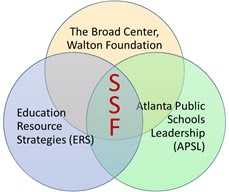
Thus we have Eli Broad, a private actor, in partnership with ERS, a private actor.  And we have ERS, a private actor, in partnership with APS Leadership, a public actor.  And we have APS Leadership, a public actor, in partnership with the Waltons and Eli Broad, both private actors.  This then means the public cannot know and trust the motives and behavior of any of the actors independently of each other; the actors are entangled.

Innately born systems thinking children learning to picture entanglement

So, how might we model and think about APS Leadership, ERS, Eli Broad, and the Waltons being entangled on the matter of student-based budgeting or, more relevantly, what Carstarphen calls Student Success Funding, or SSF?

Well, on a recent tour of Beecher Hills Elementary School, an Atlanta public school, goosebumps popped up when I noticed on a wall a display showing children were learning to “Organize our thinking using Venn Diagrams.”  (I regret I failed to take a snapshot.)

So let’s take the children’s lead, here, and make and use a simple Venn diagram to organize seeing and thinking about SSF being a common motive of the entangled actors as well as to represent a “finish”-able end to the superintendent’s Journey of Transformation of APS.
We might also recognize that thinking about SSF begs also thinking about a situation like that of Carstarphen having been superintendent in Austin, Texas, but all over again here in Atlanta.

Fortunately, a seemingly democracy-practiced Hispanic citizenry of Austin lead putting an end to her machinations and operating in cahoots with Eli Broad and the charter schools industry, soon enough.

In contrast, however, an apparent consumer-craving Black Atlanta citizenry, intersecting, Venn diagram-wise, with a paternalistic White Atlanta citizenry, is demanding destruction of APS as a public good, both actively and passively, as by silence.  Such Black and White behaviors continue to intersect as Atlanta elites’ old fashioned but still functioning Atlanta Compromise, which lets Eli Broad, et al., know Atlanta is an easy mark, I suggest.

  • “The leading figures in the actual Civil Rights Movement explicitly challenged the idea that the free market could deliver Black people from racism.” (p. 82) …
  • “Corporate education reform favors privatization and ‘free market’ solutions to school governance (‘running schools like a business’ and so on) and is, therefore, necessarily antithetical to the ethos of trade unions and of collective bargaining.” (p. 83)
  • –Brian Jones, Keys to the Schoolhouse: Black Teachers, Privatization, and the Future of Teacher Unions, Academia; accessed 4 Dec 2019.
Similarly, persons that preach a selfish, free market, “by any means necessary” ideology of education for children labeled Black–for example, as do the people of the Black organization known as BOOK (Better Options for OUR Kids), with funding by the Walton Family Foundation, support by the United Negro College Fund (UNCF), and now propaganda distribution by The 74–are so horribly racially insular as to pose a real and present existential threat to the human development and dignity of the very children they so loudly profess to care about.

But then such racially insular people show it’s not the human development of the children they care that much about.  Rather, such racially insular people show they care mostly about the children developing as a race, a race to forever believe and perpetuate it is oppressed, and a race to forever believe and perpetuate “white supremacy” is something real.  Such racially insular people show they care about developing the children just as Eli Broad and the Waltons and similar others would have it.

Anticipating intended effects

Whether the matter is framed to be about student-based budgeting or Carstarphen’s euphemistically named Student Success Funding, or SSF, some essential effects to anticipate from the superintendent’s Journey of Transformation of APS are:
  • schools turned into and managed as free market performance centers
  • principals turned into and managed as free market schoolhouse CEOs and marketers
  • teachers turned into and managed as free market fungibles to be bought and sold, as needed
  • schools and school facilities opened, closed, and sold off, as needed, to maximize usage of capital; alternatively, the portfolio model by the marketing name, “Excellent Schools”
Thus we might now understand Carstarphen’s response to non-renewal of her employment contract that she has yet to “finish the work” she was hired to do.  We might now understand her Journey of Transformation of APS can indeed reach the state of being “finished,” taking a total of about 15 years, she now says.  And when finished, all schools—public, partner, charter—will be running not just like an ordinary business but running like a conglomerate of businesses on the style of Warren Buffet’s Berkshire Hathaway conglomerate, for example, capable to generate its own internal market.

APS central office will function as the conglomerate business controlling all other businesses and each individual school will have the ballyhooed “freedom and autonomy in exchange for accountability” to function like a specialized business or branch (i.e., theme school, academy, whatever).  Still, each specialized business (i.e., each school) will be subject to certain common business management practices (think again about the Beecher Hills kids learning to make and use Venn diagrams) that originate with the controlling business (i.e., APS central office) for maximizing performance at that level.

For example, individual businesses (i.e., schools) will be subject to being opened, closed, and sold off, as needed, so as to continually maximize any or all of their financial performance, customer traffic (i.e., school enrollment), consumer satisfaction (i.e., illusory parental school choice), and other matters.  Teachers will be reduced to fungible commodities to be bought and sold at the cheapest, competitive price the internal market will pay, so different specialized businesses (i.e., schools) can also continually work at maximizing usage of the human capital they have bought—all the while generating enormous amounts of squander as well as waste of human potential.

Good, effective business marketing (i.e., lying) required

What the Walton Family Foundation calls “student-based budgeting” is also know by other conceptually accurate names, including student-based allocation, weighted student funding, and fair student funding.  But now comes Carstarphen’s marketing name, Student Success Funding, which gives no conceptual clue about the reality of the matter.

Naming the matter “Student Success Funding” makes for good business marketing.  The nature of such business marketing—and all that such business marketing implies, including manipulating consumers to believe they need something when they don’t, to consume something when they shouldn’t, to not consume something when they should, etc.—keeps with Atlanta school board chairman Jason Esteves marketing The City Fund’s truthfully named “portfolio model” by the catchy name, “Excellent Schools.”

Carstarphen’s apparent jovial easiness with business marketing leaves no doubt of it harkening back to even when “human capital” was sold at auction based on the financial accounting value, or “price tag,” owners and managers of the human capital had recorded in their “price lists.”  Carstarphen has been repeatedly advised, in public Board meetings, to let go the “human capital” language and remove it from strategic planning.  But she refuses to do that, and now we might see that the entangled SSF actors suggest why she refuses: they all stand to benefit from destroying APS as a public good.

It is also obvious that the superintendent’s carefree morals and ethics about marketing allow her to effectively be okay with the management of schools as free market performance centers, to be okay with teachers as buyable and sellable commodities, to be okay with students as customers, and to be okay with parents as consumers of schools they would choose as if choosing a Happy Meal from a McDonald’s menu price list.

And, most disturbingly, to be okay with continuing to manipulate children into marketing the “APS brand” as entrants in the Superintendent’s Annual Winter Card Contest.  Why any parents would allow their child to be used in this way is puzzling.

Similarly, perhaps following Carstarphen’s lead or command, some Atlanta public school principals have taken to talking about their school as a competitive “brand,” as if doing that is necessary to compete with the KIPP brand, the Kindezi brand, the Atlanta Neighborhood Charter School brand, etc.

  • “Two years ago I realized ANCS was a direct competition.  I had to figure out how to make parents see my school as a viable option for parents.  I don’t want it to be a competition about which is better but what fits best for my kid.  How can we make sure that Parkside is a viable neighborhood school of choice?”
  • —Principal, Parkside Elementary School, 29 Aug 2019

Funding Atlanta public schools to improve

However, funding APS as the public good it is supposed to be and budgeting for that is immaterial to the entangled SSF actors—APS Leadership, ERS, Eli Broad, the Waltons.  And let’s not forget Bill Gates.  “What about Bill Gates?,” Carstarphen once asked me in a meeting in the midst of my trying to help her understand the golden opportunity her becoming Atlanta superintendent held for her to not do in Atlanta as she had tried to do in Austin.  To understand that APS needs, has always needed, and always will need, improvement, not one-off turnaround.  Fool’s errand on my part because, obviously, Eli Broad, et al., came to Atlanta with her.

The Austin Chronicle put it this way about Austin’s citizenry seeing her to the exit door:

“[Carstarphen] never understood or cared for the public mood.”
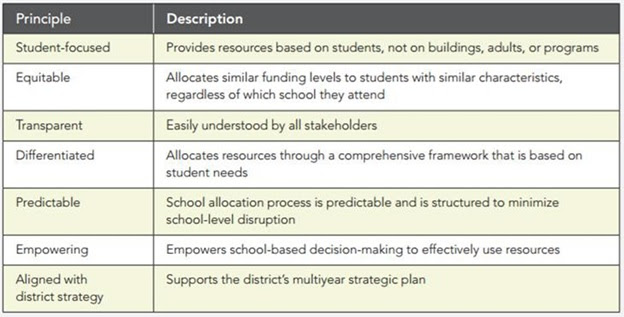
The table below lists and gives a short description of so-called “ERS Principles” the APS Leadership have apparently adopted, as given.  However, not one reference so far discovered even suggests that any ERS Principle represents a fundamental truth or proposition based in reality.  Rather, each principle inscribes, arguably, a statement of belief about free market ideology suitable for marketing SSF.
References about SSF, variously named, warn:
  • SSF is complex (e.g., this by ERS, itself)
  • SSF is fraught with implementation challenges (e.g., this)
  • SSF lacks research-based evidence that it works (e.g., this, which references APS)
  • SSF reproduces racial inequality that undermines funding equity (e.g., this and this)
  • SSF requires principals to be competently burdened “school CEOs” more so than knowledgeable leaders of educational practice and improvement

Open a window onto morals and ethics of SSF

To bring clarity and transparency to SSF in a way that exposes it for what it is, Carstarphen might engage her Accountability and Information Technology Division to model SSF as either or both a data model, so as to expose, as MLK Jr put it, the “interrelated structure of reality” SSF portends; and, a process model, possibly dynamic, so as to expose the interrelated behaviors SSF portends and to have a basis for predicting those behaviors, over time.

Structure and behavior are like opposite sides of the same coin; there cannot be one side without the other side.  An essential component of an SSF Model will be unambiguous and hype- and marketing-free definitions of things and relationships between things modeled.

(My post, Lexical Conventions for Enterprise Data Modeling, is freely available to the superintendent and her administration to draw from, as have some folk at major corporations even in faraway places such as the U.K.  So is my article, Enterprise Modeling: Checking with Reality, as published by Business Process Trends.)

Then, with either or both SSF Models in hand, people might be helped to see the complexity, inequality, absurdity, and various kinds of squander to come from implementing SSF, and then decide to reject SSF before it can be implemented and the damage done.

Even so, and essentially without expense, moral and ethical concerns alone should give pause and reason enough to reject Student Success Funding and instead commit to funding the Atlanta Public Schools system with the aim of starting the system off on a never-ending, unfinishable Journey of Continual Improvement and, along the way, detoxify APS of accumulated charter school industry squander, so the system can get back to being the wholly public good it is supposed to be.

My insertion, original emphasis:
  • “Planters strove for rationalization, standardization, and fungibility when it served their interests. Their ownership of capital [including human capital] gave them the power to commodify as they chose.”
  • —Caitlin Rosenthal, Accounting for Slavery: Masters and Management. Kindle Edition, Location 3511.

Ed Johnson
Advocate for Quality in Public Education
Atlanta GA | (404) 505-8176 | edwjohnson@aol.com

Thomas Ultican, the chronicler of the Destroy Public Education movement, writes here about the calculated destruction of the Oakland Public School District, which has suffered at the hands and by the wallets of billionaires.

In 2003, the district had a deficit of $37 million.

The state forced the district to take out a loan of $100 million.

In return, the state took control of the district.

After six years of state control, the district’s deficit increased from $37 million to $89 million.

Unfortunately for Oakland, the billionaire Eli Broad decided to turn the district into his petri dish.

Oakland Mayor Jerry Brown welcomed the state takeover.

The Broadies romped.

A California central coast politician named Jack O’Connell was elected California’s Superintendent of Public Instruction in 2002. He selected Randolph Ward, a Broad Academy graduate, to be Oakland’s state administrator. When O’Connell ran for state superintendent, his largest campaign donors had been Netflix CEO Reed Hastings ($250,000), venture capitalist John Doerr ($205,000), and Eli Broad ($100,000). Brown described the state takeover as a “total win” for Oakland.

The Broadies of Oakland

2003-2017 Broad Academy Graduates and Superintendents of OUSD

Broad Academy graduates are often disparagingly called Broadies.

The OUSD information officer in 2003 was Ken Epstein. He recounts a little of what it was like when Ward became the administrator:

“I remember a school board meeting where Ward and the board were on stage. Each item on the agenda was read aloud, and Ward would say, “passed.” Then the next item was read. In less than an hour, the agenda was completed. At that point, Ward said, “Meeting adjourned” and walked out of the board room and turned out the lights, leaving board members sitting in the dark.”

When Ward arrived in Oakland, the district was in the midst of implementing the Bill Gates sponsored small school initiative which is still causing problems. The recently closed Roots that caused so much discontent in January was one of the Gates small schools. Ward opened 24 of them (250-500 students) which in practice meant taking an existing facility and dividing it into two to five schools. He closed fourteen regularly sized schools.

When Ward arrived in Oakland there were 15 charter schools and when he left for San Diego three years later there were 28 charter schools…

Kimberly Statham, who was a classmate of Ward’s at the Broad Academy, took his place in 2006. The following year a third Broad Graduate, Vincent Mathews took her place.

After a short period of no Broadie in the superintendent’s seat, Antwan Wilson was hired in 2014. Shortly after that, the New York Times reported that the Broad Foundation had granted the district $6 million for staff development and other programs over the last decade. The Broad Center also subsidized the salaries of at least 10 ex-business managers who moved into administrative jobs at the district office.

Kyla Johnson-Trammell, an Oakland resident who and educator with OUSD, was named to replace Antwan Wilson in 2017. When he left to lead the Washington DC’s schools, he left a mess in Oakland. Mother Jones magazine says Wilson saddled the district with a $30 million deficit. They continue, “A state financial risk report from August 2017 concluded that Oakland Unified, under Wilson, had ‘lost control of its spending, allowing school sites and departments to ignore and override board policies by spending beyond their budgets.”’

The preponderance of the problems in OUSD are related to the state takeover, FCMAT and the leadership provided by Broad Academy graduates.

The usual billionaires have selected several of the OUSD board members and showered them with donations from out-of-district and out-of-state.

The fundamental problem is Oakland has a dual education system with 37,000 students in public schools and 15,000 in charter schools. It costs more to operate two systems. Every school district in California that has more than 10% of their students in charter schools has severe financial problems. Oakland has the largest percentage of charter school students in the state with 29% so financial issues are the expectation.

This is an education crisis that was manufactured by the super wealthy and implemented by neoliberal politicians.


Indiana is a swamp of school choice corruption.

If you read this post, your hair might catch on fire if  you are sensitive to things like ethics, honesty, and responsible stewardship of public money.

Seven years ago, the state superintendent of Indiana was a school choice firebrand named Tony Bennett. There was nothing he wouldn’t do to transfer public money from public schools to charter operators or religious schools. He was briefly riding high–the Thomas B. Fordham Institute named him the “reformiest of all reformers.” But then he came a cropper. An AP reporter unearthed the fact that he raised the grade of a charter school owned by one of his campaign donors. That was too much, even for the corrupt swamp overseen by Indiana Republicans. Bennett was defeated when he ran for re-election.  Bennett promptly became State Commissioner of Florida. That gig lasted only weeks, and he had to resign because of the ethics problem he left behind in Indiana.

One of his decisions during his tenure in Indiana was to hand over three low-performing schools in Indianapolis to the for-profit chain called Charter Schools USA, which is owned by a pal of Jeb Bush. The chain was supposed to “turn” those schools around.

As Indiana blogger Steve Hinnefeld writes, the schools continued to struggle. An extraordinary number of their students decided to homeschool, which boosted the graduation rate of the schools.

Lewis Ferebee, then the superintendent of Indianapolis, now the superintendent in D.C., was happy to work with Charter Schools USA.

Hinnefeld writes:

Charter Schools USA is a for-profit Florida company that operates over 80 schools in six states, according to its website. Its founder and long-time CEO, Jonathan Hage, has played influential roles in Florida Republican politics, including serving on Gov. Ron DeSantis’ education transition team.

Sherry Hage, who is married to Jonathan Hage, is founder and CEO of Noble Education Initiative, the nonprofit that would operate the three Indianapolis schools under a charter issued to ReThink Forward Indiana. There’s also ReThink Forward, a CSUSA arm that’s active in Tennessee; its vice chair is Tony Bennett, the former Indiana superintendent of public instruction.

Noble Education Initiative’s director of educational development and partnerships, Byron Ernest, is on the Indiana State Board of Education. Ernest worked for CSUSA as principal of Emmerich Manual for two years after the state took it over. (He has recused himself from state board decisions about CSUSA).

‘Turnaround academies’

Schools taken over by the state and turned over to managers like CSUSA are called turnaround academies. But they haven’t turned around quickly. T.C. Howe earned six more consecutive F’s under Indiana’s grading system after being taken over. Emma Donnan earned five F’s, then a C.

That’s despite approximately $22.3 million in federal School Improvement Grants that the State Board of Education has awarded to CSUSA for the schools. In recent years, the board has rejected recommendations from the Indiana Department of Education and its leader, Superintendent of Public Instruction Jennifer McCormick, to give a bigger share to district-run public schools that were struggling.

Charter Schools USA asked the Indiana charter board to turn the three Indianapolis schools into charters that it could add to its chain.

Shockingly, the charter board voted 4-3 NOT to give the schools to Charter Schools USA. 

As Chalkbeat reports,

Indiana Charter School Board denied charters Friday for three Indianapolis turnaround schools — a stunning move that could spell the end to the Florida-based Charter Schools USA’s operations in Indianapolis.

As a result, the three Indianapolis schools — Howe High School, Manual High School, and Emma Donnan Middle School — face the prospect of another rocky transition to new management, or even possible closure.

But the board’s 4-3 votes against the charters, which elicited gasps from the audience, marked a major victory for Indianapolis Public Schools, which could win back the three schools that have been under state takeover since 2011. (Two members of the charter board were not present for the vote.)

IPS could reclaim the three schools or close them.

But Charter Schools USA, despite its money and political influence, lost three juicy plums.

(Hint: the state schools’ chief Jennifer McCormick is secretly a friend to genuine public schools. Don’t tell the governor or the legislature.)


IT WON’T BE OFFICIALLY PUBLISHED UNTIL JANUARY 21, BUT YOU CAN PRE-ORDER YOUR COPY FROM YOUR BOOKSELLER OR AN ONLINE BOOK DEALER (PLEASE PATRONIZE INDEPENDENT BOOKSTORES, IF YOU STILL HAVE ONE NEAR YOU!).

I PROMISE YOU WON’T BE DISAPPOINTED!

IF YOU COME TO THE ANNUAL MEETING OF THE NETWORK FOR PUBLIC EDUCATION IN PHILADELPHIA MARCH 28-29, I WILL PERSONALLY INSCRIBE YOUR COPY OF THE BOOK!


EDUCATION

Slaying Goliath: The Passionate Resistance to Privatization and the Fight To Save America’s Public Schools

Knopf. Jan. 2020. 352p. ISBN 9780525655374. $27.95. ED
COPY ISBN

In this incisive, meticulously researched book, Ravitch (education, New York Univ.; The Death and Life of the Great American School) argues persuasively that the U.S. school privatization movement has resulted in poor test scores, the closure of public schools, and attacks on the teaching profession. Ravitch blames the so-called school reformers, whom she renames the disruptors, such as Bill Gates, Alice Walton, Michelle Rhee, Mark Zuckerberg, and Eli Broad, who spend millions to replace public schools with charter schools and private institutions that are run like businesses. Though disruptors view themselves as opposing the status quo, Ravitch contends that they are doing everything they can to maintain it. She devotes most of her book to the resisters, or the teachers, parents, and union leaders who have taken on the disruptors and are working to keep their local public schools open. Through this lens, Ravitch discusses the Common Core teaching standards, standardized testing, the Obama administration’s Race to the Top grant program, and Teach for America.

VERDICT This extensive analysis is required reading for anyone concerned about American education. [See Prepub Alert, 7/8/19.]
For Immediate Release
December 13, 2019
CONTACT:

Ori Korin
202-374-6103

okorin@aft.org 
Eric Jotkoff
617-784-1877

ejotkoff@nea.org 

Education, Civil Rights and Community Groups Respond to News of Planned Protest at Democratic Presidential Forum in Pittsburgh
 

PITTSBURGH—Several leaders of the 11 organizations co-hosting a forum on public education with eight Democratic presidential candidates this weekend—who, combined, represent more than 7 million people, including the Alliance for Educational Justice, the American Federation of Teachers, the Center for Popular Democracy, the Journey for Justice Alliance, the NAACP, the National Education Association, the Network for Public Education, OnePA, the Opportunity to Learn Action Fund and the Service Employees International Union—issued the following statement:


Alliance for Educational Justice National Director Jonathan Stith said:


“The mandate of black and brown students in the Alliance for Educational Justice is to end the school-to-prison pipeline wherever it rears itself.  We stand with those who stand with us against the prisonization and privatization of our schools. Students of color are in a crisis wherever they attend class. Our schools are over-policed and under-resourced, and we have no rights the federal government feels bound to protect. Our fight is for sustainable community schools that don’t need police, where Black and Brown students and their parents are respected and are able to determine the education we deserve.”


American Federation of Teachers President Randi Weingarten said:


“We are so excited that there are candidates for president who believe in public education and want to engage with the students who go to our public schools, the parents who rely on our public schools, the allies who advocate for our public schools, and the educators who work in our public schools. After all, public schools are the foundation of our democracy. That’s why Saturday’s education forum will be all about engagement—engagement around the issues that matter to all of us. We are united behind a single goal: to engage the candidates in a wide-ranging, important conversation about public education in our country and how we can best meet the needs of the people who work and learn in them.


“As to the announced protest, we are wondering why the groups didn’t simply ask any of the conveners whether they could join in the forum. Many of the organizations involved in the forum work with charter schools, many support them, and some represent educators who work in them. We’ve worked for months with partners to accommodate all inquiries from groups that requested participation in the forum. We’d encourage these groups to talk to candidates about their education platforms and proposals, or to consider holding their own forum, instead of staging a protest at the last minute at other groups’ events.


“Notably—and sadly—what we have discovered is that the group behind this protest is tied directly to a Republican campaign firm with connections to President Trump, whose track record, starting with the appointment of Betsy DeVos, the most anti-public school secretary of education in history, certainly speaks for itself.”


Center for Popular Democracy Director of Education Justice Campaigns Dmitri Holtzman said:


“This forum is an important opportunity for young people and allies to speak directly to presidential candidates about the issues that matter most to them and their futures. Education justice centers on the strengthening and uplifting of public education. That’s why the Youth Mandate for Presidential Candidates—which has been endorsed by over 150-plus youth-led organizations and allies—calls for an end to federal funding for charter schools and a moratorium on charter expansion. We stand firm in this fight and look forward to discussing these issues with presidential candidates at the forum. Any attempts to protest and disrupt this event undermine democratic and civic engagement about the future of public education.”


Journey for Justice Alliance National Director Jitu Brown said:


“We are excited to have Democratic presidential hopefuls speak to the breadth of the education justice movement: parents, educators and students. We know and live through the harm caused by inequities in public education and how the illusion of ‘school choice’ intensifies those inequities. To be clear, we will not be pitted against black and brown parents who support charters.  J4J is not anti-charter school as centers of innovation in our communities. We are, however, firmly anti-charter industry which has advocated for school closings, produced mediocre academic results and done harm by destabilizing education in our communities. We don’t have failing schools—as a public we’ve been failed.”


National Education Association  President Lily Eskelsen-García said:

“All students should have access to a quality public education no matter what ZIP code they were born, the color of their skin, or how much money their parents make. But sadly, for too long, astroturf groups have pushed privatization schemes including charters and vouchers, that divert already scarce money from the public schools that 90 percent of students attend. Despite the fact that these efforts have failed to improve education outcomes for students, Betsy DeVos and her allies continue to support efforts to privatize our public schools.


“Over the past two years, educators, parents and students across the country have come together in the #RedforEd movement to say enough is enough. It’s time to get serious about student success. Our elected leaders need to focus on the proven steps to ensure every student has access to a quality public school education. That means fully funding our public schools so students have the support and wraparound services they need, more one-on-one attention, inviting classrooms, and a well-rounded curriculum.”


Network for Public Education Executive Director Carol Burris said:


“The Network for Public Education Action believes that public schools are the pillar of our democracy and therefore parents have a right to elect those who govern their schools. Our nation’s most vulnerable children deserve public schools that have the resources to meet their needs. Well-resourced schools are undermined when funds go to privatized alternatives. Privatized choice with charters and vouchers is a means by which to distract the public from the need to equitably fund and support our public schools.”


OnePA leader and Pittsburgh parent Angel Gober said:


“When we win for the most vulnerable and underserved children, we win for all children. Charter schools are not the way.  As a black mother, what I have seen is other families choosing charter schools only to be disappointed by big promises. The lack of special education supports, the lack of innovative curriculum, and the harsh zero-tolerance policies find children right back in their public schools. We cannot continue to fund two separate education systems, especially one that leaves children with disabilities behind.”


Opportunity to Learn Action Fund Director John Jackson said:


“Today’s presidential candidates’ forum is significant because simply having an election doesn’t make a democracy, and after decades of inequities and injustices not only is our democracy on trial, but, by parents, students and educators engaging the candidates, they are placing justice on the ballot.”


SEIU International President Mary Kay Henry said:


“SEIU believes that every child should have excellent schools in their neighborhoods—no matter what their zip code or what they look like with communities, parents, teachers and classified employees having input and oversight into how our public schools and publicly-funded schools are run. SEIU members send their children to charter schools and they work in charter schools. We cannot deny how, unchecked, some charter school operators put profits over students. We see how lack of public oversight can lead to charter school operators operating for some of our communities, not all of our communities, and drain much needed resources from public schools. We will keep fighting for excellent public schools for all children, no exceptions.”


###


The AFT represents 1.7 million pre-K through 12th-grade teachers; paraprofessionals and other school-related personnel; higher education faculty and professional staff; federal, state and local government employees; nurses and healthcare workers; and early childhood educators.


Prominent groups that support public schools–not charter schools or religious schools–are meeting on Saturday in Pittsburgh to discuss the future of public education with Democratic presidential candidates.

The billionaire-funded charter industry is angry that they can’t control the event and they have released their plans to disrupt the event.

Contrary to the claims of the charter industry, charter schools are not public schools. They are private contractors that receive public money and are typically unregulated and fail to meet basic standards of accountability and transparency.

Unfortunately, their leaders insist on minimal or non-regulation, assuring that grifters and entrepreneurs will be able to receive public dollars without any accountability.

The industry resolutely refuses to acknowledge, let alone curb, the waste, fraud, and abuse that has created a backlash against charter schools.

The Center for Education Reform, led by former Heritage Foundation education analyst Jeanne Allen, sent out this email:


 Charter Schools in Pittsburgh & Leaders

 throughout Pennsylvania Unite


Issue strong message to special interest sponsors of “Public Education Forum 2020” and the Democratic candidates ignoring parental demands


WASHINGTON – Charter school leaders in Pittsburgh, joined by others throughout Pennsylvania, and by key state democratic officials issued strong statements today challenging the Democratic candidates for president who will be in Pittsburgh, Pennsylvania, this Saturday, December 14, 2019, at the David L. Lawrence Convention Center for the “Public Education Forum 2020: Equity and Justice for All.” Sponsored by unions and other interest groups, the Forum has sparked strong responses from the Pennsylvania charter school community, with its unfounded attacks upon the substantive work being carried out throughout the state and right in the city where the forum will be held.


“We call on the candidates to remember those who won’t be there: the thousands of parents from underserved communities tragically forced to watch their children suffer academically because of a failed system that refuses any real reform,” said representatives of 5 of the city’s charter schools in a statement, speaking on behalf of the state’s 143,000 charter school students and their parents.


“The Democratic Presidential candidates have been summoned to demonstrate their allegiance to the unions and special interests who they believe hold the key to their nomination,” said CER Founder & CEO Jeanne Allen. “Not invited were any charter or reform minded voices to participate in this nationally televised forum where Pennsylvania Governor Tom Wolf is expected to attend and criticize the very charter schools he has tried to keep from operating.”


Many charter educators will be on the ground in Pittsburgh to make their voices heard, including Dara Ware Allen, PhD, CEO and Principal, City Charter High School; Dr. Tina Chekan, CEO/Superintendent, Propel Schools; Jon McCann, CEO, Environmental Charter School; Vasilios Scoumis, CEO, Manchester Academic Charter School; Brian Smith, Founder & CEO, Catalyst Academy Charter School; William C. Wade, Ed.S., CEO, Urban Pathways K5 College Charter School; and David Zeiler, CEO, Provident Charter School. They have issued the following statement in response to the Public Education Forum this Saturday.


“As eight potential future presidents gather here in Pittsburgh this Saturday and are hosted by some of the nation’s most powerful special interests, we call on the candidates to remember those who won’t be there: the thousands of parents from underserved communities tragically forced to watch their children suffer academically because of a failed system that refuses any real reform. It is a cruel irony that the tagline of this weekend’s forum is ‘equity and justice for all’ when all the candidates being celebrated each oppose the very policies that help our schools give such words real meaning. Thanks to school choice, our public charter schools prevail at giving life-altering opportunity to children for whom educational success – and the more hopeful and secure future that comes with it – would likely be denied.


Steven Singer will be in Pittsburgh on Saturday as part of the Network for Public Education delegation to the MSNBC forum on public education.

Here are his questions for the candidates. 

He won’t get to ask them all, but they are all great questions!


Curtis Cardine, former superintendent of both public and charter schools, is the preeminent expert on charter schools in Arizona. He created the Grand Canyon Institute to study education issues, and it keeps a close eye on charter malfeasance.

Cardine has written two books that are well worth reading to learn about the failures of the charter industry in Arizona. He is an expert in school finance, and he demonstrates in detail how charter operators are ripping off the public.

The first was Carpetbagging America’s Public Schools.

I quote that book extensively in my own new book SLAYING GOLIATH.

Cardine’s second book, recently published, is Schooling Alone, in which he compares the atomization of society caused by school privatization, and likens its effects to sociologist Robert Putnam’s classic study of social disintegration, Bowling Alone.

Cardine recently prepared a review of Arizona charter school closures and their relation to the bond debt incurred by charters.

Read his letter to two Arizona state senators here.

Rachel Cohen writes here about the charter supporters backing Pete Buttigieg. 

Billionaire Reed Hastings held a fundraiser for Mayor Pete. Hastings, CEO of Netflix, has given millions to the California Charter Schools Association. He has said he looks forward to the day when there are no elected school boards. He likes schools run by corporate boards. He says they didn’t discuss charter schools, which is one of Hastings’ causes about which he is passionate.

Cohen writes:

Linda Lucy, who has served as the president of the South Bend teachers union since June 2018, told VICE she had never met with Pete Buttigieg, and had “nothing to add” about the union’s relationship with the mayor. “Politicians have hijacked the teaching profession in our public schools,” she said.

Buttigieg does appear to have made time for Heather Willey, one of Indiana’s top charter school lobbyists, who co-hosted a fundraiser for Buttigieg in Indianapolis on October 4, according to an invitation obtained by VICE.

Willey served on the board of the Institute for Quality Education, an Indiana school choice advocacy group, for years, and co-chairs her law firm’s “Charter School and School Innovation” group. In 2019, the Institute for Quality Education, Teach for America Indianapolis, and Charter Schools USA, Inc., a for-profit charter company, all listed Willey’s firm, Barnes & Thornburg LLP, as a hired lobbyist. According to her professional biography, Willey “has been intimately involved in the charter school and school reform movements since the inception of the laws in Indiana in 2001.” She did not return repeated requests for comment.

In Silicon Valley, meanwhile, Buttigieg has also had fundraisers with several prominent charter school supporters.

Satya Patel, a venture capitalist who formerly worked as a vice president of product at Twitter, co-hosted an event for Buttigieg in the Bay Area in late August. Between 2007 and 2017, Patel served on the board of KIPP Bay Area Schools, part of the nation’s largest charter school network, which has received tens of millions of dollars in federal grants. He did not return requests for comment.


The charter industry has lobbied for years to promote the idea that public schools and their teachers and teachers unions are uniquely responsible for denying educational opportunity to children of color. Ever since the propaganda film “Waiting for Superman,” produced by billionaire charter supporter (and rightwing evangelical zealot Philip Anschutz), the charter industry has promoted the claim that supporters of public schools are hostile to children of color while they—funded by billionaires like the Waltons, the Sacklers, the Koch brothers, the DeVos family, and every Republican governor—claim to be champions of civil rights.

”Malarkey!” says FAIR (Fairness and Accuracy in Reporting).

FAIR offers a “close reading” of media bias against public schools and demonstrates how the charter industry has deceptively labeled any opposition to charters as the work of teachers’ unions, never admitting that supporters of public schools include parents, grandparents, and graduates of public schools, as well as members of the public who understand the importance of public education in a democracy.

After thirty years of charter advocacy, only 6% of American students are enrolled in them.  In the only city that is all-charter, New Orleans, the only choice that is forbidden is a public school. This decision was not the result of a vote by the citizens of New Orleans, but a decision imposed by the white Republicans who control the State Legislature. Southern white Republicans are not typically perceived as concerned about the well-being of children of color.