I was interviewed by Brian Lehrer of WNYC, public radio about my latest book, probably my last. He is a great interviewer. He asks good questions, followed by people who called in to disagree with me.
It’s an excellent interview.
I apologize if I’m browbeating you with stuff about my book, but the book is really good; I worked on it for two years; the mainstream media has ignored it; and I think you will enjoy reading it.
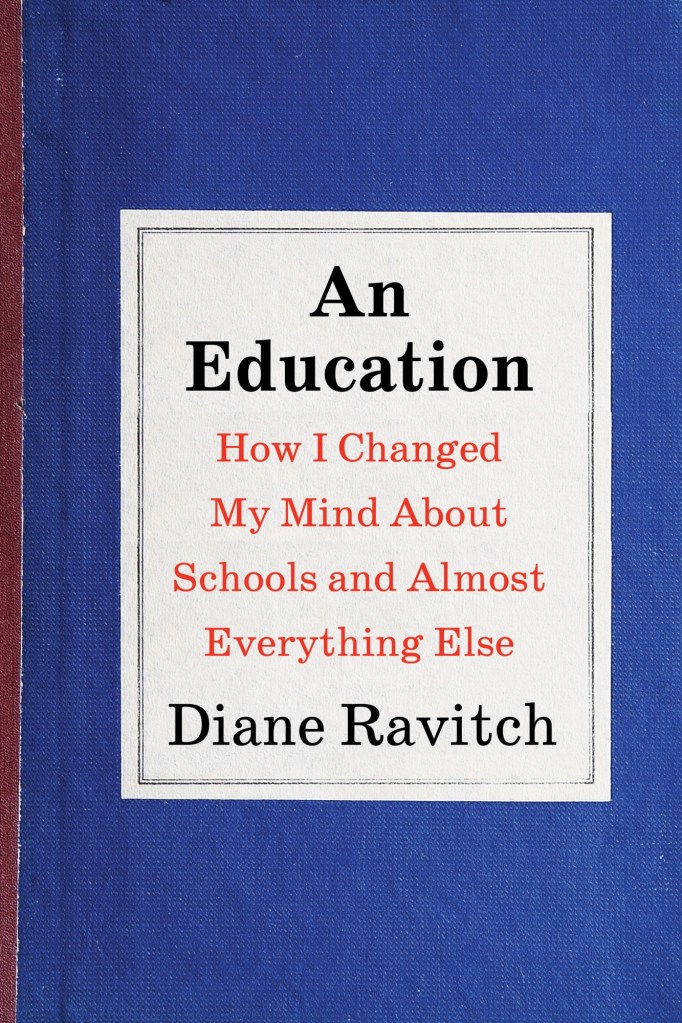
In case you haven’t noticed, the title is:
An Education: How I Changed My Mind About Schools And Almost Everything Else (Columbia University Press). You can buy it from Columbia University Press, your local independent bookstore, or Amazon.

 Diane Ravitch's blog
Good on you, Diane. Changing one’s mind means the mind was open. How rare a bird you are. Best wishes, Martha Ture Mt. Tamalpais Photographyhttps://mttamalpaisphotos.com The greatest joy in the world is in restoring the earth.
LikeLike
All I know is you welcomed me into your blog. I have always read your words as a person who entertains everyone’s ideas, stands your ground, and stands for something. As noted, when we decided our sons were not getting what they deserved in our local public school, we homeschooled and then sent my younger son to private school. “Oh, once your kids are in private school, they are the best.” Not the case for our boys. The private school was definitely inefficient in their approaches to methodologies and helping my son They both finished in public high schools. And, we paid for any costs associated with our choice, not playing with other peoples’ money. You have always stated we must protect public schools for ALL students and support them especially the marginalized (whom I advocated for and saw the savage inequities of “rich” and “poor”schools/districts). I rejoiced that I can talk to such a well known person, advocate, and author and you listen to my thoughts. I applaud your abilities and the fact that you said, “I don’t believe that way anymore.” I have done the same. In fact, you should check out Mel Robbins’ book, “Let Them.” I wrote to her and said, “If I had a nickel for every time I said “Let Them” I would be “rich” and not just in my name. Like you have always stated, “You don’t have to read my blog, you can change the channel.” And, as you probably know, I am not a “hook, line, and sinker” person. I analyze and metacognate tremendously. You are a good person and I wouldn’t feel safe expressing my words here if you weren’t. Blessings.
LikeLike
Well, thank you, Rick. I am privileged that you and others take the time to read my blog. I work hard at assembling it. Sometimes people get angry because they don’t agree with me, and I remind them that they are not compelled to read what I write. I post what interests me. I assume that the people who stick with me find my choices worthy of their time. I try to model civility and respectful discourse, but sometimes I don’t succeed.
LikeLike
I read a lot of philosophy and “How to Speak Like a Buddhist” writings that inspire me to be quiet and listen rather than “yell out” and reveal to all I am a buffoon. You listen. As a teacher who asked a lot of questions, my students told me (100% of them): “We just want someone to listen to us and not solve our problems; just listen. Maybe someday I will write a book, but I don’t think I can sit still long enough as there are far too many birds, cats, and squirrels to care for at my home and at my mother’s. You keep doing what you are doing because you create a narrative. You know I often told my art students, “If you paint a mountain, everyone knows it’s a mountain. If you paint a purple duck with a green head swimming on an orange pond, people stop and create dialogue. They want to know what is going on. Keep doing what you do.
LikeLike
❤️❤️❤️❤️❤️❤️❤️
LikeLiked by 1 person
Hey Diane,
Will there be an audio version of your book coming out soon?
LikeLike
Jeclark, I surely hope so.
LikeLike
Diane, Just listened to your interview with Brian Lehrer. Super clear, comprehensive, and on point!
Two additional points on the charter school issue I think are worth mentioning. First, charter schools represent the idea that it is impossible to improve public schools for all kids, so we need an escape valve for those who are worth (or are capable) of “saving”. As such, since it tends to attract more politically parents, it deflects pressure to do all the things we need to do especially around societal inequity and property tax funding inequity. Second, I think it is important to differentiate between what might be the right choice for an individual student and what makes sense for states and the nation to create a schools system that serves the needs of all students.
Thanks as always for your leadership, especially your public statement about changing your mind based on evidence grounded in values.
Arthur
LikeLike
Thank you, Arthur, for your comments. I appreciated them.
LikeLike
Under the leadership of extremists school choice has shifted from “saving poor kids from their zip codes,” which, by the way, they never really accomplished, to destroying public schools and grabbing public assets. The privatization of education has been co-opted by a variety of zealots, billionaires seeking to reduce their tax responsibility, and endless profiteers. We have squandered over a billion dollars on privatization, and we have very little to show for it except for ever increasing attacks on and lies about public education. While there may be some charter schools that provide some benefit, they should be managed by public boards of education that can oversee the flow of funds and provide accountability. The unaccountable charter school sector is rife with waste, fraud, bloated budgets and top heavy administrative costs.
LikeLike
Your answers to the questions posed by the callers were on point. The thing I keep thinking about when charters are mentioned is that their idea was very close to campus schools that have grown up around universities, where experiments in educational methods were tried in association with teacher training programs. These schools were in their concept, going to augment the public effort, not undermine it. The best laid plans of mice and men, I suppose.
LikeLike
Charter schools originally were supposed to be R&D centers for public schools. Their charter might be extended to continue working for another five years. But after five or 10 years, their charter would expire, and teachers would return to the public schools.
Charters were supposed to collaborate with public schools, not compete with them.
Their first proponent with a national megaphone was Al Shanker. As he saw how the charter idea was playing out, meeting none of his hopes, he turned against them.
LikeLike
Bravo, Diane! Your book is excellent – genuinely insightful and thoughtful. Thank you.
The fundamental problem with the way that we talk about high stakes testing is the same problem with the testing itself – it is discussed only in isolation, and it is used only in isolation in schools. On a macro level, instead of recognizing that high stakes testing is symptom of much larger interconnected issues – poverty, funding inequities, the corporatization of education, top down management of schools – we only look at it as the zero-sum method for evaluating students, and for measuring their success. We shouldn’t even begin to discuss evaluation, and high stakes testing, until we’ve worked through these other questions. On a micro level, we need to think about – and plan – a variety of questions/issues, such as schooling purpose, structure, use of time and space, etc. before considering evaluation and testing. Once evaluation is actually given the correct place in our thinking and planning, we would come up with much more meaningful and connected ways to measure progress, skills, capacities, inclinations, and knowledge. But, that requires a complete readjustment in how we perceive what is important and what schooling and education are for.
LikeLike
Lorenzo,
Thank you. Your comment suggests how warped our education thinking has become in the past three decades. The politicians who pass laws about education know very little about the realities of the classroom or the problems of the students or the quandaries of teachers.
Most–almost all–are locked into the testing syndrome. They don’t think much about education, so they believe that testing is the only outcome that matters. It can be quantified, simplified, understood by anyone.
The schools that get high scores are the best schools. The teachers whose students get high scores are the best. The students who get high scores are the best.
But even a cursory review demonstrates that that’s not true.
What do tests measure and how should they be used? Why are scores on tests the best indicator of quality?
I could go on but I did in the book. The more I learn about how tests are written, how they are scored, and their effects, the less I trust them.
LikeLike
Your book is wonderful! (Bought {had ordered} 1st week it was available @ our local, independent bookstore.) Also asked our suburban public library to order it, which they did, & have just put it on their “New Nonfiction” shelf in the front. Should be read by EVERYONE. Congratulations!
BTW–the perfect holiday gift for educators, parents, elected officials & Linda McMahon (show her how it’s done!).
LikeLike
Thank you!!!
❤️❤️❤️❤️❤️
LikeLiked by 1 person
I woke up this morning and was about to write something about your book. It was a wonderful coincidence to listen to this interview. It’s a dark and very cold December morning here in Upstate New York so your voice has been like a warm blanket.
There’s been a number of coincidences along the way as I enjoyed your memoir. I woke up early a few weeks ago in a Washington, D.C. hotel room and decided to stay huddled under the covers, reading a few chapters. And, there you were, on page 77, talking about attending the March on Washington in 1963. Later that day, as I walked down the mall and could see the White House, I felt as if I’d been transplanted to a different planet. But not really.
As you have relentlessly documented during your career, the prejudice and hate that have long poisoned our nation never left for good. And, public schools remain the softest target for people who want to monetize and weaponize EVERYTHING under the sun -with so many children caught in the crossfire.
There’s plenty of blame to go around. How can so many children still be poor in a nation that is so rich?
It’s an incredibly selfish time in American history. Maybe that’s one reason the “mainstream media” has ignored your memoir, as you put it. You’ve been willing to call out people all over the political spectrum during your remarkable lifetime. Who wants to look at THAT in a mirror? It takes courage. It’s not fun….it’s not a meme.
Inevitably, the pendulum will swing back. Maybe someday there will even be our own version of a Truth Commission, like South Africa used. Though it’s hard to fathom what role artificial intelligence will play in any such possible moral reckoning. Have so many humans just plain given up and our letting machines do their thinking? What kind of ethical universe is that?
It’s been a pleasure to take a break during this dire moment in world history and read a book that is truly NOT AI generated. Your memoir is intelligent, thoughtful, humane and wise. Talk about an antidote to the toxic crap that is propagated 24/7 online….everywhere.
Thanks for all your hard work, Diane. Your writing has truly been a refuge for me.
LikeLike
what a wonderful, insightful post. I agree no one wants to know the truth or what really goes on in a classroom or why the arts are cut so often. Or why the kids who need the most are shoved in corners for no one to see. Teachers who speak up are often ostracized for their efforts. And yes, why in the world does the most important discipline, education, always struggle whe geez we have 350 million for a ballroom. Your words are priceless.
LikeLike
what a wonderful, insightful post. I agree no one wants to know the truth or what really goes on in a classroom or why the arts are cut so often. Or why the kids who need the most are shoved in corners for no one to see. Teachers who speak up are often ostracized for their efforts. And yes, why in the world does the most important discipline, education, always struggle whe geez we have 350 million for a ballroom. Your words are priceless.
LikeLike
Thanks,
Take care.
LikeLike
I was skeptical of your conversion in the early years, you still seemed way too chummy with the people spreading lies about American schools and teachers. However, you have been outspoken in promoting your new views and I thank you for that.
LikeLike
Thanks, Mike. When I stopped agreeing with the rightwing view that public education is broken, I left the club of true believers and they tossed my stuff out and locked the door.
LikeLike