Trump and his acolytes have thrown around the term “critical race theory” without e we defining it. He picked it up from rightwing extremist Chris Rufo, who thought that it could be used as a blunderbuss to smear public schools. He convinced large numbers of anxious white parents that the public schools were teaching their children to be embarrassed and feel guilty about being white. That, Rufo implied, was the inevitable result of teaching the unpleasant facts about slavery, Jim row, and racism.
Here is a different point of view, written by Alan Leveritt in The Arkansas Times.
He readily admits that he is a beneficiary of critical race theory.
He writes:
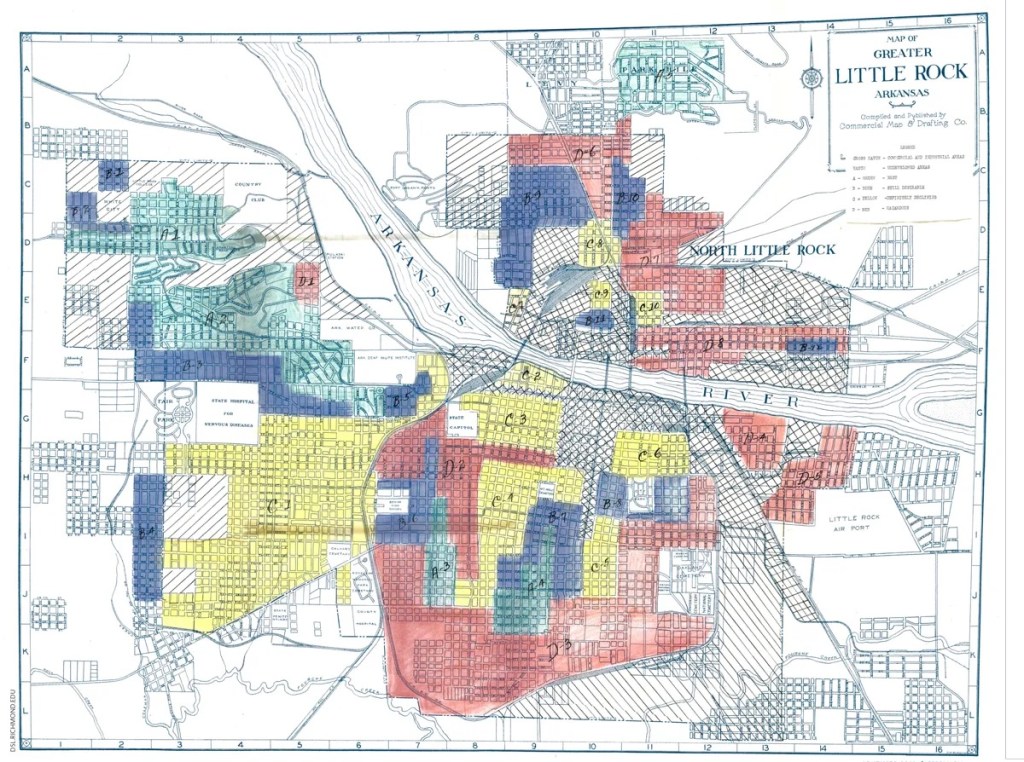
Believed to be circa 1945, a map illustrates redlining practices in the Little Rock area. Red means Black neighborhoods and no loans, while green means white neighborhoods and access to FHA loans.
Credit: dsl.richmond.edu
I came close to graduating from college, damn close in fact. Last I looked (about 30 years ago) I was three hours and an overdue parking ticket short of a history degree from UA Little Rock. But even though I remain a doubtful scholar, I am a devoted student of Arkansas history and its ability to instruct us regarding some very big issues facing our country.
I am, of course, talking about critical race theory.
Army 1st Lt. J.P. Leveritt came back from World War II, got his master’s degree in physical education and in 1950, along with my mother, built one of the first houses in Lakewood in North Little Rock for $8,000. Thus began my family’s long and beneficial association with critical race theory.
To paraphrase the Oxford American Dictionary, critical race theory argues that many of our social and economic institutions have been created for and by white people. Those institutions, many dating back almost a century, were designed to lift white people up and keep Black people down. I am a direct beneficiary of that system.
When President Franklin Roosevelt tried to create the Federal Housing Administration as part of the New Deal, his proposal to make home ownership accessible to ordinary people through federal home loan guarantees met with opposition from members of both parties. What we take for granted today was just one step from communism then. Southern Democrats ultimately agreed to support the establishment of a Federal Housing Administration on the condition that Black citizens be excluded. Now white people could more easily become homeowners and Black people could more easily become renters.
When my parents bought their home in Lakewood, they had to sign a covenant never to sell to Black buyers. This was an actual FHA requirement. Had they not signed, the FHA would have refused to guarantee them any loans in Lakewood. If Black people could move into Lakewood, the property values there would crater, putting the FHA loans at risk, was the explanation.
Another FHA innovation was to rate neighborhoods based on class and race, the thought being that neighborhoods occupied by Black people were too risky for government guaranteed loans. The Little Rock/North Little Rock redline map is color-coded, with green neighborhoods approved for FHA loans and red neighborhoods (predominantly African American) ineligible for bank loans. Thus the son of Lakewood homeowners inherits $175,000 upon his mother’s death in 2012, while the Black son of Rose City renters gets nothing.
This is an example of critical race theory in action. The primary source of intergenerational wealth is home equity. Even though Black households earn 60% of what white households earn, they only have 5% as much wealth. That wealth should have come from home ownership, which never occurred because the game was rigged.
My dad had a good war. He grew up in Smackover and went to Arkansas A&M at Monticello, where he played for the Rambling Boll Weevils and learned deep tissue massage as a trainer. He was headed to North Africa as a medic but through a series of happy accidents, wound up in the White House as President Truman’s masseuse and private trainer.
As with all vets after the war, the GI Bill allowed him to further his education and receive low-interest home loans among other benefits. But while the language of the GI Bill was inclusive of all vets, it was administered by the states, which meant that Black vets, especially in the Jim Crow South, received on average 70% of the benefits their white comrades did. Despite the GI Bill of 1944 offering free college education, it was 11 years before the first Black veteran enrolled as an undergraduate in a state-supported college in Arkansas with the exception of all-Black Arkansas AM&N. Up to then, they were directed to vocational schools if at all. The low-interest home loans the GI Bill provided weren’t much help, either. Because Black veterans could not live in white neighborhoods and Black neighborhoods were redlined, they seldom could get a loan to buy a house where they were permitted to live.
Discrimination for FHA mortgages and GI benefits has in part been remedied by various civil rights laws, many of them from President Lyndon Johnson’s time. But to understand the great economic disparity between the races, we need to know history, especially Arkansas history. The economic disparities we see today are a direct result of what happened years ago when we came up with race-based barriers to education and wealth.
Why would our Legislature and governor try to disappear this history? Why would they try to decertify an Advanced Placement African American Studies class in our high schools, or discourage honest study of systems that set some of us up to thrive but left others to struggle? Their argument that if we teach these facts, some white child might be made to feel guilty is pure nonsense.
Get over it. It’s our history. Teach our kids the truth and maybe they will be better people than we are.

 Diane Ravitch's blog
Rufo and company have gone on to DEI now, and soon another word will appear that serves as a barrier to thinking.
Of course there were barriers based on appearance. The entire slave system in the United States endured because slave systems were able to link African appearance to enslavement. This provided wealthy slaveholders a wedge that could be driven between segments of the poor in a political south, and was soon recognized by members of the growing cities in the industrial age as a good wedge for them too.
Of course modern MAGAs are the inheritance of this political system, just like Nazi antisemitism was the inheritance of European authoritarians from medieval Europe to Czar Nicholas II. Indeed it is a technique that is tried and true.
LikeLike
The Color of Law by Richard Rothstein is a great book to explain this systemic racism.
LikeLike
One caveat to any discussion of wealth gaps between races: What is usually discussed as a wealth gap between “blacks” and “whites” is mainly driven by the gap between the wealthiest Americans and everyone else.
https://jacobin.com/2020/07/racial-wealth-gap-redistribution
LikeLike
And this gets very extreme when it comes to the bottom half of Americans.
“In much of the popular discourse on the racial wealth gap, the emphasis is on the median white household and the median black household. To understand how misguided this emphasis is, we can do exactly what we did above but for the bottom 50 percent of each race. After topping off the current bottom 50 percent of black families so that they have as much wealth per household as the current bottom 50 percent of white families, mean black wealth rises by $23,100, cutting the racial wealth gap by 3 percent.
What this shows is that 97 percent of the overall racial wealth gap is driven by households above the median of each racial group. This explains why you can produce shocking conclusions that show a relatively small amount of money can dramatically reduce the (median) racial wealth difference: it is not that hard to get two groups who own relatively little to own the same amount of relatively little. But such measures would not make much of a dent in the overall racial wealth gap.”
LikeLiked by 1 person
“After topping off the current bottom 50 percent of black families so that they have as much wealth per household as the current bottom 50 percent of white families,, mean black wealth rises by $23,100….”
You’re going to have to explain that voodoo economics. Sounds like you’re saying that even in the bottom 50%, whites have an average of $23,100 more wealth than Blacks, which still seems like a heck of a gap to me.
LikeLike
It’s the difference between someone who has virtually nothing and someone who has nothing.
LikeLike
So, Blacks have nothing and whites have $23,100? I’m still confused. This statistic seems to be saying that even among the bottom 50%, whites still have more than Blacks. The amount of the gap is more narrow, of course, because you’re talking about less wealth overall. I just don’t think that statistic is saying what either your or Jacobin think it’s saying. If Black wealth is plotted separately from white wealth, white wealth is still greater at all levels.
LikeLike
The mean wealth gap among the bottom half is 23k.
LikeLike
Okay, so that’s pretty significant when you’re only comparing people who don’t have that much wealth. So the Black-white wealth gap is not “driven by” the very wealthy. It goes all the way through the system. Obviously if you compare a group of people who have anywhere from a fair amount to a hell of a lot, the gap is going to be bigger than if you compare people who range from nothing to piddling.
LikeLike
One could debate forever how much is “a lot.” $1,000 is a lot of money to some people. My point here is that it is an extremely small percentage of what people talk about when they talk about the “racial wealth gap.” My point, again, is that this gap is driven mainly by differences in wealth among the wealthiest blacks and the wealthiest whites, and that the “gap” is dramatically smaller for the rest of black and white Americans. And my larger point, again, is that the conventional discussion of the so-called wealth gap obscures this fact, and that focusing on the gap between what blacks and whites have is terrible politics that divides Americans, prevents them from seeing the importance of their common interests, and will be easily exploited by the GOP until the end of time.
I don’t think there’s anything else I can say on the topic without continuing to repeat myself, so I’ll let this drop.
LikeLike
You like to pretend that there is nothing real that divides Blacks and whites in America – that all the sins of the past are meaningless now. But they’re not and Blacks will continue to be hesitant to make common cause with whites until they have common stake with white. So long as even the poorest whites are $23,100 ahead of the poorest Blacks, that isn’t the case. The inequity between Blacks and whites pervades all levels of society. By pretending that the difference is only at the highest levels, you are obscuring damages that continue to affect the lives of Black people.
LikeLike
I should have bowed out, but of course the poorest whites are not $23,000 ahead of the poorest blacks. That is an average applied across the entire bottom half of families. The poorest whites have nothing. The poorest blacks also have nothing.
Unfortunately or happily, whichever the case may be, it’s not within my power to stop people from focusing on race as a major political issue. You are free to keep doing so. Other more influential people will keep doing so. There is an industry of NGOs whose mission is to keep doing so. So if you’re concerned my view will become the dominant one among Democrats, I wouldn’t worry if I were you. But it is terrible politics and in my view it’s one of the main reasons we will continue to see our politics cleaved into the two party system we have today.
I disagree with the suggestion that black Americans will not support Democrats if Democrats stop emphasizing “racial gaps” and instead emphasize the material things that would benefit all non-rich Americans. This is conjecture of course. But I think the last Presidential election, which saw Dems shedding black support and the GOP gaining it, should give pause to anyone who thinks the current path is good politics for Dems. Trump wasn’t picking up black voters because he was promising to reduce the racial wealth gap.
LikeLike
this is consciously created by a wealthy group that wishes to divide the poorest and least served using race
LikeLike
This is why I generally think emphasizing race, particularly through the lens of amorphous, all-encompassing terms like “systemic racism,” is very bad politics for Democrats.
LikeLiked by 1 person
Flerp: while I see your point, I also feel it would be a moral problem to ignore the history of economic favoritism and discrimination. Ignoring or de-emphasizing truth does not make it less true.
LikeLike
Absolutely agree that history should not be ignored or whitewashed.
LikeLike
Laws in this country are often designed to benefit those that are white and wealthier. So-called “choice” in education is a tool for sorting students by race and class. The choice movement has allowed the proliferation of white flight academies that now can be funded with public dollars in many states. We hardly live in post-racial America!
Real estate is wealth. Red lining, while illegal, is still quietly practiced in many communities in this country. In the South many Black families owned family farm land that had been passed down from one generation to the next. Some Black families still own the land as a “tenancy in common” property. Sometimes a white judge holds the deed on the property on which he can foreclose for back taxes. Other times a white developer buys one share of the property and forces the other landholders to sell it to him the remaining shares. “By 1910, Black Americans like Smith’s ancestors had acquired a cumulative 16 million acres of rural land. But over the century that followed, 90% of that land was lost because of threats, violent force or systematic rejection from programs offered to white landowners to help keep land through economic hardships like the Great Depression.” Al Roker co-produced a documentary called “Black Land,” which describes the hardships of holding family plots in The South. https://www.nbcnews.com/news/nbcblk/black-property-heirs-generational-land-families-developers-wealth-rcna135733
LikeLike
I taught English to Haitians for more that three decades so I have learned some of their history. When people look at Haiti, they see a poor dysfunctional island, which it is. Its history helps explain why. It is due in part to international plot of CRT. After the Haitian revolution of 1791-1804 which freed the slaves, white nations including the US conspired to make Haiti pay reparations to the SLAVE HOLDERS for its revolt. They also implemented an embargo on Haitian goods, mostly sugar cane, and the island became poorer and isolated. The US feared a free Haiti would inspire a slave revolt in the US which actively worked to keep Haiti economically marginalized. https://www.npr.org/sections/money/2021/10/05/1042518732/-the-greatest-heist-in-history-how-haiti-was-forced-to-pay-reparations-for-freed
LikeLike
Disgraceful!
LikeLike
This is a bit misleading: “…designed to lift white people up and keep Black people down.” There was no need to lift White people up as long as Black people were effectively held down – which they very much were.
LikeLike
Same in my family. They had been coal miners. Nobody owned a home until the GI bill. After WW II my uncle bought a home in Levittown PA for $11,000. Now it is worth much more. But Levittown was officially and legally whites only. This huge benefit and builder of generational wealth was denied to black families. It is not too late to offer mortgage and down payment assistance to any children, grandchildren, or great grandchildren of color whose ancestor served in WW II. It’s only fair.
LikeLike
Sonia,
Under Trump, any program to compensate any person of color for past discrimination against them or their ancestors would be banned for being DEI.
LikeLike
In my northern Democratic city in a blue state, it may not have been against the law for black people to move into white neighborhoods, but the red lines existed and it was realtors that enforced them, making sure there would be no integration through the early 70s. They did this by scaring white people into moving away and it was called block busting. They called virtually all of the white homeowners and told them that if they didn’t sell their houses right away, they would never get paid the full value for their homes. There were prosperous blacks who bought the nicest homes in the wealthier areas first, but literally all the white people moved away within about only four years time. (In the beginning, some moved out at night –which I never understood.)
The businesses left, too, and nearly half of my city has been all black ever since, with large swaths of food deserts in those neighborhoods due to the loss of so many white owned mom and pop stores. Everyone I knew moved away including my own family. I was entering my last year of high school then and I had diverse friends, so I was rooting for integration. I tried hard to fight against moving, but I had no say in the matter. It still upsets me. We haven’t been able to go back there to visit either, because it’s not the same place anymore since literally everyone we knew there moved away over 50 years ago. So sad. (I did go back anyways, but not since a gang of teenagers shouted “What are you doin here whitie?” and threw beer bottles at my car about 30 years ago.)
LikeLike
So I thought that people who work in real estate have way too much power long before I later learned about how the malignant-narcissist prevented blacks from moving into his father’s properties in NY…
LikeLike
BTW, my first teaching job, which was in Head Start at an elementary school located near my high school, was in a neighborhood that was very nicely integrated with Whites, Blacks, Hispanics and Asians, otherwise I haven’t taught in the areas where I grew up. However, I later worked at several schools in black areas of my city, which were all low income neighborhoods.
LikeLike
Also, the population of my city significantly declined because most families moved to the suburbs during white flight, including mine.
LikeLike