Texas Public Radio reported on the devastating effect that charter expansion is having on the public schools of San Antonio. The city leaders, in their ignorance, decided not to improve the public schools, but to create a parallel private system to compete with them. Both sectors are funded by the public, but the charters choose their students and some do not offer transportation.
The city’s population is growing but enrollment in its public schools is shrinking.
The main reason for the apparent contradiction is an exponential growth in publicly-funded, privately-run charter schools. Charter school enrollment in the San Antonio metro area has grown by more than 200% since 2009, according to a Texas Public Radio analysis of a decade of enrollment records obtained through public information requests.
In the past two years alone, charter networks in the San Antonio metro area gained nearly 11,000 students. For traditional school districts, that meant a corresponding loss in funding. State funding is based on attendance.
The big charter networks, like IDEA and Great Hearts, have selective enrollment practices. IDEA has received more than $200 million from Betsy DeVos and the federal Charter Schools Program.
Some local parent groups are fighting back, but they are vastly outspent by the charter networks and undercut by state policy, which favors privatization.
Charter favoritism guarantees that the local public schools, which enroll most children, will be underfunded and will serve a disproportionate number of students with the highest needs.
Some parents have organized to fight back:
Standing in the neighborhood next to Oak Meadow Elementary in the North East school district, Cameron Vickrey said her daughters’ school “experienced a kind of mass exodus” a few years ago to go to Great Hearts. Great Hearts is a charter network that uses a classical curriculum similar to private schools.
“When all of those people left there was a volunteer vacuum,” Vickrey said. “That was when I came to the school, and as a new kindergarten mom I was put on the PTA board… because they pretty much had to create a PTA board from scratch.”
Vickrey’s neighborhood is mostly one-story, ranch-style houses a short walk or drive from the elementary school.
Trimmed yards are sprinkled with white signs that say “Proudly RootEd in NEISD.”
Vickrey and a few other Oak Meadow parents started making the yard signs after hearing other parents say that nobody in the neighborhood goes to the traditional public school.
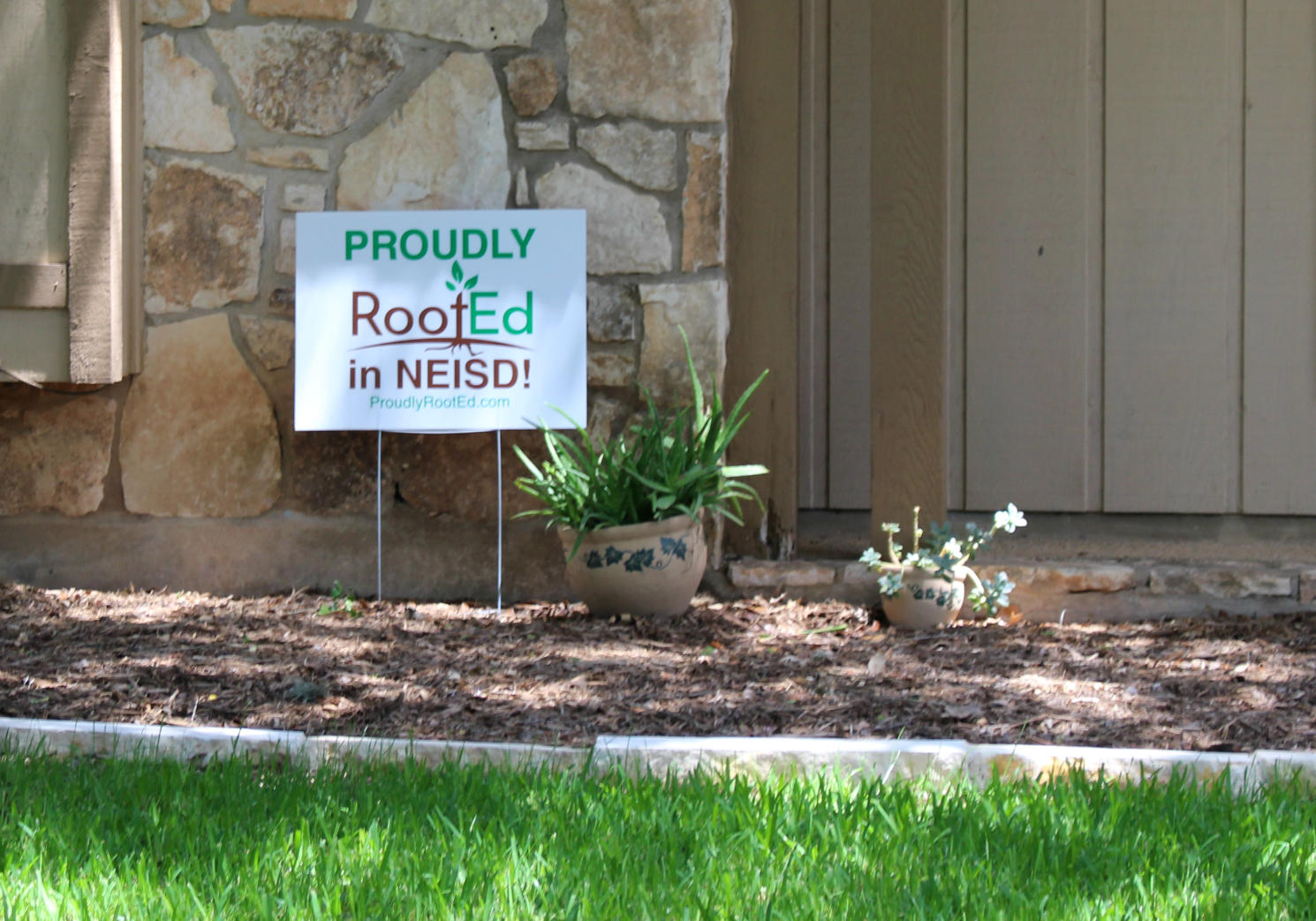
“And we stopped and thought about it, and we were like, ‘That’s not true! Of course people go to that school.’ They just don’t know those neighbors, right, because maybe they’re not in their clique or whatever.”
From there, RootEd grew into a nonprofit with a mission of spreading positive stories about district schools — both by word of mouth and on social media using the hashtag RootEd.
“RootEd just wants to say, ‘Wait, hang on a second. Remember that these schools are here. And there are awesome things happening in them still,’” Vickrey said. “Make that your first stop, the first thing that you look into and if it doesn’t work for you for whatever reason, nobody’s going to fault you for that. You have a right to do that but we just want to make sure that people don’t discount their public schools.”
Vickrey said she also wants parents to consider the “unintended side effects” of choosing charter schools: less money and volunteers for the traditional public school, and a tendency to choose a school where people look like you.
“Our middle school that we’re zoned for here is a Title I (low-income) school, Jackson Middle School,” Vickrey said. “And it’s fabulous, but so many start choosing their school path for elementary school based on trying to avoid Jackson Middle School.”
Jackson Middle School is 80% Hispanic and 72% economically disadvantaged. San Antonio’s Great Hearts schools are less than 20% low-income and almost 50% white.

 Diane Ravitch's blog
It is refreshing to see that some parents realize the great things happening in San Antonio community-based school districts. It is disturbing the most community members have not connected the dots to the orchestrated attack on San Antonio public schools that is courtesy of privately-funded special interests. From Choose to Succeed and City Education Partners to Families Empowered and SA Charter Moms, former TFA, Mind Trust, KIPP, Inc. etc. continue to exploit local communities. Organizations that include trustees of the George W. Brackenridge and Ewing Halsell Foundations that “choose to promote their beliefs on the education of others”.
LikeLike
Expand and vary the public schools, and lower class sizes.
LikeLike
That’s becoming harder to do when you are losing money to the charters. And…
1.charter administrative costs are higher
2. costs to build charter schools (with bonds) are higher,
3. lower numbers of SE students attend charters(and the ones they service cost on the low end)
4. over 2,000 charter schools have closed in the last 9 years
4. on average, test scores are no better than pubic schools
So…
All of this costs money, costs that are now being duplicated. Is this what conservative voters really want?
Why can’t we do school choice thru public schools?
LikeLike
DeVos targets poor communities for “reform,” and San Antonio is on her radar like El Paso. I cannot understand why the federal government continues to fund private charters that undermine the public schools. My understanding is education is supposed to be a state issue except for issues related to civil rights. Charters that resegregate communities are doing nothing for civil rights. The federal government should be challenged on the legitimacy of the practice of providing grants that resegregate public schools. Unchallenged, DeVos will turn cities into Texas into mini-Detroits, and we know how turned out.
It was interesting to see the meager applause that Julian Castro received at the NEA Forum. O’Rourke, another son of Texas, got a much friendlier reception. Castro grew up in poverty, and he overcame a tremendous amount. He also attended public schools. These smart young people that head to ivy league schools seem to be brainwashed by neoliberalism. Castro was a former mayor of San Antonio, and he started the city down the path to privatization. He also worked in the Obama administration.
The only candidate that opposes the DOE privatization “slush fund” that he has vowed to end is Bernie Sanders. This slush fund is designed to undermine democratic public education, and it innovates nothing. It simply is a fund that can be used to attack public schools to open the door to greedy privatizers. This is faux competition rigged by the federal government.
LikeLike
I’ve been watching the charter school debacle for years now, mostly across the country. Now it’s impacting San Antonio. My hometown. My school loses students to charters. They often come back, months behind in instruction.
Why do they leave? Mostly because we can’t seem to get a handle on discipline.
The undeserved perception of public schools doesn’t help either.
We need to vote Trump and Devos out of office.
-16 year public school veteran teacher in title one schools.
LikeLike
They leave because corporations have slick marketing campaigns that make empty promises. The parents don’t know any better. The public schools have no PR firm. Public schools are a public service. They were never designed to be part of an unfair competition. Thus, they have no means to defend themselves other than from caring members of the community. The billionaire dark money is constantly bashing public schools for being inadequate. People fall victim to the hype and spin. This is not really competition. It is an unfair war against a public institution that has served us well.
LikeLike
At least in my area, it’s not the discipline that’s the problem, although that’s a reason some parents use. The real reason in many cases is so that their children are away from “those people:” minorities, kids with special needs, behavioral issues, the poor, etc.
LikeLiked by 1 person
the hidden but most destructive element
LikeLike
Why don’t you convince the parents that the education that their child is receiving is sub par and list the advantages of the local public schools. Start on the local level. You will not get anywhere on the state or federal level.
LikeLike
Wow–I LOVE these signs & these parents–let’s get these signs up (RootED–We Love Our Public Schools!) in every hamlet, village, ‘burb, town, & city in every state in the U.S.!!
LikeLike
YES!
LikeLike
Cameron Vickrey is one of our strongest partners with Pastors for Texas Children! We are proud of her and her strong witness for public education for all children!
LikeLike
As Akademos says above, “Expand and vary the public schools, and lower class sizes.” Easier said than done, of course, when the charters are pullling the rug out from under the public school budget. But in Part II (linked at the end of the article), the superintendent describes recent SAISD efforts to provide “charter-like” specialty schools with open enrollment, including outside district. They’ve been offering many nbhd schools options to add/ change school models to incorporate dual-lang, Montessori, single gender, gifted, et al– w/some success stories, & a turnaround from quickly sliding district enrollment to a slight gain. They’re promoting it via door-to-door signups for registration & school tours (parent volunteers now aided by union).
I like the idea, but wonder how you manage this longer term w/o running into some of the same problems caused by charterization – mainly, leaving the poorest schools w/a core of all-minority, high-pop SpEd & behavior problems.
LikeLike
Not saying it can’t be done, just not on the cheap. You’d have to be doing something special everywhere – not just for those who can afford to drive their kids daily to a different option. And even w/wrap-around services & lots of extras, it doesn’t make good ed sense to have some schools whose “specialty” is severe LD, ED, & poverty.
LikeLike