Well before the attempted assassination of former President trump, Michael Hiltzik wrote a column about gun control for The Los Angeles Times. In this column, he expresses hope that the extraordinary gun violence in the United States might produce a moderating trend among policy makers. I confess that I am not as hopeful as he. Maybe it’s possible that the conservative majority might have second thoughts about their objection to sensible gun control. Hiltzik is encouraged by their recent decision that a man with a history of domestic abuse should not own a gun. I hope he is right.
He writes:
For decades, gun control policy in the U.S. has been virtually untouchable — except through efforts to make America’s gun culture deadlier, raising the toll of innocent victims.
Two recent developments suggest that the ground may finally be shifting toward rationality.
One is an “advisory” from Surgeon General Vivek Murthy identifying firearm violence as a public health crisis — the boldest statement from a government official calling attention to the horrific consequences of the nation’s turn away from common sense gun control.
Originalism tells judges not to consider the practical consequences of their interpretations.
— Former Supreme Court Justice Stephen Breyer explains why America can’t pass workable gun laws
Murthy’s report is in the finest tradition of public health policy, akin to the 1964 report by Surgeon General Luther Terry that placed the links between smoking and cancer, bronchitis and coronary disease into the public record.
As Murthy himself observes, that initiative placed the U.S. on a course of tobacco regulation that reduced the prevalence of smoking from 42% of adults in 1964 to 11.5% in 2022.
The other is a June 21 Supreme Court decision finding that laws barring domestic abusers from possessing guns are constitutional. The ruling is an indication — albeit slight — that a majority on the court has concluded that earlier decisions that found almost any state and local restrictions violated the 2nd Amendment were far too indulgent.
Let’s take the advisory and ruling in order.
Murthy’s advisory is an extraordinary synopsis of the toll of America’s fascination with firearms and its failure to regulate gun ownership.
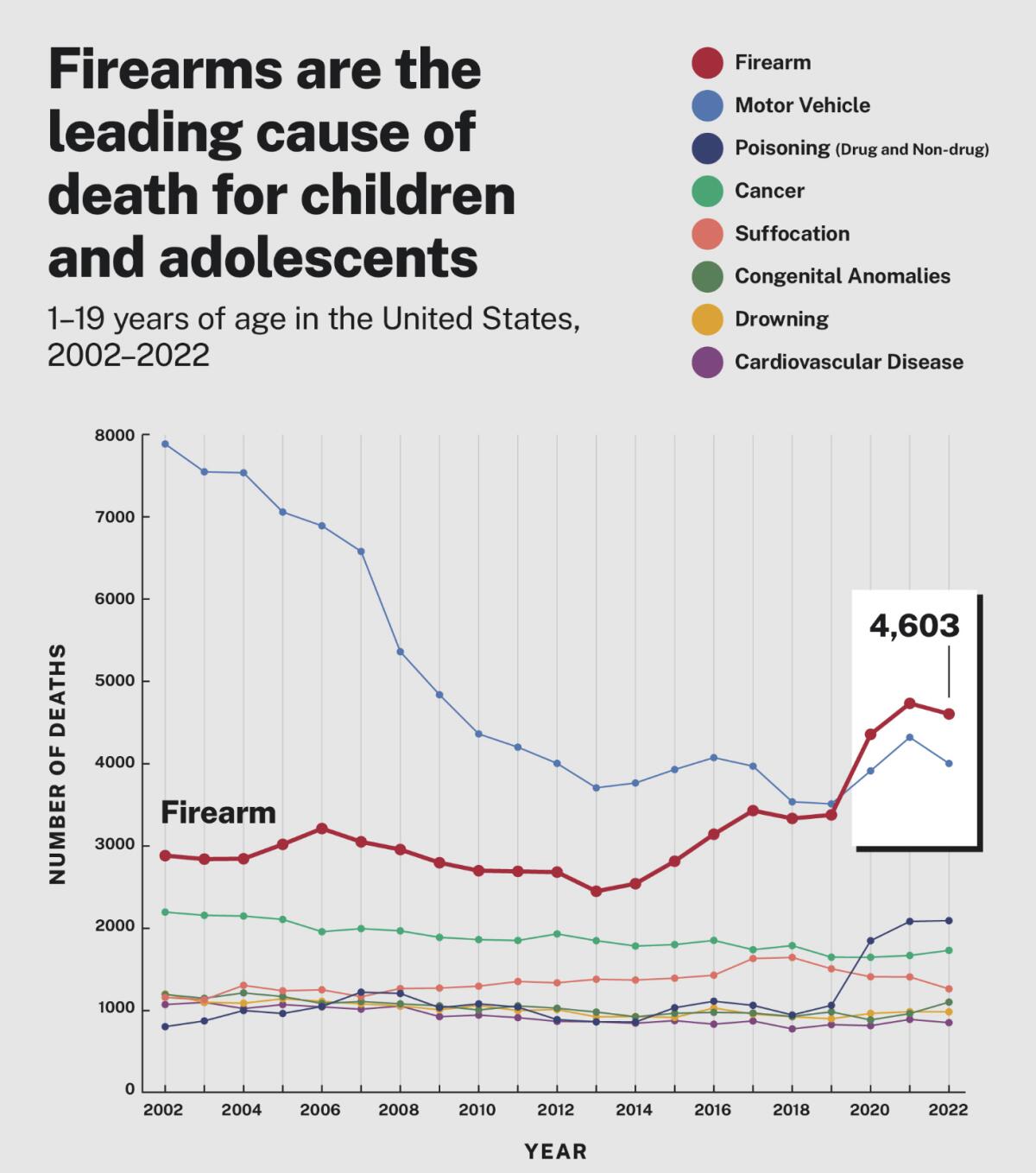
Firearms passed motor vehicles as the leading cause of death of children and adolescents in the U.S. in 2019. (U.S. Surgeon General)
He reports that firearms are now the leading cause of death among children and adolescents, having passed motor vehicles in 2019. In 2022, guns killed more than 48,200 Americans through homicides, suicides and accidents, rising by about 16,000 over the previous 10 years.
Murthy’s report notes that guns are used in 55% of all suicide attempts and that their lethality in those cases is unmatched — nearly 90% end in death, higher than any other method.
The report treats mass shootings (defined as those with four or more victims, not counting the shooter) soberly. These account for only about 1% of all firearm deaths, but their impact is far greater due to their “outsized collective trauma on society” and their “strong negative effect on the public’s perception of safety.” One in three adults “say fear prevents them from going to certain places or events.”
Murthy’s report puts the lie to the familiar claim by Republicans and gun rights fanatics that the problem, especially when it comes to mass shooting, is mental health, not firearms.
House Speaker Mike Johnson (R-La.), for instance, told Fox News anchor Sean Hannity in October, after a gunman killed 18 people in Lewiston, Maine: “Mental health, obviously, as in this case, is a big issue, and we have got to seriously address that as a society and as a government.”
Yet Murthy reports that “one’s mental health diagnosis or psychological profile alone is not a strong predictor of perpetrating violence of any type…. Importantly, most people with serious mental illness are not violent against others. In fact, people with serious mental illnesses are more likely to be victims of violence.”
For all their nattering about the need to address mental health, anyway, Republicans have never lifted a finger to promote any programs to do so.
Now to the Supreme Court.
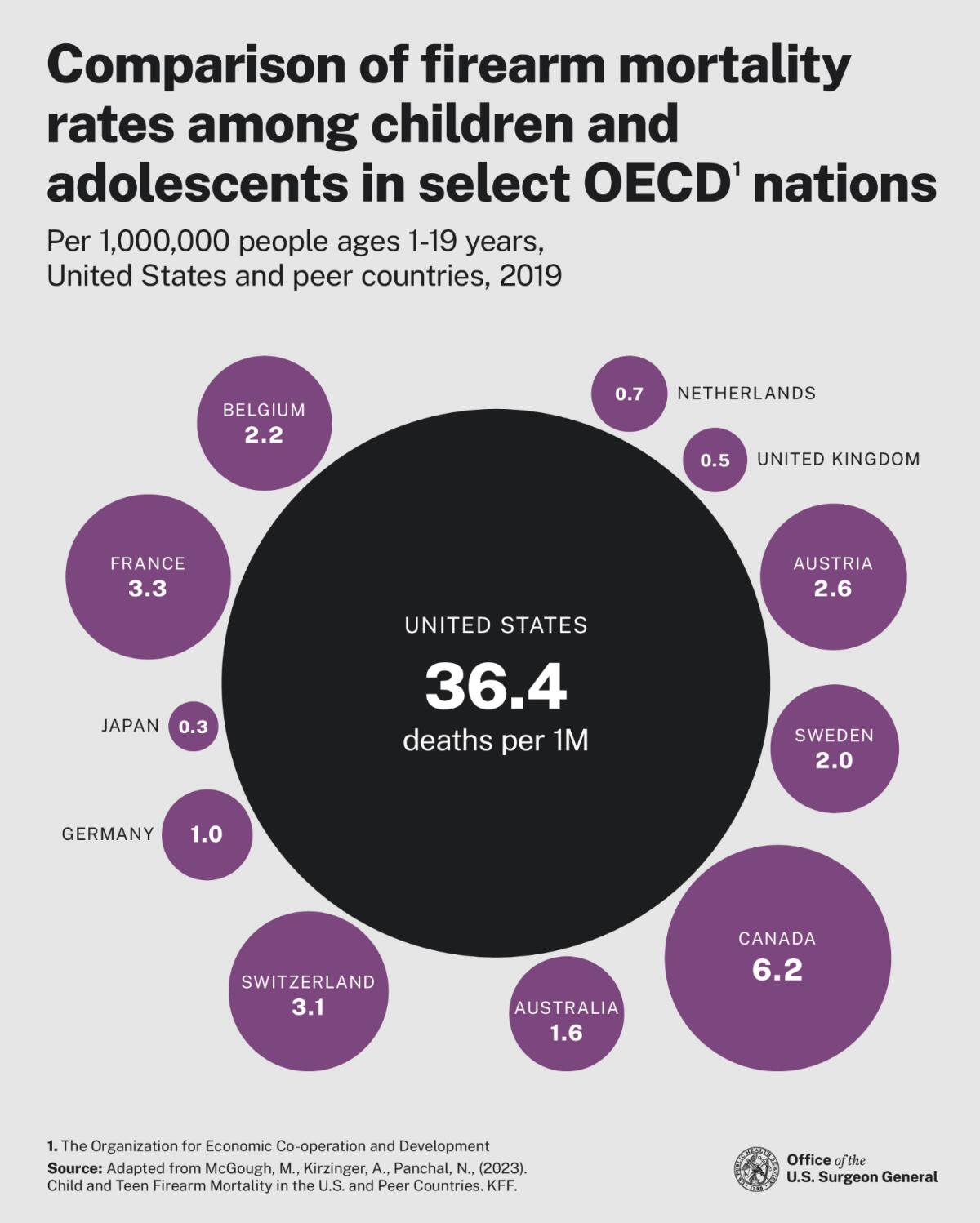
The rate of firearm deaths of childen and adolescents in the U.S. vastly surpassed the rates in other developed countries.
(U.S. Surgeon General)
Rahimi v. United States, which yielded an 8-1 decision on June 21, is the first gun-rights case to come before the court since a 2022 decision known as Bruen, in which Clarence Thomas, writing for a 6-3 majority, essentially found that all modern efforts to regulate firearms are unconstitutional.
Thomas held, in effect, that the only legitimate basis for judging gun laws is historical — weighing the laws against the language of the 2nd Amendment to determine how the amendment was viewed by its drafters in 1789 and how their approach was dictated by the political and social context of that time.
In Bruen, Thomas ridiculed Justice Stephen Breyer’s dissent (with which justices Sonia Sotomayor and Elena Kagan concurred). Breyer had opened his argument with nine pages of statistics about gun ownership and its consequences for health and safety.
“It is hard to see what legitimate purpose can possibly be served” by Breyer’s figures, Thomas sneered. “Why, for example, does the dissent think it is relevant to recount the mass shootings that have occurred in recent years?”
In Rahimi, however, Chief Justice John G. Roberts Jr. asserted that the consequences of unrestricted gun ownership were highly relevant. To be fair, this was easy. The record made clear that Zackey Rahimi, the gun owner at the center of the case, was one vicious specimen indeed. As Roberts laid out in the opening three pages of his majority opinion, Rahimi had beat up his girlfriend (the mother of his child) and fired in her direction or at a bystander as she fled his grasp.
After she got a restraining order against him, he stalked her, threatened a different woman with a gun, was suspected by police of at least five other shootings, fired at motorists in at least two road-rage incidents and fired his gun indiscriminately at least two other times. Police searched his home and found a pistol and a rifle. He was charged under a Texas law that criminalized possessing a gun while under a retraining order due to domestic violence.
Despite all that, the 5th Circuit Court of Appeals overturned Rahimi’s conviction, citing Bruen.
Roberts’ decision in Rahimi is a step toward ratcheting back the Bruen effect, in which almost every gun regulation is suspect. That brings us to the “originalism” principle, which undergirds the court conservatives’ distaste for restrictions on gun rights. As expressed by Thomas in his Bruen opinion, originalism holds that interpreting the constitution must depend on the “public understanding of a legal text in the period after its enactment or ratification.”
As the now-retired Breyer put it in a recent essay, “the originalist, instead of looking to the text and asking what the words mean now, may well ask what they would have meant to an ordinary eighteenth-century person” and applies them to the world of today. (Breyer isn’t a fan of originalism.)
Scholars such as Stanford historian Jack Rakove argue that interpretations of the 2nd Amendment depend more on originalism than any other provisions of the Constitution. Its impact emerged most notably in the Supreme Court’s so-called Heller decision. In that 2008 decision written by Justice Antonin Scalia, a 5-4 majority overturned a Washington, D.C., ordinance largely barring citizens from possessing handguns for self-defense in their own home.
Heller overturned more than the D.C. law — it upended more than 200 years of scholarship about the meaning of the 2nd Amendment’s preamble, which links “the right of the people to keep and bear arms” to the establishment of “a well regulated Militia.”
As Breyer pointed out, historians and linguists had argued (in a friend-of-the-court brief in the Bruen case) that the phrase “bear arms” overwhelmingly referred to “war, soldiering, or other forms of armed action by a group” — not to an individual right. Heller, however, established an individual right to gun ownership for the first time.
Bruen expanded that right to gun ownership outside the home. The ruling deemed unconstitutional a New York law requiring citizens to have a license to carry firearms in public. America’s rising tide of gun violence can fairly be traced to Heller.
Scholars have pointed to numerous problems with originalism. One is that judges are (usually) not historians. They may be utterly at sea when trying to find the apposite historical application to contemporary conditions.
The drafters of the 2nd Amendment, as it happens, were concerned about the public threat of a government’s standing army; historians argue that the amendment was designed to prevent the federal government from interfering with the creation of state militias.
Firearms in the 18th century were “not nearly as threatening or lethal as those available today,” Rakove writes; people in that era were concerned not with threats from “casual strangers, embittered family members, violent youth gangs, freeway snipers, and careless weapons keepers.”
In other words, applying an 18th century mind-set to 21st century conditions is a fool’s errand. “Originalism” only interferes with judges’ responsibility to ponder the real-world impacts of their decision — their option, Rakove says, is to “ransack” the historical record for quotations that can support their preexisting goals.
“Originalism,” says Breyer, “tells judges not to consider the practical consequences of their interpretations.” Its product is the paralysis of federal, state, and local efforts to regulate gun ownership. It’s also responsible for the contraction of individual rights being rolled back almost gleefully by the current Supreme Court majority, notably abortion and other women’s reproductive healthcare rights, as originalists argue that the concept of privacy on which those other rights are based can’t be found in the Constitution.
It’s also proper to note that the public during the time the 2nd Amendment was drafted, enacted and ratified is very different from the public affected by its consequences today. In 1791, among other distinctions, enslaved people were not considered citizens and women could not vote. Who set the terms back then under which today’s Americans must live?
Rahimi won’t solve the mess in gun regulation created by the Heller and Bruen rulings. A multitude of pending cases might strengthen it or undermine it. But at least it’s a step back from the abyss.
Murthy’s advisory gives a similar impression of being a first step on a path that might lead nowhere. He calls for more research on violence prevention strategies and laws preventing children’s access to guns, universal background checks, banning assault weapons and restricting the carrying of loaded firearms in public.
The bottom line, of course, is that America’s gun violence crisis can only be solved by fewer guns. There’s a long road ahead to reaching that goal.

 Diane Ravitch's blog
After Sandy Hook, I thought, well, now Congress will finally do something.
That they didn’t gives me zero confidence that they ever will.
LikeLike
cx: That it didn’t then . . .
LikeLike
I join today with millions of other Americans in saying that I am horrified by the attack on ex-President Trump and grateful for his having survived. That’s why I am calling, in the interests of his safety, for him to be immediately and PERMANENTLY removed to a safe and secure location such as an institution for the criminally insane.
LikeLike
Even Epstein’s island would do. After all Elba was good enough for Napoleon.
LikeLike
They aren’t having second thoughts. They’re just defining the outer limits.
LikeLike
If anyone ever thought a wickedly loose and vengeful wannabe fascist is too much, just imagine what a now frightened and even more defiant and feckless fascist will do to quell his fears, if elected.
LikeLike
Originalism?
The Constitution mentions “person” several times, including its requirement for a census. Nowhere does it mean “corporations.”
The same court says bump stocks that convert a semiautomatic weapon into an automatic one fits into the founders’ original vision.
Abortion was common in the 1700s, but it was women’s work (midwives and all). It wasn’t until much later that states began to ban the practice.
The founders added an amendment that says the listing of certain rights doesn’t disparage others. In the Declaration of Independence (surely an insight into the founders’ thought), they list inalienable rights, ” among them ” are life, liberty, and the pursuit of happiness. “Among them” surely means there are other.
Originalism?
Get Outlook for Androidhttps://aka.ms/AAb9ysg
LikeLike