Archives for category: Humor

Timothy Snyder left his endowed professorship at Yale University and is now ensconced at the University of Toronto, where he holds the inaugural Chair in Modern European History at the Munk School of Global Affairs and Public Policy. Snyder is known for his many books about European history.

After Trump’s long and tedious State of the Union speech, Snyder wrote this satirical description of a Cabinet meeting.

He begins:

Donald Trump, president of the United States. “Calling this meeting to order. That was a long speech that I just gave. State of the Union. Long speech. Not going to stand up and do that again next year. So let’s hear it. Plans to make sure I don’t have to. Plans to end the United States by a year from now. Around the table. Go. Start us off, Linda.”

Linda McMahon, Education. “Thank you, sir. Nothing is more important for the country than public schools. So we are destroying them by directing tax money away from public school parents and towards private education scams.”

Russ Vought, Management and Budget. “The republic depends on its institutions. As you know, sir, we are wrecking our civil service by firing those who are qualified and replacing them with political hacks. I don’t want to overstate my case, sir, but these are not just normal hacks. They are hackety-hacks, sir. They will use what remains of the government to hasten the process of its destruction. Hackety-hack, sir.”

Trump. “Good. Hack. Good. But maybe something faster.”

Scott Bessent, Treasury. “A government works on the basis of tax revenue. From the beginning of your administration, sir, we have been overseeing a shift whereby people who actually have the money won’t pay any taxes. Indeed, our oligarchs will be the happy recipients of whatever tax money we can scrape up from the middle and working classes. This wealth shift from the population at large to the wealthy few is inconsistent with the survival of a republic. This will help speed along the change Russ is talking about.”

Howard Lutnick, Commerce. “And there’s a next step, if I may, sir. When we empower the oligarchs they can help us. Big tax cuts make them happy and destructive. The endgame here, sir, is to have billionaires control extraterritorial zones, like Epstein Island, a place that I know well, but without any fear of taxation or any other form of government control. These little fiefs then replace the United States. This is the scenario and I do think we can bring it home within a year.”

Pam Bondi, Attorney General. “And a republic is based upon law. This is where Justice comes in. We can ruin law in a number of ways, such as investigating the people we ourselves murdered, or persecuting your personal enemies. A good way to kill our Constitution is to protect pedophile oligarchs, such as yourself, sir. I was attorney general in Florida while Epstein pioneered our future, sir, and I can see this through on a national scale. We can make this Epstein World, sir.”

Trump. “I like it. But that’s familiar stuff. I mean I live there now, right. Let’s see some movement. How about some color.”

silhouette of building under orange clouds

RFK Jr, Health and Human Services. “There was a lot of color in the middle ages, sir. Our freedom and security are based on modern vaccinations and hygiene. We undo all of that and promote epidemics. We see good results already in Texas and South Carolina. Not just people dying but babies and children getting really colorful diseases like encephalitis. By the way, this also opens up wellness markets for the people Howard and Scott are talking about. It takes people a while to die and there is money to be made there.”

Doug Burgum, Interior. “I may have something even more basic than that, sir. Everything we know about human history indicates that rapid changes in climate can bring down whole civilizations. We are deliberately engineering one of those. By suppressing green energy we can generate rapid global warming and make human life unsustainable. And along the way we get that color. People turning against each other, guns out until we run out of ammunition, then clubs, starvation, the works, a real spectacle. And, as Bobby says, disease. Very colorful, sir.”

Lee Zeldin, Environmental Protection. “And, if I may add, sir, our campaign to fry the species gives us all good practice in telling big lies, which are needed for all of these plans. Also, the billionaires will be fine on their islands when all of this happens.”

Trump. “OK, that’s colorful, I get it, but I want something with bad guys. Like a movie. The warming thing doesn’t work as a movie. Do you remember The Day After Tomorrow. I don’t remember the Day After Tomorrow. I want enemies. Bad guys who win.”

Marco Rubio, State. “I can help there. You are right, sir, that a republic to survive has to defend itself against autocratic enemies. So we empower the autocrats in China and Russia. We break the international system that held them back. We prop up Moscow in Ukraine and we give Beijing our most sensitive technology, ideally by way of middlemen who enrich you, sir, personally. If I may say so, sir, your friends and family have been very helpful in all of this.”

Tulsi Gabbard, National Intelligence. “Intelligence is the eyes and ears of our republic, sir, and we want these eyes and ears to be penetrated by foreigners who wish for us to fail and die. So we have liftedour cyber-defenses and announced that we have done so. If I may add, sir, both Russia and China support your incredible leadership in their information ops. It’s as though we all want the same thing. I see it every day and it’s beautiful. Spirit of Aloha. We say hello and they say goodbye…”

Kristi Noem, Homeland Security. “Without disagreeing with any of that, I just wanted to add that a republic exists because people believe they belong to a single nation. So the most direct way to kill our republic is a civil war. This almost worked the last time; this time we are getting the federal government behind white supremacy. We are creating a giant national secret police force in order to invade cities and force a conflict.”

Pete Hegseth, Defense. “Kristi is right. The war we can win is against Americans. And now that we are bringing unsupervised AI to direct our weapons, we won’t have to start it ourselves. It will be automated, we just watch from those safe islands. You see, sir? Movies. Terminators. Squiddies. Remember Wargames, sir, shall we play a game? AI likes nuclear war, it will recommend it 95% of the time. Get me into a conventional war, I lose it quickly, and boom. That would save you from having to give the speech, sir.”

Trump. “I like it. No long speeches. No Union. Steal what we can and burn the rest. Or burn first and then steal? Works either way. Steal, burn. Either way. Burn, steal. To help out I will just be me. Steal, burn. Me. Burn, steal. Me.”

(Applause)

•••

The conversation is fictional, of course. In essence, though, this is little more than a review of the news of the last few days and weeks.


Ann Telnaes was the chief political cartoonist for The Washington Post until she drew a carton of Jeff Bezos and other billionaires paying homage to Trump. Obsequiously. Her editor spiked her cartoon, presumably because The Post is owned by Jeff Bezos. She quit and started her own Substack blog where she is free to draw whatever she wishes.

Here is her latest. It refers to the Bezos-funded “Melania” film, about her life in the 20 days preceding the 2025 inauguration. It is titled “Mendacity.”

This group of friends in Maine has adapted the well-known song, “The 12 Days of Christmas” to fit a different theme: “When he’s gone.” They never say his name, but we know it.

Hilarious! Also, hopeful. Someday he will be gone. Gone with his egotism, narcissism, vengefulness, cruelty, greed, and disdain for the rule of law.

Sometimes we can learn more from comedians than from newscasters. Here are clips from our leading humorists who have late-night shows.

Jon Stewart

Seth Myers

Stephen Colbert

Jimmy Fallon

Jimmy Kimmel

Who got it right?

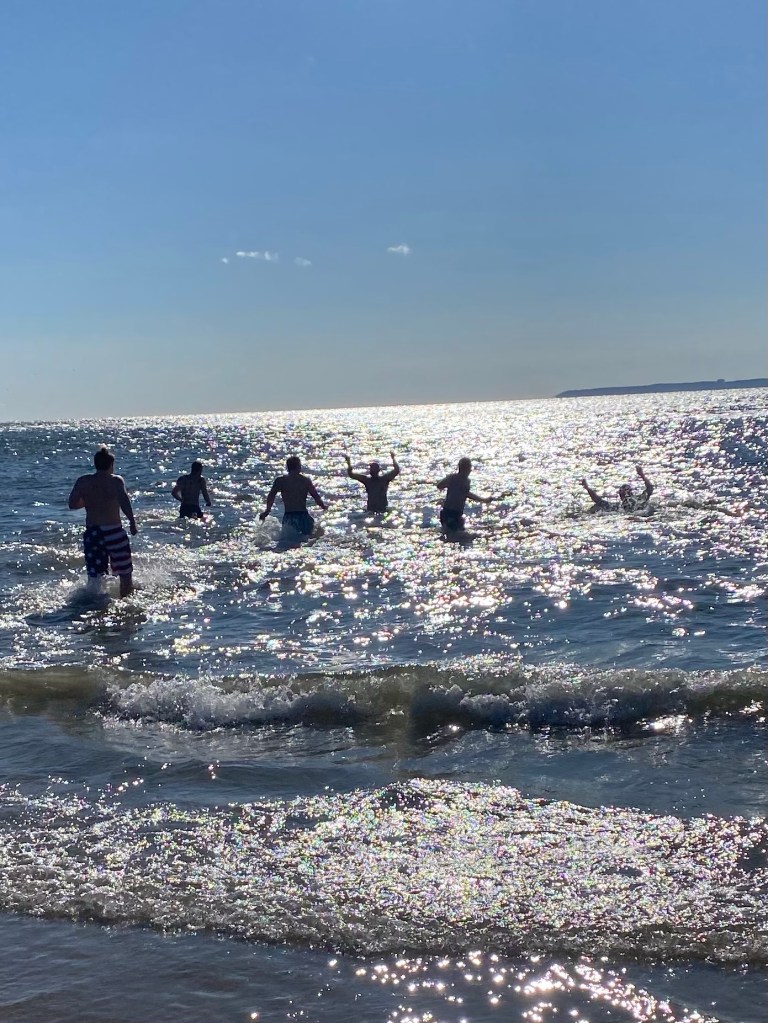
This morning I went with four friends to Coney Island in Brooklyn for the Annual Polar Bear Plunge. Hundreds of people (or more) showed up to take a dip in the ocean on a frigid day.

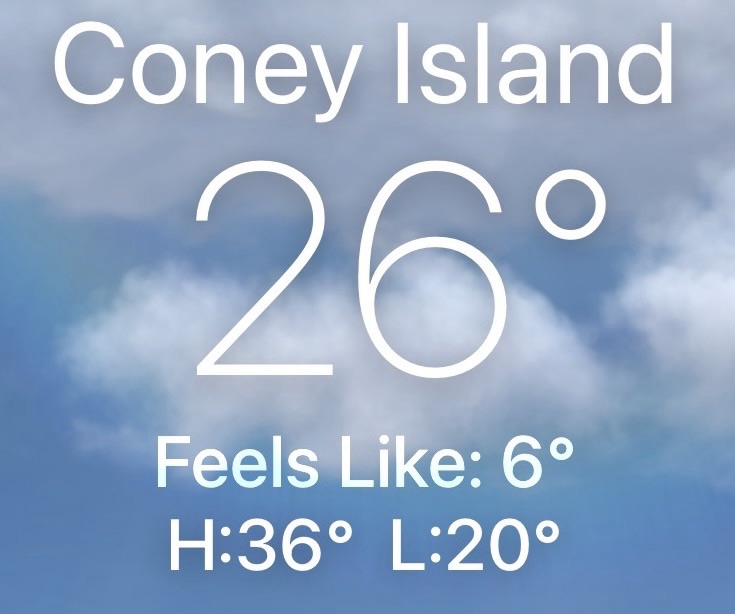
The sun was shining brightly, but the air temperature was in the high 20s, and the “real feel” due to gusty winds, was only 6 degrees.

The atmosphere was festive. Swimmers came with friends to cheer them on and offer them towels and blankets when they emerged from the water.

Some were in silly costumes. Some wore funny head pieces. None carried a mock Statue of Liberty into the water. Women and girls were in bikinis. They stripped off their warm clothes and their shoes and ran into the Atlantic Ocean.

There was a mood of hilarity about the madness of the event. Everyone was smiling or laughing or both. People run into the water. Some run out as soon as they have gotten wet. Others actually swim. Some splash around.

A lifeguard keeps watch, and a police boat is anchored about 100 yards beyond the swimmers.

The Coney Island Polar Bear Club sponsors the event every year to raise money for local charities. Their members swim all year round; the huge crowd of swimmers shows up only on January 1, to welcome in the New Year.

For two hours, politics, heated partisan issues, and acrimony were cast aside as a diverse crowd of Americans frolicked in the ocean.

I asked one young woman in a tiny bikini how it felt to jump in. She said “Exhilarating! The water was warmer than the air.”

Another young woman peeled off her clothes and stripped to her bathing suit, accompanied by three friends. She said it was her first Polar Bear Plunge. I asked why she was doing it. She said, “If I can do this, I can do anything.”

A handsome African-American man gathered a crowd as he danced around in his bathing suit, getting psyched to jump in. He told the crowd that it was his first time. He jumped up and down, kicked his legs in the air, yelled “Here I go!” And he ran straight into the ocean.

I wanted to wait until he emerged, because we were leaving, but he was cavorting in the water, having a great time. We left, bound for a hot and filling Chinese meal, at a tiny restaurant on Fort Hamilton Parkway in Brooklyn.

This is a joyful event. Join us next year if you can. I won’t swim with you but I will be glad to cheer you on.

Audrey, Hope, Maureen, me, Mary.
Getting ready to suit up and take the plunge
It was really, really cold.
Her first plunge on New Year’s Day
Dressed as a polar bear, ready to take the plunge
The swimmers had a great time!
Psyching himself up for his first January 1 swim
Doing his pre-swim high kicks, and off he goes!
Like most swimmers, they ran into the ocean as fast as they could
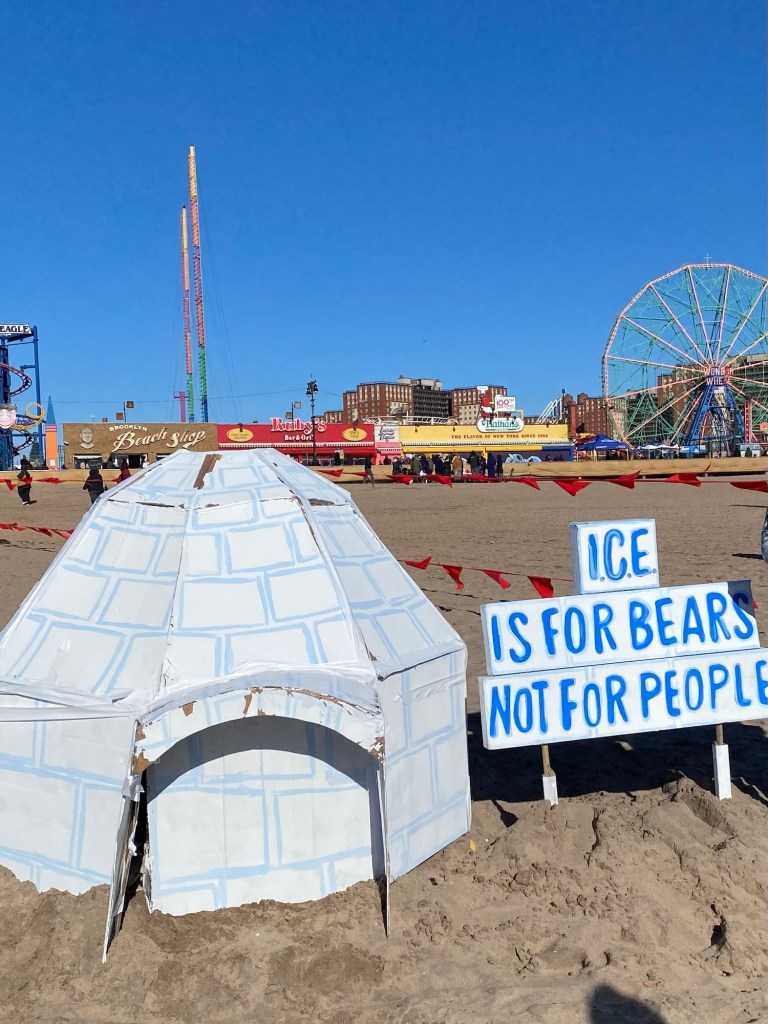
With the Ferris wheel in the background, a nylon igloo stated the obvious.

In looking around, trying to learn more about Sharyn Alfonsi, I came across a commencement address she delivered at the journalism school at the University of Mississippi. It is hilarious!

She offers an abundance of wit, mingled with great career advice for aspiring journalists.

You get insight into the character of the “60 Minutes” reporter who spoke out and stood up to her bosses when they censored her reporting about CECOT, the terrorist prison in El Salvador.

As Dan Rather said, Sharyn Alfonsi is “One Courageous Correspondent.”

While going through my Internet feed, this interesting interview popped up. It was Jimmy Kimmel interviewing former President George W. Bush. You may think it odd to look back on a president reviled by Democrats for launching years of war that cost the lives of so many Americans and changed so little.

But what fascinated me about this interview was the book that former President was selling. It’s a compilation of some of his paintings.

Its title, Out of Many, One: Portraits of America’s Immigrants.

It is described as:

“A collection of portraits and stories celebrating the resilience and contributions of immigrants to America.”

George W. Bush’s brother Jeb is married to Columba Garnico Galla (Bush), who was born in León, Guanajuato, Mexico. They have three children and four grandchildren, all of whom share her Mexican descent.

Neither George nor Jeb has ever endorsed Trump (although Jeb’s son, George P. Bush, has). None of the Bush family has denounced Trump’s vile characterizations of Mexican-Americans or his orders to ICE to deport them, as brutally as necessary.

Mexican-Americans and other immigrants that George W. Bush celebrated in his book are living in fear and snatched away from their jobs, their homes, and their families.

Wouldn’t it be great if George or Jeb or other members of the Bush family spoke out against Trump’s vicious attacks on our immigrant neighbors?

Deport “the worst of the worst,” as Trump promised, and give the others a path to citizenship.

This is the latest parody interview by the irrepressible Randy Rainbow. It takes place while the East Wing of the White House is demolished in the background.

As usual, Randy treats his viewers to a full dose of gay humor with his song “Big Phony Schmuck.”

Here is a Sunday special by one of my favorite writers, Greg Olear.

Please open and read to the end. He takes the topic and relates it to the present moment, when many of us fear that our republic is in mortal danger, as fascism swirls around us.

He writes:

Dear Reader,

A Shropshire Lad is a collection of 63 short poems, written in London by a classics scholar who had never once been to Shropshire, involving young men living, working, drinking, wooing, ruing, philosophizing, and dying in the British countryside. The narrator of most of the poems, the titular “lad of Shropshire,” is called Terence, who sometimes is, and sometimes is not, a stand-in for the actual author, A.E. Housman.

The book was published in 1896, when Housman was 37 years old, and did not exactly fly off the shelves. But many of the poems touch on the theme of mortality—particularly, of young men dying before their time—and therefore sales picked up during the Boer War and, especially, the Great War.

A number of the Shropshire poems have been set to music; there are almost 50 different songs that use “Loveliest of Trees, the Cherry Now” for lyrics.

Between their simple earnestness, melancholy bent, and wide literary renown, the poems lend themselves well to parody. You can get the gist of the entire collection from a few of the short spoofs. Pre-fascist Ezra Pound wrote a nice one, in 1911:

O woe, woe,
People are born and die,
We also shall be dead pretty soon.
Therefore let us act as if we were
dead already.

Hugh Kingsmill trod this same ground in 1920:

What, still alive at twenty-two,
A clean upstanding chap like you?

I cannot track down the full text, but “Loveliest of cheese, the Cheddar now,” by the pseudonymous Terence Beersay, made me chortle. Even Dorothy Parker, no comic slouch, took a whack at Housman:

I never see that prettiest thing—
A cherry bough gone white with Spring—
But what I think, “How gay t’would be
To hang me from a flowering tree.”

Housman claimed not to find any of the Shropshire parodies funny, which seems to me unlikely—although, being an academic who devoted most of his intellectual energy to Latin poetical scholarship, he wasn’t exactly Robin Williams with the jokes. From what I can gather, he was something of a fusspot.

But he was able to laugh at himself, or at least to recognize the prevailing darkness of his signature work. The penultimate poem in A Shropshire Lad, “Terence, This is Stupid Stuff,” attacks this head-on—as if Housman knows what the critics would say, and hits them with a preemptive strike. The text is a dialogue between Terence, who writes the depressing poems, and one of his friends, who is forced to read the depressing poems. Housman never tells us where they are when this exchange takes place, but I imagine them sitting at a pub, when, after a few pints of liquid courage, the friend offers some brutally honest criticism:

‘Terence, this is stupid stuff:
You eat your victuals fast enough;
There can’t be much amiss, ‘tis clear,
To see the rate you drink your beer.
But oh, good Lord, the verse you make,
It gives a chap the belly-ache.
The cow, the old cow, she is dead;
It sleeps well, the horned head:
We poor lads, ‘tis our turn now
To hear such tunes as killed the cow.
Pretty friendship ‘tis to rhyme
Your friends to death before their time
Moping melancholy mad:
Come, pipe a tune to dance to, lad.’

(The bit about the cow is a reference to lyrics of a song popular in Housman’s day, and thus made more sense in 1896. )

His buddy is saying, basically, “Dude, why so pouty? No one wants to read this depressing shit. I know you’re not really this much of a downer, because I see how you knock down the pints of ale. Maybe try writing something upbeat, that we can dance to.”

And Terence replies:

Why, if ‘tis dancing you would be,
There’s brisker pipes than poetry.
Say, for what were hop-yards meant,
Or why was Burton built on Trent?

Burton-on-Trent is the brewing capital of Britain—like referencing Milwaukee or Latrobe, PA or Anheuser-Busch, St. Louis, Missouri. The “peers” he refers to next include, according to the footnote at The Housman Society, “Michael Arthur Bass, baron (1886) and Edward Cecil Guiness, baron (1891):”

Oh many a peer of England brews
Livelier liquor than the Muse,

And this alliterative couplet, comparing one of the greatest of British poets to beer, is chef’s kiss:

And malt does more than Milton can
To justify God’s ways to man.

But for all the magical powers of alcohol to improve our mood, drunkenness does not make the pain go away—not really:

Ale, man, ale’s the stuff to drink
For fellows whom it hurts to think:
Look into the pewter pot
To see the world as the world’s not.
And faith, ‘tis pleasant till ‘tis past:
The mischief is that ‘twill not last.
Oh I have been to Ludlow fair
And left my necktie God knows where,
And carried half way home, or near,
Pints and quarts of Ludlow beer:
Then the world seemed none so bad,
And I myself a sterling lad;
And down in lovely muck I’ve lain,
Happy till I woke again.
Then I saw the morning sky:
Heigho, the tale was all a lie;
The world, it was the old world yet,
I was I, my things were wet,
And nothing now remained to do
But begin the game anew.

The world is full of woe and rue, you see, and we are wise to prepare ourselves for the bad stuff that’s coming down the pike, not ignore it or pretend it doesn’t exist. Poetry helps accomplish this more effectively than pints of Bass or Guiness:

Therefore, since the world has still
Much good, but much less good than ill,
And while the sun and moon endure
Luck’s a chance, but trouble’s sure,
I’d face it as a wise man would,
And train for ill and not for good.
‘Tis true, the stuff I bring for sale
Is not so brisk a brew as ale:
Out of a stem that scored the hand
I wrung it in a weary land.
But take it: if the smack is sour,
The better for the embittered hour;
It should do good to heart and head
When your soul is in my soul’s stead;
And I will friend you, if I may,
In the dark and cloudy day….

In the fall of 2025—which, at the rate we’re going, might also wind up being the fall of the Republic—this strikes me as sound advice. Too many Americans are sleepwalking through the Trump horrors, and while this “antiwokeness” might keep them docile, it will not protect them from what’s coming. The newsfeed, meanwhile, is so toxic that we risk succumbing to its fascist poison. We must make like Mithradates and take it all in small doses….

Do read it all.

Jack Hassard, retired science educator at Georgia State University, writes that authoritarians can’t tolerate jokes directed at them. They are thin-skinned. They hate being ridiculed. In Russia, one of Putin’s first targets when he took power in 2000 was a puppet show.

Hassard wrote a book about Trump after his first term, called The Trump Files. No doubt he believed that we had seen the last of Trump. Now he blogs about science, politics, and education.

In one of his latest posts, Hassard wrote:

WHY AUTHORITARIANS FEAR LAUGHTER.

[He added: “They also fear teachers.” That is an amusing echo of the title of Randi Weingarten’s first book, which was just published. Its title: Why Fascists Fear Teachers.]

It is telling that satire, of all genres, is under assault. Authoritarian leaders understand that ridicule delegitimizes power more efficiently than argument. A chart or a speech can be rebutted. A joke that makes the president look ridiculous can’t. That is why Soviet authorities censored jokes. Autocrats in Hungary and Turkey sued comedians. Despots everywhere fear being laughed at. When the United States begins punishing its comedians, it signals a shift. The shift is from democracy confident enough to tolerate ridicule. It progresses to illiberalism that can’t bear mockery….

CONSEQUENCES BEYOND COMEDY

The silencing of late-night satire does not stand alone. It echoes what we have already seen on university campuses, where professors face funding freezes and political monitors in classrooms. It mirrors attempts to pressure journalists with access threats and selective prosecutions. Step by step, the Trump administration is narrowing the arenas in which dissent can be voiced. Censoring satire matters because it collapses one of the last mass-audience platforms for critique. Millions never read a legal opinion. They never attend a lecture. Still, they still meet politics through Colbert’s monologues or Kimmel’s opening jokes. Shut those down, and you have not just silenced comedians — you have muted a public square…

The legal challenges will come. Networks sue. Civil liberties groups will file briefs. Courts eventually reaffirm that the First Amendment forbids retaliation against political speech. But lawsuits take years, and the damage happens now. In the meantime, networks will err on the side of silence. That chilling effect is harder to measure than a canceled show, but it is more corrosive. A student who stops asking questions means a small silence. A professor who drops a reading does too. A comedian who trims a monologue is also a small silence. Collectively, they create a democracy that speaks less, laughs less, and thinks less freely.

NAMING THE PATTERN

If there is one lesson from history, it is this: censorship rarely arrives all at once. It arrives as a series of “exceptions,” each one justified as minor, situational, or deserved. It started on January 20, 2025 with Trump’s first set of Executive orders, and continued for months. Today it is Colbert and Kimmel. Tomorrow it is a journalist, a novelist, a professor, or a teacher. The pattern is clear: when power fears ridicule, it begins by silencing the jesters. The canceling of a late-night joke seems trivial against the backdrop of global crises. But in a democracy, humor is not trivial. Humor is a form of truth-telling. And when the government cancels the joke, it is really trying to cancel the truth.