Tom Ultican, retired teacher of advanced mathematics and physics in California, says that all the bright and shiny fads have actually harmed students and teachers. I have not posted the entirety of his commentary. To finish reading it, open this link.
He writes:
Trump’s billionaire education leader, Linda McMahon, claimed on Fox News, “We’re doing terribly, I mean, our education system’s failed our kids.” Like a typical oligarch, she bolstered her point by mischaracterizing NAEP assessment levels stating, “only about 30% of high school and eighth graders can read proficiently or do math proficiently.” Maybe that sounds bad, but the reality is those numbers indicate that 30% of students are achieving at a high B or low A grade-level which sounds pretty good to me.
McMahon was promoting her nonpartisan “History Rocks!” tour. The sponsors of the tour are certainly not nonpartisan. They include America 250 Civics Education Coalition, led by pro-Trump America First Policy Institute which is composed of right-wing organizations such as Turning Point USA, Moms for Liberty and the Heritage Foundation.
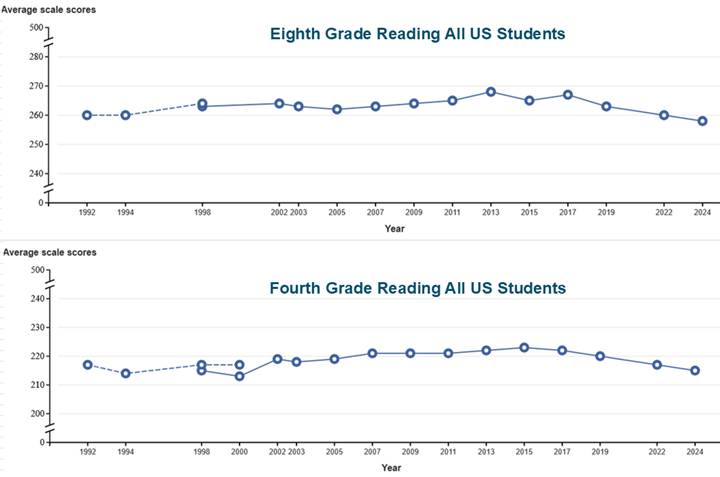
However, even though standardized testing is a terrible method for evaluating schools and students, it is notable that the National Assessment of Education Progress (NAEP) results have been falling since 2013.
The NAEP data plotted above is for all tested US students in 8th grade and 4th grade reading. Around 2013, results started dropping. Data for math also shows this same trend. Because education has so many variables, establishing a solid cause and effect relationship for this decline is impossible.
Based on my personal experience in the classroom and my years of observing education outcomes, I have developed a theory that at least partially explains the decline.
Education Technology
In the 1990s, I worked in Silicon Valley researching friction problems associated with computer equipment. Part of my assignment was to develop software that ran testing devices, gathered massive data sets and loaded them into a Microsoft data base which created reports that I shared with customers. Once the testing was setup and started, everything from then on was automated. I loved pushing technology and making it do things no one else had.
In 1999, I got tired of Silicon Valley. That is when I returned to San Diego and sought a teaching credential. At the time, I imagined being able to use my technology expertise in future classrooms. I had become genuinely excited about education technology (edtech).
I wish I could say my expectations were met but I cannot.
I discovered that instead of edtech driving exploration, it was aimed at controlling and replacing teachers.
As part of the master of education program at UCSD, we were sent to local schools to work with students. I went to a local high school to work with struggling math students in a recovery class. Students were assigned to work on computer presented math problems which were then graded by the computer.
As the education technology critic Audre Watters has observed:
“Just because it’s a worksheet on an iPad doesn’t mean it’s transformational or exciting. It’s still a worksheet.”
In retrospect, this experience was an early effort to replace teachers with computer screens. Instead of working on making edtech an exciting addition to education, the effort was pointed toward putting kids at screens instead learning from teachers. The technology industry was promising to reduce the need for costly teachers.
Physics Lab Class
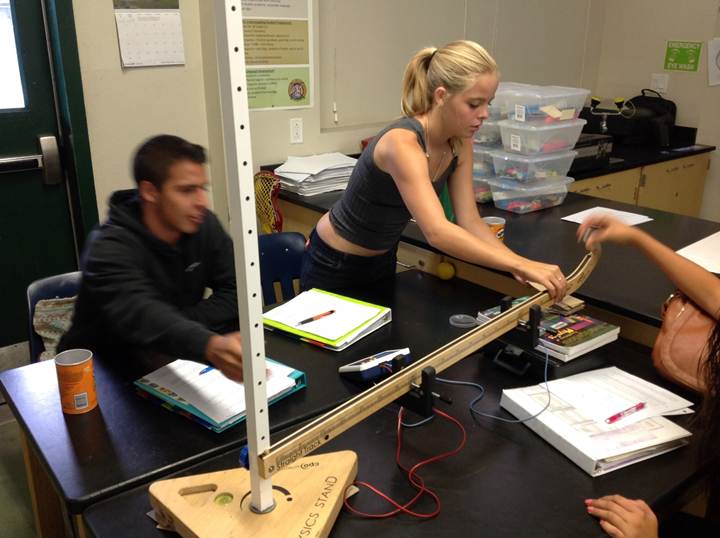
This picture shows an example of using technology to engage students in authentic learning. Two photogates affixed to the ramp were accurate to + or – 0.001 seconds. Here the students were adjusting the ramp to achieve constant velocity when a marble rolled down the ramp. The photogates provided data including the time for test object to roll through the gate and the time between gates. Since students new the diameter of the test ball and the distance between the gates, they were able to calculate three velocities. Once the three velocities were all equal, they changed to a test ball with identical geometry but significantly less mass. They were then able to observe that the mass of the ball did not change the velocity which accords with Galileo Galilei’s 1589 experiment testing mass and gravity.
Unfortunately, only small companies were working to develop engaging technology for learning. Larger companies were developing school management systems that gathered large data sets on all students and teachers. Or they were creating schemes where teachers created lessons on their platforms which then claimed ownership of the lessons.
The school district I was in bought every student an I-pad and then three years later replaced those I-pads with laptop computers. Because these devices were such a classroom distraction, teachers often required students to put them in their backpacks and store them under their desks.
It was worse than a waste of money. It was undermining learning.
In my AP physics classes, students were not working through the assigned problems. They discovered that almost all physics problems had a worked-out example on line. I was getting the most beautiful work I had ever seen but the students were clueless when tested.
It seems fair to identify edtech as a possible cause for declining test scores. Artificial intelligence will likely make — not working or thinking — an even bigger problem.
Science of Reading
The Orwellian labeled science of reading (SoR) is not based on sound science. In 1997, congress passed legislation calling for a reading study. Establishment of the National Reading Panel (NRP) was a doomed effort from the beginning. It was a massive undertaking, conducted by twenty-one unpaid volunteers over 18-months. NRP fundamentally did a meta-analysis in five reading domains, ignoring 10 other important domains. They did not review everything and there was no new research. Their report is the basis for SoR.
With the rapid spread of vouchers, which are busting the budgets of several states and tearing down the wall of separation between church and state, it’s easy to overlook the danger posed by charter schools. Charter schools are a strong step towards vouchers, replacing neighborhood schools with consumerism. Almost 90% of American students attend public schools. We should be funding those schools, not schools operated by private boards and religious groups.
Dr. Shawgi Tell reminds us that charter schools continue to breed corruption and fraud, as they drain resources from public schools. Charter schools are not subject to the same accountability as public schools. They operate under private management, which shields them from the accoubtabilty to which public schools are subject. Without oversight or accountability, bad things happen.
Dr. Tell is a professor of education at Nazareth University in Rochester, New York.
He writes:
Even though they make up only 8% of schools in the country, crimes, scandals, and arrests take place at a robust tempo in the nation’s privately-operated charter schools.
These non-stop wrongdoings usually include fraud, embezzlement, harassment, and a range of sex crimes.
This is not surprising given the weak accountability, transparency, and background checks that have plagued the crisis-prone charter school sector for more than 30 years.
A small sample of headlines from just this year speaks volumes:
Do such horrible things happen in traditional public schools and private religious schools? Yes they do, but when looking at scale, scope, frequency, and proportionality, they are considerably more rampant in charter schools, which are deregulated businesses governed by unelected private persons.
The privatization and marketization of education lends itself to such phenomena on a broad scale. Privatization increases corruption and lowers standards across a broad range of operations, roles, and services. Converting public programs and services into capital-centered programs and services usually enriches a handful of people while harming the public interest in the process. When programs and services focused on uplifting people and society are transformed into profit-maximizing entities, the majority suffers.
See here for more examples of charter school crimes and scandals.
Shawgi Tell (PhD) is the author of Charter School Report Card. He can be reached at stell5@naz.edu
John Thompson, retired teacher and historian in Oklahoma, was stunned by some survey results released about parents’ opinions on education. He took a deep dive, read the raw data, and discovered that the survey was conducted by ExcelInEd, Jeb Bush’s organization. Excel promotes high-stakes accountability for public schools but no accountability whatsoever for voucher schools, which they also promote.
ExcelinEd has familiar game plan: they use inaccurate NAEP statistics to defame public schools, demand more accountability to crush the morale of principals, teachers, and parents, then insist that vouchers and charters are the way forward. As Josh Cowen showed in his book The Privateers, voucher schools get far worse results than public schools, and numerous studies have shown that charter schools are usually no better than public schools and often much worse.
Thompson writes:
Patricia Levesque, the executive director of ExcelinEd, recently wrote a commentary about a survey of 500 Oklahoma parents, claiming that more than 80% of them want “a state testing and accountability system to measure student achievement, and they expect honesty and accuracy about their children’s grade level performance.”
So, I took a dive into the survey. My reading of it was very different than Levesque’s.
In some ways, the survey she described is consistent with the Education Department parent survey that State Superintendent Lindel Fields released. But Levesque’s interpretation of the results was very different than Fields’ analysis of the state’s parent feedback.
The survey Levesque cited found that 74% of parents want a pay raise for teachers, and another 74% say we spend too little on education. Her study found that 80% of parents were very or somewhat satisfied with their school but, for some reason, it adds, “While overall positive, this fails to hit the common 95% satisfaction sought in commercial endeavors.”
While 78% of parents support retention by 3rd grade of students who don’t read on “level,” parents estimate that about 83% students read at or above grade level; and 78% are confident in the way their schools teach reading.
FYI, in 1998, 80% of Oklahoma 8th graders read at that level, but now about 59% do. My reading of the research, and classroom experience, attributes the subsequent decline to the way that No Child Left Behind and the Race to the Top undermined the teaching of History, Science, Arts, and of the background knowledge that is essential for reading comprehension; huge funding cuts; COVID; and Ryan Walters; as well as the rise of social media.
Yes, 83% of the survey are supportive of student testing, which is no surprise. But, the study doesn’t dig into the difference between testing for tracking student progress, as opposed to high-stakes testing. After all, there is great support for testing for diagnostic purposes, as opposed to the reward-and-punish testing that has been rampant since the NCLB was enacted.
Conversely, the Education Departments’ parent survey seems to be calling for schools to tackle the crucial issues that they were forced to ignore, as districts invested in high-stakes test-prep.
When Superintendent Fields explained that the results of statewide surveys of educators and parents, informed the budget priorities he is seeking. Superintendent Fields reported, “Early literacy, support systems to improve behavior and mental health resources and teacher recruitment and retention are among the top three concerns for all groups surveyed.”
The parents survey included repeated calls for teaching critical thinking skills, and media literacy; identifying misinformation; and early grade emphasis on literacy.
It explained that parents “highlighted the importance of both academic and life skills, emphasizing the need for students to be well-prepared for real-world challenges.”
Parents said that misinformation is very prevalent, and children need to be taught how to tell fact from fiction. They understand that learning how to be critical consumers of information is “literally the foundation of a successful life.” They know that social media and A.I. can make kids “susceptible to conspiracy theories and propaganda.”
What I didn’t see in the parents’ responses was calls for data-driven accountability; online, as opposed to personal tutoring for 3rd graders; or simple “miracles.”
What I saw was a desire to return to personal connections. I saw goals that would require more support for educators, as well as requiring cooperation with social workers, health providers, and mentors that are necessary for preparing children for a full life in the 21st century.
Paul Thomas is a professor at Furman University. He has taken a leading role in refuting claims for the “science of reading.”
There are many successful ways to teach reading. some children arrive at school knowing how to read, because a parent read with them every day. Phonics is important. The joy of reading is important. Comprehension is important. Legislatures should not mandate one way to teach.
If you pay attention to the non-stop moral panicking around reading fanned by mainstream media, you may have seen this click-bait headline: Did New York blow $10 million on reading instruction that doesn’t work?
The article repeats tired and misleading (often false) stories about the failures of balanced literacy, NAEP reading scores, the “success” of Mississippi and Louisiana, the promise of structured literacy, and the National Reading Panel as well as the one research study on phonics that is linked.
Let’s consider these:
*No scientific studies identify a reading crisis in the US causally linked to balanced literacy, reading programs, lack of phonics instruction, or inadequacy of teacher education. (Aydarova, 2025; Reinking, Hruby, & Risko, 2023).
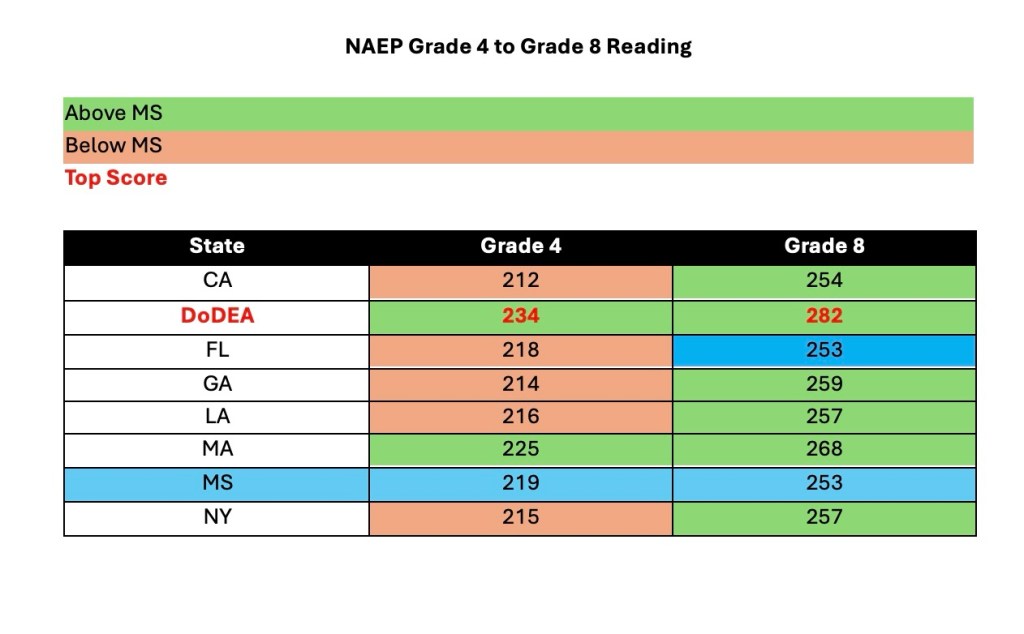
*The media hyper-focuses only on grade 4 NAEP reading scores, but notice how the story changes once we consider grade 8—states behind MS in grade 4 catch and pass MS by grade 8 (primarily because MS inflates their grade 4 scores by excessive grade retention, like FL):
*Structured literacy (scripted curriculum) is whitewashing the reading curriculum and restricting teacher autonomy and professionalism. (Khan, et al., 2022; Parsons, et al., 2025; Rigell, et al., 2022).
*The linked research suggests it replicates findings of the NRP; however, the NRP did not prove systematic phonics outperformed whole language or was a silver bullet. As Diane Stephens explains about the findings on phonics: “Minimal value in kindergarten; no conclusion about phonics beyond grade 1 for ‘normally developing readers’; systematic phonics instruction in grades 2-6 with struggling readers has a weak impact on reading text and spelling; systematic phonics instruction has a positive effect in grade 1 on reading (pronouncing) real and nonsense words but not comprehension; at-risk students benefit from whole language instruction, Reading Recovery, and direct instruction.” Further, while the article quotes from the research report, it doesn’t include this much more tentative hedge: “These findings suggest that SL approaches may yield larger positive effects on student learning compared to BL approaches.” At best, structured literacy is no better or worse than whole language or balanced literacy, but to be clear, there is no “settled science” that is works.
But the bigger problem is not that mainstream media continues to repeat misinformation, but that it fails to offer the full story.
Note that the “literacy experts” quoted in the article are supporting structured literacy programs (scripted curriculum), and some of those experts are co-authors of those programs.
Further, these experts are promoting a different teacher training program than the one being attacked in the article, and many states are spending 10s of millions of dollars on that program—LETRS. (My home state of SC a few years ago allocated $11 million for one year, for example.)
What’s missing in this story?
There are two high-quality studies that were released in 2025 on the effectiveness of LETRS, but so far, there have not been click-bait scare headlines about those findings:
*A review (Rowe & Thrailkill, 2025) of reading policy in North Carolina concludes:
Despite LETRS’ claim that it helps educators “distinguish between the research base for best practices and other competing ideas not supported by scientific evidence” (Lexia Learning, 2022, p. 4), we noticed a pattern of misinterpretation, selective inclusion, and omission of literacy research. LETRS is a prime example of a common problem with the deployment of research for educational policy and instructional decision-making, in that multiple claims are not substantiated by a close reading of the original research cited (cf. Hodge et al., 2020).
*And Gearin, et al. (2025) found:
[Abstract] We investigated whether Language Essentials for Teachers of Reading and Spelling: 3rd Edition (LETRS) was related to student reading ability by comparing the average third-grade reading achievement of schools that used LETRS to that of schools that used exclusively other professional development experiences in the context of Colorado’s Read Act. Guided by What Works Clearinghouse Standards, we conducted a quasi-experiment with propensity score matching and an active comparison group. We supplemented our primary intent-to-treat analysis with three sensitivity analyses designed to demonstrate the robustness of our claims. Effect estimates for completing a LETRS volume on educator knowledge ranged from 0.82 to 0.94. Students’ third-grade reading achievement did not statistically differ for schools that adopted LETRS compared with other professional development experiences in any model, suggesting that LETRS was comparable to the other programs at improving third-grade reading achievement at the school level.
The “science of reading” movement is a political, ideological, and market-based attack on teachers and public education, and the only people profiting off yet another moral panic are the media, political leaders, education reformers, entrepreneurs, and of course, the education market place.
The full story is never covered, because the real story about reading simply isn’t that profitable.
Ken Fredette is a Vermonter who is dedicated to improving the state’s public schools. He is a former President of the Vermont School Boards Association and is currently active in Friends of Vermont Public Education.
A decade ago, when I visited Vermont, I was very impressed by the State Secretary of Education Rebecca Holcomb. She had a vision for public schools that was centered on the well-being of children, not punishments for teachers and schools. She ran for Governor and unfortunately lost. She is currently serving in the Legislature.
The current Governor is Republican Phil Scott. Ken Fredette wrote me that Scott left the Secretary of Education job open for a year (after Holcomb’s replacement Dan French resigned). Then, Ken wrote:
In 2024, following Phil Scott delaying appointing a replacement for SecEd Dan French for a year, he then appointed Zoie Saunders, from Florida, who worked for a for-profit charter school organization, and whose only experience with public schools was closing them. I was in the Vermont Senate chamber when the vote was 19-9 against approving the appointment – that advise and consent thing – and Scott reappointed her to “fill the vacancy” created by that vote before I was out of the building. You can’t make this stuff up.
So, clearly, Vermont has a Governor and Secretary of Education who have no commitment to Vermont’s public schools, attended by 90% of the state’s children.
You can help save Vermont public schools! Log in here. Stay informed.
Ken wrote this article, which was published by Weekender Rutland Herald and also the Barre-Montpelier Times Argus.
If anyone had any doubts that there is a concerted effort to undermine public education here in Vermont and throughout the country, those doubts should have evaporated on March 20, when an assistant U.S. secretary of education — on a tour to visit a school in all 50 states — opted to visit a small (less than 60 students) parochial school in Newport for a good example of schools in Vermont.
The plan to shift support from our constitutionally-mandated public education system to private schools — sometimes religious, sometimes for-profit charter schools in other states — has been orchestrated somewhat quietly for decades by groups employing tactics from a national playbook.
But the campaign is no longer quiet, bolstered by edicts from the White House, such as the federal voucher program; The Heritage Foundation (which carved out the dark caverns of Project 2025); questionable opinions from the U.S. Supreme Court regarding the separation of church and state, enshrined in the Establishment Clause of the U.S. Constitution, and articulated by Thomas Jefferson; and countless other conservative groups.
The never-ending attacks have presented in blatant falsehoods: Remember the absurd claim that Critical Race Theory — a college level course — was being taught in our public schools? Lacking even a shred of evidence, it seems the fallback position of those promoting this was the more times the lie was told, and the louder the bombasts got, the more people would buy into it.
At the height of that hoax, a sitting member of the Vermont Legislature came to a local school board meeting with a list of words and phrases I recognized as having been generated by the Foundation Against Intolerance and Racism (one of the above-mentioned conservative groups). I watched with my eyes growing wider as they rattled off the list, ending by demanding the board immediately issue a directive to all teachers that nothing on it would ever be spoken in a classroom.
When the air let out of the CRT balloon, it merely meant it was time to turn to the next page in the national playbook. That presented as empowering parents. Seriously, what possible argument could be given against parents having a say in their children’s education?
Choice has been a highly charged topic around the country for many years. Here in Vermont, this has reached a point where it is pitting the administration against our Legislature. My faith is placed with our representatives and senators to thoughtfully deliberate such important policy matters, and not afford so much decision-making authority to the governor’s office.
Also on March 20, a commentary from the director of policy and communications at the Vermont Agency of Education sang praises of Mississippi raising their fourth-graders’ reading proficiency dramatically, and relatively quickly; our governor had also pointed to this remarkable achievement during his recent State of the State address.
I’m very glad for the kids of Mississippi, but to imply Vermont students are falling off some sort of educational cliff by cherry-picking numbers and using vague phrases like “… trending downward for a decade” (starting about when our current governor took office) is chicanery. So is skipping over a major piece of the story: Mississippi third-graders who weren’t likely to excel in the fourth-grade assessments were forced to repeat third grade.
Vermont is unique in many ways, including — and perhaps especially — our education system. When 30% of school budgets failed at Town Meeting 2024, Vermonters weren’t saying to tear down our school system — they were saying that property taxes were burying them.
There are some pretty basic steps that could be taken to relieve those tax burdens on longtime working Vermonters. Asking those affluent enough to have a second home here to pay a fairer share is an obvious one, and that’s been a very successful program in a couple of other states already. Following that, let’s update the Common Level of Appraisal system such that if I buy a place in Vermont for $475,000 that was listed at $247,000, I just agreed the new value is $475,000, and my new neighbors’ property tax rates won’t float up to subsidize mine.
There are other steps we could take, but going back to a foundation formula is not among them. When you hear talk from the administration about a plan that is “evidenced based,” please bear in mind that the highly paid outside consultants providing the evidence repeatedly conceded that it didn’t really apply to Vermont, because we are different from any of the places they’d studied.
We need to look at data germane to who and where we are in order to make informed decisions on how to best proceed, because we need to get this right.
A reader who calls himself “Gitapik” shares his experience with the introduction of new technology into the special education programs for which he was responsible in New York City public schools.
He wrote:
As a former tech guy for our five District 75 special education sites in Brooklyn, I had quite a ride on this tech roller coaster. I was in on it from the beginning.
I applied for and received multiple very large state grants in technology. Once the money was received, I would choose, order, and facilitate installation of what technology went where in all the sites. From classroom computers, iPads, laptops, Attainment Stations, and Smartboards to full scale labs. It was a very big undertaking.
This also included conducting professional development classes and individual training session sessions…very often to an unappreciative audience.
My sales pitch was always the same: this is a wonderful tool for you to incorporate into your standard every day teaching methods. You can turn it on and off in order to create interest and spur on new ideas. I would even give examples of how I, a teacher, would do a class, using the different devices.
This would’ve been all well and good if it hadn’t been so naïve on my part. I witnessed firsthand how the technology went from being a tool for the teacher to the teacher being the tool of the technology. Might sound like a catchy phrase, but looking back on it I can’t help but see it for what it was. A planned takeover of the school systems.
I could go into specifics, but this is getting pretty lengthy as it is.
Michael Mulgrew, the president of the United Federation of Teachers in New York City recently endorsed the use of AI in the classroom. He said he had met with top officials who had assured him that teachers and administrators would have a voice in how the technology would be applied. I would like to have his ear, knowing what I know. It’s the same sales pitch as was given to me. They just want to get their foot in the door
Yesterday, I posted Peter Greene’s post about the voucher battle in Nebraska. Republicans in the state legislature really want vouchers. Voters really don’t want vouchers. I no as recent referendum, Nebraska voters overturned the state’s voucher program. That shoukd have been the end of the story, but it wasn’t. The Republican Governor and legislature decided to ignore the voters and participate in Trump’s voucher plan.
But then Peter discovered the battle was not over.
As we noted last week, some Nebraska fans of taxpayer-funded vouchers tried–again–to get enact vouchers, this time through the sneaky technique of putting them in the budget. Instead of getting their vouchers, they raised a controversy that sank the entire budget.
State Sen. Rob Clements of Elmwood, Appropriations Committee chair, removed the $3.5 million of voucher money, meant to bridg the gap between the end of the state’s voucher program that was repealed by voters, and the beginning of the federal voucher system that Governor Pillen opted into (the voters get no say on that one). And lots of people were upset, as reported by the Nebraska Examiner.
Arguments for the voucher money were baloney. Sen. Christy Armendariz of Omaha argued that the vouchers were needed to protect poor kids who might be “kicked out” of public school. State Sen. Brad von Gillern of the Elkhorn area expressed frustration toward opponents, calling it hypocritical to oppose the measure when many of the same senators argue the state isn’t doing enough to help the poor.
“Shame on you,” von Gillern said. “If you make a pitch for poor people for any other reason, and you can’t support this, you’re a hypocrite.”
Except that vouchers are used mostly by wealthy, already-in-private-school students, and it’s the private schools that get to pick their students, not vice versa. It is telling that the voucher crowd did not have anecdotes of poor children who had been kicked out of public school and had been rescued by vouchers. The program ran all this year, so those stories, if real, should have been easy enough to locate.
Sen. Myron Dorn of Adams, the only Republican on Appropriations to oppose the $3.5 million in vouchers, criticized focus on this one issue, and also criticized the whole sneaky business of trying to slip this policy into the budget when there is no bill or law behind it.
Said Tim Royers, president of Nebraska State Education Association–
This standoff is exactly why you don’t try and pass policy through the budget, especially when that policy is to extend an incredibly unpopular program that was repealed by voters in the most recent election. … We hope enough can come together and negotiate a path forward that keeps vouchers out of the budget.
So Nebraska voucherphiles managed to sink the state budget over a program that voters had already voted down. That’s a bold stance to take and one can hope that Nebraska voters will deliver the reward they so richly deserve. It’s yet another reminder, in a backhand way, that no matter how hard voucherphiles insist to the contrary, supporting taxpayer-funded school vouchers is not actually a winning political issue.
Peter Greene retired after 39 years of teaching, and now is the best-informed and most prolific writer about misguided and sometimes malicious efforts to “reform” public schools.
Peter has his own blog–Curmudgucation–and also writes a column about reform frauds for FORBES.
In this post, he tells the remarkable and unsavory story of vouchers in Nebraska. Nebraska is a solid red state, but its voters don’t want vouchers. Rural legislators–even Republicans–know it’s a waste of money and are sure to defund their public schools.
But the voucher-pushers keep looking for clever ways to bypass the voters, who have made it clear that they don’t want vouchers.
Peter Greene writes:
Nebraska’s voucher fans are bound and determined, like legislators in many states, to get around the voters so they can get vouchers installed.
In May of 2023, Nebraska’s Governor Jim Pillen signed into law LB 753, creating tax credit vouchers for subsidizing private schools.
The concept has been floated in Nebraska before, notably turning up more than once in 2022’s session. In 2023, it finally progressed through the legislature. But NSEA political action director Brian Nikkelson told the Nebraska Examiner that the public did not support the vouchers, and if the bill was passed, there would be a petition drive to force the bill to go on the ballot for voters to decide.
And so there was. It was a heck of a battle, with the pro-voucher forces have attracting a mountain of money, some of it from outside the state. Paul Hammel at the Nebraska Examiner reported that big money contributors include C.L. Werner, an Omaha-based trucking company executive ($100,000), Tom Peed and his son Shawn of a Lincoln publishing company ($75,000 each), and former Nebraska governor U.S. Senator Pete Ricketts ($25,000). Governor Pillen himself has contributed $100,000 to the campaign to save vouchers from a vote.
At the same time, Hammel reported, the American Federation for Children, the school choice advocacy group founded by Betsy DeVos, has contributed $103,000 in in-kind services and $583,000 in cash to the campaign.
It didn’t matter. Support Our Schools needed 60,000 signatures to force a referendum. They ended up with about twice that number (that’s roughly 10% of all eligible voters in the state). So this November, the voters of Nebraska were supposed to have their say. So you’d expect that voucher fans, who keep telling us how much everyone loves vouchers, would just sit back, secure in the knowledge that their program would win the referendum handily.
Well, no.
Instead, legislators cooked up LB 1402. This bill proposed to repeal the Opportunity Scholarships that were created under LB 753, and then to replace them with a new version of Opportunity Scholarships. This version would have been an education savings account (ESA) style super-voucher that hands over taxpayer money to send a student to a private or parochial school. It was more sketchy than last year’s bill because it appropriates state funds (rather than tax-credited contributions) to pay for the vouchers.
But mostly what it did it render the petition drive moot, because it repealed the version of vouchers that the public was going to vote on. “Ha,” they apparently thought. “That’ll stop those damned voters.”
In 67 days, the coalition of opponents gathered the necessary signatures—again. That repeal passed in November 2024, with 45 out of 49 legislative districts voting to repeal, and Nebraska’s voucher law was toast. The voters had sent a clear and unequivocal message.
Surely the state’s leaders would say, “Well, the voters have spoken, so that’s that.”
Fat chance.
Voucherphiles were back with a new proposal in January 2025. “I’m not dissuaded by the fact that it was defeated at the ballot box,” said freshman State Sen. Tony Sorrentino of Omaha.
Pillen’s new idea is to sell vouchers for the “gap” year, the year between the time when Nebraska’s vouchers are required to end and the time when the federal vouchers are supposed to kick in. The proposal is being sent through the state’s Labor Department rather than the Department of Education because that would skirt the requirement for any sort of hearing or debate, probably because voucherphiles have a pretty good idea of how that would go.
Nebraska is one of those states where rural Republicans have opposed all attempts at vouchers, and they aren’t sounding any friendlier about this one. Zach Wendling at Nebraska Examiner talked to State Sen. Tom Brandt of Plymouth, a Republican who opposed Linehan’s previous proposals; he said he is opposed to using any public money for private school choice. He’s still waiting to see how the federal tax credit program includes public schools (because, remember, there are no actual rules yet attached to the federal voucher program).
“The referendum simply eliminated that. Period, end of story,” he continued on the state policy. “There’s no other interpretation you can draw from that.”
The gap funding would cost about $5 million for around 2,500 students. Of course, with no rules in place, it’s possible that not all of Nebraska’s current voucher students would qualify for federal vouchers. Nor can we predict what slice of the federal money pie Nebraska would be entitled to. If it comes to that, we could expect voucherphiles to argue that more gap funding is needed to cover new gaps, or maybe to expand above and beyond the federal offerings.
Nebraska voucher fans are making a lot of “think of the children” noises, but families have plenty of time to look for new arrangements (i.e. finding the student a new school or going back to paying the full tuition with their own money).
This is the same story we’ve seen over and over again. Vouchers never win when voters have a chance to be heard. Every single taxpayer-funded voucher program in this country has been created without giving the taxpayers a say or ignoring the say they had already said. Taxpayer-funded vouchers are all the result of legislators backed by deep-pocketed voucher fans deciding they are going to inflict these on the taxpayers. Nebraska’s taxpayers just happen to have a few more tools to fight back with, but Nebraska’s voucherphiles just keep looking for a way to avoid that whole pesky democracy thing.
Audrey Watters is one of the best–maybe the very best–writers about Ed-tech. As she has documented in her writings, including her book, Teaching Machines, the quest for a cheap and mechanical way to replace teachers with efficient devices has a long history. A few people dream of endless profits, but the promise of better teaching by machines has never been realized.
This morning I attended one of the new NYC Chancellor’s public “conversations,” his administration’s initiative to “engage directly with communities to reflect on what safety, academic rigor, and true integration look like in practice.” There were about one hundred folks in attendance, including members of the AI Moratorium for NYC schools, who were there to leaflet beforehand (and were vastly outnumbered, I should note, by the NYPD).
As the aforementioned name suggests, this coalition of local organizations is asking for a two-year moratorium on AI in the city’s schools, pointing to the growing opposition to AI and (in their words) “to evidence that it represents substantial risk to student privacy, cognitive development and skills, critical thinking, creativity, mental health, and the environment.” I’d add that it represents substantial risk more broadly: to labor (teachers’, librarians’, translators’, social workers’) and to democracy itself.
And really, what’s the rush?! I mean, other than the desperate need of the tech sector to prove that the trillions of dollars invested in this endeavor will soon show some profit and that – unlike crypto and Web 3.0 – this isn’t just some giant fraud being perpetrated so executives can buy more private islands.
I’ve said repeatedly (but didn’t articulate into any open mic at the meeting because I still very much feel like a new New Yorker), this recent push for “AI” is yet another grandiose and grotesque experiment on children – one that no one asked for and few want. Another grandiose and grotesque experiment on all of us.
We have lived through decades and decades now of repeated digital promises — we’ll be better, faster, stronger, more connected, what have you — and none of the computational fantasies have really come to fruition, certainly not for everyone. We are not more productive (despite now being asked to work so much more, clicking away on our devices at all hours of every day); we are not smarter; and most importantly, we are not better. (A tiny group of men are, on the other hand, now richer than any other humans have ever been in all of history. So there’s that.) Our public institutions are crumbling, in no small part because these men are fully and openly committed to the failure of democracy, having positioned themselves to profit mightily from years of neoliberalism. “AI” marks the further (and they hope, final) consolidation of their power – not just the privatization and monopolization of all information under their control, but the automation of the dissemination and replication of knowledge. These men are more than happy to sell a story, a system that trains all of us, but particularly young people, to become entirely dependent on and subservient to computational machinery; they are more than happy for us to sacrifice our cognitive capabilities, our creativity, our agency, our decision-making, our morality, to solidify their crude oligarchal dreams of total efficiency, total financialization, total domination.
We should know by now that this stuff is almost entirely wretched – we do, right? I mean, at this stage, I’d be deeply embarrassed if I was out there, trying to argue that this stuff is any damn good. And yet here comes Silicon Valley and education reform, hand-in-hand once again, trying to peddle disruption and innovation and their long war on “one size fits all education,” armed with their algorithmic bullshit and billionaire board members.
It doesn’t help, I think, that there are several prominent technology journalists who keep falling for / perpetuating this stuff, who loudly insist in caps-lock-on prose that “THERE IS NO EVIDENCE!!!111” that devices are bad for children. (The irony, of course, is after they repeat this claim — and with such certainty — they turn around and point to dozens of stories of the most batshit–crazynews about the horrors of digital culture.)
And maybe part of the problem too is just that: we are so steeped in the insanity of techno-capitalism, the insanity of techno-capitalists that some folks are losing track of what aberrant behavior really is. Cory Doctorow writes a bit about this this week, offering “three more AI Psychoses” — a response, in part, to Samantha Cole’s excellent piece in 404 Media, “How to Talk to Someone Experiencing ‘AI Psychosis’.”
I wonder if it isn’t simply that “AI” delusions are ubiquitous (at this stage, I’m thinking these delusions are experienced by almost everyone, not just a tiny fraction of “AI” users); it’s that many of these delusions are unrecognizable as such because they reflect precisely the sort of sociopathy long embraced by Silicon Valley’s Ayn-Randian, libertarian set. “Here’s to the crazy ones” indeed.
[A] great embarrassing fact… haunts all attempts to represent the market as the highest form of human freedom: that historically, impersonal, commercial markets originate in theft. – David Graeber, Debt…
If plagiarism is wrong and bad and theft is wrong and bad and schools are duty-bound to help instill these values in students, how can they justify adoption of a technology that is, at its core, built on stolen work and whose purpose is the extrusion of text to be passed off as one’s own thinking and writing?
I invite you to open the link and continue reading this thought-provoking article.
The Century Foundation published an analysis of Trump’s federal voucher program, which explains why it is a hoax and a fraud. The authors are Kayla Patrick and Loredana Valtierra.
The promise it makes is that families and students will choose schools that are just right for them, but the reality is that schools choose the students they want.
The promise is that school choice will benefit black and brown children, as well as children with disabilities, but children abandon all civil rights protections when they enroll in private schools.
The promise is that schools of choice will produce better academic outcomes but typically they produce worse outcomes (see Josh Cowen, The Privateers).
The promise is that school choice represents accountability but it usually means no accountability at all, because nonpublic schools don’t take national or state tests.
Kayla Patrick and Loredana Valtierra write:
Modern school voucher programs are often framed as a response to declining academic achievement and a way to expand “parent choice” by enabling private educators to operate within the public system. But in practice, vouchers operate quite differently than advertised. It’s the private schools, not families, who ultimately decide who enrolls, and they do so outside the accountability systems that govern public education and public dollars and ensure every student has equal opportunity to learn.
The Federal Tax Credit Scholarship Program (FTCS), passed as part of the Republican Party’s “One Big Beautiful Bill” (OBBBA), scales this model for camouflaged privatization to the national level. Though branded as a tax incentive, it functions as a nationwide voucher system that diverts public dollars to private schools while allowing those schools to play by different rules than public providers—evading civil rights protections, academic oversight, and any requirement to provide meaningful evidence to the public of their students’ outcomes.
A National Voucher Program Disguised as a Tax Credit
The FTCS nationalizes a model that at least twenty states and counting –including Arizona, Georgia, Louisiana, and Pennsylvania – have already adopted, one which functions by siphoning public dollars through scholarship granting organizations (SGOs). Under this law, individual taxpayers can donate up to $1,700 annually to SGOs in exchange for a 100 percent federal tax credit, effectively turning private donations into reimbursed public expenditures.
SGOs then will distribute “scholarships” to K–12 students to use toward private school tuition, books, curriculum materials, tutoring or other educational classes, and educational therapies provided by licensed providers. While the program is optional for states, at least twenty-seven have already signaled their intent to participate.
[To see which states have expressed their intent to participate, open the link.]
Despite its branding, this design drains public revenue that would otherwise support public schools—which still educate roughly 90 percent of American students—and redirects it to private, religious, and largely unregulated providers.
The program model also ignores what parents time and again have told us they want for their children. When given a direct choice at the ballot box, voters have repeatedly rejected school vouchers and related private-school subsidy measures. In the 2024 election, proposals to authorize or expand voucher-style programs in Colorado, Kentucky, and Nebraska were defeated, and historical ballot measure data show that voters have rejected every statewide private voucher or education tax credit initiative placed before them since 1970. This opposition is reflected in polling that shows nearly 70 percent of voters say they would rather increase federal funding for public schools than expand government-funded vouchers, including majorities across party lines.
[Open the link to see which states have held referenda on vouchers.]
Broad Eligibility, Few Quality Controls, and Limited Public Benefit
Even measured against its stated goal of affordability, the FTCS program misses the mark. But if the goal is to make education more affordable for families under real financial strain, this program is also ineffective. Private K–12 tuition averages nearly $13,000 per year nationwide, placing private schooling out of reach for many families even with a modest subsidy. Yet the tax credit is not targeted to families facing affordability pressures. It allows households earning up to 300 percent of area median income to qualify, a threshold that would make roughly 90 percent of U.S. households eligible. In high-income regions, families earning as much as $500,000 per year could receive publicly subsidized support for private education, while in a city like New York—where median income is about $81,000—families earning nearly $244,000 would qualify. At a time when families are struggling to afford groceries, housing, and child care, this program directs public dollars toward a limited use—private education subsidies for households that largely do not need the financial help—rather than toward measures that would help most families, like lowering child care or housing costs.
At a time when families are struggling to afford groceries, housing, and child care, this program directs public dollars toward a limited use—private education subsidies for households that largely do not need the financial help—rather than toward measures that would help most families, like lowering child care or housing costs.
At the same time, the program imposes no meaningful accountability requirements on participating schools. There are no academic performance standards, no transparency obligations, and no requirement to evaluate outcomes. In contrast to nearly every other federal program serving children, from Title I to Head Start, this is public spending without public oversight. Federal programs historically are monitored for fiscal, quality, and sometimes for safety compliance by the agency with charge over the program. In this case, U.S Department of Education (ED) expertise plays no role in oversight of new national policy for education.1
What State Leaders Can and Cannot Control
FTCS offers a tempting hook for well-intentioned state policymakers as well: Some governors and state legislatures may view the tax credit as a way to unlock new resources for priorities like tutoring or after-school programs. In practice, however, it offers no new, flexible funding for states and gives them little control over how public dollars are used. The law defines “scholarship-granting organizations” so broadly that states cannot meaningfully restrict eligibility, set standards, or influence whether funds flow primarily to high-cost private schools rather than unmet public needs.
Once a state opts in, its role is largely administrative and unfunded. States receive no resources to carry out oversight, cannot impose safeguards, and must submit eligible organizations to the U.S. Treasury without authority to shape program design or accountability. Far from being additional education funding that states need, opting in requires that states absorb the fiscal, administrative, and equity consequences of a federal program they are unable to direct or correct. It is not “free money” for states. The opt-in decision is therefore the only meaningful leverage states have—and governors should use their right to refuse to play along in order to protect their public education systems.
Why Oversight and Accountability Matters
Public funding should never function on a good-faith system. It’s very simple: in good policymaking, whenever taxpayer dollars are allocated, oversight measures are put in place to make sure those dollars are spent in the way intended. We already know from numerous examples in the school choice policy space itself that no accountability means that those who need the help the least receive the most benefit.
Eighteen states have a universal private school choice program. Unfortunately, states that have expanded vouchers or education savings accounts with minimal oversight have already seen waste, fraud, and abuse. Arizona’s universal Empowerment Scholarship Account (ESA) program, for instance, has minimal controls, audit practices that automatically approve reimbursements, and has been linked to purchases of non-educational items like diamond rings, televisions, and even lingerie with taxpayer funds, prompting investigations by the state attorney general. Rather than lowering costs for families, the program has generated ballooning expenses for the state and contributed to a growing budget crisis—with no measurable benefit to students at all.
Similarly, the federal Charter Schools Program has repeatedly been shown to lack meaningful accountability, with investigations and audits documenting hundreds of millions of dollars wasted on schools that never opened or closed prematurely, and charter networks facing conservatorship over financial mismanagement and self-dealing. These outcomes are the predictable result of public dollars flowing to private operators without meaningful oversight.
Decades of research on voucher programs show mixed or negative academic outcomes, particularly in math and reading, and no evidence that vouchers close opportunity gaps. In Louisiana, Indiana, and Ohio, studies found declines in student achievement following expansions in voucher programs. Students in Louisiana’s voucher program experienced drops in both math and reading in their first two years, while voucher students in Indiana and Ohio performed worse than comparable peers who remained in public schools.
The program nationalizes an unproven experiment while insulating it from the very safeguards that exist to protect students and taxpayers alike.
Taken together, these examples underscore why oversight and accountability are not optional when public dollars are at stake. The FTCS program includes no meaningful accountability, evaluation, or research requirements to justify an estimated $26 billion cost to taxpayers. Without data on student learning, fiscal integrity, or long-term outcomes, the public has no way to assess whether this investment is helping students or simply reshuffling them across systems while diverting resources away from the public schools that serve most children and toward unknown corporate interests.2 In effect, the program nationalizes an unproven experiment while insulating it from the very safeguards that exist to protect students and taxpayers alike.
Who Profits When Public Dollars Become Private Subsidies?
Another consequence of turning public education dollars into private subsidies is that it creates a lucrative marketplace for the companies that manage these voucher systems. A handful of firms have seized on state voucher expansions to secure multimillion-dollar contracts, turning what was pitched as a cost-saving policy into a business opportunity for tech and finance intermediaries. These companies often have limited experience running education programs, and in some states have faced scrutiny over operational problems, questionable spending controls, and high administrative costs.
This track record raises questions about whether families truly benefit from FTCS’s model. It would seem the opposite: it diverts taxpayer dollars into private profit streams instead of lowering education costs for struggling families. Instead of more wasteful government contracts, these dollars should be used to improve neighborhood schools by hiring high-quality educators, increasing after school programs, expanding pre-K, and hiring mental health professionals.
A Tax Policy Not Designed to Support Education
Congress gave sole interpretive authority for this program to the U.S. Treasury Department, deliberately excluding the U.S. Department of Education and its education-specific expertise. As a result, a major national education policy will be implemented through the tax code, with limited attention to accountability, equity, or educational impact. While advocates have urged the Treasury Department to include stronger transparency, safeguards, and state authority, it is unlikely those measures will be adopted to address the program’s core design flaws.
This use of the tax code stands in sharp contrast to prior policies that successfully supported children and families. The 2021 expanded Federal Child Tax Credit helped to lift more than 2 million childrenout of poverty and reduced the country’s child poverty level to a historic low of 5.2 percent. This program will likely do the opposite. Research shows that private school voucher programs disproportionately benefit wealthy families. Consistent with many other provisions in the law, Congressional Republicans have chosen to prioritize a tax break that disproportionately benefits the wealthy, over nearly every other form of charitable giving, such as donations to food pantries, hospitals, or community services.
By incentivizing families to exit public schools, the voucher tax credit also undermines the financial stability of those schools, particularly in rural and high-need communities. Because education funding is largely enrollment-based, even modest shifts can lead to school closures, consolidations, and reduced services. This leaves behind those families who don’t have the time or resources to navigate private systems, and asks taxpayers to reimburse private donations on top of existing public education costs.
Civil Rights Protections Are Excluded
Public schools that receive federal funding are required to comply with federal civil rights laws, including Title VI and Title IX of the Civil Rights Act, the Individuals with Disabilities Education Act (IDEA), and Section 504 of the Rehabilitation Act. In 2024, ED received 22,687 civil rights complaints, including about 8,400 related to disability discrimination, reflecting just how often students and families rely on these protections.
These laws require schools to take corrective action to prevent and respond to discrimination, provide accommodations and services to students, investigate complaints, and offer families meaningful avenues for recourse. This is what public accountability looks like in practice, and its success depends on ED’s legal authority and the staff capacity to respond when families ask for help.
By contrast, the OBBA does not require scholarship-granting organizations or the private schools and programs they fund to comply with these federal civil rights protections, even though they benefit from publicly subsidized dollars. This means that if a student experiences harassment or discrimination based on race, national origin, sex, religion, or disability, families may have little or no ability to hold private schools accountable or seek remedies comparable to those guaranteed in public schools.
Evidence from state voucher programs shows why this gap matters. An investigation in North Carolina found that voucher funds flowed to private schools that were significantly whiter than the communities they serve, reinforcing racial segregation rather than expanding opportunity. In the absence of enforceable civil rights guardrails, public funding supports exclusionary practices that would be unlawful in public schools.
The Cost to Public Schools and Communities
Ultimately, this voucher/tax credit perpetuates a broader pattern of states, in addition to the federal government, stepping back from their responsibility to fully fund and strengthen public schools. Rather than address the systemic problems that perpetuate low-performing schools, it treats educational inequity as a series of individual problems to be solved by sending public dollars to private education. No matter how the administration spins it, these programs fail to prioritize students from lower-income families while simultaneously subsidizing private education for higher-income families. It invites taxpayers to feel as though they are helping children access opportunity, while leaving the underlying inequities in public education unresolved and, in many cases, deepened.
[Open the link to see data on source of insurance.]
This tax credit is projected to cost $26 billion, which is a high price tag that instead could be doing real good in public schools. If Congress instead invested this through Title I, that money would amount to roughly $1,238 per student in schools serving low-income communities. Research shows that investments of this size improve reading and math outcomes. In other words, we know how to use public dollars to help students succeed. This policy chooses not to.
Imagine putting that $26 billion, the lowest estimated cost of the tax credit over ten years, toward Title I, the federal program that benefits most public schools. That would more than double Title I’s current funding at $18.4 billion. Title I’s flexibility allows schools to meet their specific needs to improve student achievement: more teachers, aides, professional development, wraparound services, and more.
IDEA is supposed to fund 40 percent of each student’s special education each year, but the federal government has never met that promise. Current funding at $14.2 billion amounts to less than 12 percent of the promise. However, adding $26 billion to IDEA would almost triple current funding and completely close the gap.
We know that the unprecedented funding from the American Rescue Plan and other COVID relief packages will make a major return on investment: every $1,000 invested per student will be worth $1,238 in future earnings. That funding also required states to at least maintain their education budgets at prior funding so that the federal investment would not replace their responsibility and effort, but work together. The FTCS model completely disregards these precedents, and their values.
The Federal Tax Credit Scholarship Is a Heist Taken Straight from the Right’s Privatization Playbook
The Federal Tax Credit Scholarship program follows a familiar privatization strategy. It routes public dollars to private actors while stripping away the oversight, transparency, and civil rights protections that normally accompany public investment. Framed as generosity and choice, it instead creates a system in which taxpayers assume the cost while private schools and intermediaries operate largely beyond public accountability.
The program recreates many risks at a national scale. The schools and organizations receiving these publicly subsidized funds are not required to demonstrate academic results, comply with federal civil rights law, or provide transparency about how dollars are spent. Families are left without protections, taxpayers without accountability, and policymakers without evidence that the investment is improving student outcomes.
When public dollars are transformed into lightly regulated private subsidies, they invite exploitation. The Federal Tax Credit Scholarship is not an isolated policy choice: it follows a pattern of policies that weaken, and normalize weakening, public education while insulating private actors from responsibility. History shows where this path leads: higher costs, weaker safeguards, and fewer assurances that public investments serve the public good.
Notes
The Trump administration has taken multiple actions to reduce the role of the U.S. Department of Education, including firing staff and reassigning education programs and staff to other agencies through interagency agreements (IAAs) without congressional authorization. Such actions raise legal and governance concerns and further erode the education-specific expertise, oversight, and accountability that Congress has historically vested in ED.
Under the OBBA, the federal tax credit for contributions to SGOs applies to individual taxpayers. The law does not provide separate federal tax credit rules for corporate contributions; whether and how corporations might participate or benefit may depend on future Treasury and IRS regulations and state tax policies. Many states currently allow corporate contributions to SGOs.






 Diane Ravitch's blog